The Tariff Takes Effect Today, Manufacturing Won't Catch Up for Four Years
Section 232 tariffs are enforced law for patented drugs, but the generics tariff remains an unsigned announcement — here's the legal status gap and why manufacturing reshoring takes years, not months.

Introduction
Section 232 pharmaceutical tariffs have moved from threat to enforced trade law this year, and the effective dates behind that shift explain why the industry's response is running on a slower clock than Washington's.
The distinction matters because the two tariff tracks are not at the same stage of the legal process, even though headlines often treat them as one policy. One track is a signed, enforced proclamation with a fixed compliance calendar.
The other is a stated intention with a distant start date and no formal text. Reading them as equivalent risks either overreacting to a policy that may still change, or underestimating the compliance burden that is already alive.
What Happened?
On April 2, 2026, the White House issued a proclamation under Section 232 of the Trade Expansion Act of 1962 imposing tariffs of up to 100% on patented pharmaceuticals and their active pharmaceutical ingredients (APIs). The order phases in through four annexes:
a) Annex I — lists the patented products and APIs subject to the tariff.
b) Annex II — ratifies pre-existing company-specific onshoring agreements; some qualify for a zero rate through January 2029.
c) Annex III — Names roughly 17 large drugmakers whose tariff took effect first, on July 31, 2026 (120 days after signing).
d) Annex IV — Lists HTSUS codes, largely pharmaceutical chemicals, vitamins, hormones and antibiotics, carrying a 0% rate "at this time."
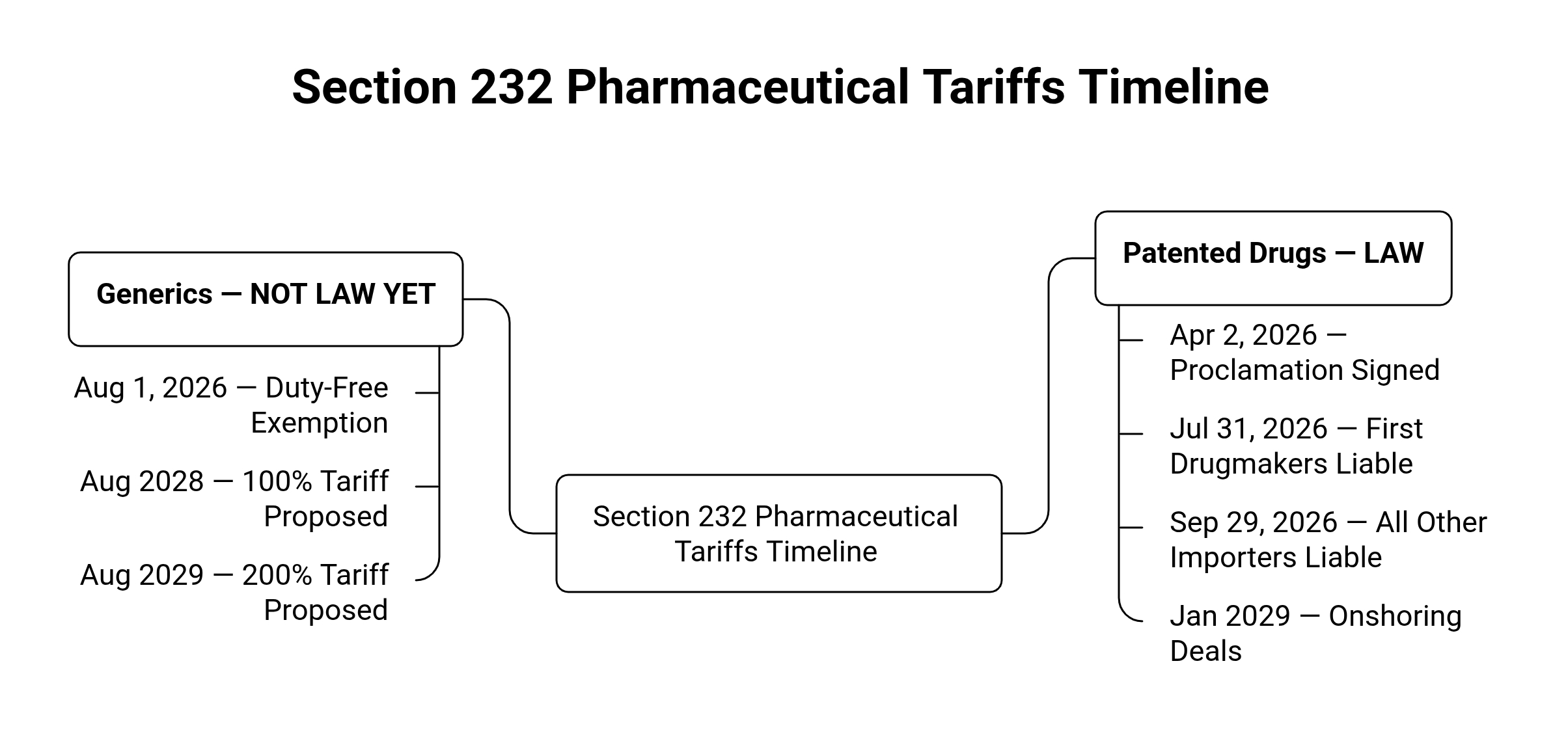
All other importers — anyone not in Annex II or III became liable on September 29, 2026, the 180-day mark. Companies with a Commerce-approved onshoring plan pay a reduced +20% add-on instead of the full rate; those with signed MFN pricing agreements can see their rate cut to zero.
Generic drugs, biosimilars and their ingredients were excluded from this proclamation entirely, pending a formal review.
That exemption gained an expiration date on July 21–22, 2026, when President Trump announced via a Truth Social post that generics would:
Stay duty-free for two years from August 1, 2026
Face a 100% tariff for one year starting August 2028
Rise to a 200% tariff from August 2029
He described the eventual tariff as a penalty for manufacturers that don't build US plants and equipment within the window. Tariffs on branded and patented drugs were left unchanged.
The Legal Status Gap
This is the detail that separates the two halves of the timeline:
Patented-drug tariffs are law. A signed presidential proclamation, published with binding annexes, is currently being enforced at the border.
The generic tariff is not law yet. It exists only as a social media announcement, a stated intention, a rate schedule, a start date, with no executive order, no annex structure, and no published detail on whether it applies to finished-dose products, API, or both.
Trade advisories tracking the announcement note that its scope, API applicability, and exemption structure "remain to be formally specified," and that it has "not yet been formally signed into law." Until a proclamation is issued, generics continue to operate under the April exemption, not the July announcement.
Geopolitical risk and tariffs are exactly why onshoring has become a priority, see the real structural challenges holding back API production from actually coming home.
→ Read: The Future of Pharma: Onshoring API Manufacturing
Why Four Years, Not Two?
Government timelines assume supply chains can relocate on a policy clock — 120 and 180 days for patented drugs, roughly two years for generics. Manufacturers describe a different reality:
Dr. Reddy's Laboratories CEO Erez Israeli told CNBC that shifting his company's generic portfolio into US production would take four to seven years, not two.
New manufacturing sites require sequential, regulatory-gated steps, FDA site qualification, API-sourcing validation, and commercial-scale ramp-up, that cannot be compressed by announcement.
India supplies roughly half of the US generic drug market, and China dominates upstream API production, concentrating the exposure in exactly the supply chains that take the longest to relocate.
Brookings' Marta Wosinska summarized the mismatch directly: a tariff can support a reshoring strategy, but it does not by itself build factories. That timeline mismatch is the central tension in the story — a policy deadline set in years, applied to a manufacturing process that runs in half-decades.
India's API dominance isn't accidental — see how the PLI scheme is rebuilding domestic manufacturing capacity, and why that matters when reshoring timelines run in years, not months.
→ Read: How India's PLI Scheme Is Transforming API Manufacturing
What To watch?
1) Whether the generics announcement is ever converted into a signed Section 232 proclamation with its own annexes and HTSUS codes, the step that would make it enforceable.
2) Compliance exposure for patented-product importers, where classification under Annex I versus Annex IV, orphan-drug exclusivity, and onshoring-plan status now determine actual landed cost.
3) The 2028 generics deadline as a planning horizon, not settled law, sourcing and capital decisions are already being shaped by it, even though the underlying policy remains unsigned.
The tariff already in force today is real, dated, and binding. The one aimed at generics is an announced intention sitting on top of a four-year manufacturing reality and that gap is where most of the near-term regulatory risk sits.
Reporting on the science, business and regulation shaping the pharmaceutical industry.
More in Future Pharma Trends
All articles →
Pharmaceutical Regulatory Affairs: Challenges, Innovations, and Global Harmonization

AI in Clinical Trials: Improve Efficiency and Save Money
Discussion