How IBM’s HR Automation Model Is Redefining Hiring for the Pharma Industry
How IBM’s AI-driven HR model is reshaping pharma recruitment with automation, predictive hiring, and strategic workforce transformation.


A Case Study on AI-Driven Recruitment, Efficiency, and Workforce Transformation
In the pharmaceutical industry, where speed-to-market, compliance, and talent quality determine competitive advantage, hiring has become one of the most complex and resource-heavy functions. The talent landscape is evolving faster than HR teams can handle—data scientists, regulatory strategists, clinical experts, digital health specialists, and bioprocess engineers are in global shortage. Against this backdrop, IBM’s automation-driven HR model has emerged as a blueprint for how the future of hiring in pharma will look.
IBM didn’t just automate tasks. It re-engineered the hiring lifecycle using AI, machine learning, neuro-analytics, and workflow automation. And today, large pharmaceutical companies are looking to replicate the same transformation to solve talent shortages, speed up recruitment, and build agile, data-driven HR teams.
This case-study-style blog explores how IBM automated HR roles, what outcomes it achieved, and how the same model is now shaping hiring in the global pharma sector.

Why Pharma Needs HR Automation More Than Ever
Before diving into IBM’s model, it’s crucial to understand what the pharma industry is up against.
The talent ecosystem is undergoing seismic shifts:
- Drug development timelines are compressed, especially in biologics, gene therapies, and mRNA platforms.
- Regulatory requirements are increasing, demanding high-skilled specialists in QA, PV, RA, QC, and clinical operations.
- Digital skills gaps are widening, from AI-driven drug discovery to predictive manufacturing.
- The talent shortage is global, with chronic gaps in data analytics, automation engineering, and biostatistics.
Traditional HR systems—manual shortlisting, lengthy interviews, slow verification processes, siloed data—simply cannot match the speed and precision required.
This is where IBM’s automation-driven HR transformation becomes a benchmark for the industry.
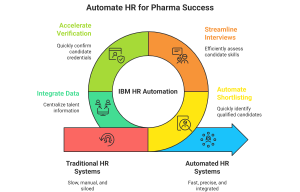
IBM’s HR Automation Blueprint: A Case Study Breakdown
IBM’s approach was not about replacing HR teams—it was about expanding their capacity through intelligent automation. By integrating AI, predictive analytics, and workflow automation into its HR ecosystem, IBM reduced manual intervention, increased accuracy, and reshaped the employee lifecycle.
Here’s how the transformation unfolded:
1. Automating Candidate Sourcing Through AI Algorithms
IBM introduced Watson-powered talent sourcing tools that scan millions of profiles across job boards, internal databases, and global talent networks. Instead of recruiters manually filtering thousands of resumes, AI engines shortlist candidates based on: skills match percentages, experience depth, project relevance, learning agility, cultural alignment signals
In pharma, where niche scientific roles require precise expertise, this level of automated filtering can reduce sourcing time by up to 70%.
Why it matters for pharma:
Automated sourcing helps pharma companies fill high-demand roles—clinical data managers, pharmacovigilance associates, formulation scientists, and automation engineers—with unparalleled speed and accuracy.
2. Using AI to Predict Candidate Success and Job Fit
One of IBM’s biggest breakthroughs was the introduction of predictive analytics to forecast which candidates are most likely to succeed. Instead of depending on traditional hiring intuition, the system analyses historical hiring performance, behavioral data, interview responses, personality patterns, and advanced learning models.
By combining these data streams, IBM’s AI can evaluate not only how well a candidate fits the current role but also their future growth potential within the company.
Pharma application:
Predictive hiring models can determine which clinical trial managers are more compliant under pressure, which QA specialists handle audits effectively, and which regulatory experts are suited for dynamic, fast-paced global submissions.
3. Automating Interview Scheduling and Coordination
Recruiters have long spent countless hours coordinating interviews across teams, time zones, and shifting candidate schedules. IBM eliminated this bottleneck by automating the entire workflow.
AI now schedules interviews instantly, automated reminders significantly reduce no-shows, and self-service portals let candidates reschedule without back-and-forth emails. Hiring managers also receive real-time updates, ensuring everyone stays aligned throughout the process.
Impact for pharma:
With global clinical operations teams spread across the US, EU, and APAC, interview coordination is a major bottleneck. Automation cuts delays by 30–40%.
4. AI-Enhanced Screening Through Chatbots and Virtual Assessments
IBM deployed digital HR assistants that now handle the earliest stages of candidate evaluation, conducting first-level screenings, collecting background information, administering skill assessments, and even running culture-fit questionnaires.
These chatbots are trained to understand context and interpret responses with surprising accuracy, significantly reducing the workload on HR teams and accelerating the overall hiring cycle.
Pharma relevance:
For large-scale hiring—think manufacturing technicians, QC analysts, process operators—AI chatbots can manage heavy candidate inflow while maintaining consistency and compliance.
5. Seamless Onboarding Through Automated Workflows
Once a candidate is selected, IBM streamlines the entire onboarding journey through full-stack automation. Digital tools manage offer letters, verify documents, assign training modules, trigger IT setup workflows, and complete all compliance-related paperwork.
By replacing manual coordination with integrated automation, IBM has dramatically reduced onboarding time while ensuring consistency, accuracy, and a seamless first-day experience for new hires.
For pharma companies:
Automated onboarding ensures compliance with GMP, GCP, data integrity, and training documentation—critical in regulated environments.
6. Redefining HR Roles: From Manual Tasks to Strategic Workforce Planning
IBM’s automation initiatives freed HR teams from operational burdens, allowing them to redirect their time toward high-impact priorities such as capability building, talent analytics, diversity hiring, workforce planning, and strengthening leadership pipelines.
In essence, automation transformed HR from an administrative service into a strategic powerhouse driving long-term organizational value.
How IBM’s Automation Model Is Reshaping Pharma Hiring
Pharmaceutical companies are now adopting IBM’s model to solve their biggest HR challenges:
1. Solving the Talent Shortage With AI-Powered Talent Pipelines
Pharma talent markets—particularly in biopharma, QC, PV, and regulatory affairs—are overstretched. Automation improves hiring velocity and precision, enabling companies to secure talent before competitors do.
2. Ensuring Compliance-Ready Recruitment
IBM’s systems ensure data integrity, audit-ready documentation, and role-based access, which align perfectly with pharma compliance frameworks.
AI creates a consistent, bias-controlled recruitment process that withstands regulatory scrutiny.
3. Reducing Time-to-Hire for Critical Roles
In pharma manufacturing and clinical trials, delays directly impact revenue and patient access.
IBM-style automation can cut hiring time by 40–60%, especially in:
- Aseptic manufacturing roles
- Clinical operations
- Quality assurance and quality control
- Automation and engineering roles
4. Creating Data-Driven Workforce Strategies
IBM’s HR dashboards allow pharma leaders to:
- Predict future talent shortages
- Identify skill gaps
- Understand attrition patterns
- Forecast headcount needs
- Plan capability-building modules
This shifts HR from reactive hiring to strategic workforce planning.
The Future: AI-First HR Models Will Become the Pharma Standard
IBM’s automation journey proves a fundamental truth:
HR teams cannot meet future talent demands without AI.
As pharma enters the era of digital health, precision medicine, cell therapy, and automation-first manufacturing, hiring will increasingly depend on:
- Intelligent candidate assessment
- Predictive workforce planning
- Automated HR operations
- AI-driven talent analytics
- Skill mapping for future technologies
IBM has shown what an optimized, automated HR future looks like. The pharma sector is now following the same path—not to replace people, but to empower them.
Final Thoughts
The pharma industry is redefining how it discovers, assesses, and engages talent. IBM’s automation-first HR transformation offers a powerful blueprint—one that is helping pharmaceutical companies build stronger, faster, compliant, and future-ready hiring ecosystems.
In an industry where every skilled employee directly influences patient outcomes, the shift toward automated, AI-driven recruitment is not just operational—it is strategic.
FAQs
1. How is IBM’s automation technology improving pharma hiring?
IBM uses AI-driven screening, skills-based matching, and automated workflows to reduce manual HR workload, enabling pharma companies to hire faster, more accurately, and at scale.
2. Can automation fully replace human HR teams in pharma?
No. Automation handles repetitive tasks, but human judgment is still essential for culture fit, leadership roles, and ethical hiring decisions. IBM’s approach is augmentation—not replacement.
3. Is automated hiring compliant with pharma regulations?
Yes. IBM’s systems are designed to meet compliance needs, including data privacy rules, audit trails, and fair hiring standards, which are critical in the highly regulated pharma industry.
4. How does automation improve candidate quality?
AI tools identify skill gaps, evaluate competencies, and use predictive analytics to shortlist candidates more precisely. This reduces bias and helps match the best-fit talent for niche pharma roles.
5. Can IBM’s HR automation be integrated with existing pharma HR systems?
Yes. IBM’s HR suite integrates with leading platforms such as SAP SuccessFactors, Workday, Oracle HCM, and proprietary pharma systems, allowing seamless adoption without workflow disruption.
Reporting on the science, business and regulation shaping the pharmaceutical industry.
More in HR in Pharma
All articles →
Crisis Management: HR's Role in Business Continuity in the Pharmaceutical Industry

Top HR Strategies for Successful Pharma Mergers: People, Culture, and Integration 2025

Discussion