The Global Competition For Biopharma Talent: Why The Race Is Accelerating And What It Means For The Industry?
Biopharma talent war: cell therapy, bioinformatics, CMC gaps. Geographic shift reshaping hiring. Internal academies, academic partnerships.


Spend five minutes with any biopharma executive today and the conversation almost always finds its way to the same topic: people. Not pipelines, not capital markets, not regulatory timelines — people. Where to find them, how to hold on to them, and whether the organisation will have the capabilities it needs when the next critical moment arrives.
What makes this moment particularly unusual is the contradiction sitting at the heart of it. In 2025, an estimated 42,700 biopharma employees were laid off — a 16% rise year-on-year.
And yet, in the same period, companies were desperately competing for cell and gene therapy manufacturing scientists, computational biologists, and regulatory affairs specialists with advanced modality experience. Layoffs and acute shortages were happening simultaneously, in the same industry, at the same time.
This isn't a paradox that will resolve itself. It's a sign that the biopharma talent market has become something genuinely new — a market where the workforce is contracting in some areas and critically undersupplied in others, where geography is being redrawn by government investment, and where the organisations that win are those that plan ahead rather than react.
This blog unpacks what's driving that, where the pressure is building most intensely, and what it's going to take to navigate it well.
The Reason The Talent Shortage Keeps Getting Worse, Not Better
There's a version of the talent shortage story that frames it as a cyclical problem like tightness during booms, relief during downturns, broadly self-correcting over time. That version is wrong. What the biopharma industry is experiencing right now is structural.
The gap between the capabilities the industry needs and the people trained to provide them is widening, not narrowing, and the forces driving it aren't going away.
Approximately one in three biopharma executives currently report severe or critical shortages in areas tied to advanced drug modalities like cell and gene therapies, mRNA therapeutics, antibody-drug conjugates, and AI and digital capabilities.
These aren't peripheral specialisms. They're the disciplines at the centre of where the industry is investing and where patients will benefit most. The fact that they're also the hardest areas to staff is not a coincidence. It's the result of several converging pressures that have been building for years:
- Science has moved faster than education systems can respond. Cell and gene therapy, mRNA platforms, and antibody-drug conjugates require combinations of scientific knowledge and hands-on manufacturing skill that most universities simply weren't building programmes around until very recently. The talent pool is small because the training infrastructure is still catching up, and there's no shortcut through that gap.
- Biopharma is now competing with technology companies for the same people. Bioinformaticians, computational biologists, and AI drug discovery scientists are being recruited by pharma, biotech, major technology companies, and well-funded startups, all at the same time. Pharma used to compete within its own sector for technical talent. That's no longer true, and the implications for both hiring and compensation are significant.
- An entire generation of senior scientists is approaching the exit. The cohort of experienced pharmaceutical scientists, manufacturing leads, and regulatory affairs professionals who built their careers in the 1980s and 1990s is heading towards retirement. The institutional knowledge they hold about specific compounds, manufacturing processes, regulatory history, and quality systems is irreplaceable in the short term and is rarely captured in any deliberate way before they leave.
- Recent layoffs haven't released the people companies are looking for! The restructurings of 2024 and 2025 mostly affected general and administrative functions and commercial teams, not the laboratory and manufacturing disciplines where shortages are sharpest. Lab vacancy rates stayed below 3% throughout the same period. Unemployment among life sciences professionals in Massachusetts, one of the world's largest biopharma hubs, never rose above 2%. The contraction and the shortage lived in entirely different parts of the same market.
The Four Disciplines Where The Talent Gap Is Becoming A Business Risk
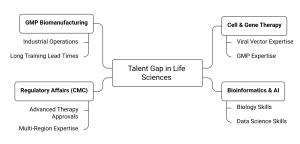
The talent shortage doesn't fall evenly across the industry. It's concentrated in specific disciplines — ones that are difficult to enter, slow to develop, and impossible to scale quickly by throwing money at a job posting. In three critical areas alone — cell and gene therapy manufacturing,
AI-enabled drug discovery, and CMC regulatory affairs, the ratio of qualified candidates to open roles has reached the point where conventional hiring approaches simply don't work.
Understanding where the pressure is most intense matters because it changes how organisations need to respond:
a) Cell and gene therapy manufacturing is perhaps the most acute example. This work requires expertise in viral vector production, GMP-compliant bioprocessing, and quality systems designed for the specific demands of advanced modalities, a combination that takes years of hands-on experience to develop and that very few training programmes produce at meaningful scale.
Cell and gene therapy attracted $15.2 billion in investment in 2025 alone, growing 30% on 2023 figures. That capital will eventually translate into enormous hiring demand. The talent infrastructure to support it has not grown anywhere close to the same pace.
b) Bioinformatics and computational biology roles are asking people to be excellent biologists and excellent data scientists or programmers simultaneously. Very few people have built that combination over the course of a single career.
And because the skills are transferable to technology companies, academic institutions, and startups, biopharma finds itself in a genuinely open-market competition for people it used to consider a captive pool.
c) Regulatory affairs specialists with experience guiding advanced therapy medicinal products through complex multi-region submissions are among the most consistently difficult roles to fill anywhere in the industry.
In Europe, the talent gaps in translational research, clinical bioinformatics, and scaled biomanufacturing have persisted through funding cycles, leadership changes, and multiple rounds of industry restructuring.
d) GMP biomanufacturing technicians and process engineers don't get as much executive attention as the scientific roles above, but they are increasingly the constraint that limits how quickly companies can actually manufacture what they've developed.
Running a cell therapy suite or a biologic fermentation train to GMP standard requires a specific blend of biological understanding and industrial operations experience. The pipeline for these roles is thin, and the lead times for developing people who can work reliably in these environments are long.
The hardest roles to hire are exactly where next year's growth is concentrated.
Waiting until everyone is hiring is already too late.
→ Read: Biotech Talent Trends | Preparing For The 2026 Growth Cycle
The Changing Geography Of The Global Talent Race
For most of the past three decades, the global biopharma talent race was primarily a competition among a small number of established hubs — greater Boston, the San Francisco Bay Area, the UK's golden triangle, and a handful of European clusters in Switzerland and Germany. That map is being redrawn, and the pace of change is accelerating.
1) The United States is still the largest single market, but it's no longer the automatic first choice. Massachusetts alone employs approximately 118,000 people in direct biopharma roles. But funding volatility, the high cost of living in key hubs, and significant cuts to federal research spending in 2025 have created real headwinds for talent attraction.
At the same time, job postings dropped 20% year-over-year in Q1 2025 while applications surged over 90%, a sign that the market has become intensely competitive for candidates, even in a period of reduced opportunity.
2) Asia-Pacific has moved from emerging interest to genuine competitor. South Korea's jump from twelfth to third place in the 2025 Cytiva Global Biopharma Index was not an accident. It reflected years of deliberate government investment in digital innovation, clinical trial infrastructure, and R&D capacity.
The South Korean government has committed to developing 10,000 additional biotech professionals by 2030 through structured partnerships between industry and academia. Singapore has opened a dedicated Training Institute for Biologics.
China, meanwhile, is producing life science graduates at scale, and a meaningful reverse brain drain is now underway, senior Chinese scientists who left for positions in the US and Europe are returning, attracted by generous packages and the scale of opportunity in domestic programmes.
3) Europe is fighting to hold what it has! In Basel, Cambridge, and Munich, local competition for scientific talent is fierce, and international firms are increasingly making remote-first offers to European researchers rather than asking them to relocate. US and Asian companies are offering equity-heavy packages and faster regulatory pathways.
EU-based companies, navigating slower approval cycles and more fragmented labour regulations across member states, are finding it progressively harder to match those propositions. Switzerland and the UK remain at the top of the Global Biopharma Index, but that position is being defended, not extended.
4) Emerging markets are building patiently and with genuine intent. India's volume of STEM graduates is enormous, but specific training in advanced biopharma modalities remains a bottleneck. Brazil, Israel, and several Gulf states are making structured investments in biopharma ecosystem development that will take a decade to fully bear fruit but are already beginning to shift where certain types of work can be done.
What The Layoff Headlines Have Actually Meant For The Talent Market?
It's worth being direct about something that many leadership teams have got wrong. When biopharma layoff news dominated headlines through 2024 and 2025, a reasonable inference would have been that the talent market had loosened, that more people were available, and that hiring critical roles would become easier. For most organisations that acted on that inference, the result was a rude surprise.
The restructurings that drove those headlines were concentrated in general and administrative functions, commercial operations, and business development teams. They were not concentrated in laboratory science, advanced manufacturing, or specialised regulatory affairs.
The people the industry most needed stayed employed throughout. Companies that reduced investment in talent strategy, executive search partnerships, or internal development programmes on the basis of what they read in the news found themselves worse positioned when hiring activity resumed.
The layoff cycle has had three real effects on the talent market that leadership teams should understand clearly:
- It has redistributed experienced professionals, mostly toward smaller biotechs, CROs, and contract development and manufacturing organisations without adding to the total supply of people with advanced modality expertise
- It has accelerated the loss of institutional knowledge at large companies, where the disruption of restructuring rarely allows for structured knowledge transfer before experienced people leave
- It has created an expectation gap between candidates and employers, where professionals who have lived through multiple rounds of restructuring are more cautious about joining companies that can't speak credibly about financial position, strategy, and what job security actually looks like, making the pitch of "join us, it's exciting" significantly less effective than it used to be
Layoffs freed up the wrong people.
The roles that actually matter stayed scarce.
Here's how the 2026 hiring market is reshaping biopharma talent demand.
→ Read: Pharma And Biotech Hiring Market Shift In 2026
Five Strategic Moves That Separate The Best-Positioned Organisations From The Rest
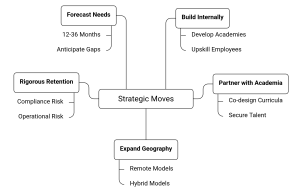
There's no single answer to a talent challenge this structure. The companies navigating it most effectively aren't relying on one lever — they're pulling several simultaneously, and they started earlier than their competitors.
1) Build capability internally instead of depending on a market that can't supply what you need. The external supply of cell and gene therapy manufacturing specialists, AI drug discovery scientists, and advanced regulatory affairs leads cannot be reliably accessed at the speed most organisations need.
Companies like Biogen have tackled this by building internal academies, structured programmes designed to develop existing employees in digital therapeutics, AI-driven drug discovery, and advanced bioinformatics. The approach takes longer than hiring but builds capabilities that are harder to poach and better aligned with the organisation's specific context.
2) Get into the academic pipeline earlier and stay there. Advanced modality talent is scarce partly because academic training has not caught up with industry needs. The companies that will be best positioned in five years are those forming genuine, sustained partnerships with universities today such as co-designing curricula, funding research positions, and creating clear pathways from graduation into industry employment. These pipelines are not accessible to companies that show up once a year at a careers fair.
3) Rethink which roles actually need to be co-located in expensive, competitive hubs. The assumption that every critical function must sit in Boston, South San Francisco, or Basel needs to be examined against the reality of where the talent actually is!
Hybrid and remote models have already expanded the effective hiring geography for regulatory affairs, clinical operations, and scientific programme management. Organisations that have adapted their geographic strategies to follow talent rather than expecting talent to come to them are accessing candidate pools their competitors aren't.
4) Treat retention with the same rigour applied to patient safety or regulatory compliance. In a market where the pool of qualified candidates for certain roles is genuinely tiny, losing an experienced cell therapy manufacturing specialist or a senior CMC regulatory scientist isn't primarily a recruitment problem, it's a capability risk with direct implications for programme timelines and compliance.
Structured retention planning, visible career development pathways, and thoughtful succession management for critical roles need to be resourced and governed accordingly, not left as a discretionary HR line item.
5) Use talent forecasting to see gaps before they become crises. The organisations least vulnerable to this market are those that know, based on their pipeline, their planned modality expansions, and their retirement projections, where capability gaps are likely to emerge twelve to thirty-six months from now, and who have already begun building or sourcing for those capabilities. Reacting to a talent gap when it is already constraining a programme is significantly more expensive, slower, and less effective than anticipating it.
In Conclusion
The biopharma talent landscape is undergoing a structural shift, and organisations that recognise this reality are already adapting with purposeful planning and long-term capability building.
Those that continue treating shortages as short-term anomalies will remain reactive, repeatedly facing the same constraints despite changing market cycles. In a market where specialised skills cannot be quickly replaced or scaled, delaying action only compounds the long-term capability gap.
Ultimately, the companies that lead the next decade of scientific progress will be those that invest early and strategically in talent such as developing skills internally, engaging academia, expanding geographic reach, and strengthening retention with intent.
Competitive pipelines and strong balance sheets matter, but the real differentiator will be the organisations that build and sustain the specialised human capability their science requires.
FAQs
1. Why Is The Biopharma Talent Shortage Getting Worse Instead Of Improving?
The shortage is structural, not cyclical — meaning the gap between industry needs and available talent keeps widening because training systems, academic pipelines, and upskilling programmes cannot keep pace with scientific innovation. Even as the industry expands advanced modality work, the number of people trained to support it grows far more slowly. This creates a long-term imbalance that will continue until education, workforce planning, and industry investment scale in alignment with scientific progress.
2. Which Talent Areas Pose The Greatest Business Risk For Biopharma Companies Today?
Roles in cell and gene therapy manufacturing, bioinformatics and computational biology, advanced CMC regulatory affairs, and GMP bioprocessing are now the hardest to fill and the most critical for scaling modern pipelines. These disciplines require specialised training that takes years to build and cannot be filled quickly by traditional hiring. Because these capabilities directly influence speed to clinic and speed to market, shortages in these areas increasingly determine how fast companies can actually grow.
Reporting on the science, business and regulation shaping the pharmaceutical industry.
More in HR in Pharma
All articles →
Crisis Management: HR's Role in Business Continuity in the Pharmaceutical Industry

Top HR Strategies for Successful Pharma Mergers: People, Culture, and Integration 2025

Discussion