Leadership Fatigue In Pharma: The Hidden Risk Undermining Continuous Transformation
Leadership fatigue in pharma explained, causes, organizational impact, hidden costs and structural strategies to build resilient leadership culture.


The pharmaceutical industry has been in a near-constant state of transformation for over a decade. Restructuring, digital overhauls, regulatory shifts, patent cliffs, post-pandemic operational changes, and now the rapid integration of AI and data-driven technologies — each wave of change has arrived before the last one was fully absorbed.
For leaders tasked with driving these transformations while simultaneously delivering on day-to-day operational and commercial goals, the cumulative toll is significant. Leadership fatigue in pharma is no longer a fringe concern. It is an organizational reality with measurable consequences, and it deserves to be taken as seriously as any other strategic risk.
What Leadership Fatigue Actually Means?
Leadership fatigue, sometimes called executive burnout or change fatigue at the leadership level, is not simply feeling tired after a busy quarter. It is a deeper, more systemic condition that develops when prolonged exposure to high-stakes decision-making, unrelenting change demands, and chronic uncertainty gradually erodes a leader's resilience, judgment, and capacity to inspire their teams.
McKinsey's research on the pharmaceutical industry describes this condition as one that sets in after years of successive restructuring, acquisitions, cost-cutting cycles, and organizational upheaval and once it takes hold, it is difficult to reverse.
- Nearly 60% of leaders report feeling “used up” at the end of the workday.
- Executives experience 40% more career-related stress and anxiety than the broader workforce.
- Executive job satisfaction has declined by 15% in recent years.
- In healthcare and pharma, leaders have operated in a near-constant state of emergency preparedness, navigating pandemic pressures, supply chain disruptions, rapid digital transformation, cost containment demands, and pricing scrutiny.
Why Are Pharma Leaders Especially Vulnerable?
Not all industries place the same demands on their leaders, and pharma is uniquely positioned to generate the conditions in which fatigue takes hold. Several factors converge to make leadership fatigue particularly acute in this sector.
1) The Pace And Volume Of Change
McKinsey has described the current era as "the age of perpetual organizational upheaval," and few industries embody that description more fully than pharma.
Over the past decade, pharmaceutical companies have navigated patent expirations, pricing pressure from governments, the shift to specialty and precision medicines, digital and mobile transformation of physician and patient engagement, COVID-19 and its aftermath.
And now the integration of AI across R&D, manufacturing, and commercial operations. Each of these changes demands strategic recalibration, cultural adaptation, and significant investment of leadership energy.
When changes overlap and stack as they routinely do in pharma, leaders are continuously managing multiple transformations at once without meaningful recovery time between them.
2) The Unique Pressure Of A Regulated Environment
Unlike leaders in most other industries, pharma executives operate within one of the most heavily regulated environments in the world. Every strategic decision, whether it involves a manufacturing change, a new digital system, a clinical program, or an organizational restructuring, carries compliance implications.
This means that leaders cannot simply move fast and iterate; they must move quickly while maintaining meticulous documentation, regulatory alignment, and quality standards.
The cognitive and emotional burden of holding this tension, urgency on one side, precision and compliance on the other is a compounding source of fatigue that has no real equivalent in less regulated industries.
3) The Ambiguity Of Leading Digital Transformation
The pressure to digitally transform is now one of the defining demands placed on pharma leaders. According to Deloitte, 83% of pharma executives recognize the need for reskilling and upskilling their organizations, and more than 85% of biopharma executives said they would increase investment in data, AI, and digital tools.
But many of these leaders are themselves in unfamiliar territory. Leading a transformation you do not fully understand — while being held accountable for its outcomes and managing the fears and resistance of a workforce that is also uncertain, creates a particular kind of cognitive and emotional strain.
The absence of a proven playbook for AI-driven transformation means leaders must navigate by feel, which is exhausting even for the most experienced executives.
4) The Loneliness Of Leadership
Leadership burnout is often compounded by isolation. In many pharma organizations, the expectation that senior leaders project confidence and stability means that fatigue is rarely acknowledged openly, let alone addressed.
Research shows that stigma and shame frequently prevent leaders from recognizing or naming their own burnout, even as it is actively undermining their performance. This culture of silence is especially counterproductive during periods of transformation, when the organization most needs its leaders to be honest about what is working, what is not, and what support they need.
How Leadership Fatigue Shows Up In The Organization?
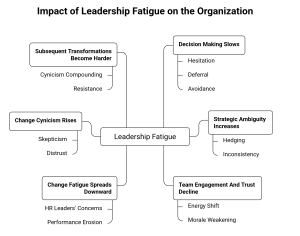
Leadership fatigue does not stay contained at the top. It cascades through the organization in ways that can be difficult to trace back to their source but are deeply damaging nonetheless.
- Decision-making slows or becomes risk-averse, as fatigued leaders hesitate, defer, or avoid difficult conversations.
- Strategic ambiguity increases, with previously clear communicators beginning to hedge or communicate inconsistently.
- Team engagement and trust decline, as employees sense the shift in leadership energy and direction even when it is not openly acknowledged.
- Change fatigue spreads downward, with Gartner reporting that it erodes performance, hinders technology adoption, and reduces employee engagement — and 90% of HR leaders say managers are not adequately supporting employees struggling with change fatigue.
- Change cynicism rises, as employees grow skeptical of new initiatives when previous transformations stalled due to organizational exhaustion rather than flawed strategy.
- Subsequent transformations become harder to execute, as cynicism and fatigue compound over time, a particularly serious risk in pharma, where transformation is continuous and mission-critical.
Fatigue does not just slow leaders down. It quietly hollows out the quality systems they are responsible for.
→ Read: Why Pharmaceutical Quality Systems Fail Without Capability Building
What Is The Cost Of Not Addressing It?
The organizational and financial consequences of leadership fatigue are substantial and well-documented. Burnout costs businesses globally an estimated $322 billion annually in lost productivity alone.
Healthcare costs associated with burnout add a further $190 billion. And because burnout is a significant driver of turnover, the cost of replacing fatigued leaders, particularly in specialized, senior roles in pharma, multiplies these figures considerably.
In pharma specifically, the downstream effects of leadership fatigue are visible in a number of ways:
- Transformation programs stall or fail to deliver expected returns as fatigued leaders struggle to sustain momentum and communicate direction
- Talent exits accelerate as high performers follow burned-out leaders out of the organization or leave in search of more stable, purposeful environments
- Regulatory and quality risks increase as the attention and rigor required for compliance functions are compromised by cognitive overload
- Innovation slows as leaders shift into survival mode, defaulting to familiar approaches rather than championing the experimentation that transformation demands
- Organizational culture deteriorates as cynicism and disengagement spread from the leadership level downward
What Pharma Organizations Can Do?
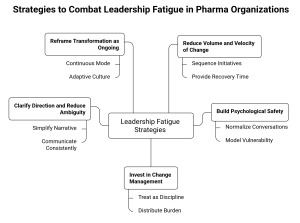
Addressing leadership fatigue is not simply a matter of offering wellness programs or encouraging executives to take more holidays. It requires structural and cultural changes at the organizational level, sustained over time. Several strategies are proving effective in pharma and adjacent industries.
a) Reduce The Volume & Velocity Of Simultaneous Change — One of the most effective interventions is also one of the most counterintuitive: doing less, more deliberately. Pharma organizations that sequence transformation initiatives rather than launching them all at once give their leaders and their workforce the recovery time needed to consolidate gains before the next disruption begins.
McKinsey's research into pharma change fatigue consistently points to over-initiation, launching too many programs simultaneously with too little prioritization, as a primary driver of organizational exhaustion.
b) Build Psychological Safety At The Leadership Level — If senior leaders cannot acknowledge fatigue without risking their credibility or career trajectory, the condition will remain hidden until it is severe. Organizations that actively work to normalize honest conversations about stress, capacity, and wellbeing at the leadership level are better positioned to identify fatigue early and respond before it becomes debilitating. This requires boards and CEO-level sponsors who model vulnerability and treat leadership wellbeing as a strategic priority rather than a personal matter.
c) Invest In Change Management As A Core Capability — The Pistoia Alliance's 2025 research on change management in pharma and life sciences identifies a persistent pattern: transformation efforts stall not because the strategy is wrong but because the human dimensions of change like communication, engagement, capacity-building are underfunded and undervalued.
Pharma organizations that treat change management as a professional discipline, and invest in building that capability across the leadership pipeline, create structures that distribute the burden of transformation more evenly and reduce the pressure concentrated on individual leaders.
d) Clarify Direction & Reduce Ambiguity — According to Gallagher's 2025 Employee Communications Report, 44% of HR and communications leaders now identify change fatigue as one of their top five barriers to success and a lack of clear direction from senior leadership ranks as the second most cited challenge, behind capacity alone.
Leaders who can cut through complexity and communicate a clear, consistent strategic narrative reduce the cognitive load on their teams and on themselves. In pharma, where the external environment is complex and fast-moving, the ability to simplify and prioritize is an increasingly critical leadership skill.
e) Reframe Transformation As Ongoing, Not Episodic — Organizations that treat transformation as a discrete project, something to be launched, endured, and completed, create a cycle that guarantees fatigue. When the next transformation begins before the last one has been fully embedded, the cumulative load becomes unsustainable.
Pharma leaders who reframe transformation as a continuous operating mode, something the organization is always doing at a managed pace, rather than lurching through in waves, build the kind of adaptive culture that distributes change effort over time and reduces the peaks that cause burnout.
Clear direction is the most underrated antidote to change fatigue. How leaders communicate matters as much as what they decide.
→ Read: From Compliance To Connection: Storytelling As A Leadership Tool In Pharma
In Conclusion
Leadership fatigue during continuous transformation is one of the most consequential and least openly discussed challenges facing the pharmaceutical industry today. The leaders who are expected to guide their organizations through digital transformation, regulatory complexity, talent shortages, and commercial disruption are themselves operating under conditions that are, without adequate support, unsustainable.
Recognizing this is the first step. Building the structural, cultural, and strategic responses needed to address it is the work that follows. Pharma organizations that invest in the wellbeing and capacity of their leaders, not as a soft benefit but as a hard business imperative, will be better placed to sustain the kind of continuous transformation the industry now demands.
FAQs
1) Why Is Leadership Fatigue Becoming A Strategic Risk In The Pharmaceutical Industry?
Leadership fatigue is emerging as a major strategic risk because pharma leaders have been managing nonstop transformation cycles for years without any meaningful period of stability or recovery. The constant layering of restructures, digital upgrades, compliance pressures, and AI adoption steadily drains executive focus and resilience. Over time, even high-performing leaders struggle to sustain clarity, energy, and direction under chronic change conditions. When this happens at scale, the organization begins to lose momentum, alignment, and execution strength.
2) How Does Leadership Fatigue Affect Transformation Outcomes In Pharma Organizations?
Leadership fatigue slows down critical decisions, increases hesitation around risk, and creates inconsistent communication, all of which directly weaken transformation outcomes. When leaders are stretched thin, teams receive mixed signals, priorities shift unpredictably, and execution becomes fragmented. Fatigue also fuels organizational cynicism, making people less willing to engage with new initiatives because previous ones felt exhausting or incomplete. As this pattern repeats, each successive transformation becomes harder to launch, harder to sustain, and less likely to deliver its intended impact.
3) What Structural Actions Can Pharma Companies Take To Prevent Leadership Fatigue?
Pharma companies can reduce leadership fatigue by narrowing the number of simultaneous initiatives so executives can focus on fewer priorities with greater discipline and clarity. Creating space for leaders to openly discuss capacity, workload, and pressure also helps normalize early intervention rather than waiting for burnout to become visible. Strengthening change management capabilities across the company distributes the burden so leaders are not personally carrying every operational, cultural, and digital shift. When organizations treat transformation as an ongoing rhythm, not a sudden upheaval, leaders are better able to sustain performance over time.
Reporting on the science, business and regulation shaping the pharmaceutical industry.
More in HR in Pharma
All articles →
Crisis Management: HR's Role in Business Continuity in the Pharmaceutical Industry

Top HR Strategies for Successful Pharma Mergers: People, Culture, and Integration 2025

Discussion