The Quiet Strain On Pharma: How Middle Managers Carry The Industry's Hidden Burden?
Pharma middle managers: invisible burden, four strain dimensions, compliance paradox, burnout costs, and five concrete solutions for support.

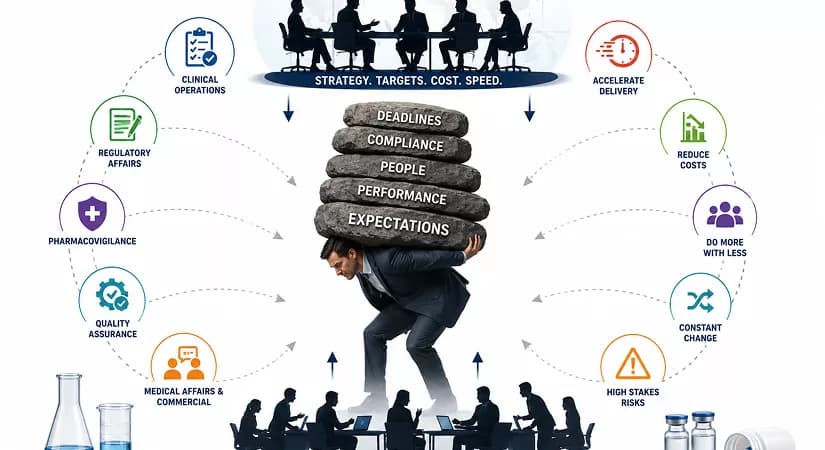
Walk into any pharmaceutical company and you will find a particular kind of person. They sit in the middle of the organizational chart, attend more meetings than anyone else, and carry full responsibility for entire teams while answering to multiple layers of leadership above them. Their phones ring on weekends.
Their inboxes are never fully empty. They are middle managers, and the pharmaceutical industry, for all its earnest talk of innovation and people-first culture, has quietly placed an extraordinary and largely unacknowledged weight on their shoulders. This is a structural reality the industry tends to overlook and that silence is itself part of the problem.
The Invisible Architecture Of Pharma
In the pharmaceutical world, the public story is almost always about two things: the molecules that get discovered and the executives who steer the company. The scientist who develops a breakthrough compound is celebrated.
The CEO who announces a major approval gets the press release. Both deserve recognition. But between those two worlds sits an entire layer of professionals who make the industry's machinery actually run and they rarely get a mention.
Middle managers in pharma operate across nearly every function of the business. Their presence spans the full width of the organization:
- Clinical Operations — overseeing trial conduct, site management, and cross-geography data integrity
- Regulatory Affairs — managing submission timelines and ensuring dossiers meet FDA, EMA, and other authority standards
- Pharmacovigilance — coordinating post-market safety monitoring and adverse event reporting
- Quality Assurance — maintaining compliance while keeping production and audits on track
- Medical Affairs & Commercial — bridging scientific value to the medical community and the market
In every one of these functions, middle managers are the connective tissue of the organization. They take broad leadership goals and convert them into real daily work, communicate in both directions, manage timelines, resolve conflicts, and absorb problems before they reach the C-suite. Without them, nothing moves yet this very position makes the role so relentlessly demanding.
What The Role Actually Demands?
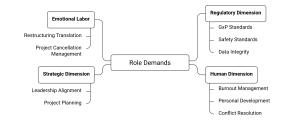
To understand the burden, consider what a pharma middle manager genuinely handles every single day. The job description might say "manage a team of clinical data coordinators." In reality, the role operates across four distinct and simultaneous dimensions:
- The Regulatory Dimension — Ensuring every process meets Good Clinical Practice, Good Manufacturing Practice, pharmacovigilance standards, and data integrity requirements. A single documentation lapse can trigger a full regulatory audit.
- The Human Dimension — Managing burnout, performance gaps, personal development, and interpersonal conflict — all while the business runs at full pace. When a team member is struggling, the middle manager is first to notice and first to act.
- The Strategic Dimension — Representing the team in leadership meetings, contributing to project planning, and being expected to offer solutions rather than surface capacity concerns. Saying "we are stretched" is rarely welcomed.
- The Emotional Labor — Delivering difficult news downward like restructurings, role eliminations, project cancellations while projecting enough stability that team performance does not suffer.
Key Finding:
Across pharmaceutical workforce surveys, middle managers consistently report higher burnout rates than either senior leadership or individual contributors. They carry the accountability without the authority, and the visibility without the support.
Squeezed From Both Sides
From above, middle managers face constant pressure to cut costs, accelerate delivery, and align with the latest strategic pivot. From below, they face the hard reality of what is possible with the people and resources available. In pharma, this squeeze carries unique weight because the consequences of failure are genuinely serious:
- A delayed clinical trial means real patients wait longer for potentially life-saving treatments
- A regulatory submission error can cost tens of millions and set a program back by a year or more
- A quality failure in manufacturing can result in product recalls and direct patient harm
- A safety reporting lapse can have consequences for public health and trigger regulatory action
The industry has also gone through significant turbulence in recent years. Patent cliffs, post-pandemic restructuring, the rise of AI-driven drug discovery, and tightening regulatory scrutiny have all contributed to persistent organizational instability.
Companies have been merging, downsizing, and reorganizing at pace. Each reshuffle lands in the middle manager's lap, they are handed the new structure and expected to keep delivering without missing a beat.
"The standard is demanded at the top. The risk is carried in the middle. That gap is where the quiet strain lives.”
The Compliance Paradox
One of the sharpest contradictions in the middle manager's daily reality is the compliance paradox. The pharmaceutical industry operates under some of the most rigorous regulatory frameworks in existence, and middle managers are responsible for ensuring their teams meet all of them — writing SOPs, conducting training, preparing for audits, and managing corrective actions when deviations occur. The major frameworks they must uphold include:
- GCP (Good Clinical Practice) — governing how clinical trials are conducted and documented
- GMP (Good Manufacturing Practice) — setting production and quality control standards
- GVP (Good Pharmacovigilance Practice) — defining post-approval drug safety monitoring
- Data Integrity Requirements — ensuring all records are accurate, complete, and fully traceable
Yet they are simultaneously pushed to deliver faster, reduce headcount, and cut timelines. These two demands exist in constant, unresolved tension.
When something goes wrong, it is rarely the executive who approves the aggressive timeline who faces the consequence, it is the team closest to the work, and their manager, who are held to account.
The Talent Development Trap
Most pharmaceutical companies describe developing people as a strategic priority, pointing to mentoring programs, high-potential tracks, and leadership academies.
What they discuss far less openly is that middle managers, the very people most responsible for developing others every single day are often the least developed professionals in the entire organization.
Promotion into management in pharma typically rewards technical excellence: the brilliant scientist, the meticulous regulatory specialist, the outstanding project manager.
But managing people demands a different skill set, one most companies fail to formally build. What new pharma managers are rarely prepared for includes:
- Conducting structured, meaningful performance conversations, especially difficult ones
- Delegating effectively while maintaining clear accountability for outcomes
- Advocating for their team's capacity in resource and planning conversations with senior leadership
- Recognizing early signs of burnout in their team members and in themselves
Navigating organizational politics without compromising their team's interests or integrity
These are not soft skills in the dismissive sense. They are core competencies for leading people in a high-stakes environment, and most pharma organizations leave their managers to develop them through trial and error with real teams and real consequences.
What Gets Lost When Middle Managers Burn Out?
When a middle manager leaves through burnout, restructuring, or simply deciding the role is no longer worth the cost, the visible loss is a recruitment fee and months of onboarding. The real cost is far larger and rarely calculated honestly. What walks out the door includes:
- Institutional Knowledge — why processes work the way they do, built through years of navigating the organization's history and culture
- Cross-Functional Relationships — trust built with colleagues, vendors, clinical sites, and regulators that cannot be quickly rebuilt
- Team Psychological Safety — the working norms that allowed people to raise problems early rather than conceal them
- Regulatory Memory — detailed recall of past submissions, inspection histories, and deviation patterns that directly informs better future decisions
In pharmaceutical development, where programs run for years and institutional memory directly shapes submission quality and patient safety decisions, these losses are genuinely consequential. They typically only become visible months later by which point the cost has already been paid in full.
By the time burnout is visible, your best middle managers are already halfway out the door.
Here's how predictive leadership catches it before the damage is done.
→ Read: Predictive Leadership For Burnout Prevention In Pharma
What Would Actually Help?
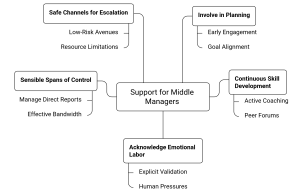
The strain on pharma's middle managers is not inevitable. It is the product of structural choices, about how roles are designed, how accountability is distributed, and how investment in people is prioritized. That means it can be changed. Here are five concrete actions:
1) Involve middle managers in planning, not just execution. When targets are set without input from those responsible for delivering them, accountability disconnects from reality. Genuine consultation leads to more realistic plans and a management layer that feels true ownership.
2) Invest in management skills continuously. A two-day annual leadership workshop is not sufficient. Ongoing coaching, peer forums, and structured feedback on how someone manages people, not just whether their team hits targets, is what builds durable capability over time.
3) Acknowledge the emotional labor explicitly. Organizations that name and recognize the weight middle managers carry create environments where managers feel seen rather than quietly used. This costs very little and remains far rarer than it should be.
4) Set sensible spans of control. A manager responsible for twelve direct reports across multiple time zones cannot do the job well regardless of talent. Adding management capacity when genuinely needed signals that leadership takes the role seriously.
5) Create safe channels for capacity concerns. If the only acceptable answer in a resourcing conversation is "we will find a way," problems stay hidden until they escalate. Honest early escalation is not weakness, it is good risk management.
Acknowledging the weight is step one.
Here's what empathetic leadership actually looks like inside high-pressure pharma organisations.
→ Read: Empathetic Leadership Best Practices In Pharma
An Industry That Can Afford To Do Better
The pharmaceutical industry generates hundreds of billions in revenue annually, funds world-changing science, and at its best saves lives at remarkable scale. It has both the financial resources and the moral responsibility to properly support the people who hold its daily operations together.
The people in the middle of the organization are not a line item to be optimized away. They are the operational backbone that determines whether strategies reach patients, whether clinical trials are conducted with full integrity, and whether companies can navigate turbulence without losing the institutional knowledge they have spent years carefully building.
The quiet strain on pharma's middle managers will not resolve itself. It will persist until organizations choose to look honestly at what the role truly demands, what support it currently receives in return, and what would genuinely need to change to make it sustainable over the long term.
That begins with a simple but meaningful act: openly acknowledging that the hidden burden is real, it is heavy, and it is carried every single day by some of the most important and least celebrated professionals in the entire industry.
FAQs
1. Why Do Middle Managers Carry Such A Heavy Operational Burden In Pharma?
Middle managers sit between strategic decision-makers and frontline teams, translating high-level goals into daily execution while absorbing the pressure that comes from both directions. They handle workload spikes, regulatory expectations, people issues, and shifting priorities without having full authority over the decisions that shape their reality. This creates a constant and often invisible strain that compounds over time. The complexity of drug development magnifies this burden because a single mistake can have regulatory, financial, and patient-impacting consequences.
2. What Makes The Middle Manager Role Uniquely Challenging In A Regulated Industry Like Pharma?
They are responsible for meeting strict GCP, GMP, GVP, and data-integrity standards while simultaneously being asked to accelerate timelines and reduce costs. These competing demands place them in a structural paradox where compliance risks rise even as expectations intensify. The accountability often lands squarely on them when issues surface. This dual pressure creates a stressful environment where managers are expected to deliver flawless output under conditions that are increasingly difficult to control.
3. What Happens When Middle Managers Burn Out Or Leave Pharma Organizations?
The loss goes far beyond replacing a single role — it includes disappearing institutional knowledge, disrupted cross-functional relationships, weakened team culture, and gaps in regulatory memory. These losses often reveal themselves months later in slower decision-making, repeated past mistakes, or reduced confidence during audits and submissions. The true cost rarely appears on a balance sheet but directly affects long-term performance. When middle-management stability erodes, the organization’s operational backbone weakens, creating ripple effects across clinical, regulatory, quality, and commercial functions.
Reporting on the science, business and regulation shaping the pharmaceutical industry.
More in HR in Pharma
All articles →
Crisis Management: HR's Role in Business Continuity in the Pharmaceutical Industry

Top HR Strategies for Successful Pharma Mergers: People, Culture, and Integration 2025

Discussion