The Future Of Work In Pharma: What Jobs Will Look Like In 2030?
Imagine a pharma lab in 2030, AI dashboards, evolving roles, new skills. Here's how pharma jobs are set to change over the next few years.

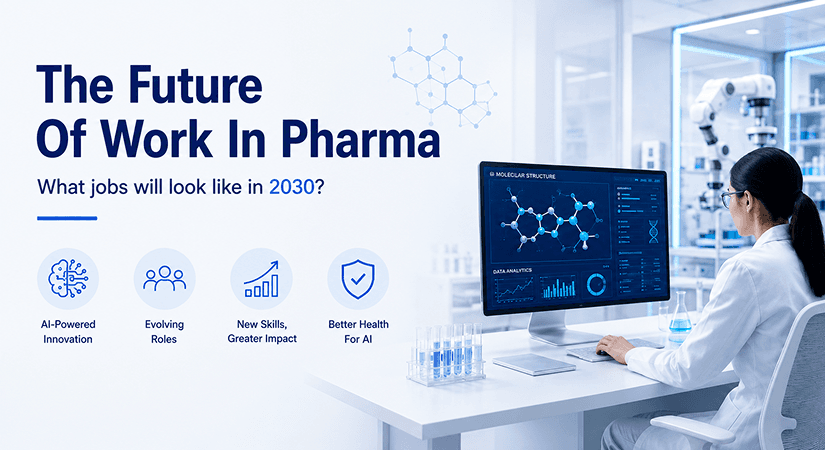
Picture a pharma lab in 2030. A scientist reviews a dashboard of AI-generated molecule predictions before lunch, then spends the afternoon debating ethical guardrails for an algorithm that's writing part of a clinical trial protocol. That's not science fiction anymore, it's the direction the industry is already moving.
Over the next several years, the day-to-day reality of pharma work is set to look noticeably different from what it does today, even if the mission behind it stays exactly the same. Let's take a simple look at how pharma jobs are changing, what new roles are emerging, and what it all means for the people building careers in this space.
Why Are Pharma Jobs Changing So Fast?
Pharma has always been a slow-moving, heavily regulated industry, but a few forces are speeding things up:
- AI and machine learning are now used to predict drug candidates in days instead of years.
- Automation in manufacturing is reducing the need for repetitive manual tasks on production lines.
- Personalized medicine is shifting focus from mass-market drugs to smaller, targeted patient groups.
- Remote and hybrid work has moved into functions once thought to require a physical lab presence, like data review and regulatory writing.
- Rising R&D costs are pushing companies to find efficiency wherever technology allows.
- Patient expectations are rising too, as people increasingly expect faster diagnoses and treatments tailored to their own biology.
None of this means fewer jobs overall. It means different jobs, with different skills attached to them, and a workforce that looks meaningfully different within just a few years.
New Roles That Will Define 2030
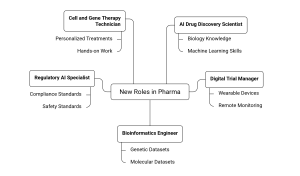
Some job titles that barely existed a decade ago are becoming central to how pharma operates. Here are a few worth watching:
- AI Drug Discovery Scientist: Combines biology knowledge with machine learning skills to guide algorithms toward promising compounds.
- Digital Trial Manager: Runs clinical trials that use wearable devices and remote monitoring instead of only in-person visits.
- Bioinformatics Engineer: Turns massive genetic and molecular datasets into usable insights for drug development teams.
- Regulatory AI Specialist: Ensures that AI-driven decisions in drug development meet compliance and safety standards.
- Cell and Gene Therapy Technician: Works hands-on with increasingly common personalized treatments that didn't exist at scale a decade ago.
These roles didn't replace older ones so much as they layered new expertise on top of traditional pharma knowledge.
Jobs That Will Look Very Different
Not every role is brand new. Many familiar pharma jobs are simply evolving:
- Quality control analysts will spend less time on manual testing and more time interpreting automated sensor data.
- Sales representatives will rely more on data-driven insights and virtual engagement than traditional in-person visits.
- Manufacturing technicians will manage robotic systems and monitoring dashboards rather than operating every machine by hand.
- Regulatory affairs professionals will need to understand AI systems well enough to explain and defend their decisions to health authorities.
- Medical science liaisons will use real-world data platforms to have more informed conversations with healthcare providers.
- The core purpose of these roles stays the same, protecting patients and ensuring quality. The tools and daily tasks around them are what's shifting most.
Skills That Will Matter Most
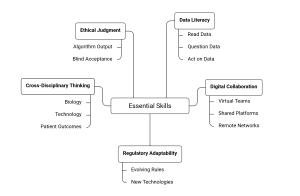
If you're planning a pharma career for the next decade, technical knowledge alone won't be enough. Employers are increasingly looking for a blend of skills:
1) Data Literacy — the ability to read, question, and act on data, even without being a data scientist.
2) Digital Collaboration — comfort working across virtual teams, shared platforms, and remote trial networks.
3) Regulatory Adaptability — staying current as rules evolve to keep pace with new technologies.
4) Cross-Disciplinary Thinking — connecting biology, technology, and patient outcomes instead of staying in one lane.
5) Ethical Judgment — knowing when to question an algorithm's output rather than accepting it blindly.
Technical training will still matter a great deal, but the professionals who thrive will be the ones comfortable moving between disciplines.
Knowing which skills matter is step one. Here are 11 concrete upskilling and reskilling paths pharma professionals can start on now.
→ Read: 11 Upskilling & Reskilling Areas for Future Pharma Jobs
How Automation Will Reshape The Workforce?
Automation in pharma isn't about replacing people wholesale. It's about changing where human effort is most valuable. Here's a simple way to think about it:
- Repetitive tasks get automated first, things like sample sorting, data entry, and routine quality checks.
- Judgment-heavy tasks stay human like interpreting ambiguous results, making ethical calls, and managing patient relationships.
- New oversight roles appear such as someone still needs to monitor, audit, and improve the automated systems themselves.
- Career paths shift sideways, not just up — a lab technician might move into data oversight rather than climbing a traditional ladder.
The pattern isn't unique to pharma, but the stakes are higher here, since mistakes can affect patient safety rather than just business outcomes.
Automation isn't just changing jobs, it's changing how pharma finds people for them. See how AI is rewriting recruitment itself.
→ Read: AI-Driven Hiring: The Future of Pharma Recruitment
Challenges The Industry Will Need To Solve
None of this transition is guaranteed to go smoothly. A few real challenges stand in the way:
a) Skills Gaps — Many current employees weren't trained for AI-augmented workflows and will need reskilling.
b) Talent Competition — Pharma now competes with tech companies for the same data science and AI talent.
c) Regulatory Lag — Rules don't always keep pace with how fast new tools are being adopted.
d) Job Security Concerns — workers in roles most exposed to automation may feel uncertain about their long-term place in the industry.
e) Equity In Access — smaller companies may struggle to afford the same advanced tools as large pharma firms, widening the gap between them.
Addressing these challenges honestly will matter just as much as the technology itself.
A Closer Look: How One Role Is Already Shifting
To see this transition in action, consider the quality control analyst, a role that has existed in pharma for decades. In 2015, this job largely meant manually testing samples, recording results by hand, and flagging anything outside spec for a supervisor to review. By 2030, that same title will likely involve something quite different:
1) Reviewing automated sensor data streaming in continuously from manufacturing lines, rather than pulling samples on a fixed schedule.
2) Investigating flagged anomalies that an algorithm has already sorted from routine noise, rather than checking everything by hand.
3) Validating AI-driven quality decisions before they're finalized, since human sign-off is still required for regulatory compliance.
4) Collaborating with data engineers to fine-tune the systems that generate these automated alerts in the first place.
The title hasn't changed, but the daily rhythm of the job barely resembles what it looked like fifteen years earlier. This same pattern is playing out across dozens of pharma roles at once, from clinical operations to supply chain management.
What This Means For The Industry's Bottom Line?
Beyond individual careers, this shift carries real financial weight for pharma companies. Consider what's at stake:
- Faster drug discovery timelines mean noticeably lower R&D costs and quicker paths to revenue.
- Automated manufacturing also reduces error rates, which lowers the cost of recalls and rework.
- Companies that reskill their workforce early avoid the higher cost of hiring external talent later.
- Firms that lag in adopting new roles risk losing ground to competitors who bring drugs to market faster.
- Investing in digital and AI talent now is cheaper than scrambling to catch up once these skills become industry standard.
The companies that treat workforce transformation as a strategic investment, not just an HR issue, are the ones most likely to lead the market by 2030.
In Conclusion
The future of work in pharma isn't about robots replacing scientists or algorithms making every decision. It's about a workforce that blends deep scientific expertise with digital fluency, ethical judgment, and comfort working alongside intelligent systems.
Roles like AI drug discovery scientists and digital trial managers will sit alongside evolved versions of familiar jobs, from quality control to regulatory affairs, each shaped by new tools rather than replaced by them.
The companies and professionals who invest early in reskilling, cross-disciplinary thinking, and thoughtful oversight of automation will be the ones best positioned when 2030 arrives.
For an industry built on improving human health, the most important shift may simply be this: technology handles more of the repetitive work, so people can spend more time on the judgment calls that actually save lives.
FAQs
1) What Will Pharma Jobs Look Like In 2030?
Pharma jobs in 2030 will combine scientific expertise with digital technologies such as artificial intelligence, automation, and advanced data analytics. Many professionals will spend more time analysing data, managing intelligent systems, and making strategic decisions rather than performing repetitive manual tasks. While technology will reshape daily responsibilities, human expertise and critical thinking will remain essential.
2) Which Skills Will Be Most Important For Future Pharma Professionals?
Skills such as data literacy, digital collaboration, regulatory knowledge, and cross-disciplinary thinking will become increasingly valuable across the pharmaceutical industry. Professionals who can adapt to new technologies while maintaining a strong understanding of science and compliance will have a competitive advantage. Continuous learning and upskilling will be key to long-term career success.
3) Will Automation Replace Jobs In The Pharmaceutical Industry?
Automation is expected to transform many roles rather than replace them completely by taking over routine and repetitive tasks. This will allow employees to focus on higher-value work, including problem-solving, innovation, quality oversight, and patient-centred decision-making. As a result, new career opportunities will continue to emerge alongside evolving traditional roles.
Reporting on the science, business and regulation shaping the pharmaceutical industry.
More in HR in Pharma
All articles →
Crisis Management: HR's Role in Business Continuity in the Pharmaceutical Industry

Top HR Strategies for Successful Pharma Mergers: People, Culture, and Integration 2025

Discussion