Why quality culture starts with Leadership and not SOPs
Why Quality Culture Starts with Leadership explains how leaders, not SOPs alone, shape behaviour, ownership and fearless reporting in pharmaceutical quality.

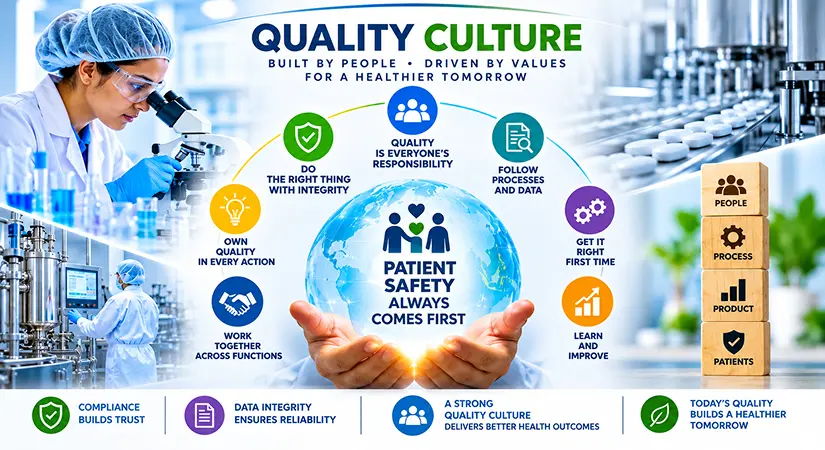
Quality is in everything we do. From the time we wake up, breathing fresh air (quality air), to using the right mouthwash, having our first coffee, cooked food, and the list is endless. Quality matters to every individual, from the consumables to the non-consumables and the environment one lives in. It’s the trust that the individual has in the product used and the environment one lives in. From individuals to mid-sized and large-scale organisations, everyone expects a quality product to be received and manufactured.
Quality Culture plays an important role in an organisation to deliver quality products, especially in the pharmaceutical industry. Lakhs of patients blindly trust the medicines to help them get better with every pill they take. To ensure that the drug products manufactured are quality-compliant and consistent, a set of Standard Operating Procedures (SOPs) is defined and followed by every organisation. These ensure that any trained pharmaceutical professional performs the right task as required, maintains consistency and minimises errors during the operations performed in the manufacturing of the drug product.
SOPs also help meet the regulatory expectations, i.e. compliance w.r.t. manufacturing and documentation. They serve as documented evidence during audits and help reduce risk. They serve as a training tool and avoid ambiguity for the same task performed by two different individuals by avoiding guesswork. Timely review of the SOPs helps ensure they are in line with the regulatory expectations and thereby helps in continuous improvement.
Therefore, SOPs lay a foundation for Quality to ensure uniformity, control and reliability is built into the drug products. SOPs concentrate on the technical aspects and the tasks to be performed by an individual but do not guide on any of the behavioural aspects for the tasks performed by a human, and hence the need arises for a Quality culture.
Quality culture is about the collective behaviour of an organisation, values and attitudes that promote building quality and achieve regulatory compliance.
There goes a Sanskrit phrase “Yatha Raja Tatha Praja" –meaning “As the King, so are the subjects”- the behaviour and character of the leaders directly influences their followers.
In the Pharmaceutical industry, the leadership team's commitment to quality in decision-making, and their response to product or business failures, determines quality culture. USFDA now views Quality culture as a core regulatory expectation to a mere compliance exercise
The leadership team, when it lays down a clear document, shows visibility and provides ownership at all levels, hence building a Quality culture. Regardless of the level of an individual in an organisation, he/ she must voluntarily report any problem fearlessly. When every employee owns the action performed to the outcomes received fearlessly demonstrates a strong Quality Culture.
Leaders establish the organisational mindset towards any business action. Therefore, their actions in prioritising Quality in business initiatives establish a Quality culture. Employees take such cues from the leaders rather than only relying on the policies and SOPs. When leaders encourage and engage with employees at the floor, the employees feel valued, and this fosters a sense of ownership at all levels. Recognising and rewarding employees for their achievement reinforces the Quality culture and enables it to be consistently maintained.
When leaders exhibit emotional maturity, courage and empathy in quality issues without any blame, a successful quality culture is built in. When such mindsets are inculcated into the employees at all levels and integrated into every process they perform, a nourished Quality Culture is in place.
Therefore, Quality Culture defines the Way one works vs the SOP defines how to do the work.
Reporting on the science, business and regulation shaping the pharmaceutical industry.
More in HR in Pharma
All articles →
Crisis Management: HR's Role in Business Continuity in the Pharmaceutical Industry

Top HR Strategies for Successful Pharma Mergers: People, Culture, and Integration 2025

Discussion