Raman + Hyperspectral Imaging In QC In The Pharmaceutical Industry
Raman spectroscopy and hyperspectral imaging enable faster, non-destructive pharmaceutical QC with deep chemical insight and spatial accuracy.


Quality control (QC) in the pharmaceutical industry has long relied on analytical methods that ensure every tablet, vial, infusion, or lyophilised product meets the strictest safety and efficacy standards. As drug molecules become more complex and manufacturing processes evolve toward continuous and personalised production, traditional QC methods are being increasingly pushed to their limits. The industry now demands analytical technologies that can deliver speed, specificity, spatial detail, and chemical insight, all without destroying the product.
This is where the combined use of Raman spectroscopy and hyperspectral imaging (HSI) is transforming modern pharmaceutical QC. Together, these techniques provide unparalleled visibility into chemical and physical attributes at micro- to macro-scales, supporting real-time release testing (RTRT), process analytical technology (PAT), and advanced product characterisation.
Understanding the Two Technologies
Raman spectroscopy identifies molecules based on how they scatter incident light. When photons interact with molecular bonds, the resulting shifts in wavelength create a distinct chemical “fingerprint” for each compound. Raman is highly specific, requires minimal sample preparation, and can non-destructively analyse solids, liquids, gels, and suspensions. It is especially powerful for distinguishing polymorphs, monitoring crystallinity, detecting contaminants, and verifying excipient homogeneity.
Hyperspectral imaging, on the other hand, captures spatially resolved spectral data across hundreds of wavelength bands. Instead of a single spectrum, HSI provides a chemical map of an entire surface or volume. This makes it ideal for analysing content uniformity, coating thickness, distribution of active pharmaceutical ingredients (APIs), and defects in formulations or packaging.
Individually, Raman and HSI are strong tools. Together, they deliver a multidimensional view that aligns perfectly with the modern QC expectations of regulatory agencies and pharma manufacturers.
Why the Combination Matters for Modern QC
The pharmaceutical QC landscape is undergoing a quiet evolution. Regulators increasingly call for a deeper understanding of critical quality attributes (CQAs) and critical material attributes (CMAs). Manufacturing teams want faster and non-destructive methodologies, especially for high-value biologics, controlled substances, and personalised products. Raman-HSI integration offers a solution tailored to these demands.
The combination provides both chemical specificity and spatial resolution. Raman offers molecular detail down to subtle structural forms, including polymorphic transitions or hydrate formation. Meanwhile, HSI provides a broader, high-resolution map of chemical distribution. This synergy enables QC teams to identify not only what a product contains, but precisely where each component is located, how it is distributed, and whether it aligns with expected quality profiles.
For example, in tablet manufacturing, Raman may identify the unique fingerprint of API and excipients, but HSI reveals the actual distribution of these components across the tablet surface or within a cross-section. Together, they provide a robust picture of uniformity, a key requirement for oral solid dosage forms.
Applications Across Key Pharmaceutical QC Processes
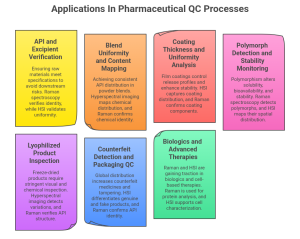
1. API and Excipient Verification
Ensuring raw materials meet pharmacopeial and internal specifications is essential for avoiding downstream risks. Raman spectroscopy is highly effective for verifying the identity of incoming APIs and excipients, particularly because it pierces through transparent containers and does not require direct sampling. When combined with HSI, manufacturers can further validate uniformity of powders, granules, or blends, identifying agglomerations, contamination, or distribution issues that traditional sampling might miss.
2. Blend Uniformity and Content Mapping
One of the classic challenges in oral solid dosage manufacturing is achieving consistent distribution of API within powder blends and granules. Conventional methods rely heavily on sampling, which introduces variability and risks missing hotspots.
Hyperspectral imaging maps the chemical distribution in real time. Raman confirms chemical identity of specific regions, especially when polymorphic or structurally similar excipients complicate spectral interpretation. The combined approach provides both quantitative and qualitative data on blend uniformity, supporting real-time decision-making in continuous manufacturing lines.
3. Coating Thickness and Uniformity Analysis
Film coatings play a functional role, controlling release profiles, enhancing stability, enabling taste masking, or improving swallowability. Variations in coating thickness can directly impact dissolution and, ultimately, therapeutic performance.
HSI excels at capturing coating distribution across tablets, capsules, or pellets. Raman adds confirmation of coating components, particularly when differentiating between multiple functional layers. This integration enables QC teams to monitor consistency without destructive sectioning, facilitating faster batch release and more robust process control.
4. Polymorph Detection and Stability Monitoring
Polymorphism poses one of the highest risks in pharmaceutical development. A shift from one polymorphic form to another can alter solubility, bioavailability, and stability. Raman spectroscopy remains one of the most sensitive tools for polymorph detection because different crystalline forms produce distinct Raman shifts.
However, localized polymorphic hotspots can go unnoticed without spatial imaging. By pairing Raman with HSI, QC teams can not only identify forms but also map their spatial distribution. This is especially important for high-energy forms prone to conversion during compaction, granulation, or coating processes.
5. Lyophilized Product Inspection
Freeze-dried biologics and small molecules require stringent visual and chemical inspection. Hyperspectral imaging can detect vial-to-vial variations, cake collapse, moisture gradients, or reconstitution anomalies. Raman spectroscopy complements this with molecular verification, ensuring that API structure remains preserved and that no degradation occurs during sterilization or drying.
6. Counterfeit Detection and Packaging QC
The rise of global distribution channels has increased the prevalence of counterfeit medicines and tampering with packaging. HSI can quickly differentiate between genuine and fake products by analyzing spectral signatures from packaging materials, inks, or tablets. Raman adds molecular specificity to confirm identity at the API level. The combination enhances anti-counterfeiting measures and supports regulatory compliance in highly regulated markets.
7. Biologics and Advanced Therapies
Though Raman and HSI are often associated with small-molecule pharma, they are gaining traction in biologics and cell-based therapies. Raman spectroscopy is increasingly utilised for protein structural analysis, monitoring protein aggregation, and assessing formulation stability. Hyperspectral imaging supports cell characterisation and microenvironment monitoring, especially in PAT frameworks.
When used together, these techniques help ensure that biologics remain structurally intact, stable, and free of aggregates, factors critical to clinical outcomes.
Enabling Real-Time Release Testing (RTRT)
The pharmaceutical industry’s long-term goal is to shift from end-product testing toward continuous quality assurance through RTRT. Raman and HSI are foundational to this transformation. Their non-destructive nature, compatibility with automation, and ability to integrate into production lines make them ideal PAT tools.
A Raman-HSI setup integrated with machine learning can detect process variations within seconds, enabling immediate interventions. Manufacturers can release batches based on high-fidelity data instead of labour-intensive laboratory testing. This reduces cycle time, increases throughput, and aligns with regulatory expectations for enhanced process understanding.
Regulatory Acceptance and Evolving Standards
Both Raman spectroscopy and hyperspectral imaging are increasingly recognised by regulatory bodies, including the FDA, EMA, and PMDA, particularly within PAT frameworks and advanced manufacturing initiatives. Raman is well-established in pharmacopoeias globally. Hyperspectral imaging, though newer, is gaining acceptance through quality by design (QbD) applications and documented analytical method validations.
Regulators encourage robust, well-justified deployment of these technologies as part of modern control strategies. Combined Raman-HSI platforms enhance pharmaceutical companies’ ability to demonstrate a comprehensive understanding of their processes, supporting smoother inspections, audits, and technology transfer activities.
The Future: AI-Enhanced Raman and HSI Analytics
Artificial intelligence and deep learning algorithms are accelerating the value of Raman-HSI systems. AI can rapidly process hyperspectral datasets, classify chemical species, and identify spatial anomalies. When applied to Raman spectra, AI improves peak interpretation, reduces noise, and enhances quantification accuracy.
The combination of Raman, hyperspectral imaging, and AI forms a powerful triad for future pharmaceutical QC, enabling predictive quality, automated defect detection, and intelligent process control.
As the pharmaceutical industry moves toward personalised medicines, continuous manufacturing, and smaller batch sizes, these analytical technologies will be indispensable in ensuring safety, consistency, and regulatory compliance.
FAQs
1. What is the role of Raman spectroscopy in pharmaceutical QC?
Raman spectroscopy provides molecular identification and structural analysis, helping verify API identity, detect polymorphs, and ensure formulation consistency in a non-destructive manner.
2. How does hyperspectral imaging improve quality control?
HSI captures detailed chemical distribution maps that reveal uniformity, coating thickness, defects, and API dispersion across solid dosage forms.
3. Why combine Raman and hyperspectral imaging?
The integration offers both molecular specificity and spatial resolution, giving QC teams a complete picture of chemical composition and distribution.
4. Is Raman-HSI suitable for continuous manufacturing?
Yes, both technologies support real-time data collection and can be integrated into PAT frameworks for real-time release testing.
5. Can Raman and HSI detect counterfeit medicines?
Raman confirms chemical identity while HSI analyzes packaging and surface spectra, making the combination highly effective for counterfeit detection.
Reporting on the science, business and regulation shaping the pharmaceutical industry.
More from the Knowledge Hub
All articles →
Pharmaceutical Regulatory Affairs: Challenges, Innovations, and Global Harmonization

Cold Chain Logistics in Pharma: Building Resilient Supply Chains

Discussion