Silico Clinical Trials: Testing New Medicines In A Computer
Silico Clinical Trials use computer simulations and digital twins to predict drug behavior before real human trials begin.


Introduction
Developing a new medicine has traditionally followed a long, expensive, and slow path: years of lab research, testing on animals, and then multiple phases of human clinical trials — each one taking months or years and costing enormous sums of money. Along the way, many promising drug candidates quietly fail, sometimes after being tested on thousands of real patients.
Now imagine being able to test a new drug on a "virtual patient" first — a detailed computer simulation of a human body that responds to the drug almost exactly the way a real person would. This isn't science fiction anymore. It's called an “in silico clinical trial”, and it's quickly becoming one of the most talked-about innovations in modern drug development.
The term "in silico" simply means "performed on a computer or via computer simulation" — a nod to silicon, the material used in computer chips, much like "in vivo" means inside a living organism. In silico clinical trials use advanced computer models, biological simulations, and artificial intelligence to predict how a drug or medical device will behave in the human body, before or alongside real-world testing.
This article explains what in silico clinical trials are, how they actually work, why regulators are increasingly supportive of them, and what challenges remain before they can fully transform the way new medicines are developed.
What Exactly Is An In Silico Clinical Trial?
At its core, an in silico clinical trial uses computational models, built from biology, physiology, and mathematics, to simulate how a drug or treatment will affect the human body. Instead of relying only on real human volunteers, researchers can run simulations on "virtual patients" whose biological systems are modeled using real scientific data.
These simulations can be used in a few different ways:
Replacing Certain Early-Stage Tests: Predicting toxicity, drug absorption, or side effects before a drug ever reaches human trials.
Supporting Or Supplementing Real Trials: Running alongside actual human trials to help design better studies or interpret results.
Creating Virtual Control Groups: In some cases, computer-generated patient data is used to represent a comparison group, reducing the number of real patients who need to receive a placebo.
Personalizing Predictions: Estimating how a specific type of patient based on age, genetics, or existing health conditions might respond to a treatment.
The Technology Behind It: Digital Twins
One of the most important concepts driving in silico trials is the “digital twin”. A digital twin is a detailed virtual replica of a biological system — it could represent an organ, a specific disease process, or even an entire simulated patient. These digital twins are built using real biological, genetic, and clinical data, then combined with mathematical modeling and machine learning to predict how that system will behave under different conditions.
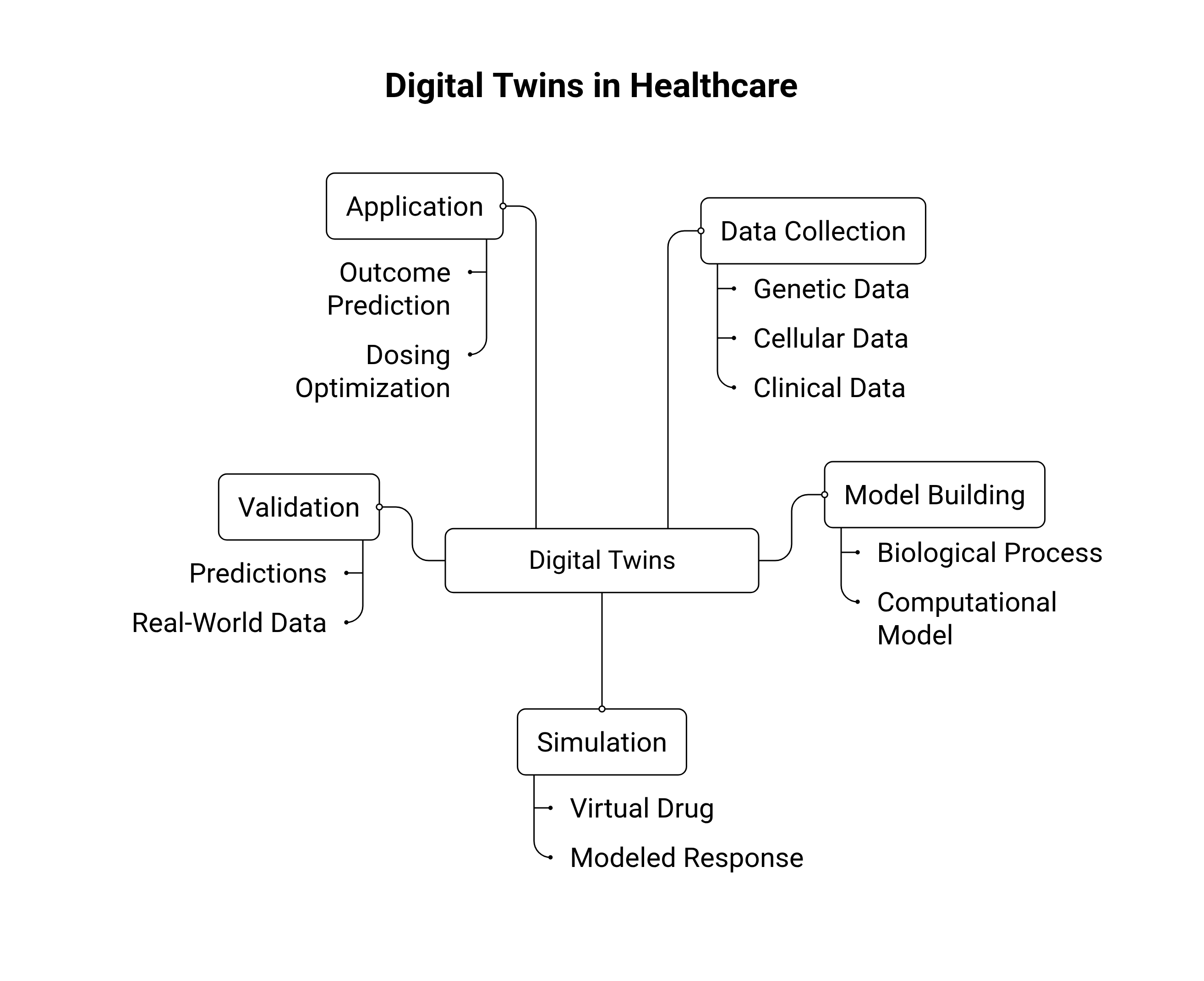
Here's a simplified breakdown of how digital twins are typically built and used in drug development:
1) Data Collection: Scientists gather biological data such as genetic information, cellular behavior, and clinical measurements from real patients or existing research.
2) Model Building: This data is used to construct a mathematical or computational model that mimics how a specific organ, disease, or biological process functions.
3) Simulation: Researchers introduce a "virtual drug" into the model and observe how the simulated biological system responds.
4) Validation: The model's predictions are compared against real-world data to check accuracy and refine the simulation.
5) Application: Once validated, the digital twin can be used to predict outcomes, optimize dosing, or help design smarter, more efficient real-world trials.
Digital twins have already shown promising results in specialized medical fields, including modeling heart rhythm disorders to help guide treatment decisions in select patient cases — an early but powerful glimpse of how far this technology can go.
Digital twins go beyond clinical trials, they're reshaping manufacturing and personalized medicine too. See the full scope of what this technology can do.
Read: Digital Twins | Reshaping The Pharmaceutical Sector
Why Is This Approach Gaining Momentum?
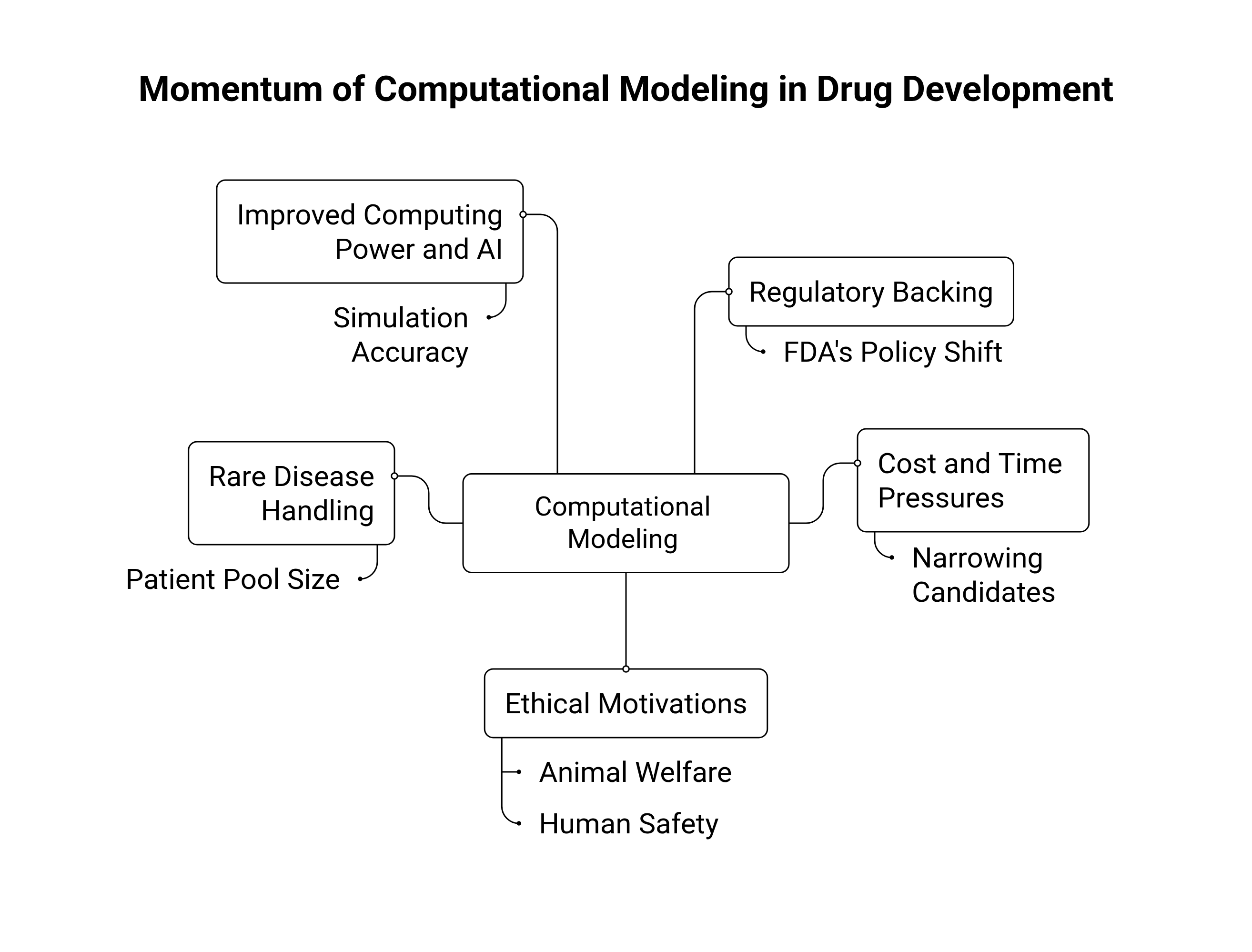
Interest in in silico trials has grown rapidly in recent years, driven by a combination of scientific advancement and regulatory support:
1) Regulatory Backing Is Increasing — In April 2025, the U.S. Food and Drug Administration announced plans to move away from mandatory animal testing requirements for certain drug types, actively encouraging the use of modern alternatives such as computational models and lab-based human-relevant methods.
2) Cost & Time Pressures In Drug Development — Traditional clinical trials are extremely expensive and slow, and computational simulations offer a way to narrow down promising drug candidates earlier, before committing to costly human trials.
3) Ethical Motivations — Reducing reliance on animal testing and minimizing the number of human participants exposed to unproven or potentially ineffective treatments is a major driver behind this shift.
4) Better Handling Of Rare Diseases — For conditions where very few patients exist, gathering enough real trial participants can be nearly impossible — computational modeling offers a way to still generate useful scientific insight.
5) Improved Computing Power & AI — Advances in artificial intelligence and biological data modeling have made simulations far more accurate and useful than they were even a few years ago.
Where In Silico Methods Are Already Being Used?
While the idea of a "fully virtual clinical trial" is still emerging, computational modeling already plays a meaningful role at several stages of drug development:
a) Toxicity Prediction: Computational tools are used to estimate how likely a drug candidate is to cause harmful side effects, helping researchers rule out risky candidates early.
b) Drug Absorption & Metabolism Modeling: Simulations help predict how a drug will be absorbed, processed, and eliminated by the body.
c) Trial Design Optimization: Modeling helps researchers determine better dosing strategies, patient selection criteria, and trial timelines before launching expensive real-world studies.
d) Virtual Control Arms: In select trials, particularly for rare diseases, simulated or historical patient data can reduce the number of real participants needed in a comparison group.
e) Cardiac & Organ-Specific Modeling: Specialized simulations have been used to help predict outcomes for certain heart procedures and to support the study of rare cardiac conditions.
In silico modeling is just one part of AI's growing role in clinical trials. See how AI is boosting efficiency and slashing costs across the board.
Read: AI In Clinical Trials | Boost Efficiency & Slash Costs
The Benefits: Why Does This Matter?
The appeal of in silico clinical trials goes beyond simply being a "cool new technology." The practical benefits are significant:
Faster Development Timelines: Promising candidates can be identified more quickly, while weak candidates are filtered out earlier.
Lower Overall Costs: Reducing the number of failed late-stage human trials saves enormous amounts of money across the drug development process.
Reduced Risk To Real Patients: Fewer people are exposed to unproven or potentially harmful treatments in early testing stages.
More Personalized Insights: Simulations can model how different patient subgroups might respond differently to the same treatment.
Support For Rare Disease Research: Conditions with very small patient populations become more feasible to study.
The Challenges That Still Remain
Despite the excitement, in silico clinical trials are not yet a full replacement for real human trials, and several important challenges remain:
Model Accuracy & Validation: A simulation is only as good as the data and biological understanding behind it; poorly validated models can produce misleading predictions.
Regulatory Frameworks Are Still Changing: While agencies like the FDA and the European Medicines Agency are increasingly supportive, clear, standardized rules for how much weight computational evidence can carry are still being developed.
Data Quality & Availability: Building accurate digital twins requires large amounts of high-quality biological and clinical data, which isn't always available, especially for less-studied diseases.
Trust & Adoption: Researchers, clinicians, and regulators need to build confidence in these tools over time, particularly for higher-risk decisions.
Complex Human Biology Is Hard To Fully Simulate: The human body is an incredibly complex system, and no model can yet perfectly capture every biological variable that might affect how a real patient responds to treatment.
In Conclusion
In silico clinical trials represent one of the most promising shifts happening in modern drug development. By using detailed computer simulations and digital twins to predict how treatments will behave in the human body, researchers can identify promising drug candidates faster, reduce risk to real patients, and support research into conditions that are otherwise extremely difficult to study.
Growing regulatory support, including recent moves by the FDA to reduce reliance on traditional animal testing, signals that this approach is moving from the fringes of research into the mainstream of drug development.
That said, in silico methods aren't replacing human clinical trials anytime soon — they are becoming a powerful complement to them. As computational models continue to improve in accuracy and regulators continue building clearer frameworks around their use, this "fourth pillar" of drug development is likely to play an increasingly central role in how tomorrow's medicines are discovered, tested, and brought safely to the patients who need them.
FAQs
1. What Are In Silico Clinical Trials?
In silico clinical trials use computer models and simulations to predict how a medicine may behave in the human body. They can support drug development before or alongside traditional human clinical trials.
2. How Do Digital Twins Help In Drug Development?
Digital twins are virtual models of biological systems, organs, diseases, or patients created using real scientific and clinical data. Researchers can use them to simulate how different treatments may affect these systems.
3. Why Are In Silico Clinical Trials Becoming More Popular?
They can help researchers save time, reduce development costs, improve trial planning, and reduce reliance on animal and human testing. Advances in artificial intelligence and computing power are also making these simulations more useful.
4. Where Are In Silico Methods Used In Drug Development?
In silico methods can be used for toxicity prediction, drug absorption and metabolism modeling, trial design, virtual control groups, and organ-specific simulations. These applications can help researchers identify potential problems and promising treatments earlier.
5. Can In Silico Clinical Trials Replace Human Clinical Trials?
No, in silico trials cannot completely replace human clinical trials because computer models cannot yet capture every aspect of human biology. For now, they are mainly used to complement real-world testing and make drug development more efficient.
Reporting on the science, business and regulation shaping the pharmaceutical industry.
More from the Knowledge Hub
All articles →
Pharmaceutical Regulatory Affairs: Challenges, Innovations, and Global Harmonization

Cold Chain Logistics in Pharma: Building Resilient Supply Chains

Discussion