Why GLP-1 Manufacturing Capacity Is Biggest Bottleneck in Pharma
A practical look at where GLP-1 manufacturing capacity stands today, and how Novo Nordisk, Lilly, and a growing CDMO network are closing the supply gap.

Introduction
For nearly three years, the biggest question in metabolic health hasn't been whether GLP-1 drugs work. It's whether the industry can make enough of them. Semaglutide and tirzepatide became two of the best-selling medicines in history almost overnight, and demand simply outran supply. Pharmacies ran short, patients switched doses, and regulators had to step in on compounding rules.
That story is starting to shift. GLP-1 manufacturing capacity is now expanding faster than at any point in the drug class's history, and the choices companies make over the next few years will decide how quickly these medicines reach patients worldwide.
Here's a clear, practical look at where GLP-1 manufacturing stands today and where it's headed.
Why GLP-1 Drugs Are So Hard to Make
GLP-1 drugs aren't simple tablets. Most approved products, including semaglutide and tirzepatide, are peptides delivered as sterile injectables. That combination creates two separate manufacturing challenges.
Peptide synthesis is slow and resource-heavy. Building a peptide chain, whether through solid phase peptide synthesis (SPPS) or liquid phase peptide synthesis (LPPS), requires many sequential chemical steps, each with its own purification and quality checks. A single batch can take weeks. Scaling this isn't like scaling a small-molecule tablet line; it needs specialized reactors, synthesizers, and trained peptide chemists.
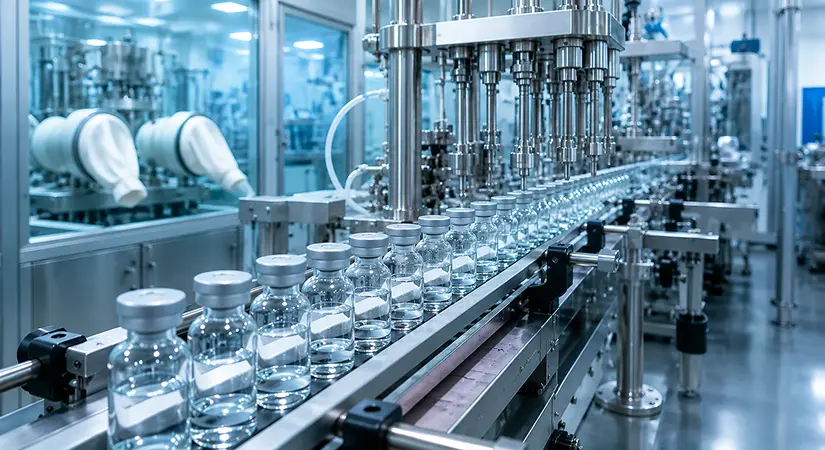
Sterile fill-finish adds another bottleneck. Once the peptide is made, it must go into pre-filled pens or vials under strict aseptic conditions, following requirements like EU GMP Annex 1. Fill-finish lines, glass vial supply, elastomer components, and device assembly all have to scale together, not just the drug substance itself.
This is why capacity expansion here involves investment across the whole chain, not just one factory.
EU GMP Annex 1 is just one piece of the compliance puzzle for sterile GLP-1 manufacturing. See the full regulatory checklist spanning FDA, EU, and CDSCO requirements.
→ Read: Injectable Manufacturing Regulations: FDA, EU & CDSCO Checklist
How the Big Players Are Expanding Capacity
Novo Nordisk and Eli Lilly, the two companies leading the GLP-1 market, have both made large, public commitments to close the supply gap.
Novo Nordisk's parent company, Novo Holdings, acquired the contract manufacturer Catalent, and Novo Nordisk separately took over three Catalent fill-finish sites in Indiana, Belgium, and Italy. These plants were already producing GLP-1 medicines, so the move gave Novo Nordisk dedicated, ready-to-run capacity rather than starting from scratch.
Eli Lilly has taken a similar path with its own facilities. It significantly increased its investment in a new manufacturing campus in Lebanon, Indiana, adding billions of dollars on top of its original commitment. The site is built for tirzepatide production and is one of several large domestic investments Lilly has made to expand its GLP-1 output.
Both companies have also leaned on contract development and manufacturing organizations (CDMOs) to add capacity faster than building it alone would allow. This shift has turned GLP-1 manufacturing into a major growth driver for peptide and sterile injectable CDMOs.
The Rise of Specialized CDMOs and Component Suppliers
Because demand has outpaced what any single company can build in-house, contract manufacturers and component suppliers have become central to the GLP-1 supply story.
CDMOs with peptide expertise are expanding rapidly. In India, Neuland Laboratories is opening a dedicated peptide facility near Hyderabad, designed with room for future expansion as demand grows. Other Indian CDMOs, including Sai Life Sciences, have announced similar peptide-focused investments.
Component suppliers are scaling too. West Pharmaceutical Services, which makes elastomer components used in GLP-1 injection devices, has reported that GLP-1-related products now make up a meaningful share of its revenue, reflecting how far the demand ripple extends beyond the drugmakers themselves.
Near-shoring is gaining attention. Some manufacturers are looking to build capacity closer to major markets to reduce tariff exposure and shorten supply chains.
This spread of investment means GLP-1 capacity growth isn't just a story about two companies. It's a broader shift in how the peptide and sterile injectable manufacturing ecosystem is built.
Neuland and Sai Life are leading the peptide-CDMO surge in India, see how they stack up against the broader US CDMO landscape driving pharma capacity. → Read: Top 20 Contract Manufacturing Organizations in US Pharma
What's Changing the Supply-Demand Balance
Factor | Effect on Capacity |
Acquisition of dedicated fill-finish sites (e.g., Catalent sites to Novo Nordisk) | Immediate, ready-to-use sterile manufacturing capacity |
New peptide-focused CDMO facilities (India, other regions) | Adds specialized synthesis capacity outside the two market leaders |
Multibillion-dollar campus expansions (e.g., Lilly's Indiana site) | Long-term, large-scale drug substance and product capacity |
Growth in elastomer and device component supply | Prevents fill-finish from becoming the new bottleneck |
Emerging oral GLP-1 pipeline | Could reduce pressure on sterile injectable lines over time |
Entry of generic and biosimilar-style manufacturers, particularly in India | Expands capacity for lower-cost versions once patents allow |
Even with all this investment, supply in 2026 is better than the acute shortages of 2023 and 2024, but it still hasn't fully caught up with underlying patient demand at current prescribing levels.
The Oral GLP-1 Factor
One development worth watching is the shift toward oral GLP-1 drugs. Several companies, including Lilly with orforglipron, are working on oral formulations that could reduce dependence on injectable lines. If oral GLP-1s reach the market at scale, they would ease pressure on peptide synthesis and sterile fill-finish, since tablets are generally faster and cheaper to make than sterile injectables. This is still an emerging area, and capacity commitments here are not yet at the scale seen for injectables.
What Manufacturers Should Be Tracking

Capacity Planning Checklist for GLP-1 Manufacturing
Secure dedicated peptide synthesis capacity (SPPS or LPPS), not shared general-purpose lines
Confirm sterile fill-finish capacity aligns with EU GMP Annex 1 requirements
Lock in long-term component supply agreements (vials, elastomers, pen devices)
Build redundancy through CDMO partnerships to avoid single-site dependency
Monitor near-shoring opportunities to manage tariff and logistics risk
Track oral GLP-1 pipeline progress for future capacity reallocation
Plan for generic and biosimilar-style entrants as patents near expiry
The Road Ahead
GLP-1 manufacturing capacity is no longer just playing catch-up. It's being built out deliberately, with investments spanning peptide synthesis, sterile fill-finish, component supply, and a growing CDMO network. The two market leaders are securing dedicated capacity through acquisitions and new campuses, while contract manufacturers, especially in regions like India, are entering the space to meet global demand.
The next few years should bring a more stable supply picture, wider access, and eventually lower prices as generic-style competition and oral formulations mature. For now, companies that plan capacity carefully across the full chain will be best positioned to keep up with one of the fastest-growing drug categories in pharma history.
Frequently Asked Questions
1. Why has GLP-1 manufacturing capacity been so limited?
Making GLP-1 drugs involves complex peptide synthesis and sterile fill-finish, both of which are slow to scale compared to standard tablet manufacturing.
2. Who are the main companies expanding GLP-1 capacity?
Novo Nordisk and Eli Lilly lead capacity expansion, supported by CDMOs like Neuland Laboratories and Sai Life Sciences.
3. Will GLP-1 shortages end soon?
Supply has improved significantly since 2023-2024, but it still hasn't fully matched patient demand as of 2026.
4. How do oral GLP-1 drugs affect manufacturing capacity?
Oral versions could ease pressure on injectable manufacturing lines since tablets are generally faster and cheaper to produce.
5. Why are CDMOs important for GLP-1 supply?
CDMOs let drugmakers add peptide and sterile manufacturing capacity faster than building new facilities alone.
Reporting on the science, business and regulation shaping the pharmaceutical industry.
More from the Knowledge Hub
All articles →
Pharmaceutical Regulatory Affairs: Challenges, Innovations, and Global Harmonization

Cold Chain Logistics in Pharma: Building Resilient Supply Chains

Discussion