Death at Sea: The Hantavirus Cruise Ship Crisis That Has the World Watching
The MV Hondius hantavirus cruise ship crisis explained deaths, Andes virus transmission, ship location saga and global health response.

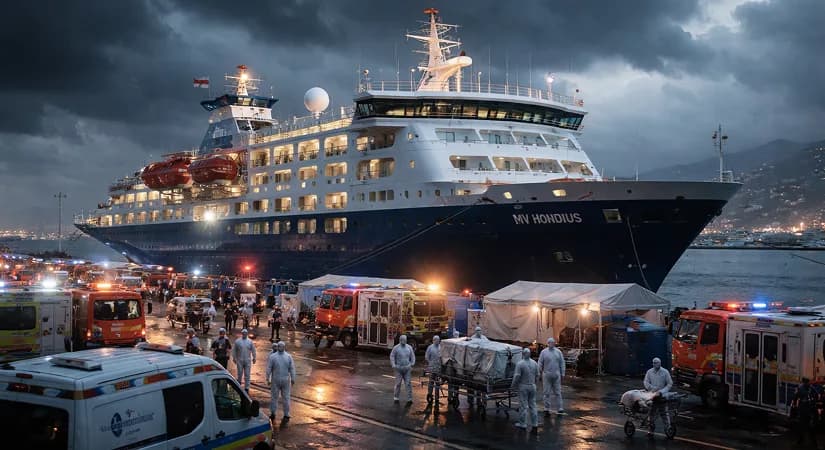
It started as a dream voyage, an Antarctic expedition cruise through some of the most remote and breathtaking waters on Earth. What it became is now the subject of a global health emergency, diplomatic standoffs, and heartbreak on a scale no one on board could have imagined when they set sail from the tip of South America just weeks ago.
This is the story of the hantavirus cruise ship MV Hondius, and the chain of events that has left three people dead, nearly 150 stranded at sea, and health authorities across a dozen nations scrambling for answers.
Which Cruise Ship Has Hantavirus?
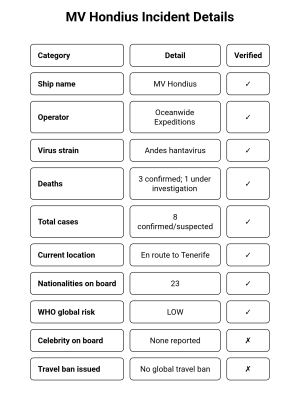
The vessel at the centre of this crisis is the MV Hondius, a Dutch-flagged expedition ship owned by Oceanwide Expeditions, a Netherlands-based polar adventure company. Built to carry up to 196 passengers, the Hondius departed Ushuaia, Argentina, the southernmost city in the world, on April 1, 2026, with approximately 147 passengers and crew aboard representing 23 nationalities. Most passengers hailed from Spain, the United Kingdom, and the United States, while the majority of crew members were from the Philippines.
The trip was designed to be extraordinary. The itinerary promised Antarctica and "several isolated islands in the South Atlantic." What no one knew at the time was that at least one passenger had already been exposed to one of the most dangerous viruses on the planet before they ever stepped on board.
How It All Started: The Index Case
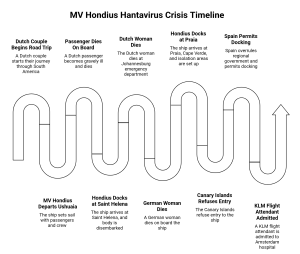
According to Argentine health investigators, the leading hypothesis is that the first infected passengers, a Dutch couple, contracted the virus while birdwatching during a four-month road trip through South America. The Argentine health ministry has traced their movements across Chile, Uruguay, and Argentina between November 27, 2025 and April 1, 2026, the day they boarded the Hondius.
This is the critical piece of the puzzle. Argentine authorities confirmed that no passengers showed symptoms when the ship initially departed. The virus was already silently incubating.
On April 11, the Dutchman became gravely ill and died on board. The ship's medical team could not determine the cause of death at sea. His body remained on the vessel until April 24, when the Hondius docked at Saint Helena, a remote British overseas territory in the South Atlantic, where the body was finally disembarked. His wife, visibly grief-stricken but seemingly healthy, went ashore with him.
She never made it home. The Dutch woman deteriorated rapidly during her return flight to Johannesburg on April 25 and died upon arrival at the emergency department on April 26. Lab testing later confirmed what everyone had feared: hantavirus.
The Hantavirus Cruise Update: Deaths, Cases, and a Ship Adrift
The hantavirus cruise ship deaths now stand at three, with a fourth death under investigation. As of May 7, 2026, the WHO has confirmed eight cases linked to the MV Hondius. A third passenger, a British national, was medically evacuated to a Johannesburg ICU after presenting with fever, shortness of breath, and signs of severe pneumonia on April 24. He remains hospitalised in critical but stable condition.
On May 2, a German woman died on board. Her cause of death has not yet been officially confirmed as hantavirus, though the timing and symptoms align closely with the outbreak.
On May 6, Swiss authorities confirmed that an additional passenger from the cruise is now being treated at a hospital in Zurich, bringing the total number of infections to eight, spread across multiple countries.
Perhaps most alarming from a public health standpoint: on May 7, a flight attendant from the KLM flight that briefly had the deceased Dutch woman on board was admitted to Amsterdam University Medical Centre on suspicion of infection.
Hantavirus Cruise Ship Location: A Ship Nobody Wants
The hantavirus cruise ship location has become as troubling as the outbreak itself.
After leaving Ascension Island on April 27, the Hondius sailed to Praia, the capital of Cape Verde, where it docked on May 3. Cape Verdean authorities moved swiftly, setting up isolation areas, deploying medical teams, and expanding safety protocols near the port. But Cape Verde simply does not have the infrastructure to manage the full evacuation of nearly 150 people from a vessel carrying a potentially transmissible disease.
The plan was to sail to Tenerife, in Spain's Canary Islands, which has the hospitals, airports, and logistical capacity to handle such an operation. But Canary Islands President Fernando Clavijo refused. "I cannot allow MV Hondius to enter the Canaries," he declared on May 6, citing the safety of his citizens and, pointedly, the trauma of the COVID-19 pandemic.
The WHO pushed back hard. "Spain has a moral and legal obligation to assist these people, among whom are several Spanish citizens," the organisation stated. Spain's national Health Minister Mónica García ultimately overruled the regional government, announcing that the Hondius would be permitted to dock in Tenerife, with passenger evacuation beginning May 11. Those without symptoms who are healthy will be repatriated to their home countries from there.
Why This Strain Is Different: The Andes Virus
Not all hantaviruses are created equal. Most strains are what virologists call "dead-end infections", a human picks up the virus from rodent droppings or urine and does not pass it on. What makes this outbreak uniquely terrifying is the confirmed strain: the Andes virus.
The Andes strain is the only known hantavirus capable of human-to-human transmission. Confirmed by South Africa's National Institute for Communicable Diseases through gene sequencing, it is normally found in South America and is carried by the long-tailed pygmy rice ratwhich is which is common in agricultural areas of Argentina.
Research from a 2018 outbreak in the small Argentine village of Epuyen, where a single birthday party triggered a chain of infections that killed 11 people, showed that the transmission window is short, roughly a day, centred on the moment a patient first develops a fever. But within that window, exposure needs to be only brief. The first patient in that outbreak infected another person during a momentary encounter in a hallway on the way to the restroom.
The WHO notes that spread between humans requires "prolonged and very close contact," and WHO Director-General Tedros Adhanom Ghebreyesus has stated that the current risk to the general public remains "low." But on a ship where 150 people share dining rooms, corridors, and common spaces, "close contact" is unavoidable.
The Andes virus is just one of dozens of hantavirus strains circulating across six continents.
A complete global breakdown of where hantavirus is found, how it spreads and why it is an emerging threat.
→ Read: What Is Hantavirus | A Global Threat You Need To Know
Is There Any Celebrity on the Hantavirus Ship?
This is a question many have asked as global attention has turned to the Hondius. Based on all available verified reporting from Oceanwide Expeditions, the WHO, and international media as of May 7, 2026, no celebrities or high-profile public figures have been identified among the passengers or crew. The passenger manifest reflects a diverse group of international travellers, adventure tourists from Spain, the UK, the US, the Netherlands, Germany, Switzerland, and beyond, but no famous names have surfaced in any official or credible media report.
It is worth noting that Gene Hackman's wife, Betsy Arakawa, died of hantavirus in the United States in early 2025, a separate, unrelated case that renewed public awareness of the disease. That case involved a different strain contracted from rodent exposure at their Santa Fe home and had no connection to the current cruise ship outbreak.
The International Response
The scale of coordination required for this outbreak is extraordinary. The WHO, the CDC, the Africa CDC, and health ministries from at least six countries, the Netherlands, the UK, South Africa, Spain, Cape Verde, and Switzerland, are all actively involved.
The CDC released a statement confirming it is "closely monitoring the situation with U.S. travellers onboard" and described the government's response as a "coordinated, whole-of-government" effort. Contact tracing has been initiated in South Africa, the Netherlands, and France, where a French national was identified as a passenger on a flight taken by one of the confirmed cases.
Rodent capture and testing are underway along the Dutch couple's travel route through South America, with Argentine scientists from the Malbrán Institute working to identify the specific location where the original infection occurred.
While India has no confirmed cases linked to the MV Hondius outbreak, the evidence tells a different story.
Seroprevalence data, clinical cases and surveillance gaps reveal what pharma and public health in India cannot ignore.
→ Read: What Do We Know About Hantavirus In India?
What Happens Next
As of today, the MV Hondius is sailing toward Tenerife. About 150 passengers and crew, people who boarded a ship for the adventure of a lifetime, are heading toward a port that initially didn't want them, in a situation nobody planned for, having lived through weeks of fear, grief, and uncertainty at sea.
Three of their fellow travellers did not survive the journey.
The WHO's risk assessment for the general public remains low. But the events aboard the MV Hondius are a reminder of something uncomfortable: the world is still learning how viruses, even old and obscure ones, can find new ways to reach us, wherever we are.
FAQs
Q1: Which cruise ship has had a case of hantavirus?
The MV Hondius, a Dutch expedition cruise ship operated by Oceanwide Expeditions, is at the centre of the 2026 hantavirus outbreak. The ship was sailing an Antarctic route when the first cases emerged in April 2026.
Q2: How many deaths have occurred on the hantavirus cruise ship?
As of May 2026, three confirmed deaths have been linked to the hantavirus cruise ship outbreak aboard MV Hondius, with several more passengers hospitalised across multiple countries, including South Africa, Switzerland, and the Netherlands.
Q3: Where is the hantavirus cruise ship located now?
The hantavirus cruise ship location is currently en route to Tenerife, Spain's Canary Islands, after being anchored off Praia, Cape Verde. Spain initially refused docking but later approved it under pressure from the WHO.
Q4: Can hantavirus spread from person to person on a cruise ship?
The strain identified on the MV Hondius is the Andes virus, the only known hantavirus capable of limited human-to-human transmission. This is what makes this cruise ship outbreak especially alarming to global health authorities.
Q5: Is there any travel ban or warning related to the hantavirus cruise ship?
No global travel ban has been issued, but the WHO has rated the public risk as low. Passengers on the MV Hondius are undergoing health screening, and contact tracing is active across multiple countries as a precaution.
Reporting on the science, business and regulation shaping the pharmaceutical industry.
More from the Knowledge Hub
All articles →
Pharmaceutical Regulatory Affairs: Challenges, Innovations, and Global Harmonization

Cold Chain Logistics in Pharma: Building Resilient Supply Chains

Discussion