Beyond the Pharmacy Counter: How Indian Pharmacy Graduates Are Transforming U.S. Healthcare Through Virtual Clinical Support
One antibiotic course, two delayed symptoms, how silent gut disruption connects acne and vaginal infections months later.

Introduction: Healthcare Has No Borders Anymore
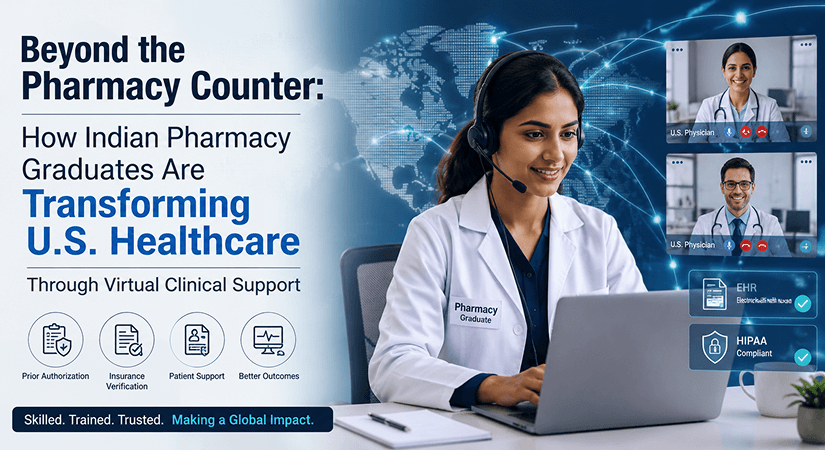
At 9:00 a.m., a physician in New Jersey begins seeing patients with a fully booked clinic schedule. While consultations are underway, a parallel team is working quietly behind the scenes. Insurance eligibility has already been verified for the day's appointments. Prior authorization requests for specialty medications are being prepared. Prescription refill requests have been reviewed and routed appropriately. Patient referrals have been coordinated, medical records organized, and electronic health records updated.
Although these essential tasks support patient care in the United States, many are completed by clinically trained professionals working thousands of miles away.
Among these professionals are Indian pharmacy graduates.
Their contribution reflects one of the most significant yet underappreciated developments in modern healthcare—the emergence of a globally connected clinical workforce, where technology enables healthcare professionals to collaborate across borders while maintaining high standards of quality, compliance, and patient care.
The healthcare landscape has changed dramatically over the past decade. Aging populations, increasing administrative complexity, physician shortages, rising healthcare costs, and rapid digital transformation have prompted healthcare organizations to rethink how care is delivered. As telemedicine, cloud-based electronic health records, and virtual collaboration become standard practice, healthcare teams are no longer confined to a single clinic or hospital.
Today's healthcare system depends not only on physicians and nurses but also on a diverse network of professionals who ensure that patients receive timely, coordinated, and efficient care. Virtual Medical Assistants, Prior Authorization Specialists, Medical Scribes, Insurance Verification Specialists, Referral Coordinators, and Revenue Cycle Management professionals have become integral members of this extended healthcare ecosystem.
For Indian pharmacy graduates, this transformation has opened an exciting new chapter.
Traditionally, pharmacy careers have been associated with community pharmacies, hospital practice, pharmaceutical manufacturing, research, academia, regulatory affairs, and the pharmaceutical industry. While these remain important career pathways, digital healthcare has expanded the profession's horizons, creating opportunities where scientific knowledge and clinical reasoning can be applied in innovative ways beyond the conventional pharmacy counter.
A Profession Built for a Changing Healthcare Landscape
Pharmacy education has always been multidisciplinary. Students are trained not only to understand medicines but also to appreciate the complex relationship between diseases, treatment decisions, patient safety, and evidence-based healthcare.
Throughout their academic journey, pharmacy graduates develop competencies in pharmacology, therapeutics, pathophysiology, pharmacokinetics, patient counseling, healthcare ethics, medical terminology, and clinical decision-making. More importantly, they learn to think critically, interpret clinical information, evaluate medication therapies, and communicate effectively with healthcare professionals.
These capabilities are directly applicable to many of today's virtual healthcare roles.
Consider a patient newly diagnosed with Type 2 diabetes who has been prescribed a GLP-1 receptor agonist. Before treatment can begin, the physician's office must often verify insurance coverage, determine whether prior authorization is required, gather supporting clinical documentation, and communicate with the patient's insurance provider. Delays in any of these steps can postpone access to therapy.
A pharmacy graduate working as a Prior Authorization Specialist understands not only the administrative workflow but also the clinical rationale behind the prescribed treatment. Familiarity with treatment guidelines, disease progression, medication mechanisms, and payer requirements enables them to prepare accurate documentation and communicate effectively with providers and insurers, helping patients receive appropriate care more efficiently.
Similarly, when a patient contacts a clinic regarding a prescription refill, the process extends beyond simply forwarding a message. It may involve reviewing the patient's last office visit, confirming medication dosage, checking whether laboratory monitoring is current, documenting the request accurately within the electronic health record, and ensuring the physician has the information needed to make a timely clinical decision.
These examples illustrate why pharmacy graduates often adapt quickly to virtual clinical support roles. Their education equips them to understand the context behind healthcare workflows rather than viewing administrative tasks in isolation.
A Personal Perspective on a National Question
My appreciation for the versatility of pharmacy education has been shaped by experiences across two distinct phases of my professional journey.
During my tenure as National President of the Indian Pharmaceutical Association (IPA) Students' Forum, I had the privilege of interacting with pharmacy students, educators, researchers, and healthcare professionals from every region of India. Through national conferences, leadership programs, institutional visits, and professional forums, I witnessed remarkable enthusiasm among students eager to contribute meaningfully to healthcare.
Despite differences in geography and academic institutions, one question surfaced repeatedly during these interactions:
"What meaningful career opportunities exist for pharmacy graduates in an increasingly global healthcare environment?"
The same question resurfaced during my involvement as Project Manager of the Indian Pharmaceutical Association Infectious Disease Pharmacist Fellowship, a national educational initiative supported by Pfizer. Working alongside experienced clinicians, academicians, and pharmacy professionals reinforced my belief that Indian pharmacy graduates possess strong scientific foundations and the capacity to succeed in diverse healthcare environments when provided with structured training and professional mentorship.
Today, I have the opportunity to observe that potential from another perspective.
As a Team Lead supporting healthcare operations for physician practices in the United States, I have seen pharmacy graduates successfully transition into roles requiring clinical understanding, operational discipline, technological proficiency, and effective communication. Many begin their careers in virtual healthcare support and progressively advance into quality assurance, training, operations management, and leadership positions.
Their journeys demonstrate that pharmacy education is not confined to a single career pathway. Instead, it provides a versatile foundation that enables graduates to adapt to the evolving needs of healthcare systems around the world.
The Rise of the Virtual Medical Assistant
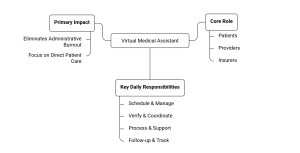
One of the fastest-growing roles within modern healthcare is that of the Virtual Medical Assistant (VMA).
Despite the title, VMAs do far more than perform administrative tasks. They serve as an operational bridge between patients, providers, pharmacies, insurance companies, and healthcare organizations.
On any given day, a Virtual Medical Assistant may:
- Schedule patient appointments.
- Verify insurance eligibility and benefits.
- Coordinate referrals between specialists.
- Process prescription refill requests.
- Prepare prior authorization documentation.
- Manage medical records.
- Document patient interactions in electronic health records.
- Follow up on laboratory results and imaging requests.
- Support providers with inbox management and clinical workflows.
Imagine an orthopedic clinic seeing more than fifty patients each day. Without dedicated operational support, physicians and nurses would spend valuable clinical time answering administrative calls, tracking referrals, verifying insurance, and documenting routine communications.
By managing these responsibilities efficiently, Virtual Medical Assistants enable clinicians to focus on what matters most—providing direct patient care.
Importantly, virtual healthcare professionals do not replace physicians, nurses, or pharmacists. Rather, they strengthen healthcare teams by ensuring that essential administrative and clinical support processes are completed accurately, efficiently, and in compliance with established standards.
For pharmacy graduates, these roles represent a natural extension of their education. Their clinical knowledge allows them to understand the purpose behind each workflow, while structured operational training prepares them to navigate U.S. healthcare systems, electronic health records, payer requirements, and regulatory expectations.
Why Pharmacy Graduates Excel in Prior Authorization

Among the many roles within virtual healthcare, Prior Authorization (PA) stands out as one of the most clinically demanding. While often perceived as an administrative process, prior authorization is fundamentally rooted in clinical decision-making, evidence-based medicine, and payer policy.
Before approving certain medications, procedures, or diagnostic tests, insurance companies frequently require providers to demonstrate that the requested treatment is medically necessary and align with established clinical guidelines. This process involves reviewing patient history, diagnosis codes, laboratory findings, previous therapies, physician documentation, and payer-specific requirements.
For professionals without a clinical background, these requirements can be challenging to interpret. For pharmacy graduates, however, many of the underlying concepts are already familiar.
Their education provides a strong understanding of disease states, medication mechanisms, treatment algorithms, adverse effects, and evidence-based therapeutic guidelines. This enables them to appreciate not only what information is required, but also why it matters in the context of patient care.
Consider a patient with moderate-to-severe psoriasis whose dermatologist prescribes a biologic medication. Before treatment can begin, the insurer may require documentation confirming the diagnosis, disease severity, previous treatment failures, and adherence to clinical guidelines. A Prior Authorization Specialist must gather the necessary clinical information, organize supporting documentation, and communicate effectively with both the provider and the payer.
For pharmacy graduates, understanding therapeutic escalation, biologic medications, and clinical rationale makes this process significantly more intuitive.
It is important to recognize, however, that pharmacy education alone is not sufficient. Success in prior authorization also requires structured training in U.S. healthcare workflows, insurance policies, payer-specific criteria, electronic health record systems, regulatory compliance, and effective documentation practices. When clinical knowledge is combined with operational expertise, pharmacy graduates become highly effective members of healthcare teams, helping reduce delays in treatment while improving provider efficiency and patient access to care.
Insurance Verification: The First Step Toward Patient Access
Every patient encounter begins long before the consultation itself. One of the earliest and most important steps is confirming that insurance coverage is active and understanding the patient's financial responsibilities.
Insurance Verification Specialists review eligibility, benefits, copayments, deductibles, coinsurance, prior authorization requirements, referral needs, and network participation before appointments take place. Their work helps prevent unexpected costs for patients while allowing providers to plan appropriate care.
Imagine a patient scheduled for an MRI after a sports injury. If insurance eligibility is not verified in advance, the patient may arrive for the appointment only to discover that prior authorization is required or that the imaging center is outside the insurance network. Such situations often lead to frustration, appointment cancellations, and delays in diagnosis.
By verifying insurance coverage proactively, healthcare support professionals help minimize these disruptions, allowing providers to focus on delivering care while improving the overall patient experience.
For pharmacy graduates, understanding medical terminology, insurance documentation, and healthcare workflows enables them to communicate effectively with provider offices, payers, and patients, contributing to a smoother care journey.
Technology Is Redefining the Pharmacy Profession
The practice of healthcare has become increasingly digital. Electronic Health Records (EHRs), telemedicine platforms, electronic prescribing systems, cloud-based documentation, artificial intelligence, and automated workflow tools have transformed the way healthcare organizations operate.
Today's pharmacy graduates are expected to combine clinical knowledge with digital competency.
Professionals supporting virtual healthcare routinely work with EHR platforms, payer portals, electronic prescribing systems, scheduling software, documentation tools, and secure communication platforms. Increasingly, artificial intelligence is also being used to assist with documentation, summarize patient interactions, prioritize work queues, and support administrative efficiency.
Importantly, AI is not replacing healthcare professionals. Rather, it is becoming a tool that enhances productivity while allowing clinicians and healthcare support teams to devote more attention to complex decision-making and patient-centered care.
For pharmacy graduates, this evolution presents an opportunity. Those who combine scientific knowledge with technological proficiency, communication skills, and continuous learning will be well positioned to contribute to the future of healthcare.
Staffingly, Inc.: Developing Pharmacy Graduates into Global Healthcare Professionals
My perspective on the evolving role of pharmacy graduates has also been shaped by my experience at Staffingly, Inc., headquartered in Piscataway, New Jersey. As a healthcare outsourcing organization supporting physician practices and healthcare providers across the United States, Staffingly delivers services including Virtual Medical Assistance, Prior Authorization, Insurance Verification, Medical Scribing, Revenue Cycle Management, and other clinical support functions that help improve operational efficiency and patient care.
What distinguishes the organization's approach is its emphasis on developing people, not simply filling positions. Pharmacy graduates joining the workforce undergo structured training that combines their clinical knowledge with practical exposure to U.S. healthcare systems, payer policies, electronic health records, regulatory requirements, and provider workflows. This allows them to transition confidently into roles that require both scientific understanding and operational excellence.
Under the leadership of President Dan Nandan, Staffingly has fostered a culture centered on continuous learning, quality improvement, professional accountability, and leadership development. Rather than viewing healthcare outsourcing solely as an operational service, the organization recognizes the value of investing in clinically trained professionals and equipping them with the skills needed to contribute meaningfully to healthcare delivery.
As a Team Lead, I have had the privilege of mentoring and working alongside pharmacy graduates as they begin their professional journeys. I have witnessed individuals who entered with strong academic foundations develop into confident healthcare professionals supporting physicians, specialists, pharmacies, insurance providers, and patients across multiple medical specialties. Many have progressed beyond their initial responsibilities into roles involving quality assurance, training, workforce management, client operations, and leadership.
One experience that continues to inspire me is watching newly hired pharmacy graduates transform within a few months. Initially, they may be unfamiliar with concepts such as U.S. insurance workflows, prior authorization criteria, or electronic health record systems. Through structured mentorship, continuous learning, and hands-on experience, they develop the confidence to navigate complex clinical workflows, collaborate effectively with healthcare providers, and contribute to improving patient access to care. Their growth is a testament not only to the strength of their pharmacy education but also to the importance of an environment that encourages learning and professional development.
My experience at Staffingly, Inc has reinforced an important lesson: when pharmacy education is combined with the right mentorship, operational training, and a culture of continuous improvement, graduates can make meaningful contributions to modern healthcare while building rewarding international careers. In many ways, the organization reflects how the pharmacy profession itself is evolving; where clinical expertise extends beyond traditional practice settings to support healthcare systems on a global scale.
A Message to the Next Generation of Pharmacy Graduates
To every B.Pharm and Pharm.D student standing at the crossroads of their career, one message is worth remembering: your degree is far more versatile than you may realize.
For many years, pharmacy careers were viewed through a relatively narrow lens, often centered on community pharmacy, hospital practice, pharmaceutical manufacturing, or academia. While these remain highly respected and rewarding professions, the healthcare landscape has evolved dramatically. Today, technology has expanded the boundaries of pharmacy practice, creating opportunities that were scarcely imaginable a decade ago.
Healthcare is no longer delivered solely within the walls of hospitals and clinics. Digital platforms, telehealth, artificial intelligence, electronic health records, and global collaboration have transformed the way healthcare organizations operate. These changes have created demand for professionals who not only understand medicines but can also navigate clinical workflows, communicate effectively, analyze healthcare data, and support patient care through technology-enabled services.
This is where pharmacy graduates have a unique advantage.
Your education has equipped you with scientific knowledge, clinical reasoning, critical thinking, and a patient-centered mindset. These are not skills confined to dispensing medications; they are competencies that translate across a wide range of healthcare environments.
However, success in this evolving landscape requires more than academic excellence.
Communication skills, adaptability, digital literacy, professionalism, emotional intelligence, and a commitment to lifelong learning are becoming equally important. Healthcare continues to change rapidly, and professionals who embrace continuous learning will be best positioned to grow alongside it.
Whether your ambition is to become a clinical pharmacist, researcher, entrepreneur, healthcare leader, or virtual healthcare professional, never stop investing in your own development. Every new skill you acquire broadens the impact you can make—not only for your career but also for the patients and healthcare teams you serve.
The Future of Pharmacy Is Global
Healthcare has entered an era where expertise is no longer limited by geography.
A physician in the United States may collaborate with a healthcare professional in India. A patient may receive faster access to treatment because a Prior Authorization Specialist reviewed clinical documentation from another continent. A Virtual Medical Assistant may coordinate care for patients they may never meet in person yet still play an essential role in improving their healthcare experience.
This is not the future of healthcare. It is the reality of healthcare today.
Emerging technologies, particularly artificial intelligence, will continue to reshape healthcare operations. Administrative tasks will become more automated, documentation will become more efficient, and decision-support systems will become increasingly sophisticated. Yet technology alone cannot replace clinical judgment, ethical decision-making, empathy, or effective communication.
The future belongs to healthcare professionals who can combine scientific expertise with technological adaptability.
Pharmacy graduates are exceptionally well positioned to meet this challenge. Their ability to interpret clinical information, understand therapeutic principles, communicate across multidisciplinary teams, and adapt rapidly evolving technologies makes them valuable contributors to modern healthcare systems.
Conclusion
The story of pharmacy is no longer defined solely by where pharmacists practice. It is increasingly defined by how their knowledge is applied to improve healthcare delivery.
Across the world, pharmacy graduates are demonstrating that their education extends well beyond medication dispensing. They are helping physicians navigate complex insurance processes, supporting patients through timely access to treatment, improving clinical documentation, strengthening healthcare operations, and enabling providers to dedicate more time to direct patient care.
My own journey; from interacting with pharmacy students across India as National President of the Indian Pharmaceutical Association (IPA) Students' Forum to leading teams that support healthcare providers in the United States: has reinforced a simple yet powerful belief: pharmacy education has the potential to create global healthcare leaders when knowledge is combined with opportunity, mentorship, and continuous learning.
Organizations that recognize this potential are not simply creating new jobs; they are helping redefine how pharmacy professionals contribute to healthcare in an increasingly interconnected world.
As healthcare continues to evolve, the role of pharmacy graduates will evolve with it. Whether working in hospitals, research laboratories, community pharmacies, healthcare technology, clinical operations, or virtual healthcare support, one principle remains constant: our profession is fundamentally improving patient outcomes.
The pharmacy profession has always adapted to meet society's healthcare needs. Today, those needs extend beyond geographical boundaries, and so do the opportunities.
For the next generation of pharmacy graduates, the message is clear: the future of pharmacy is not confined to a counter, a clinic, or even a country. It is global, collaborative, technology-enabled, and filled with possibilities for those prepared to embrace change.
Beyond every prescription lies a patient. Beyond every patient lies a healthcare system that depends on collaboration, innovation, and compassion. As pharmacy graduates continue to extend their expertise beyond traditional practice settings, they are not merely adapting to the future of healthcare; they are helping shape it.
Reporting on the science, business and regulation shaping the pharmaceutical industry.
More from the Knowledge Hub
All articles →
Pharmaceutical Regulatory Affairs: Challenges, Innovations, and Global Harmonization

Cold Chain Logistics in Pharma: Building Resilient Supply Chains

Discussion