by Simantini Singh Deo
6 minutes
Beyond One-Size-Fits-All: How Flow Chemistry And Targeted Delivery Are Shaping Personalized Medicine
Flow chemistry and smart delivery systems are redefining drug design, precision dosing, and personalized medicine.

The concept of “dose” has always been central to medicine. From ancient herbal remedies to modern precision therapies, every breakthrough in healthcare has been shaped by the question: How much of a drug should a patient receive and how should it be delivered? Today, this question is being reimagined through two powerful scientific advancements: flow chemistry and next-generation drug delivery systems.
Together, they are reshaping how medicines are developed, optimized, and administered. These innovations are not only improving safety and efficacy but also creating pathways for fully personalized treatment. As the pharmaceutical industry steps into a new era of technology-driven design, the meaning of a dose, once uniform and static, is evolving into something dynamic, individualized, and deeply scientific.

A New Understanding Of Dose In Modern Medicine
Traditionally, dosing has been determined using population-based studies that aim to find a “one-size-fits-most” amount. However, modern healthcare demands far more precision. Variations in genetics, metabolism, environment, and disease progression make standardized dosing imperfect. At the same time, the complexity of newer therapeutic molecules from highly potent APIs to biologics means that traditional methods of synthesis and delivery are no longer enough.
This shift has created a need for technologies that allow scientists to design medicines more thoughtfully, accurately, and efficiently. Flow chemistry is revolutionizing how drugs are manufactured at the molecular level, while advanced delivery systems are enabling controlled, targeted, and personalized dosing. When combined, these technologies are redefining the dose itself, not as a fixed number, but as an adaptable component of therapy that can be tailored to each patient and optimized in real time.
Flow Chemistry: A Breakthrough In Drug Synthesis
Flow chemistry is one of the most important advancements in pharmaceutical manufacturing in recent decades. Unlike traditional batch chemistry, where reactions occur in large vessels, flow chemistry moves reactants continuously through small channels or tubes, allowing highly controlled and efficient reactions. This approach enables precise manipulation of temperature, pressure, reaction time, and mixing—conditions that greatly influence the formation of complex molecules.
The advantages of flow chemistry are transformative. Because reactions happen in a steady, continuous stream, scalability becomes much easier. A successful reaction at a small scale can be multiplied simply by running it longer or faster, rather than redesigning an entire process. This reduces development time and costs, making it easier for researchers to take promising molecules from lab to market.
Flow chemistry also enhances safety. Many pharmaceutical reactions involve hazardous intermediates or extreme conditions. In a flow system, reactive species are generated in small quantities and consumed immediately, reducing risk significantly. This opens the door for chemists to explore more complex synthetic pathways that were previously too dangerous to attempt in traditional setups.
Finally, flow chemistry supports greener, more sustainable pharmaceutical development. Its continuous nature allows for more efficient use of reagents, less waste generation, and energy savings all important factors in today’s environmentally conscious industry.
Precision Through Reaction Control And Data Integration
One of the most compelling aspects of flow chemistry is its ability to enable precise control of reaction parameters. This level of control is crucial for producing high-purity compounds, a requirement for potent drugs with narrow therapeutic windows. Flow chemistry systems can adjust conditions instantly, enabling real-time optimization guided by sensors, data analytics, and automation tools.
Increasingly, flow chemistry platforms are integrating with artificial intelligence and machine learning systems. These digital tools analyze reaction data, predict outcomes, and make recommendations for system adjustments. The result is a new type of intelligent manufacturing environment where processes are not only stable but self-improving. This synergy allows scientists to refine molecular structures rapidly, identify optimal pathways, and produce more consistent drug substances than ever before.
With this level of precision, flow chemistry is helping redefine how active ingredients are designed and how dosing is ultimately determined. When the molecular composition is consistent and optimized, dosage calculations can become more accurate, predictable, and personalized.
Enhancing Accessibility And Innovating Molecule Design
Flow chemistry also makes it possible to synthesize molecules that were once considered too complex or unstable for large-scale production. Microreactor systems allow for reactions that need extreme temperatures or pressures to occur safely. They also support multi-step syntheses where unstable intermediates form and react instantly before they degrade something that batch reactors simply cannot achieve effectively.
The ability to create new molecular architectures opens opportunities for novel drug classes and therapeutic approaches. Researchers gain access to structures that are more potent, more selective, and more compatible with targeted delivery. This advances the evolution of the dose, allowing medicines to be designed with precision at both the molecular and clinical levels.
Drug Delivery Systems: Beyond The Traditional Pill
While flow chemistry improves how drugs are made, advanced drug delivery systems shape how drugs reach the body. Traditionally, drugs have been administered through simple methods such as tablets, capsules, syrups, injections designed to release the active ingredient into systemic circulation.
However, this approach often delivers too much or too little medicine, causes side effects, or fails to reach the intended tissue. Modern drug delivery systems aim to change that. They are designed to deliver drugs more precisely, more efficiently, and more safely. By controlling how, when, and where a drug is released in the body, these systems play a crucial role in redefining the dose.
Controlled And Sustained Release: Smoother Therapies
Controlled-release technologies ensure that a drug is delivered steadily over time rather than all at once. This avoids peaks and troughs in drug concentration that can reduce effectiveness or increase side effects. Patients benefit from stable therapeutic levels, longer dosing intervals, and reduced medication burden.
Sustained-release implants, microspheres, and polymer-based depots are becoming widely used for chronic conditions like cancer, diabetes, and psychiatric disorders. They release medication slowly over weeks or months, offering consistent treatment without daily intervention. These systems redefine the dose as a smooth, continuous experience rather than an abrupt, repeated introduction of medication.
Targeted Delivery: A New Level Of Precision
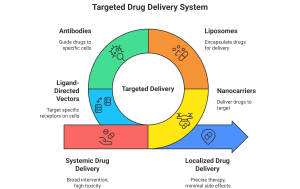
Targeted drug delivery is one of the most significant advancements in modern therapeutics. These systems deliver medicine directly to the site of disease like tumors, inflamed tissues, infected cells allowing for smaller doses with greater impact. The benefits are substantial:
- Reduced systemic toxicity
- Improved therapeutic outcomes
- Minimized side effects
- Enhanced patient safety
Nanocarriers, liposomes, antibodies–drug conjugates, and ligand-directed vectors are leading this revolution. By guiding drugs directly to where they are needed most, they shift the definition of dose from a broad systemic intervention to a precise and localized therapy.
Smart Delivery Systems And Patient-Centric Innovation
Smart drug delivery systems are emerging as the next frontier. These technologies use sensors, stimuli-responsive materials, and digital integration to release medication based on real-time biological feedback. For example, glucose-responsive insulin systems deliver a dose only when blood sugar levels rise. pH-sensitive capsules release drugs in specific regions of the gastrointestinal tract.
Wearable injectors can tailor dosage based on individual physiological patterns. These innovations represent the future of personalized dosing. Instead of fixed schedules, medicines adjust themselves to the patient, a powerful shift in healthcare that merges technology with biology.
Personalized Medicine & Adaptive Dosing
Flow chemistry and advanced drug delivery are converging with the broader movement toward personalized medicine. As genetic testing, digital monitoring, and biomarker-based diagnostics become more common, dosing will move from being population-driven to individual-driven.
Flow chemistry enables on-demand synthesis of customized drug molecules, while delivery systems ensure that these molecules are released in harmony with the patient’s physiology. Together, they make adaptive dosing possible, where treatment evolves continuously based on real-time data. This approach reduces risk, increases therapeutic impact, and builds the foundation for medicine that is uniquely designed for each person.
Shaping The Future Of Drug Design And Development
The evolution of dose is reshaping every stage of drug development. Flow chemistry streamlines synthesis and gives researchers unprecedented control over molecular design. Advanced delivery systems ensure that drugs are used more efficiently, safely, and precisely within the body. Together, these technologies are eliminating the traditional boundaries of dosing, making it more accurate, more individualized, and more aligned with real-world biological complexity.
As the pharmaceutical landscape continues to advance, the integration of smart manufacturing, intelligent delivery, and data-powered personalization will define the therapies of the future. Each innovation moves us closer to a world where medicines are not only effective but custom-designed for the people who need them.
FAQs
1. What Is Flow Chemistry, And Why Is It Important For Medicine?
Flow chemistry is a method of continuously producing drugs in small, controlled channels, allowing safer, faster, and more precise synthesis of complex molecules for personalized treatments.
2. How Do Advanced Drug Delivery Systems Improve Patient Care?
These systems control how, when, and where a drug is released, reducing side effects, improving effectiveness, and enabling targeted or sustained delivery tailored to individual needs.
3. How Do Flow Chemistry And Targeted Delivery Enable Personalized Medicine?
Flow chemistry creates precise drug molecules, while smart delivery systems adapt dosing in real time to a patient’s biology, making treatments safer, more effective, and individualized.