by Mrudula Kulkarni
null minutes
How to Build a Contamination Control Strategy (CCS) That Works
Explore how CCS strengthens sterility, reduces deviations, and drives proactive contamination control in pharma.

It usually begins with a deviation that no one sees coming.
During a routine media fill, a sterile injectable manufacturer discovers a single contaminated unit — despite adhering to flawless SOPs, utilising validated systems, and employing qualified operators. The ensuing investigation consumes weeks, the audit is extended, and the batch is lost.
This is the most common scenario playing out in plants worldwide. The procedures were there. The documentation was there. What was missing was a strategy — a unified, risk-based approach to contamination control that moves beyond compliance and into prevention.
That’s the core of today’s regulatory and operational expectation. Under EMA Annex 1 and FDA’s risk-based guidance, Contamination Control Strategy (CCS) has evolved from a checklist document into a living, dynamic framework that aligns facility design, process behaviour, and data integrity into one integrated system.
A good CCS doesn’t just control contamination — it builds confidence in sterility.

1. From SOPs to Strategy: The New Contamination Control Mindset
For decades, we managed contamination reactively — CAPAs after deviations, procedural tightening after audits, and retraining after failures. While this approach satisfies regulators on paper, it does not prevent recurrence.
A modern CCS shifts pharma teams from rigid, siloed compliance to an integrated, risk-based strategy. Instead of reactive CAPA and static EM schedules, it promotes cross-functional ownership, data-driven monitoring, and lifecycle contamination control—transforming validation into a continuous, proactive effort to prevent issues before they occur.
As the Quality Assurance leader says, “ true sterility assurance isn’t about what you find — it’s about what you prevent.”
2. Case for example: How “Biozen Laboratories” Rebuilt Control from the Ground Up
Biozen Laboratories, a CDMO specialising in sterile injectables, their operations were technically compliant yet chronically reactive. Contamination excursions occurred quarterly, each triggering costly investigations and tension between QA and production.
The turning point came when their CEO reframed the question from “How do we fix contamination?” to “How do we prevent it — structurally?”
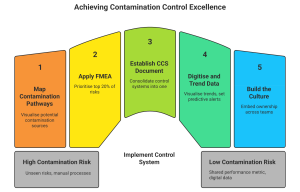
Here’s how they built a resilient CCS in five steps:
Step 1: Map the Contamination Pathways
Every potential source — personnel, material, equipment, utilities, and environment — was visualised. Airflow mapping and smoke studies revealed unseen risks at material transfer points and Grade B/C interfaces.
Step 2: Apply FMEA for Risk Prioritisation
Each contamination vector was ranked for severity, likelihood, and detectability. The team focused on the top 20% of risks that caused 80% of deviations.
Step 3: Establish the CCS Master Document
They consolidated all control systems — HVAC, water, EM, gowning, cleaning, and waste management — into a single CCS document. This became the “constitution” of their contamination control governance.
Step 4: Digitise and Trend Data
Manual logbooks gave way to dashboards visualising CFU trends, airflow stability, and pressure differentials. Predictive alerts were set for deviations before they occurred.
Step 5: Build the Culture
They launched “Contamination Awareness Weeks,” embedding ownership across teams. Operators began to see contamination not as a QA problem but a shared performance metric.
Results after 18 months:
- 72% reduction in EM excursions
- Zero major contamination deviations
- Faster regulatory approvals and audit readiness
- Enhanced team morale and accountability
3. The Executive Framework: Design → Conduct → Control
An effective Contamination Control Strategy (CCS) is built on three strategic pillars: Design, Conduct, and Control. The Design pillar focuses on facility layout, HVAC systems, material flow, isolators, and RABS.
Leadership must insist on contamination-risk mapping during the design phase and ensure airflow visualisations and differential pressure integrity are approved early in CapEx planning. The Conduct pillar encompasses gowning, operator behaviour, cleaning practices, and all human interventions. Here, leaders play a crucial role by embedding aseptic discipline into performance KPIs and making training a continuous, cyclic process rather than a once-a-year exercise.
The Control pillar covers monitoring, trending, risk reviews, and CAPA effectiveness. Strong leadership means chairing quarterly CCS review boards to evaluate data, identify trends, and drive coordinated actions across departments.
The most successful companies treat CCS the way they treat finance — reviewed routinely, owned collectively, and continually optimised.
4. The Data Imperative: Turning Monitoring into Foresight
Pharma 4.0 has given us unprecedented visibility into our cleanrooms. Yet, data alone doesn’t protect sterility — interpretation does.
When integrated correctly, EM, HVAC, and utility data become predictive rather than forensic. For instance:
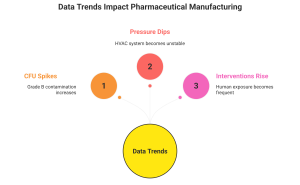
Data integrity here goes beyond ALCOA principles — it’s about decision integrity. When you can see the trend, you can change the outcome.
5. Leadership & Culture: Where CCS Truly Lives
Technology and SOPs can build systems; only leadership builds culture.
Executives must position CCS as a strategic business enabler, not a regulatory burden. It protects yield, ensures audit readiness, and enhances brand trust.
6. Global Lens: What Regulators Expect
EMA’s revised Annex 1 (2022) captures the essence perfectly:
“A Contamination Control Strategy (CCS) should document the holistic approach to control the risk of contamination across the facility.”
FDA’s guidance aligns closely — both expect cross-functional ownership, continual verification, and documented rationale for every control measure.
Inspectors now look for:
- Comprehensive mapping of contamination risks
- Documented CCS with lifecycle thinking
- Continuous verification of effectiveness
- Evidence of management review
- Demonstrated cultural ownership
In short, they’re no longer asking if you have a CCS document, but how it lives in your daily operations.
7. The Payoff: From Reactive to Resilient
When a Contamination Control Strategy (CCS) is executed correctly, it creates measurable impact across the business. In sterility assurance, organisations see a tangible reduction in batch failures and deviations.
Audit readiness improves as well, leading to faster regulatory approvals and fewer Form 483 observations. From an operational efficiency standpoint, a strong CCS lowers downtime, rework, and material waste. This naturally strengthens financial performance, shifting costs from reactive CAPA activities to proactive prevention.
Finally, the overall brand reputation benefits, with greater trust from both regulators and the market.
The real question for leadership is no longer, “Do we have a CCS?” but rather, “Does our CCS work — and does it evolve?”
Conclusion: CCS as a Strategic Advantage
In my view, contamination control is the true litmus test of operational maturity. A well-structured CCS does more than ensure sterility — it ensures continuity.
The most advanced facilities I visit share one trait: they view CCS as a living framework, continuously learning, adjusting, and predicting.
So as you step into your next board meeting, consider this: your cleanroom may be validated, your SOPs immaculate, but is your strategy alive?
Because in modern sterile manufacturing, contamination control isn’t a document — it’s a discipline.
And in that discipline lies your competitive advantage.
FAQ's
1. What exactly is a Contamination Control Strategy (CCS), and why is it mandatory in modern pharma manufacturing?
A CCS is a holistic, facility-wide plan that identifies contamination risks, evaluates their impact, and outlines controls across the entire product lifecycle.
With the rise of Annex 1, regulatory bodies now expect manufacturers to demonstrate proactive risk control, not just reactive CAPAs. A CCS proves that sterility is not left to chance—it’s engineered, monitored, and continuously improved.
2. How do I identify critical contamination risks in my facility?
Risk identification starts with:
- Process understanding
- Historical deviations
- Material/personnel flows
- Facility/equipment design
- Environmental monitoring data
Tools like FMEA, Hazard Analysis, Process Mapping, and Barrier Risk Assessments help pinpoint where microorganisms, particulates, and endotoxins can enter or propagate.
3. What elements must be included in a robust CCS?
A strong CCS integrates controls across:
- Facility & HVAC design
- Water systems & utility quality
- Cleaning & disinfection strategy
- Aseptic gowning & personnel behavior
- Material transfer & workflow segregation
- EM program design and trending
- Automation, isolators, and closed processing
- Root cause analysis & ongoing performance review
It must show how each element works together to prevent contamination end-to-end.
4. How do we measure if our CCS is effective?
CCS performance is evaluated using:
- EM trend
- Sterility test outcomes
- Contamination event reduction
- CAPA recurrence rates
- Gowning qualification performance
- Equipment cleaning verification
- Deviation root-cause closures
- Audit observations
The goal is a system that shows control, consistency, and continuous improvement.
5. What are the most common mistakes companies make when implementing a CCS?
Typical pitfalls include:
- Treating CCS as a documentation exercise instead of a strategic system
- Poor cross-functional collaboration
- Inadequate understanding of process risks
- Over-reliance on manual aseptic operations
- Weak trending of EM and deviation data
- Lack of periodic review and updating
A successful CCS must be dynamic, updated with process changes, new technologies, deviations, and regulatory feedback.