The Editing Revolution in Gene Therapy
Gene editing revolution | CRISPR/Cas9, base editing, prime editing, clinical applications & manufacturing challenges explained.

Introduction
For decades, medicine has largely focused on managing disease rather than correcting its root cause. Gene therapy began to change that equation by introducing healthy copies of genes into cells to compensate for defective ones. But a newer generation of technologies is pushing the field even further. Instead of simply adding genes, scientists can now rewrite the genome itself with remarkable precision.
This shift marks one of the most important transitions in modern biotechnology. Gene therapy is evolving from gene addition to genome engineering.
At the center of this transformation is gene editing, a rapidly advancing field that allows researchers to directly modify DNA at precise locations. Patients with inherited blood disorders are already receiving therapies designed around these technologies, while researchers are exploring applications across cancer, infectious disease, and regenerative medicine.
Understanding Gene Therapy vs Gene Editing
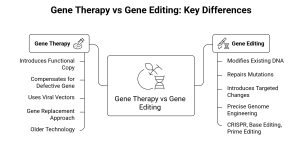
Although the terms are often used interchangeably, gene therapy and gene editing are fundamentally different approaches.
Traditional gene therapy typically introduces a functional copy of a gene into a patient’s cells to compensate for a defective or missing one. Many early therapies relied on viral vectors, particularly adeno-associated viruses (AAVs), to deliver therapeutic genes into cells.
Gene editing takes a more direct approach. Instead of adding a new gene, it modifies the existing DNA sequence itself. Scientists can repair mutations, remove problematic sequences, or introduce highly targeted genetic changes.
The rise of CRISPR-Cas systems sped up this shift significantly. Today, tools such as CRISPR, base editing, and prime editing are broadening the boundaries of what scientists can do. Rather than focusing only on gene replacement, the field is increasingly centered on precise genome engineering.
Why Gene Editing Became a Scientific Breakthrough
The discovery of CRISPR originated from bacterial immune systems. Scientists observed that bacteria could store fragments of viral DNA and use them to recognize future infections. That natural defense mechanism eventually became one of the most important molecular tools in modern biology.
What made CRISPR revolutionary was its simplicity and programmability. Earlier gene-editing technologies existed, but they were technically difficult and expensive to customize. CRISPR changed that dynamic by allowing researchers to design guide RNAs that direct the system toward nearly any desired DNA sequence.
The impact on research was immediate. Genome engineering has become faster, more scalable, and significantly more accessible. Laboratories around the world that previously lacked advanced editing infrastructure could now participate in genetic research and therapeutic development.
In many ways, CRISPR democratized biotechnology.
Where Gene Editing Is Transforming Therapy
Rare Genetic Diseases
Rare genetic disorders have become some of the earliest success stories for gene editing.
Diseases such as sickle cell disease and beta thalassemia are particularly well suited for editing approaches because they are caused by clearly defined mutations in single genes. In these cases, the therapeutic objective is relatively direct: correct or bypass the faulty genetic instruction.
Recent clinical progress has demonstrated how transformative these therapies can become. Gene-edited stem-cell therapies have shown the potential to free patients from lifelong painful crises and repeated hospitalizations. Researchers are also exploring editing approaches for inherited retinal diseases and Duchenne muscular dystrophy.
For many patients, gene editing represents more than symptom management. It introduces the possibility of durable or even curative treatment.
Cancer Therapy
Gene editing is also reshaping cancer immunotherapy.
CAR-T cell therapies already rely on engineering immune cells to recognize and attack tumors. Editing technologies are now making those engineered cells more sophisticated by improving tumor targeting, enhancing persistence, and modifying immune checkpoints.
Edited T-cells are increasingly being designed as programmable therapeutic platforms rather than single-purpose treatments.
In Vivo Editing
Most early editing therapies relied on ex vivo approaches, where cells are removed from the patient, edited outside the body, and then reinfused.
In vivo editing changes that paradigm by delivering the editing machinery directly into the patient’s body. Liver-targeted therapies have emerged as leading examples because the liver is relatively accessible through systemic delivery approaches such as lipid nanoparticles.
This strategy could simplify treatment workflows and expand access to diseases where cell extraction is impractical.
Infectious Diseases
Researchers are also exploring whether gene editing could eventually transform infectious disease treatment.
Scientists are investigating ways to target latent viral reservoirs in diseases such as HIV, engineer viral resistance, and modify immune pathways involved in chronic viral disease. Although still early, these efforts highlight how broadly technology could eventually extend beyond inherited disorders.
The Rise of Next-Generation Editing Technologies
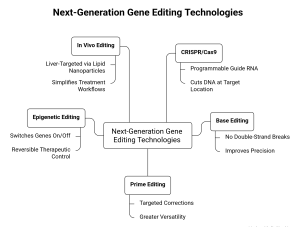
As the field matured, scientists recognized that cutting DNA alone was not always ideal. This realization led to more refined editing systems.
Base Editing
Base editors allow scientists to change individual DNA letters without introducing double-strand breaks in the genome.
This matters because many inherited diseases arise from single-letter mutations. By avoiding full DNA breaks, base editing may reduce unintended genomic damage while improving precision.
Prime Editing
Prime editing expands editing flexibility even further.
Often described as a “search-and-replace” system for DNA, prime editors can introduce targeted corrections, insertions, and deletions with greater versatility than traditional CRISPR approaches.
Epigenetic Editing
Not all diseases require permanent DNA sequence changes.
Epigenetic editing focuses on altering gene activity rather than rewriting the genetic code itself. Scientists can potentially switch genes on or off without permanently modifying the underlying DNA sequence, creating opportunities for reversible therapeutic control.
Gene editing is not the only frontier in programmable biology.
Live biotherapeutic products are reshaping medicine by restoring biological balance at the microbiome level.
→ Read: Live Biotherapeutic Products | Clinical Safety & Market Potential
The Delivery Challenge
Despite extraordinary progress in editing technology, one major challenge remains: delivery.
Editing DNA is often easier than delivering the editor safely and efficiently to the correct cells.
Researchers continue to explore multiple delivery approaches, including viral vectors, lipid nanoparticles, and emerging non-viral systems. Each platform involves tradeoffs related to payload size, tissue targeting, durability, and immune response.
Certain organs remain particularly difficult to target effectively, including the brain, lungs, and muscle tissue. Increasingly, delivery and editing are no longer viewed as separate problems. The success of future therapies will depend on how well these systems are engineered together.
Scientific and Ethical Limitations
Like any transformative technology, gene editing also raises important scientific and ethical questions.
One of the primary safety concerns involves off-target editing, where unintended genomic regions may also be modified. Even rare unintended edits could carry long-term risks, particularly in permanent therapies.
Another challenge is mosaicism, where not all cells edit uniformly. In some tissues, only a subset of cells may receive the intended modification, which can affect therapeutic effectiveness.
Perhaps the most debated area involves germline editing, changes made to reproductive cells or embryos that could be inherited by future generations. Questions around consent, societal equity, and “designer baby” concerns continue to shape global policy discussions. For now, most countries maintain strict limitations on clinical germline editing.
Regulatory and Manufacturing Challenges
Gene editing therapies also challenge traditional pharmaceutical infrastructure.
Many therapies involve highly personalized manufacturing workflows, specialized quality testing, and extensive long-term patient monitoring. Unlike conventional drugs produced in large uniform batches, some editing therapies must be customized for individual patients.
This creates significant manufacturing complexity and increases the need for advanced GMP systems, genomic quality assurance, and specialized production ecosystems.
Regulators are also adapting alongside science. Long-term follow-up requirements and evolving regulatory pathways will continue shaping how these therapies reach patients.
Gene editing therapies are rewriting what biological medicines can do, but getting them approved is a journey of its own.
A complete breakdown of the regulatory pathway from IND application to market authorization for biopharmaceuticals.
→ Read: Regulatory Pathways For Biopharmaceuticals
India and the Global Gene Editing Landscape
India is increasingly positioned to play a meaningful role in the future of gene editing and advanced therapeutics.
The country already possesses strong capabilities in biotechnology manufacturing, vaccine production, and increasingly, genomics research. India’s growing scientific talent pool and expanding biotech ecosystem could support broader participation in genome engineering innovation.
At the same time, meaningful growth will require continued investment in translational research infrastructure, regulatory modernization, GMP manufacturing capacity, and indigenous platform development.
Affordability may also become an important differentiator as gene editing therapies evolve globally. Scalable manufacturing and cost-efficient development models will be critical for expanding patient access.
The Future: Programmable Biology
Gene editing is gradually pushing medicine toward something far more programmable.
Researchers are now exploring engineered cells that can sense their environment, respond dynamically, and perform therapeutic functions with increasing sophistication. Synthetic biology, AI-guided design, regenerative medicine, and genomic engineering are beginning to converge into a broader technological ecosystem.
Future therapies may involve programmable immune cells, adaptive gene circuits, or personalized genomic interventions designed around an individual patient’s biology.
In many ways, biology itself is becoming increasingly engineerable.
Conclusion
The editing revolution in gene therapy represents more than a technological milestone. It reflects a broader shift in how medicine approaches disease itself.
The field has evolved from adding genes toward rewriting biology with increasing precision. Technologies such as CRISPR, base editing, and prime editing are expanding therapeutic possibilities across rare disease, cancer, infectious disease, and regenerative medicine.
At the same time, major challenges remain. Delivery limitations, manufacturing complexity, regulatory adaptation, and ethical considerations will continue shaping how quickly these therapies mature.
Still, the pace of progress is difficult to ignore.
Only a decade ago, editing DNA with precision seemed almost unimaginable. Today, genome engineering is becoming one of the defining technologies of modern medicine. The question is no longer whether gene editing will influence healthcare, but how broadly and responsibly the field can translate its extraordinary scientific potential into real-world patient impact.
Reporting on the science, business and regulation shaping the pharmaceutical industry.
More from the Knowledge Hub
All articles →
Pharmaceutical Regulatory Affairs: Challenges, Innovations, and Global Harmonization

Cold Chain Logistics in Pharma: Building Resilient Supply Chains
Discussion