Senolytics and Microbiome Modifiers Two Quiet Levers Reshaping the Biology of Ageing
How senolytics and microbiome modifiers are reshaping ageing biology by targeting inflammation, senescence, and system-level decline.


For decades, ageing was treated as an inevitability rather than a process. Something to be managed, not interrogated. Medicine focused on the downstream consequences of ageing diseases, degeneration, and decline while largely ignoring the upstream biology driving them.
That mindset is changing.
Not with a single breakthrough, but with a convergence of insights. Among the most compelling are two therapeutic strategies that, until recently, lived in separate scientific conversations: senolytics and microbiome modifiers.
Individually, each challenges long-held assumptions about how chronic disease develops. Together, they point toward a more integrated way of thinking about ageing not as a passive countdown, but as a dynamic, modifiable biological state.
This is not about immortality. It is about restoring balance to systems that have drifted, accumulated damage, and lost resilience over time.
Cellular Senescence: When Cells Stop Helping and Start Hurting
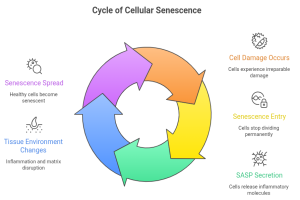
To understand senolytics, we need to understand what cellular senescence is.
Senescence is a protective mechanism. When cells experience irreparable damage, DNA instability, oxidative stress, or telomere shortening, they enter a state where they permanently stop dividing. This prevents damaged cells from turning cancerous.
In youth, senescence is tightly regulated. Senescent cells appear, do their job, and are efficiently cleared by the immune system.
However, with age, that clearance becomes imperfect. Senescent cells begin to accumulate. Although they no longer divide, they remain metabolically active. They secrete a complex mix of inflammatory cytokines, growth factors, and proteases collectively known as the senescence-associated secretory phenotype, or SASP.
This SASP is responsible for changing the tissue environments, promoting chronic inflammation, disrupting extracellular matrices, impairing stem cell function, and spreading senescence signals to neighbouring healthy cells.
At this point, senescent cells shift from a protective to a pathogenic state.
Senolytics: Selective Removal, Not Reversal
Senolytics are compounds designed to selectively eliminate senescent cells while sparing healthy ones. This selectivity is key. Senescent cells rely on altered survival pathways to resist apoptosis. Senolytics exploit these vulnerabilities by targeting anti-apoptotic mechanisms that senescent cells depend on more heavily than normal cells.
The goal is not to reverse ageing at the cellular level, but to remove cells that are actively degrading tissue environments. Preclinical studies have shown striking effects. In animal models, clearing the senescent cells improved physical function, enhanced tissue regeneration, reduced inflammation, and extended healthspan.
Importantly, these effects often occur without continuous dosing. Periodic clearance appears sufficient to reset tissue environments. This intermittent nature changes how we think about chronic therapies. Senolytics are less about daily suppression and more about strategic intervention.
The Microbiome: An Organ We Didn’t Know We Had
Parallel to senescence research, another field quietly redefining human biology is microbiome science. The gut microbiome is not a passive passenger. It is a metabolically active ecosystem that influences immunity, metabolism, neurobiology, and inflammation.
Over time, the microbiome changes, the diversity declines, and the beneficial species diminish. Opportunistic organisms gain ground. This shift is not benign. The Age-associated microbiome dysbiosis is responsible for Chronic low-grade inflammation, Impaired gut barrier function, Altered immune response, Metabolic dysfunction, and Neuroinflammatory signalling.
In many ways, the ageing microbiome mirrors senescent tissue environments. Less resilient. More inflammatory. Less adaptable to stress.
Microbiome Modifiers: Steering an Ecosystem, Not Controlling It
Microbiome modifiers encompass a broad class of interventions: targeted probiotics, prebiotics, postbiotics, dietary components, microbial-derived metabolites, and even precision antibiotics or phage therapies.
Unlike traditional drugs, microbiome modifiers do not act on a single receptor or pathway. They influence community dynamics. This makes them harder to standardize but also more powerful when used thoughtfully.
The goal is not to impose a fixed microbial composition. It is to restore functional balance. To support metabolic outputs that favour resilience over inflammation. Well-designed microbiome interventions have shown potential to improve insulin sensitivity, modulate immune tone, enhance gut barrier integrity, and even influence brain health.
They operate upstream of many disease processes, shaping the biological context in which pathology develops.
Where Senolytics and the Microbiome Converge
At first glance, senolytics and microbiome modifiers appear unrelated. One targets damaged host cells. The other reshapes microbial ecosystems.
In reality, they intersect at multiple levels.
Chronic inflammation is the most obvious bridge.
Senescent cells drive inflammatory signaling through SASP. A dysbiotic microbiome amplifies inflammation through microbial metabolites, endotoxins, and immune activation.
Each reinforces the other.
Senescence alters tissue environments, including the gut lining, making it more permeable and susceptible to microbial imbalance. In turn, microbial dysbiosis increases systemic inflammation, accelerating senescence in distant tissues.
This creates a feedback loop.
Breaking that loop likely requires dual intervention.
Sequential vs. Combined Strategies
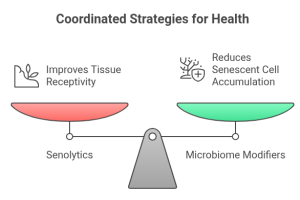
One emerging concept is sequencing.
Clearing senescent cells may improve tissue receptivity to microbiome interventions. Reduced inflammatory noise could allow beneficial microbial signals to take hold more effectively.
Conversely, stabilizing the microbiome may reduce the rate at which new senescent cells accumulate by dampening chronic immune activation and oxidative stress.
In practice, this suggests that senolytics and microbiome modifiers may work best not as standalone therapies, but as coordinated strategies.
This is a shift from single-target thinking toward systems-level intervention.
Ageing as a Systems Failure, Not a Single Defect
One of the most important implications of this convergence is philosophical.
Ageing is not caused by one broken pathway. It is the result of cumulative dysregulation across interconnected systems.
Senescent cells represent a failure of cellular quality control. Microbiome dysbiosis represents a failure of ecological balance.
Both are emergent phenomena. They arise gradually, through many small deviations, rather than a single catastrophic event. This is why reductionist approaches often disappoint in ageing research. Fixing a single node rarely restores the entire network.
Senolytics and microbiome modifiers succeed where others struggle because they address root contributors to systemic dysfunction, not just symptoms.
Therapeutic Design Challenges
Despite the promise, neither approach is simple.
Senolytics raise important questions about dosing frequency, tissue specificity, and long-term effects. Senescent cells are not universally harmful. In some contexts, they play roles in wound healing and tissue remodelling.
Timing matters.
Microbiome modifiers face challenges of variability. Individual microbiomes differ profoundly. Diet, geography, genetics, and lifestyle all shape microbial responses.
This makes personalization less of a luxury and more of a necessity.
Regulatory frameworks are also still catching up. Traditional drug development models are not well-suited to therapies that act intermittently or through ecological modulation.
Clinical Translation: Progress Without Headlines
The field is moving, but deliberately.
Early-stage clinical trials of senolytics are exploring indications such as idiopathic pulmonary fibrosis, osteoarthritis, and age-related metabolic disorders. Microbiome-based therapies are being tested across inflammatory bowel disease, metabolic syndrome, oncology support, and neurodegenerative conditions.
What is notable is not speed, but restraint.
Serious groups are resisting hype. They are measuring functional outcomes, not just biomarkers. They are asking uncomfortable questions about variability, durability, and unintended effects.
This discipline matters. Ageing biology is not forgiving of shortcuts.
Manufacturing and Scalability Considerations
From an industry perspective, both senolytics and microbiome modifiers pose manufacturing challenges distinct from those of conventional small molecules.
Senolytics often require precise pharmacokinetics to achieve selective clearance without collateral damage. Microbiome interventions require control over living systems, stability, and reproducibility. Quality here is not just chemical purity. It is functional consistency.
This is where deep process understanding becomes critical. Scaling biology without flattening its complexity is one of the defining challenges of the next decade.
Looking Ahead: Integration, Not Replacement
Senolytics will not replace existing therapies. Neither will microbiome modifiers.
They will sit alongside them, informing combination strategies that are more nuanced and more humane. As tools improve, as biomarkers sharpen, and as clinical experience accumulates, these approaches will become less experimental and more infrastructural.
Quietly. Gradually. Inevitably.
Final Thoughts
Senolytics and microbiome modifiers represent more than new therapeutic classes. They represent a shift in how we understand ageing itself, not as an enemy to be defeated, but as a process to be guided.
They ask the industry to think in systems, to respect complexity, and to intervene with precision rather than force.
For a field under pressure to innovate responsibly, manage costs sustainably, and deliver meaningful outcomes, that shift may prove to be one of the most consequential of this generation.
Not because it promises eternal youth. But because it offers something far more realistic and valuable: the possibility of ageing with less suffering, greater function, and greater dignity.
FAQs
1. What are senolytics, and why are they important in aging and disease?
Senolytics are compounds designed to selectively eliminate senescent cells. These are aged or damaged cells that no longer divide but remain metabolically active, secreting inflammatory factors known as the SASP. Accumulation of senescent cells is linked to chronic inflammation, tissue dysfunction, and age-related diseases such as osteoarthritis, fibrosis, and metabolic disorders. By clearing these cells, senolytics aim to restore tissue function and improve healthspan rather than merely managing symptoms.
2. How do microbiome modifiers differ from traditional probiotics?
Microbiome modifiers go beyond adding beneficial bacteria. They include targeted prebiotics, postbiotics, engineered microbes, and small molecules designed to reshape microbial ecosystems and metabolic outputs. Unlike conventional probiotics, which often struggle to colonize consistently, microbiome modifiers focus on functional outcomes such as reducing inflammation, improving barrier integrity, or modulating immune signaling.
3. What is the connection between senolytics and the gut microbiome?
The gut microbiome influences systemic inflammation, immune surveillance, and metabolic signaling, all of which affect senescent cell accumulation. Dysbiosis can promote chronic inflammation that accelerates cellular senescence. Conversely, microbiome modulation may reduce senescence burden or improve the efficacy of senolytics. Emerging research suggests that combining senolytics with microbiome modifiers could create synergistic effects on aging and chronic disease pathways.
4. Are senolytics and microbiome modifiers currently used in clinical practice?
Most senolytics are still in clinical or late preclinical development, with a few compounds repurposed from oncology or anti-inflammatory drugs being evaluated in human trials. Microbiome modifiers have broader clinical exposure, particularly in metabolic, gastrointestinal, and immune-related conditions. However, combination strategies involving both remain largely experimental and are an active area of translational research.
5. What are the key challenges in developing senolytics and microbiome-based therapies?
Major challenges include selectivity, long-term safety, and biomarker validation. For senolytics, avoiding damage to healthy cells and determining optimal dosing schedules is critical. For microbiome modifiers, inter-individual variability and regulatory classification complicate development. Demonstrating durable, mechanism-linked clinical outcomes remains the central hurdle for both fields.
Reporting on the science, business and regulation shaping the pharmaceutical industry.
More from the Knowledge Hub
All articles →
Pharmaceutical Regulatory Affairs: Challenges, Innovations, and Global Harmonization

Cold Chain Logistics in Pharma: Building Resilient Supply Chains

Discussion