The Antibiotic Resistance: Zosurabalpin And The War On Superbugs
Zosurabalpin is a first-in-class antibiotic targeting Gram-negative superbugs and offering new hope against antimicrobial resistance.


Antimicrobial resistance (AMR) has shifted from a theoretical future risk to a present-day clinical emergency. Each year, multidrug-resistant (MDR) infections claim millions of lives globally, with Gram-negative bacteria posing the most formidable challenge. Among them, Acinetobacter baumannii has earned a place on the World Health Organisation’s critical priority pathogen list due to its ability to resist nearly every available antibiotic. Against this bleak backdrop, zosurabalpin has emerged as one of the most scientifically exciting antibiotic candidates in decades, symbolizing a potential renaissance in antibacterial drug discovery.
Why Gram-negative superbugs are so hard to kill
Gram-negative bacteria are inherently more resistant than Gram-positive organisms because of their complex cell envelope. Their outer membrane acts as a permeability barrier, while efflux pumps and enzyme-mediated resistance mechanisms further reduce the effectiveness of antibiotics. Over time, excessive reliance on carbapenems and colistin has driven resistance even to these last-line therapies.
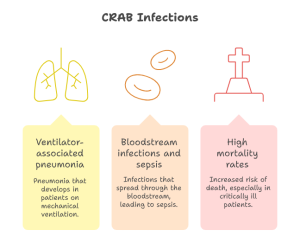
Acinetobacter baumannii exemplifies this problem. It thrives in hospital environments, survives on dry surfaces for prolonged periods, and frequently infects the most vulnerable patients in intensive care units. Clinically, CRAB infections are associated with:
- Ventilator-associated pneumonia
- Bloodstream infections and sepsis
- High mortality rates, often exceeding 40–50% in critically ill patients
These realities have created an urgent demand for antibiotics that work differently, not just better versions of existing drugs.
Zosurabalpin: a mechanistic breakthrough, not an incremental fix
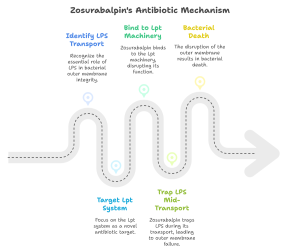
Zosurabalpin (also known as RG6006 or Ro7223280) represents a rare leap forward in antibiotic mechanism. Instead of targeting traditional bacterial processes, such as protein synthesis or cell wall cross-linking, zosurabalpin disrupts lipopolysaccharide (LPS) transport in Gram-negative bacteria.
LPS is essential for maintaining the integrity of the bacterial outer membrane. Its transport from the inner membrane to the outer membrane is mediated by the Lpt (lipopolysaccharide transport) system, a highly conserved and essential pathway. Zosurabalpin binds to this machinery and effectively “traps” LPS mid-transport, leading to catastrophic failure of the outer membrane and bacterial death.
This approach is particularly significant because:
- The Lpt system has not been exploited by existing antibiotics
- Common resistance mechanisms do not neutralize Lpt inhibition
- Mutations in Lpt proteins often come with severe fitness costs for the bacteria
In short, zosurabalpin targets a bacterial vulnerability that resistance evolution struggles to bypass.
The science behind tethered macrocyclic peptides
Zosurabalpin belongs to a new class of antibiotics known as tethered macrocyclic peptides (MCPs). These molecules occupy a unique space between small molecules and biologics, combining high target specificity with properties similar to those of drugs.
What makes this class distinctive is its structural design. Zosurabalpin forms a stable macrocycle that binds simultaneously to both the Lpt transporter and its LPS substrate. This dual binding mode creates exceptional affinity and selectivity.
From a drug-discovery perspective, this matters because:
- Protein–substrate interfaces are harder for bacteria to mutate
- The binding strength reduces the likelihood of resistance development
- Macrocycles can access targets previously considered “undruggable”
The discovery of zosurabalpin underscores how advances in structural biology and rational drug design are reshaping antibiotic innovation.
Preclinical evidence: strong signals against CRAB
Before entering human trials, zosurabalpin demonstrated compelling activity in preclinical models. In laboratory testing, it showed potent bactericidal effects against a broad panel of carbapenem-resistant A. baumannii isolates, including strains resistant to colistin.
Animal infection models further supported its promise, showing:
- Significant bacterial load reduction in lung and bloodstream infections
- Improved survival outcomes compared to standard-of-care treatments
- Favorable pharmacokinetic and pharmacodynamic profiles
These findings positioned zosurabalpin as one of the few truly novel Gram-negative antibiotics to advance beyond the discovery phase in recent years.
Clinical development: moving into late-stage testing
Zosurabalpin has completed Phase I clinical studies evaluating safety, tolerability, and pharmacokinetics in healthy volunteers. These studies indicated that the compound was generally well tolerated, supporting further clinical advancement.
The program has since progressed toward Phase III development, with trials designed to assess efficacy in patients suffering from serious CRAB infections. This is a crucial milestone — not only for Roche’s pipeline but for the entire antibiotic field, which has seen few Gram-negative agents reach late-stage trials.
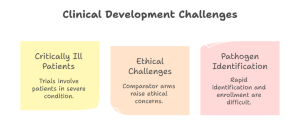
However, clinical development in this space is complex. Trials must contend with:
- Critically ill patient populations
- Ethical challenges around comparator arms
- Difficulties in rapid pathogen identification and enrollment
Economic and stewardship challenges beyond approval
Even if Zosurabalpin gains regulatory approval, its impact will depend on how it is deployed. Antibiotics targeting MDR pathogens are used intentionally sparingly to preserve their effectiveness, which limits traditional revenue models.
This has led to widespread industry retreat from antibiotic R&D. To counter this, governments and health systems are exploring alternative incentives, including:
- Subscription-based reimbursement models
- Market entry rewards decoupled from sales volume
- Public–private partnerships to de-risk development
At the same time, antimicrobial stewardship will be essential. Zosurabalpin must be reserved for confirmed or highly suspected CRAB infections, supported by rapid diagnostics and surveillance programs.
Resistance risks and unanswered questions
While Zosurabalpin’s mechanism reduces the likelihood of rapid resistance, no antibiotic is resistance-proof. Ongoing surveillance will be necessary to monitor for:
- Mutations in Lpt pathway components
- Adaptive changes in membrane composition
- Combination therapy strategies to extend clinical lifespan
Manufacturing complexity is another consideration. Macrocyclic peptides require sophisticated synthesis and quality control processes, which could influence cost and global accessibility.
What zosurabalpin signals for the future of antibiotics
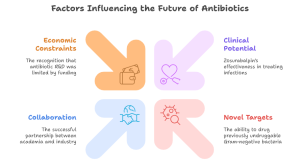
Beyond its clinical potential, zosurabalpin carries symbolic weight. It demonstrates that:
- Novel Gram-negative targets can be drugged successfully
- Academia–industry collaboration can deliver transformative innovation
- Antibiotic R&D is not scientifically “finished” — it was economically constrained
If successful, Zosurabalpin could catalyze renewed investment into non-traditional antibacterial platforms, from peptide antibiotics to bacteriophage-derived therapies.
Conclusion: a cautious but meaningful renaissance
Zosurabalpin will not end antimicrobial resistance on its own. However, it represents something equally important: proof that the antibiotic pipeline can be rebuilt with smarter science, better incentives, and responsible stewardship. In the war on superbugs, zosurabalpin is not just another weapon; it is a signal that innovation is once again possible.
FAQs
1. What is zosurabalpin?
Zosurabalpin is a novel macrocyclic peptide antibiotic targeting the LPS transport system in multidrug-resistant Gram-negative bacteria.
2. Which bacteria does zosurabalpin target?
It is primarily developed for carbapenem-resistant Acinetobacter baumannii infections.
3. Why is Zosurabalpin considered a breakthrough?
It utilizes a first-in-class mechanism that disrupts outer membrane assembly, rather than targeting traditional bacterial sites.
4. What stage of development is zosurabalpin in?
The drug has completed Phase I studies and is advancing toward late-stage clinical trials.
5. Can zosurabalpin solve antimicrobial resistance?
No single drug can solve AMR, but zosurabalpin could become a critical tool against high-risk hospital infections.
Reporting on the science, business and regulation shaping the pharmaceutical industry.
More from the Knowledge Hub
All articles →
Pharmaceutical Regulatory Affairs: Challenges, Innovations, and Global Harmonization

Cold Chain Logistics in Pharma: Building Resilient Supply Chains

Discussion