Data Integrity, Not Scale, Is India's Real Competitive Advantage - Chakravarthi AVPS on India's Pharma Leadership at GPACTS 2026
At GPACTS 2026, Chakravarthi AVPS declared data integrity, not scale, as India's pharma competitive advantage amid FDA, EMA scrutiny and AI-driven manufacturing.
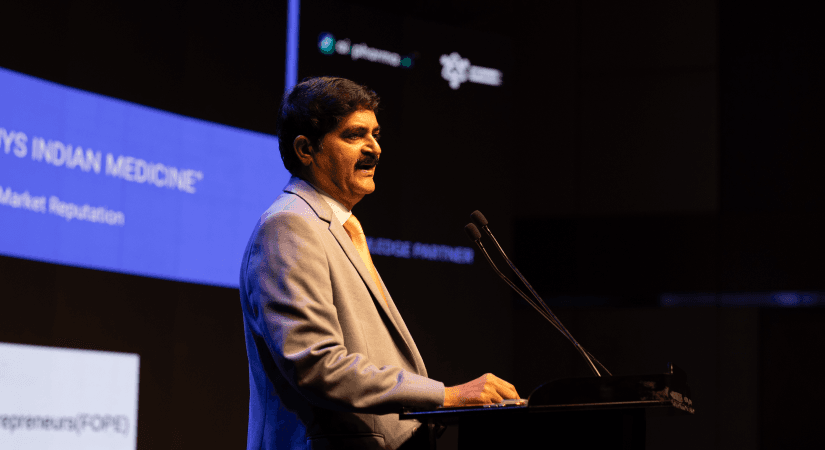
Mr. Chakravarthi AVPS, Chairman of the Federation of Pharma Entrepreneurs (Telangana & Andhra Pradesh), delivered the defining message of GPACTS 2026 this week: India's pharma industry has outgrown the question of volume and entered an era where regulatory trust, data integrity, and manufacturing intelligence determine global standing.
Addressing over 400 pharma IT and quality leaders at the summit, Chakravarthi reframed the narrative. For decades, India's role as the "Pharmacy of the World" rested on a single metric: the ability to manufacture 20–25% of global generics and 60% of the world's vaccines at scale. That story is over. Foreign buyers, regulators, and healthcare systems no longer ask whether India can make medicines. They ask whether India can prove the integrity of every medicine from plant floor to patient.
This shift marks a fundamental change in what regulators audit. The FDA, EMA, and MHRA no longer inspect finished tablets. They pull raw electronic audit trails. They examine timestamps, deleted test runs, and data continuity. A missing timestamp between 2:00 a.m. and 4:00 a.m. no longer reads as a technical glitch. It reads as a breach of trust. The result: a single data integrity lapse triggers a 483 warning letter affecting the entire facility. ALCOA+ data integrity is no longer a compliance checkbox. It is the primary currency of international trade.
Chakravarthi moved from regulatory pressure to operational transformation, making the case that AI on the manufacturing floor is no longer optional. High-speed blister packing lines running at 400–500 units per minute cannot be manually inspected. Fatigue-prone operators miss submillimeter defects that AI-driven machine vision detects instantly, 30 high-resolution images per pocket per second. Automated validation removes human error and converts compliance from a periodic burden into a continuous, natural outcome of plant operations.
But the most provocative argument came when he named the "last centimetre" — the distance between the container door and the scanner at a foreign port. Every 2D barcode, every QR code leaving an Indian plant is a physical mirror of internal data and quality. A single serialization failure, a missing temperature log during transit, or a broken seal does not just reject one shipment. It puts a question mark over an entire company's global standing and, by extension, India's pharmaceutical reputation across 215 countries.
The message crystallized into three action items for every leader in the room: break organizational silos between IT, quality, and engineering into one continuous compliance system; treat data with the same rigour as active pharmaceutical ingredients; and own the last mile — recognizing that every product leaving a facility carries the weight of India's global healthcare reputation.
GPACTS 2026 assembled this moment intentionally. Over two days, 50 speakers and 400+ pharma IT and quality decision-makers from India's top 50 pharmaceutical companies converged on a single unifying question: how do pharma CIOs, CISOs, CDOs, and manufacturing IT leaders align strategy when regulatory frameworks are shifting, AI is becoming mandatory, and data integrity has become the cornerstone of competitive advantage.
Chakravarthi's keynote was not a vendor pitch or a compliance lecture. It was a call to reposition India's pharma leadership from supplier to system-setter — from the world asking India to make medicines to the world watching how India proves their integrity.
For those who missed the live keynote, the full session recording is on Pharma Now’s LinkedIn page.
For those who attended, this message serves as the connective tissue for the two days of technical tracks, practitioner clinics, and strategic roundtables that followed.
GPACTS 2026 will publish complete session summaries, speaker presentations and thought leadership articles across its channels. The scale of the summit, the calibre of its speakers, and the urgency of its central thesis confirm what Chakravarthi argued: India's pharma industry is no longer building to global standards. It is writing them.
Follow Pharma Now and GPACTS on LinkedIn for complete session recordings, speaker insights, and further updates on the event's impact to the Indian pharma IT leadership community.
Reporting on the science, business and regulation shaping the pharmaceutical industry.
Discussion