by Simantini Singh Deo
8 minutes
The 5-Second Challenge: How Pharma Must Win Attention In The Scroll Economy
80% of users never scroll past the first screen. Here's how pharma brands win attention fast without breaking FDA fair balance rules.
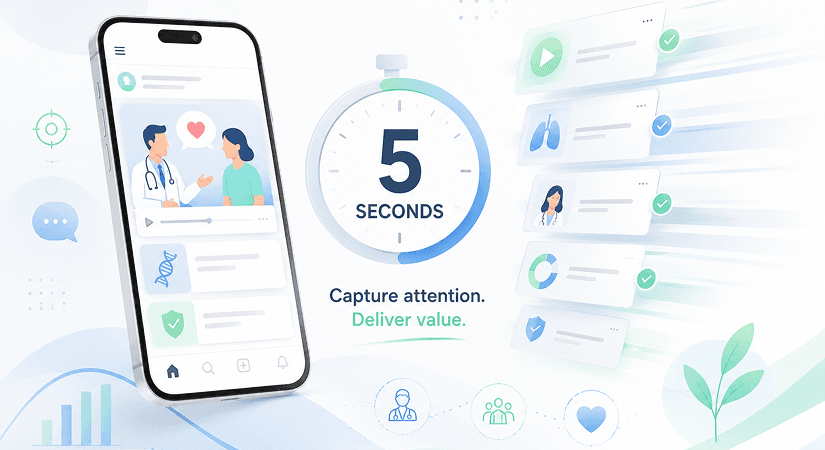
Every pharmaceutical brand is competing for the same finite resource, human attention. And that resource is shrinking fast. In 2000, the average attention span was around 12 seconds. By 2025, it had dropped to 8.25 seconds, below the famously modest focus of a goldfish.
Users now encounter more than 5,000 pieces of content daily, and the average person checks their phone 96 times a day. The question for pharma marketers is no longer whether their message is well-crafted. The urgent question is whether it survives the first five seconds, before the thumb moves on.
This is the scroll economy. Three forces define the pressure pharma now faces:
- Collapsing attention windows average focus time has fallen by over 30% since 2000, with no sign of reversal
- Exploding content volume users encounter more than 5,000 content pieces daily, meaning every brand competes against thousands for the same eyeballs
- Regulatory complexity unlike any other industry, pharma cannot strip its message down to sensation alone; every claim requires fair balance
For most consumer brands, adapting means going shorter, faster, and louder. For pharmaceutical companies, the challenge is far more complex. They must earn attention inside one of the most tightly regulated communication environments in the world, serving distracted patients, time-pressured physicians, and compliance-alert regulators, all at once.
Why The Attention Problem Hits Pharma Harder Than Other Industries?
The attention crisis is universal, but its consequences for pharma are distinctly severe. Most industries adapt to short-form content by stripping their message to its emotional core. A shoe brand compresses its message into three seconds of visuals.
A pharma brand advertising a prescription medication cannot be legally obligated to present fair balance, communicating risks and benefits with comparable prominence regardless of format.
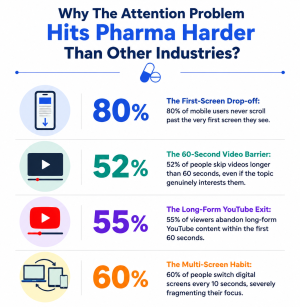
This creates structural tension. The FDA's updated 2025 guidance requires all promotional posts to include material risk disclosures in the same visual or auditory frame as the benefit claim.
For short-form video on TikTok, Instagram Reels, and YouTube Shorts, risk information must appear with equal visual weight to the product claim, inside a format where viewers abandon content well before 60 seconds.
The data underlines how steep this challenge truly is:
- 80% of mobile users do not scroll past the first screen they see
- 52% of respondents in a 2025 study admitted to skipping videos longer than 60 seconds, even on topics that genuinely interested them
- 55% of viewers leave long-form YouTube content within the first 60 seconds
- Social media reduces sustained attention by 25%, according to Statista, training audiences for rapid, low-commitment consumption
- 60% of people switch screens every 10 seconds, fragmenting focus across multiple devices simultaneously
These are the odds pharma marketers work against every time they push content into a digital feed. The industry most in need of sustained, careful reading is operating in a world that has engineered that out of human behavior.
HCPs absorb 1.4 pharma interactions every working hour — and barely half even land.
Here's how the industry is resetting its entire approach to digital attention in 2025.
→ Read: Pharma's Digital Reset: Trust, Relevance, and Engagement in 2025
The Two Audiences And Why Each Demands A Different Strategy?
Pharma's attention problem is complicated further by the fact that it serves two fundamentally distinct audiences, each with different digital behaviors, informational needs, and thresholds for engagement.
Healthcare Professionals (HCPs) are increasingly digital but time-poor. A recent Indegene survey found 26% prefer content on brand and product awareness, their most-requested type while one in three now identifies as a digital native, up from 20% previously. The formats performing best with this audience are:
- Short-form clinical video featuring KOLs, mechanism of action animations, and congress highlights
- Compliant SMS outreach, reaching open rates up to 98% versus email's 20% — HCPs are three times more likely to respond
- Interactive digital tools like dosing calculators, clinical case studies, and on-demand webinars
- LinkedIn and professional platforms, where brands like Merck and AstraZeneca run AI-targeted campaigns in a professional mindset
Patients, by contrast, are living inside the general scroll economy with no professional filter. With 57% of Instagram users searching for health information and one in three Gen Z individuals turning to TikTok for medical advice, the patient population is already forming opinions about conditions, treatments, and brands based on content that may not be accurate or balanced.
This creates both an obligation and an opportunity: pharma brands that show up with trustworthy, accessible content can fill a real vacuum but only within regulatory guardrails that were never designed with TikTok in mind.
Generic messaging is the fastest way to lose both HCPs and patients at once.
Here's why most pharma marketing fails them, and the fix that actually works.
→ Read: Why Pharmaceutical Marketing Is Failing HCPs and Patients. And How to Fix It
What Winning The Five-Second Window Actually Looks Like?
Given these constraints, what does success in the scroll economy actually look like for a pharma brand? The answer lies not in abandoning rigor but in restructuring how it is delivered. The most effective strategies emerging in 2024 and 2025 share four consistent characteristics:
1) Front-load the value proposition. Pharma brands that lead with the patient benefit, not the brand name and build quickly toward disclosure rather than delaying it are seeing stronger completion rates and engagement.
2) Design for context, not just platform. A TikTok video reaching casual nighttime scrollers is worth less than content reaching a patient actively researching a diagnosis. Leading teams invest in contextual targeting, understanding not just who sees content but what mindset they are in.
3) Build always-on resource hubs. The most effective brands shift from campaign-first to resource-first thinking, building searchable digital libraries where patients and HCPs access clinical data, treatment guidelines, and safety information on demand.
4) Partner with credible voices, carefully. Digital Opinion Leaders offer access to trusting audiences, but the FDA's 2025 guidance requires pre-approval for high-reach influencers, and sponsored content must meet the same standards as brand-owned material.
Translating these principles into practice means rethinking the entire content brief. Every asset should be evaluated against three non-negotiable questions:
- Does this content deliver value within the first five seconds, or does it bury the lead?
- Is the risk-benefit balance communicated in a way that is both compliant and visually coherent?
- Is this reaching the right person in the right context or just generating impressions?
Brands that build these questions into their creative process from the start consistently outperform those that apply compliance as a late-stage filter after the creative is already locked.
The Compliance Paradox: Rules That Restrict And Rules That Protect
There is a version of this story that frames FDA regulation as the villain, the force slowing pharma down while nimble consumer brands race ahead. But that framing misses something important. Disclosure requirements are also what makes a pharma brand credible in an environment drowning in misinformation.
When one in three Gen Z patients gets medical advice from TikTok, a brand showing up with compliant, balanced, accurate content is not just following rules, it is differentiating itself in the most meaningful way possible.
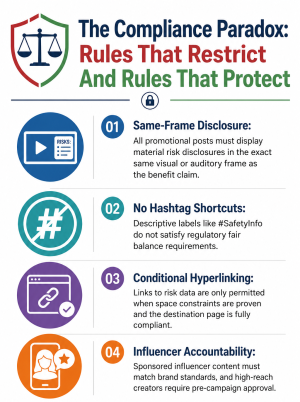
The FDA's March 2025 guidance clarified four critical points pharma teams must operationalize:
1. Real-time disclosure is non-negotiable — all promotional posts must include material risk disclosures in the same visual or auditory frame as the benefit claim.
2. Hashtags are not disclosures — labels like #SafetyInfo does not satisfy fair balance requirements.
3. Hyperlinks are conditionally acceptable — only when space constraints are proven and the linked page is fully FDA-compliant
4. Influencer standards match brand standards — sponsored content must carry the same disclosures as brand-owned material, and high-reach influencers require pre-campaign approval
Far from being merely restrictive, this framework gives marketing teams a clearer operational map for digital channels many previously avoided out of regulatory uncertainty. Brands treating compliance as a creative constraint to design around rather than a barrier to avoid are building the most durable digital presence.
Conclusion: Attention Is Not Enough On Its Own
Winning the five-second challenge is not the same as winning the communication challenge. A pharma brand can engineer content that stops the scroll — striking visuals, a compelling patient story, a provocative question about a condition affecting millions.
But if that content lacks trust, accuracy, and transparency, it will either fail regulatory review, erode brand credibility, or contribute to the exact misinformation it should be combating.
The pharma brands best positioned to lead in the scroll economy understand attention as the beginning of a relationship, not the end goal. That means:
- Creating content that earns the next five seconds after the first five
- Building digital environments that patients and HCPs return to by choice
- Treating regulatory compliance not as a cost of doing business but as a trust signal in a landscape full of noise
- Measuring success not just by impressions and reach but by the quality of engagement and accuracy of information delivered
The scroll economy relentlessly rewards speed and sensation. The pharma industry's obligation is to inject something it desperately lacks: reliable, compliant health information that is still compelling enough to be seen.
That is not a contradiction, it is arguably the most important creative and strategic challenge in pharmaceutical marketing today. The brands that solve it will not just win attention at the moment. They will earn something far more durable — trust.
FAQs
1) Why Is The Five-Second Window So Important For Pharmaceutical Marketing Today?
The five-second window is critical because modern audiences are exposed to thousands of pieces of content every day and often decide within seconds whether to continue engaging. Pharmaceutical brands must capture attention quickly while still communicating accurate, balanced, and compliant information. Unlike many other industries, pharma cannot rely solely on emotional or promotional messaging due to regulatory requirements. Successfully earning attention within those first few seconds can significantly improve engagement and information retention.
2) How Can Pharmaceutical Companies Improve Engagement In The Scroll Economy?
Pharmaceutical companies can improve engagement by delivering value early, using audience-specific content formats, and ensuring information is relevant to the viewer's needs and context. Strategies such as short-form educational videos, interactive digital tools, searchable resource hubs, and credible expert-led content can help increase audience interest. It is also important to balance creativity with compliance to maintain trust and meet regulatory expectations. Brands that focus on both usefulness and accessibility are more likely to build lasting relationships with patients and healthcare professionals.
3) Why Is Compliance Important In Digital Pharmaceutical Marketing?
Compliance helps ensure that pharmaceutical information is accurate, balanced, and transparent, particularly when discussing treatment benefits and risks. Regulatory requirements protect patients and healthcare professionals from misleading or incomplete information while supporting informed decision-making. Although compliance can create content challenges, it also strengthens credibility and trust in an environment where health misinformation is common. Companies that integrate compliance into their content strategy from the beginning are better positioned to build sustainable and trustworthy digital engagement.