Why Do Spores Keep Returning to Your Cleanroom?
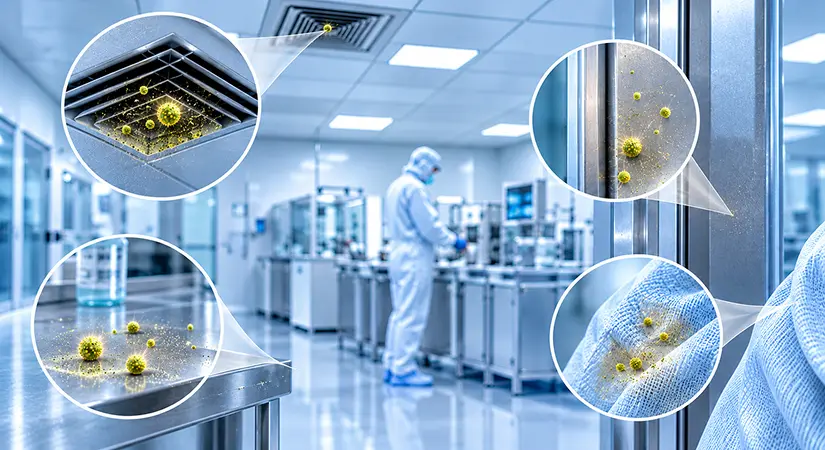
Spores In Cleanroom keep returning after routine cleaning. Here are the seven causes, from weak sporicide use to residues, and the fixes that hold up.

Introduction
A microbiology head opens the weekly environmental monitoring report. One Grade C contact plate shows a mold colony. Two weeks earlier, a Bacillus isolate turned up in the same room.
The team cleaned. The team rotated disinfectants. The procedure was followed. So the question lands on her desk, and it is the one this article answers: why do spores keep returning to your cleanroom?
The honest answer is that it is rarely one cause. Six problems sit behind most recurring spore findings, and a seventh problem hides them from view. Each one is fixable with evidence, and each one is something an inspector can ask about.
Spores Are Built to Survive
Bacterial endospores are dormant and extremely resistant to heat, desiccation, radiation and toxic chemicals. Their toughness is structural, not accidental.
Peter Setlow's review in the Journal of Applied Microbiology names the main defenses. Spore coat proteins likely react with and detoxify chemicals, the inner membrane is relatively impermeable, and DNA is protected by small acid-soluble proteins.
The same review notes that oxidizing agents appear to damage the spore's inner membrane. That is why oxidizing chemistries such as hydrogen peroxide and peracetic acid sit at the center of most sporicidal agent choices.
Setlow and colleagues also showed that spores lacking dipicolinic acid were less resistant to hydrogen peroxide. Even one internal molecule changes how well a spore withstands oxidation.
Routine Disinfectants Do Not Reach Them
Most cleanroom disinfection relies on broad-spectrum products for daily use. These work well on vegetative bacteria, but alcohols will not kill bacterial spores. A sporicide is needed for efficacy against endospores.
Regulators and compendia point the same way. The table below summarizes what the sources state.
Source | Stated position |
|---|---|
EU GMP Annex 1 (2022) | More than one type of disinfecting agent should be employed, including periodic use of a sporicidal agent |
EU GMP Annex 1 (2022) | The disinfection process should be validated |
USP <1072> | Rotating an effective disinfectant with a sporicide is encouraged, with weekly or monthly sporicide use suggested alongside a daily bactericidal disinfectant |
USP <1072> | Rotation systems should be evaluated using area classification, environmental monitoring data and risk assessment |
USP <1072> puts it plainly: "The rotation of an effective disinfectant with a sporicide is encouraged".
There is a catch. A sporicide is inherently corrosive, so it is typically not recommended for daily use. That gap between daily cleaning and periodic sporicide use is where spores can recover.
The rules also leave the details open. Laura Brennan of Ecolab notes that Annex 1 gives no guidance on how many chemistries to rotate or how often.
The Sporicide Is Too Rare or Too Weak
Frequency is a trade-off. Weekly use gives more assurance against spore-formers and molds, but it may cause corrosion over time depending on the chemistry.
Quarterly use may suit sites with chemistry or health and safety constraints, such as respirator needs. That approach can look reactive instead of proactive, and a strong rationale is needed if a site reduces frequency later.
Dose and contact time matter just as much as frequency. A Cairo University study tested a peroxyacetic acid and hydrogen peroxide agent on vinyl. At 2% it was significantly effective after 5 minutes against Aspergillus brasiliensis and after 10 minutes against Bacillus subtilis.
At 1%, the same agent did not achieve even one log reduction after 20 minutes. A dilution error can turn a validated sporicide into a placebo.
Chemistry and surface also play a part. A US EPA study tested six sporicidal liquids on nine materials. Hydrogen peroxide and peracetic acid products performed best, followed by hypochlorous acid chemistries, and results varied by material.
Residues, Soil and Technique Quietly Protect Spores
A sporicide only works if it touches the spore. Residues or soiling can act as a physical barrier that stops disinfectants reaching microbial cells.
Annex 1 therefore expects cleaning to be validated so that it removes residue or debris that would harm disinfectant effectiveness. Residue removal is part of spore control, not a separate chore.
Industry practice is moving this way. In the 2020 PDA Letter poll, 170 respondents (67%) had a procedure for removing residue build-up. In the 1997 survey, 13 (50%) said they rinsed areas to remove residue.
Technique completes the picture. Industry commentary on Annex 1 lists inconsistent operator technique among common challenges, noting that even validated agents fail if wiping does not ensure proper coverage. Residue accumulation is flagged as a particular issue in high-use isolators where sporicides are applied often.
Cleaning only counts if you can prove it works. See how to validate yours for inspectors.
Read: Cleaning & Sanitization - Proving It Works in Pharmaceutical Cleanrooms
New Spores Keep Arriving
Sometimes the spores are not survivors. They are newcomers. An ISPE article lists events that may warrant additional sporicidal treatment:
Facility construction
Maintenance activities
Extended shutdowns
Mold recovery
Adverse microbiological trends
Material flow matters too. Annex 1 commentary notes that transfers from controlled not classified areas into Grade C may support sporicide use, depending on incoming bioburden and the quality risk assessment.
Environmental monitoring should connect to action. If spore-formers are consistently recovered in Grade C, the contamination control strategy should dictate more frequent sporicidal use or an investigation of ingress points.
The Rotation Plan Rests on Habit, Not Data
Here is where many programs quietly fail. Disinfectant rotation was historically justified by fear of microbial resistance. Current thinking is more nuanced.
An ISPE article explains that true resistance in cleanrooms is generally considered unlikely. Disinfectants act on multiple cellular targets and are applied at concentrations well above minimum inhibitory levels.
Scott Sutton, as summarized in Cleanroom Technology, concluded that selection of mutants resistant to in-use disinfectant levels has not been shown in cleanroom settings. The stronger case for rotation is spectrum of activity, with a broad-spectrum product for vegetative organisms and a sporicide for spore-formers.
What Practice Looks Like
The PDA Letter compared a 1997 survey with a 2020 STERIS webinar poll. The two used different definitions of rotation, so the figures are not a like-for-like trend.
Indicator | 1997 survey | 2020 poll |
|---|---|---|
Respondents | 26 companies (survey sent to 167) | 553 people invited; 180 to 519 answered each question |
Rotated disinfectants | 25 (96%) | 190 (68%), not counting sporicides |
Rotation justified by historical EM data | Not reported | 79 (51%) |
The 2020 poll also asked what sets cleaning and disinfection frequency.
Basis for frequency | Respondens |
|---|---|
Cleanroom grade classification | 102 (36%) |
Microbial risk assessment | 98 (34%) |
Historical EM data and excursions | 72 (26%) |
Only about half of respondents tied rotation to their own data. The rest followed specific or national guidelines, which suggests guidelines are not aligned on how many disinfectants should accompany a sporicide.
Do You Need Three Products?
Brennan reviewed in-situ monitoring data from four established manufacturing sites. Her conclusion was that rotating two broad-spectrum disinfectants with a sporicide does not necessarily improve environmental control over one broad-spectrum product plus a sporicide.
This supports a risk-based approach. A formal microbial risk analysis, periodic EM review and procedure audits should set the number of agents and the frequency, not an arbitrary rule.
Two cautions apply. The data came from four sites, and the author stated that a peer-reviewed publication was to follow. Treat it as a strong signal, then confirm it with your own data.
A field trial is only as good as the monitoring data you link it to. See how to choose sampling sites, set frequencies by grade and build EM maps that show whether your sporicide is really working.
Read: Designing an EM Program – Locations, Frequency & Maps in the Pharmaceutical Microbiology Industry
The Efficacy Study Never Matched Real Life
The seventh problem hides the other six. A program can look validated on paper while spores keep returning on the floor. Tim Sandle describes qualification in three phases, which are suspension tests, surface tests and field trials. The first two are described in standards, but no standard describes the field trial.
Laboratory Targets Differ by Document
Disinfectant efficacy studies rest on the log reduction an agent can achieve. Accepted targets vary.
Document | Vegetative organisms | Spore-formers |
|---|---|---|
EN 13697:2015+A1:2019 | More than 4 log | More than 3 log |
USP <1072> | More than 3 log | More than 2 log |
PDA Technical Report 70 | More than 1 log | More than 1 log |
There are no compendial or harmonized log reduction requirements for pharmaceutical manufacturers. Sites should define targets from their activities and historical EM data, and USP <1072> criteria are often the most suitable.
EN 13697 methodology is frequently adapted with extra surfaces, facility-specific organisms and lower inoculation levels. ASTM E2967 simulates wiping with a device, though its limited microbial scope may restrict use in pharmaceutical cleanrooms.
Of the 2020 respondents, 154 (63%) qualified disinfectants with reference organisms and 68 (28%) used supplier data. Supplier data is acceptable only when the coupons tested represent the user's own cleanroom surfaces.
What Peer-Reviewed Sporicide Testing Shows
The quantitative Three Step Method was adopted as AOAC Official Method 2008.05 in May 2008. Its collaborative study tested sodium hypochlorite, a peracetic acid and hydrogen peroxide combination, and glutaraldehyde against B. subtilis spores on glass. Data from 8 of 10 participating laboratories were used in the final analysis.
The mean control log density was 6.86 spores per carrier across 72 tests. In a later study, control densities ranged from 6.63 log on wood to 7.14 log on steel, so the surface changes what you recover.
Why Lab Data Alone Is Not Enough
Laboratory challenges use far higher counts than a real cleanroom. The EPA often requires 5 to 6 log reductions within about a 10 minute contact time, while cleanroom populations are much lower and randomly distributed.
The field trial closes that gap. It tests disinfectants at the point of use and links efficacy to environmental monitoring data. It can also settle how often to disinfect, how often to rotate and whether residues need removing.
A Field Trial in Action
Sandle's case study covered Grade B, C and D rooms. Each room used 4 weeks of a low residue quaternary ammonium product followed by 1 week of a sporicidal hydrogen peroxide product, repeated for three cycles over 15 weeks.
Six contact plates per room were taken before and after scheduled disinfection, with neutralizer in the agar.
Cleanroom grade | Typical reduction, quat | Typical reduction, sporicide | Overall reduction |
|---|---|---|---|
Grade D | 71% | 56% | 70% |
Grade C | 63% | 77% | 66% |
Grade B | 74% | 94% | 79% |
Source: Sandle, Cleanroom Technology, 2021.
This is the answer to the opening question in miniature. Bacillus and Aspergillus were recovered early in the study but were not sustained, and no resistant strains were found after disinfection. The sporicide in rotation was doing its job.
Note the limits. The study used products from one supplier, small sample counts and percent reductions in counts, so it illustrates a method more than it proves a result.
FAQs
1. Why do spores keep coming back in cleanrooms?
Usually several causes overlap. Spores resist chemicals by design, alcohols do not kill them, and sporicides may be used too rarely or at the wrong dose. Residues, construction and transfers add to the problem.
2. Is a sporicidal agent required in a cleanroom disinfection program?
Annex 1 states that disinfection should include periodic use of a sporicidal agent. USP <1072> encourages rotating a sporicide with a disinfectant. Frequency should come from your risk assessment and EM data.
3. How often should a sporicide be used?
USP <1072> suggests weekly or monthly use alongside a daily bactericidal disinfectant. Sites use weekly to quarterly intervals, each with trade-offs in corrosion, safety and assurance.
4. Is disinfectant rotation needed to prevent resistance?
Published commentary says resistance to in-use disinfectant levels has not been shown in cleanrooms. Rotation is better justified by covering a wider spectrum of organisms, including spores.
5. What log reduction should a disinfectant efficacy study demonstrate?
There is no harmonized requirement. EN 13697 uses more than 3 log for spore-formers, USP <1072> uses more than 2 log, and PDA TR 70 uses more than 1 log. Define yours using your activities and EM history.
References
Setlow P. Spores of Bacillus subtilis: their resistance to and killing by radiation, heat and chemicals. J Appl Microbiol. 2006;101(3):514-525. https://agris.fao.org/search/en/records/65dfd44763b8185d9caf4997
Setlow B, Atluri S, Kitchel R, Koziol-Dube K, Setlow P. Role of dipicolinic acid in resistance and stability of spores of Bacillus subtilis with or without DNA-protective α/β-type small acid-soluble proteins. J Bacteriol. 2006;188(11):3740-3747. https://pmc.ncbi.nlm.nih.gov/articles/PMC1482921
Manufacturing Chemist. EU GMP Annex 1: What's new for cleaning and disinfection. https://manufacturingchemist.com/eu-gmp-annex-1-what-s-new-for-cleaning-and-disinfection-147687
Brennan L. In-situ verification of disinfectant rotation for contamination control. PDA Letter. https://pda.org/pda-letter-portal/home/full-article/in-situ-verification-of-disinfectant-rotation-for-contamination-control
Cleanroom Technology. Lifecycle approach to cleaning and disinfection rotation (quoting USP <1072> and summarizing Sutton). https://cleanroomtechnology.com/lifecycle-approach-to-cleaning-and-disinfection-rotation-140448
Sporicidal efficacy of a peroxyacetic acid and hydrogen peroxide agent on vinyl. Bulletin of the Faculty of Pharmacy, Cairo University. Dec 2014. https://doaj.org/article/96d3d87fe5cf4c5d90fe57c8db4a8995
PDA. 2023 Annex 1 Workshop Series (Singapore), cleaning and disinfection slides, 2022. https://pda-asiapacific.glueup.com/resources/protected/organization/1176/event/68240/fadad127-d117-4e29-ad39-435f786df2c0.pdf
ISPE. What makes a cleanroom disinfection program effective? https://ispe.org/pharmaceutical-engineering/ispeak/what-makes-cleanroom-disinfection-program-effective
El Azab W. The evolution of cleaning and disinfection practices over 20 years. PDA Letter. https://www.pda.org/pda-letter-portal/home/full-article/the-evolution-of-cleaning-and-disinfection-practices-over-20-years
Cleanroom Technology. How to design your pharmaceutical facility disinfection programme. https://cleanroomtechnology.com/how-to-design-your-pharmaceutical-facility-disinfection-programme
Cleanroom Technology. EU GMP Annex 1: What's new for cleaning and disinfection. https://cleanroomtechnology.com/eu-gmp-annex-1-what-s-new-for-cleaning-and-disinfection-184850
PharmaNow. Cleaning and disinfection programs under Annex 1. https://www.pharmanow.live/microbiology-ccs/annex1-cleaning
Sandle T. Assessing disinfection rotation at the point of use: designing a field trial. Cleanroom Technology. 17 Mar 2021. https://www.cleanroomtechnology.com/assessing-disinfection-rotation-at-the-point-of-use-designing-a-field-trial-175279
Ecolab. Overcoming existing challenges for disinfectant wipe validation in cleanrooms. https://en-eg.ecolab.com/articles/2026/08/overcoming-existing-challenges-for-disinfectant-wipe-validation-in-cleanrooms
Tomasino SF, et al. Use of alternative carrier materials in AOAC Official Method 2008.05. J AOAC Int. 2010;93(1):259-276. https://read.qxmd.com/read/20334188/use-of-alternative-carrier-materials-in-aoac-official-method-2008-05-efficacy-of-liquid-sporicides-against-spores-of-bacillus-subtilis-on-a-hard-nonporous-surface-quantitative-three-step-method
Determining the efficacy of liquid sporicides against spores of Bacillus subtilis on a hard nonporous surface using the quantitative Three Step Method: collaborative study. J AOAC Int. https://read.qxmd.com/read/18727544/determining-the-efficacy-of-liquid-sporicides-against-spores-of-bacillus-subtilis-on-a-hard-nonporous-surface-using-the-quantitative-three-step-method-collaborative-study
Wood JP, et al. Efficacy of liquid spray decontaminants for inactivation of Bacillus anthracis spores on building and outdoor materials. 2011. https://agris.fao.org/search/ar/records/65de56370f3e94b9e5cdb541
Cleaning and disinfection program part of the lifecycle approach: a risk based rather arbitrarily imposed approach. Teknoscienze. https://www.teknoscienze.com/tks_article/cleaning-and-disinfection-program-part-of-the-lifecycle-approach/
Reporting on the science, business and regulation shaping the pharmaceutical industry.
More in Microbiology & CCS
All articles →
Active Air Sampling vs Settle Plates vs Contact Plates
Setting EM Alert & Action Levels (Grades A–D): A Practical Guide for Pharma Professionals
Discussion