From Shop Floor to Strategy: Abhay Kumar Srivastava on Building Quality, Culture, and Leaders in Pharma
In this conversation with Pharma Now, Abhay Kumar Srivastava shares insights on pharma manufacturing leadership, quality culture, Lean Six Sigma, and the mindset shifts needed to move from shop floor execution to strategic operations leadership.

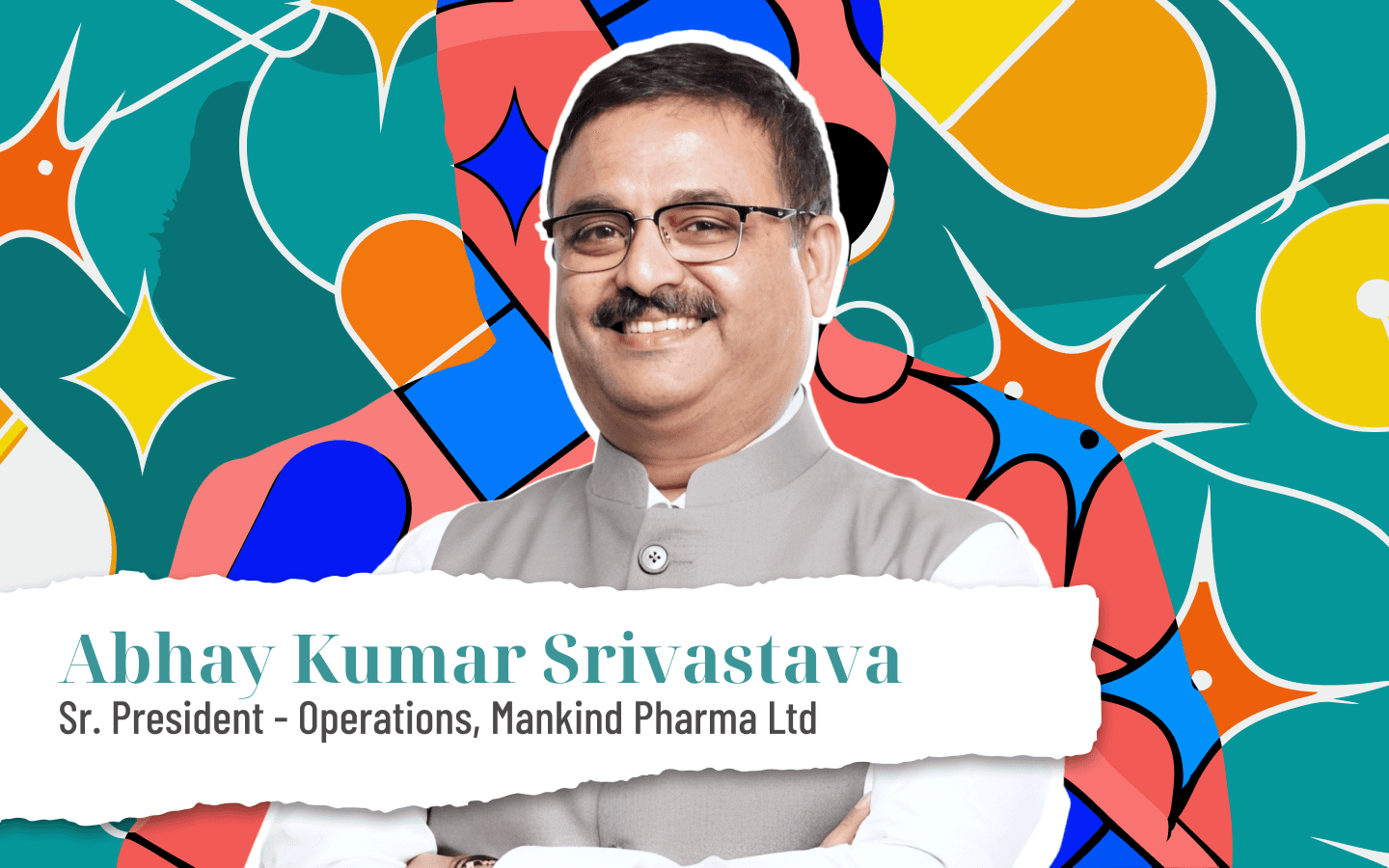
Pharma Now: From the shop floor to the strategy boardroom, our Mr. Srivastava today has covered every chapter of pharma manufacturing leadership. Mr. Abhay Kumar Srivastava, Senior President of Operations at Mankind Pharma, is known for elevating manufacturing plants, championing innovation, and empowering people to thrive in evolving industry landscapes. His passion for shaping the future of Indian pharma makes this conversation one you won't want to miss. Welcome, Mr. Abhay.
Mr. Srivastava: Thank you so much for inviting me. I am doing good. Thank you.
Pharma Now: How was your experience at Pharmig India 2025? Your session has just completed. Can you please give some feedback on your session?
Mr. Srivastava: The session was wonderful. For the first time, you have invited microbiologists, and I appreciate this because they hold a very different position now, and a lot of empowerment is needed today. As the industry moves from general to complex molecules, which earlier we used to make as simple injectables, and now towards biologics, we need well-trained, well-informed, well-empowered microbiologists. I said we should start empowering microbiologists. You have, at the very least, given them a platform. They play a crucial role in the industry. In my panel, as a speaker, I said one thing: microbiologists hold a very important position in all other industries, especially in the food industry and the dairy industry. Why aren't they in the sterile operations that occur in the pharmaceutical industry? You have provided a platform where they feel empowered.
Pharma Now: You have a remarkable journey from BIT Mesra to leading operations at Mankind Pharma. What have been the most defining moments in your career that shaped you as a leader?
Mr. Srivastava: I was very clear from the beginning, when I joined the B Pharmacy program. During my BPharm, I was not particularly interested in joining it. I completed my 10th and 12th classes as a very top-class student, and then I suddenly filled out many forms. I was confused. In the same year, I gave the engineering entrance, the medical entrance, and the pharma entrance. I got selected for BIT Mesra. I went there and suddenly realized that people were telling me, "Look, I was jabbed.
When I was growing up, there were no mobile phones, and telephones were a luxury. I grew up knowing I was not interested in pursuing this course, and I was coming back home. I wrote a telegram to my father. My father wrote back saying, "Please continue with zeal and courage." I understood the concept of courage, but I did not fully grasp the term 'zeal'; my English was not as good at that time. I felt Papa was telling me to stay there. Then a letter came. It was a very big letter. In the letter, it said, "Tell me, Abhay, which is the best shoe shop or the sweet shop in Agra? Name them." Then he said, "Do one thing: whatever studies you are doing, do the best in that." That is how it all started.
I was a very average student. I scored 63% marks in my 10th class, 74% in my 12th class, but when it came to B.Pharm, I topped my class with 87.6%. At that time, there was no GPA system; instead, a percentage system was used. Achieving 87.6% was a significant milestone in my time. This is how I started. From that day, my father wrote to me to be the best. I began working to excel in both my studies and my career.
The second thing was that since I came from a very humble family, and my father was in the Air Force, the Government of India and the Indian Air Force sponsored my studies at BIT Mesra. Somewhere, I felt there was a burden on me, a debt. I wanted to repay that. For me, that meant sticking to this profession and contributing to it. So I went into manufacturing. That was the second thing.
When I entered the manufacturing industry, I was still very young. In 1991, it was a very shallow start; I wouldn't even say it was humble. I had a very slow start because these things were mainly controlled by private businesses. Pharma is a very fragmented industry. Generally, the Tatas and Birlas do not invest money in this kind of business. There are very small players, and it all started with those small players. But thanks to the pharma fraternity, the graduates from the 90s who contributed so much, we have become a pharmacy for the world.
They created the right environment for India, where many thinking people like me entered the manufacturing sector. They changed the game for India. India has now become a global pharmacy. In that fragmented industry, companies like Sun Pharma and Mankind began as small operations. This is how they became very big.
The third thing I also felt was that, as an industry, we were not learning from other industries. We felt that there was so much inbreeding within the pharmaceutical industry that the genetics were gradually becoming weak.
Mr. Srivastava: Then I joined a company where my boss was from IIT Kanpur, and his boss was from IIT Kharagpur. When I, a pharmacy graduate, went under their wing, they gave me a big, broad picture. I realized that other industries are also regulated, just like ours. Whether it is an airplane or a car, if there is an accident, people will die too. They also have to follow some rules. I started working in other industries to participate in learning programs. I gained valuable knowledge from the automotive industry, where I studied Total Productive Maintenance and Lean Six Sigma. I began researching the airline industry, learning about asset management and how airlines maintain their aircraft. I learned about sanitization from the dairy industry. I have learned many lessons from various industries. I began introducing these concepts to the pharmaceutical industry.
Then I started learning about Lean Six Sigma because, when I was in the automotive industry, I saw that its utilization was very effective in improving product quality. I started introducing Lean Six Sigma, and I slowly became fond of it because it not only improves the quality of the product but also engages the workers. Once you engage them and educate them on Lean Six Sigma, they start developing a skill. When their competency improves, they get clarity. When they gain clarity, they are able to identify any problems with the product.
With Lean Six Sigma, when they attempt to solve a problem, their soft skills also improve because they have to negotiate cross-functionally with all the people in the room. Their soft skills start improving. Then they accomplish something, and they gain more confidence and conviction. If you combine all this, it becomes a culture.
A big question people ask me is how to build culture in a company. My answer is to start improving the competency of the last person. Culture will start growing eventually. This is something I have done extensively in my career.
Pharma Now: In organizations, people at higher levels often focus primarily on the immediate lower level. But it's crucial that even the last person in the chain understands the organization's vision; that's when we can truly say everyone is aligned.
Mr. Srivastava: The key point is: Who builds quality into the product? It's the person operating the machine. So who needs to be skillful? They do. Who needs to be motivated? They do. Who needs to be engaged? They do. Please take this to heart; it's vital. It's not your job to handle the quality directly. If frontline workers own the product's quality, your role is to create an environment and ecosystem where they can continue learning and growing.
Pharma Now: So, rather than just giving them checklists, we should focus on building their soft skills and competencies?
Mr. Srivastava: I fully agree.
Pharma Now: In your early days, how did you stay motivated?
Mr. Srivastava: The first thing was that I felt the government had invested in my education, so I owed it to give back through service. That's why I avoided marketing or other domains; they didn't feel like true service to people.
The second was that, back then, many non-pharmacy graduates led departments and companies with huge influence. We wanted pharmacists like us to step up, take those positions, and make the decisions. That drove me; the pharma fraternity needed to lead.
Third, I was committed to building the right quality and infusing science into everything I did.
In the middle of my career, what kept me going was the data I collected and analyzed, it yielded excellent results thanks to my Lean Six Sigma training, and I was steadily progressing.
My primary motivation is educating others and fostering a learning environment for my team. Three career phases, three different motivational forces.
Pharma Now: When you look back on your day, what were the key decisions that helped you transition from operational execution to strategic business transformation?
Mr. Srivastava: What actually happened was that the first thing I always do, and I always feel, is that a person can easily become a manager. Going from a manager to a general manager is one thing. Going from a general manager to an Assistant Vice President is another thing. Transitioning from an AVP to a President is one thing, and assuming the role of a CEO is another.
At every stage, be it a manager, a GM, an AVP, or a president, one should unlearn the skill set they have and learn the skills required for the next role. In a managerial role, you can assume the responsibilities of an AGM, GM, or DGM. But the requirements for a General Manager are different. When I became the GM, I felt that the basic instinct is that it will always tell you to do the lower job. This is where people make a big mistake. They will again go to the shop floor and get involved in everything that is no longer their role. It is very important to unlearn these things. These are four stages that require a new skill set. At every step, from manager to GM, or from GM to AVP, or from AVP to President, you need to unlearn and relearn the new skill set. That is point number one.
Point number two is to slowly incorporate the habit of solving problems. You have to move toward problem-solving because you have to accept the fact that your salary is coming only because of your problem-solving ability. If you are not solving the problems of your people, people will neither respect you nor your organization, and you are not doing justice to what you are being paid for. It is very important to do this.
When you are moving from the role of AVP to a senior position, one more thing is very important: you must learn some external training as well. Even today, I take online classes in college. The last class I took in a year was at IIM Lucknow, where I spent a year studying strategy. It is important that you go back to academia to relearn some of the skill sets required for this position. Some people generally do not do it, and they continue with their old habits. Then, from here on out, they slowly stop doing what they were doing as an executive, in a position where they are performing the same tasks as a GM and the same tasks at an AVP position. Presidents arrive with a few new skills. But to be an effective leader, you need to unlearn and relearn. The unlearning process can be very difficult at times. Let me tell you my personal experience. When I became a General Manager, I still felt the urge to go to the shop floor and stand in the packing line. I had a habit of packing, and I was very worried about how to stop this. It was not until I realized that I needed to end this habit somehow.
The second point is that strategy is not limited to the top level. It is even applicable to those at the forefront. It has to be incorporated somewhere because there are many types of strategies. You do functional strategy. Then, after that, you do a business strategy. Then you do corporate strategy. Then you do a real strategy. There is a hierarchy for this as well. If it is not in your habit from the beginning, and even as a GM, you still feel the need to sign batch records, then somewhere in this hierarchy, you will remain stuck in the functional strategy.
Pharma Now: As people move up the ladder, they also experience FOMO, or Fear of Missing Out, possibly due to losing control over their work.
Mr. Srivastava: Yes, that is right. People often forget that there is a huge difference between control and monitoring. If you incline more toward controlling, then you are killing the creativity of your people. You monitor them. If you have FOMO, you monitor them. Let me explain my method of monitoring. Imagine you have a helicopter. Consider yourself a President sitting inside a helicopter. You are flying over a plant. Then you go to your plant and ask what is going on. You call the plant manager. They respond that there is a slight deviation, but they will solve it. Then you take the helicopter and fly it back. However, if the plant manager suddenly identifies a problem, and there are serious issues with the batches, or an accident occurs in the plant, and someone is injured, at that time, you arrange for a helicopter to land. Then you go into the details.
My intention is not how it happened; my intention is how it will not happen in the future. I cannot do anything about what has happened. My focus should be on preventing it from happening in the future. Whatever has happened now was under the control of the plant manager. However, I want to understand the conditions under which the accident or incident occurred and how it can be prevented from happening in the future. That is my role.
People differentiate between controlling and monitoring. It is not that I do not monitor. I monitor from a helicopter. If you visit my cabin, I have a TV where the parameters of different plants are constantly displayed. We also use Tableau, which allows us to view all the data directly. We also utilize AI, which provides valuable insights into what you should see. The bottom line is that you should monitor. Do not point fingers, and do not control. Whatever they are doing, they will do it better than you because they are on the site where it has happened. They are more aware than you. Your role is only to ensure that it does not happen again. If you are doing this correctly, you are on the right track. If you are stuck asking, "Who did it? How did you do it?" then it will go wrong. What you should be focusing on is how it should not happen in the future.
Pharma Now: Based on your claim that it should not happen, how? Have you developed a specific process?
Mr. Srivastava: Yes. This is where Lean Six Sigma comes into the picture, of which I am a very big follower. It creates and tells you the different protocols that need to be there. Your 5 Whys analysis should be done properly, why? Because you should keep asking why until you get a constant answer to find the root cause. If you find the root cause, you have solved 50% of the problem. Now, to address the root cause, you need to build a system that prevents the problem from happening again.
This is very important. If you remain superficial in such situations, you will be unable to take any action. You have to admit another fact that being alone in such situations will not lead to anything either. That is one of the reasons we are creating various belts, such as Green Belts and Black Belts, within our organization. You will be surprised to learn that we have around 1,600 belts per day. Out of them, I have around 150 Green Belts to date. There are 12 or 13 people among us who hold the rank of Black Belt. Every year, we have a target to increase our Green Belts by 30%.
There is no doubt that I am creating an ecosystem, as we need top-quality leaders to lead a highly efficient and skilled workforce. I am managing them, and they are becoming skilled. The individuals who monitor them should also be equally skilled, so we place a strong emphasis on Lean Six Sigma.
Pharma Now: That’s very true. Sir, there’s a post of yours on LinkedIn which says, “We often mix R&D with innovation, but they play very different roles. R&D creates knowledge, innovation converts that knowledge into value.” Can you please elaborate a bit more about this post?
Mr. Srivastava: Officers and juniors working on the shop floors often get confused between innovation and R&D. They think that whatever output R&D has given them, they have to keep doing it the same way and never think about improving it.
The second point is that if you examine any quality policy in the pharmaceutical industry, I can say that 95% of these policies state that we will continuously improve. The third thing is that if you change the policy, then we will control it. If you try to do something, then it becomes a deviation, and you cannot deviate from it. In all these things, the junior becomes confused. In that state, they say that whatever we have learned, we must continue to do it in the same way. Now this process becomes static.
What they have been missing is that they can make the process more robust by utilizing the learning curve that is approaching them. They are examining the literal meaning of change control, which is controlling change. They are not looking at it technically, that if they apply change control, their life will become easier. This is about motivating them.
First, I wanted to ensure that they understand the difference between innovation and R&D. Innovation can be achieved by anyone. For R&D, there are scientists. Innovation creates value, whereas research and development (R&D) creates knowledge. Your learning curve will eventually surpass that of R&D over time. If you are collecting data, understanding how the critical parameters are related, and then conducting plant experiments with them and fine-tuning all that, you will improve. Because the timelines given in R&D are quite broad. Only the production team can tell where our products are improving. They can also innovate by conducting small experiments in a controlled environment, observing plant deviations, and making those changes by adjusting the control parameters. That is why I encourage them to think of this as their job. Innovation and R&D is not their job.
These people confuse innovation and R&D. I have even seen that in the course of time, if a product has 300-400 batches, then the technician who is operating it has a lot of knowledge compared to the one who performed the R&D. Now, by using that knowledge, if you can improve something or make the product more robust, that is where I am encouraging people the most. This is what I wanted to communicate through my LinkedIn post.
Pharma Now: Talking about quality, cost optimization is crucial, but without compromising on quality. What principles do you rely on while making such decisions?
Mr. Srivastava: Quality is something that should never be compromised. I wouldn't advise you to put your process on hold. What happens is that you have to make your process efficient day by day. You cannot keep it static.
Let me give you a very small example. How will you reduce your costs? By eliminating waste. If you remove waste, are you removing quality? If you are completely eliminating waste and reducing it, will the cost improve? It will improve. On one hand, you are improving cost and also improving quality.
The biggest misconception in the pharmaceutical industry is that running a cost program automatically reduces quality. No. First of all, you should think about how to reduce costs, that is, how you can reduce waste.
You should not cut any corners. Focus on reducing waste production. This will increase the quality of your product. You will also save resources. You have to be very clear about this. I do not think that reducing your costs necessarily compromises quality. You should reduce waste. You should optimize it. If you do not reduce waste, you cannot predict what will change. You should build scientific curiosity into your process. You can continue to change without compromising quality by maintaining a regulatory guardrail. If you remain static, your ecosystem will change.
Now let me tell you what we do. We assume a 7% inflation rate every year. There will also be 5% price variability. Add that 5%, which is approximately 12%. We target that 12%. We identify programs that are equivalent to this offset, ensuring our relevance remains current every year.
The next thing is to take full advantage of statistics. What should be your batch size? If you have volume, how should you plan your capacity?
I learned the concept of batch size at IIM Ahmedabad. In a lecture, they taught us something called the degree of leverage. In terms of leverage, they explained that you have a fixed cost. If you keep the remaining batch size to offset, that is the most optimal option. After that, the additional tablets you produce will push your profitability into an exponential curve. I thought, what is the quality issue with increasing the batch size unless the product is not very robust? A very robust product typically has no problems. So, I started experimenting with it and saw immediate benefits because it was all fixed. The second thing they said was, Do not touch quality. You should slowly move toward variable costs, what costs you can vary or what are semi-variable costs. If you feel that quality will suffer if you compromise on cost, then you are making a big mistake. Because you have blocked your creative mind with just this statement.
Pharma Now: Do you have any closing remarks you'd like to add?
Mr. Srivastava: Yes. I want to share one experience that has happened with me. Many people are very confused. The biggest confusion in the industry today is how to establish a quality culture within an organization. Everyone is saying that we have to build a quality culture, but how? I have been experimenting on this, and my learning is to start improving the competencies of your people right from the top to bottom. When you improve the competencies of the people, clarity comes into them because right now they do not know what they are doing.
You tell them how to do this and how to do that, and they should improve it a little. They will be able to improve only when they know the entire process. Let us take an example: I have a house in Chandigarh. It takes other people 6 hours to go from Delhi to Chandigarh. It takes me 5 hours. The reason is that I am familiar with the roads. I am familiar with the type of roads, and I can drive at the required speed. In this scenario, I am familiar with the entire process. One should always try to understand the process thoroughly before proceeding. When they understand the process, a sense of clarity comes in their mind. When clarity emerges, they begin to build competency through that process. When competence arrives, so does conviction. Courage is the next step after conviction. When they get courage, it is possible for them to say no. Only with the help of courage can they say, "This batch will not be released. It will not run this time. This batch is going to fail." They will start saying no. Even the people from the shop floor will start saying no. That is the ultimate goal of a quality culture.
The moment they start saying no, your culture will begin to build up. Culture building takes time unless you start today, it is going to take not even five years, but more than that because it takes time to percolate. One more thing I believe is that only a few people are engaged in the culture on today's platform, which is taking time. If the entire organization gets engaged from day one, then the culture will develop much faster than expected. This is the hierarchy, and a quality culture will be built in this manner only. Otherwise, in today's time, people have started writing SOPs on quality culture, which is a thoughtless process.
Pharma Now: So until we do not go on the shop floor, work on it, know the process, and get the clarity, that is when, after a certain point, we can think about what new things can be done.
Mr. Srivastava: That is absolutely correct. That is why I gave the analogy about the helicopter to be brought down. Because if there is any fatal problem, we need to understand and bring the helicopter down. Yes, it is very important.
Pharma Now: That was wonderful, Abhay Sir. Let us move on to the last rapid fire round. What is the one book that changed the way you lead?
Mr. Srivastava: The name of the book is "Good to Great." I recall a line from the book: "Sometimes being good is what kills the greatness."
Then I read a book on TPS, which is the Toyota Production System, and that further led me to Lean Six Sigma. These are the two books that were key in the way I lead now.
Pharma Now: What would you prefer on the shop floor: tea or coffee?
Mr. Srivastava: Throughout my career on the shop floor, I have always preferred coffee, until I became a General Manager. However, now tea is something I absolutely love, as it requires creativity every time. Now I am a tea person.
Pharma Now: If not pharma, then what career would you have chosen?
Mr. Srivastava: I would have been an engineer.
Pharma Now: Thank you so much, Abhay Sir, for this conversation. It was really great talking to you.
Mr. Srivastava: Same here. Thank you so much.
A seasoned pharmaceutical operations leader with over two decades of experience, Mr. Abhay Kumar Srivastava currently serves as President of Operations at Mankind Pharma Limited. He leads end-to-end manufacturing strategy across formulations, API, pet food, and agritech, while overseeing operations, projects, engineering, EHS, and operational excellence initiatives. A B.Pharma graduate from BIT Mesra with a PGDBA, and an Executive Alumnus of IIM Ahmedabad and IIM Lucknow, he is a Certified Lean Six Sigma Black Belt known for driving large-scale operational transformations. His career spans leadership roles at USV, Alkem, and Sun Pharma, where he played a key role in elevating family-owned manufacturing units, embedding digital thinking, and building high-performance cultures. Passionate about innovation, continuous improvement, and people-led excellence, he is focused on shaping future-ready manufacturing ecosystems within Indian pharma.
More interviews
All interviews →
The Untold Story of COVID-19 Vaccine Development: Dr. Subhash Thuluva Speaks

Mastering Pharma Regulations: Rajni Jha's Guide to Global Compliance Success