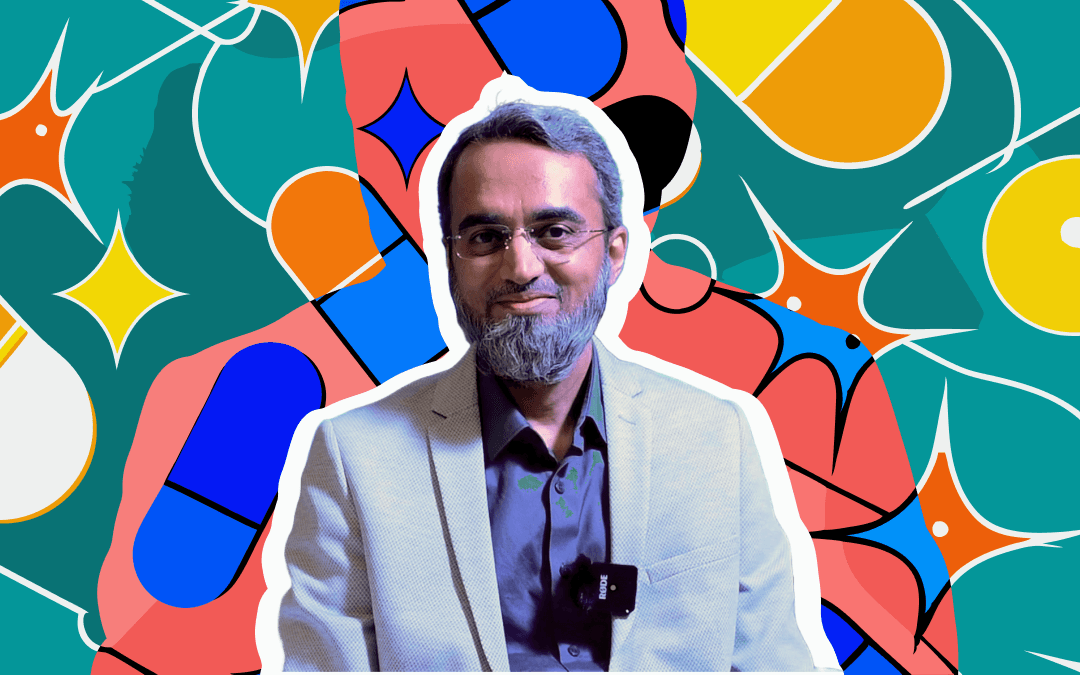
Dr Sweta Raghavan On Building Systems That Turn Science Into Societal Impact; Kindness, Integrity, And Impact
Dr Sweta Raghavan built the Karnataka AMR Action Plan on one uncomfortable truth: great evidence means nothing if it never enters the room where decisions are made.
20260312114207.png&w=1920&q=75&dpl=dpl_Fe2VLXz7WmA2eVjpEbUc2scjDNEB)
20260312114207.png&w=1920&q=75&dpl=dpl_Fe2VLXz7WmA2eVjpEbUc2scjDNEB)
Pharma Now: Today’s conversation sits at the intersection of science, policy, and power. Our guest doesn’t just talk about impact, she designs it and delivers it.
Dr Sweta Raghavan is a scientist by training, a policy strategist by practice, and a system builder by conviction. From advising governments on antimicrobial resistance and public health preparedness to shaping innovation strategy across India and South Asia for the Royal Society of Chemistry, her work has quietly influenced decisions that affect millions of lives.
This conversation is not just about motivation, it’s about how change actually happens. Dr Sweta, how did you begin your journey as a scientist and move into policy and governance? At what point did you realise that science alone is not enough to create impact?
Dr Sweta Raghavan: First of all, thank you for having me on Pharma Now. I’ve usually been drenched in work, either in a lab or in some remote district collecting evidence. Very early in my career, I realised that science does not automatically translate into action. It’s not something you can take for granted.
I’ve seen excellent data, and I’ve produced credible data as both a wet-lab and dry-lab scientist, but it often remains confined to journals. And the evidence in those journals rarely enters the rooms where decisions are made. That is both disappointing and frustrating, especially when you’ve created that evidence yourself.
So I consciously shaped my career to bridge that gap, to bring evidence from labs into decision-making rooms. One of the key lessons I learned early on was that if you want to create lasting impact, you must translate science into systems, into laws, budgets, workflows, and accountability mechanisms. Without these, it’s challenging to see where science actually goes.
Science, in the context of impact, is like a compass. But governance is the engine that drives it. Unless we marry the two, we cannot move forward meaningfully.
Pharma Now: Many professionals struggle to move from expertise to influence. What helped you make that transition successfully?
Dr Sweta Raghavan: In my opinion, many influencers focus on convincing people. I’ve never subscribed to that approach. My modus operandi has always been about enabling people.
When you’re in a decision-making space, people don’t really care how technically sound or intellectually sharp you are. What decision-makers want to know is: science does not automatically translate into action?
They are accountable to the public. Their job is risk management. So if you want to be an effective influencer, you must create what I call decision-ready evidence. It’s not about exhaustive data or complex theories. It’s about clarity of action.
Actionable evidence resonates because it reduces risk and solves problems. At the end of the day, people want to fix problems, they are not inherently hesitant or complacent. Often, they simply lack access to the proper evidence, at the right time, in an implementable form.
I always frame evidence around three questions: Is this implementable within existing systems? Who is accountable if it is implemented? If we do nothing, what happens?
If you bring answers to these questions early in the conversation, people grasp the relevance immediately.
The influencer’s role is to present evidence in a language that strips away scientific jargon and makes its importance unmistakably clear.
Pharma Now: Is there a specific example you’d like to share where clarity was initially missing, but through your intervention, decisions were shaped, and policies moved forward?
Dr Sweta Raghavan: I’ll share a recent example. I’ve been working on drafting the Antimicrobial Resistance (AMR) State Action Plan for Karnataka. When we began, we were already six years late in initiating the process, for various reasons.
At that stage, I needed strong leadership commitment. Instead of walking into the room and presenting resistance patterns, microbiological trends, or the number of resistant organisms, I reframed the evidence.
I presented it differently. I showed them what hospital mortality looks like today, and what it could look like tomorrow if we don’t intervene. I showed the projected budget escalation we would face. I explained how system fragility could intensify and how the burden on our already stretched public health infrastructure would grow.
That shift in framing changed everything. Any policy decision rarely has perfect evidence behind it, and waiting for ideal evidence is often the most expensive cost of policymaking. You need evidence that is timely, trustworthy, and communicates urgency.
When I presented this to the minister, his immediate response was: “Let’s begin without delay.” The next question was, “Why hasn’t this already been done? And if it has, why hasn’t it worked?” That opened the door for real action.
Instead of creating a purely literature-driven document, we made a deliberate choice: we went into the field. We spoke to stakeholders whose lives would be directly affected by the policy. When people talk about AMR, the first instinct is often to curb antimicrobial sales. The focus is almost always on overuse. But we very rarely address access.
And we were among the first to take the access issue seriously. It is as essential to reduce misuse as it is to ensure access to the right antimicrobial at the right time.
If a patient doesn’t have access to the correct antibiotic, they may use an inappropriate one, which is also misuse and directly contributes to resistance. Incorrect dosing or delayed access compounds infections, increases complications, and ultimately worsens patient outcomes.
This also increases out-of-pocket expenditure, places enormous pressure on families, and further burdens a public health system that is already stretched, especially in a country as large and diverse as ours, where rural and economically disadvantaged populations rely heavily on it.
So we asked ourselves: how much more can the system stretch? That is why stakeholder engagement became central to the process. When you engage people early, two things happen: You receive candid feedback that improves workflows. You create relatability and ownership.
By the time the policy reaches the ground, you’ve already earned goodwill. But we didn’t stop there. We ensured that accountability was embedded at every level. Accountability is not a vague ideology; it is infrastructure. It clearly defines who does what, when, and where. That makes policy implementable.
Alongside accountability, transparency is critical. In my view, transparency is the best regulator. When progress, or its lack, is visible, people can question, demand, and accelerate action; and finally, measurability. If a policy is not measurable, it is not enforceable.
Throughout the process, we integrated practical realities, technical expertise, and safeguards to ensure that, while pursuing the public good, we never infringed on individual rights. Policy design is complex. But if you balance evidence, accountability, transparency, and measurability, clarity emerges.
Pharma Now: So accountability, transparency, and measurability are central themes. Speaking of AMR, you were closely associated with spearheading and authoring the Karnataka State Action Plan on Antimicrobial Resistance. What were the most complex challenges you faced, technically and politically?
Dr Sweta Raghavan: Technically, I would say data fragmentation was the biggest challenge. Data exists, but it exists in silos, almost like isolated lakes that are not interconnected. For instance, there is surveillance data, mostly from tertiary care hospitals. But there is minimal data from outpatient departments or other clinical settings. Then there’s environmental data, such as wastewater surveillance. There’s pharmacy sales data, hospital antimicrobial usage data, and manufacturing and procurement data.
All of this data exists, but none of it speaks to the other. What’s being measured in each of these “data lakes” differs, so the systems are not interoperable. Breaking these silos and integrating the datasets so they could speak to each other and maintain internal consistency was a significant technical challenge.
We also found that data collection methods changed over time, which made retrospective analysis difficult. When data is inconsistent, long-term policy planning becomes fragile.
To address this, one of the key innovations we introduced in the Karnataka State Action Plan is a unified digital infrastructure called SWARM — Single Window for Antimicrobials Monitoring.
SWARM tracks the entire lifecycle of antimicrobials, from manufacturing, procurement, distribution, and sale, to usage, non-use, return, and disposal. It integrates environmental surveillance, hospital surveillance, usage patterns, and sales data into one ecosystem. When data sits together, policy becomes smarter.
This integrated view helps us tailor regulatory enforcement, design targeted awareness programs, improve procurement strategies, and ensure clinicians have the proper diagnostics and resources to make informed decisions. That was the technical side.
Politically, the bigger challenge was perception. AMR is often seen purely as a health department issue. My task was to shift that mindset, from a “health department problem” to a whole-of-government responsibility. Antimicrobial resistance does not stop at clinics and hospitals.
Antimicrobials are used in agriculture, animal husbandry, and food processing. Industrial effluents enter the environment. Packaging and pharmaceutical waste affect ecosystems. So multiple ministries must be involved: environment, forests, agriculture, animal husbandry, education, urban governance, and rural development.
Integrating these departments required building trust, persistence, and demonstrating that collaboration would actually reduce bureaucratic burden rather than increase it. AMR is a systems problem, and systems problems require systems thinking.
I would say those were the two biggest challenges: technical integration and political integration. And while the journey is ongoing, we are in a significantly stronger position today than when we began.
Pharma Now: You’ve advised governments on complex public health challenges. How do decisions actually get made when evidence, politics, and urgency collide?
Dr Sweta Raghavan: Policies, at least in India, are rarely made under ideal conditions. There is political scrutiny, budgetary and resource constraints, time pressure, and very often, incomplete or imperfect evidence. That’s the reality.
And when you’re dealing with something like antimicrobial resistance, which doesn’t look like an immediate emergency but actually is, the challenge becomes even more complex. AMR is largely invisible. You cannot “see” it unfolding in real time the way you would see a pandemic or a natural disaster.
So one of the biggest tasks is making the invisible visible. When evidence, politics, and urgency collide, the key is contextualization. Evidence must be clear and grounded. Much scientific evidence is abstract or theoretical. It attempts to solve a futuristic problem that policymakers may not immediately grasp. If you present it that way, it doesn’t translate.
You need to show where the problem sits today, how it affects existing systems, how interventions can be implemented, and how progress can be measured. When everyone, bureaucrats, technocrats, and political leadership, is aligned around a standard definition of the problem, decision-making becomes easier. And by “speaking the same language,” I don’t mean Hindi or English; I mean agreeing on what the problem truly is.
In my experience, what ultimately binds good decisions together is commitment at the highest level, the willpower to change the status quo, and the persistence to accept that change will not happen overnight. When leadership is ready to jump in with that mindset, that’s when the real magic of impact begins.
What once looked abstract or aspirational starts to fall into place. And once the structure is in place, implementation becomes far more navigable.
Pharma Now: From your experience, what separates policies that stay on paper from those that truly get implemented?
Dr Sweta Raghavan: Three things, and I’ve touched upon them earlier, but they are worth repeating. First, accountability and ownership. They go hand in hand. Unless someone owns a policy and feels personally responsible for implementing it, it goes nowhere.
Second, transparency. Transparency is one of the most potent regulators we have, especially in democratic systems like ours. When progress is visible, people can question it, monitor it, and accelerate it. Public scrutiny is not a threat; it is a catalyst.
Third, measurable impact. If I don’t know what success looks like, I cannot reach it. Policies cannot be arrows shot into the dark. There must be defined milestones for where we expect to be in six months and in one year. These targets don’t have to be rigid, but they must exist. They allow you to assess progress and identify bottlenecks early.
The strongest policies embed success metrics from the very beginning, not as afterthoughts or ad hoc additions.
So the policies that move from paper to practice are those that have: Clear ownership, Built-in accountability, Transparent progress tracking, and defined success metrics. Those are the policies we see today, not just surviving, but actively shaping lives.
Pharma Now: AMR is often called a silent pandemic. Why does it still struggle to get boardroom-level urgency?
Dr Sweta Raghavan: Let’s begin by understanding how AMR actually works. Unlike COVID-19 or other epidemics we’ve faced in recent times, AMR does not explode overnight. It does not disrupt visibly in a single moment. It erodes systems slowly.
AMR has what I call a lag effect. If you misuse antimicrobials today, the consequences are tomorrow’s treatment failures. The damage is not visible in real time. What we did yesterday is affecting us today, and what we do today will affect us years from now.
Because of this lag effect, AMR doesn’t trigger immediate urgency in boardrooms. Now, if you look at how boardrooms function, they focus on operational risk, reputational shocks, supply chain fragility, and regulatory exposure. They are evaluating continuity and stability.
AMR is rarely framed in that language. It is often presented purely as a health emergency. But it is very seldom communicated as a business continuity risk.
The way companies function today, especially in volume-driven antimicrobial sales, could, over time, erode treatment efficacy, damage customer trust, invite regulatory tightening, and ultimately impact revenue streams. If we reframe AMR as a business risk rather than just a health risk, boardrooms will pay attention.
In India, larger pharmaceutical companies are increasingly aware of this. Many are investing in stewardship initiatives. The bigger challenge lies with MSMEs. They operate with limited capital and tight margins. For them, compliance measures may feel like added pressure.
And this is where policy design becomes delicate. You cannot introduce regulations that infringe upon someone’s right to trade or livelihood. No business willingly supports something that appears harmful to its growth.
So two things become essential. First, communication must be in boardroom-relevant language. Show clearly how AMR affects long-term profitability, brand equity, and regulatory exposure.
Second, there must be co-ownership. Industry and government must clearly define roles: This is what industry will commit to, This is what government will support, These are the shared outcomes. And then those outcomes must be fiercely protected.
For example, industry and government could agree to reduce sales of last-resort antimicrobials by a defined percentage, say 20%, and to protect that goal.
Another structural change would be to decouple incentives from volume-driven sales. Today, incentives are often linked to how much is sold. If stewardship is the goal, incentives must align with responsible use, not with higher volume.
These are not impossible changes. They are practical shifts. But they require trust, clear communication, and a shared investment in each other’s goals. When AMR is understood as both a public health issue and a business sustainability issue, urgency naturally follows.
Pharma Now: A lot of experience explains your work today. But how did your early career look? Did you ever imagine yourself here, moving from laboratories to newsrooms, governments, and boardrooms? As a child, did you picture this journey?
Dr Sweta Raghavan: That’s an interesting question. I don’t think I ever had one singular dream growing up. My parents always told my sister and me just one thing: be good citizens. They never said, “Become a doctor,” or “Become a lawyer,” or “Become a technocrat.” They said, Be responsible citizens. That’s how you give back, to your country and to the world. Because the world is shrinking, and we’re all interconnected.
That mindset stayed with me. Whatever we choose to do, the goal is not gratification; it is satisfaction. Satisfaction in how you spend your time, energy, effort, and knowledge.
Perhaps because of that upbringing, I’ve always been drawn toward the development sector. I never meticulously planned my career. I chose science because I scored well in it. Once I entered science, wet lab research felt like a natural progression, curiosity, troubleshooting, persistence, those traits suited me.
That’s how I earned my PhD. But after that, I paused and asked myself: How do I give back? I had seen high-quality scientific evidence being generated, but not translated into action. And I noticed that very few people were filling that gap.
So I thought, why not try something different? Moving from a controlled laboratory, working with human cell lines, to working with actual human beings was transformative. When you step into society, you’re dealing with aspirations, law, socioeconomic realities, and political contexts.
Society is like a living laboratory, far more complex than any wet lab. I entered this space with the training of a scientist. And that became my advantage. I applied academic rigour, neutrality, and structured thinking to policy analysis. It helped me remain inclusive, fair, and holistic while building recommendations.
Everything else, exposure to governments, politics, newsrooms, and industry, came with the turf. Nothing surprises me anymore. Sometimes you’re in the middle of high-intensity negotiations; sometimes you’re working in isolation. Both are necessary.
In a country as large and complex as ours, with layers of cultural, social, and economic variables, you need both immersion and reflection. It has been an enriching journey. If you ask me where I’ll be in five years, I honestly don’t know. At every stage, my question is simple: Can I be impactful?
And when I say impactful, I mean, can I build systems that outlast me? Maybe this sounds ambitious, but I often wonder: Where are the transformative scientists of today? Where is the next M. S. Swaminathan? Where is the next Verghese Kurien? Where is the next Vikram Sarabhai?
These are enormous shoes to fill. But if I can help create systems that enable more scientists to step into those roles, and if I can achieve even a fraction of what they did, I think there is no more gratifying life than that.
Pharma Now: You are a subject-matter expert working closely with the government in critical policy areas. But beyond that, as a woman in these rooms, was it challenging? Did being a woman ever become a barrier?
Dr Sweta Raghavan: That’s a very loaded question. Discrimination, when it happens, is not always blatant. There have been moments, not constantly, but occasionally, when my opinion was overlooked because I’m a woman and also relatively young. There is often an expectation that policy advice must come from someone older, someone who “looks” like authority.
There are stereotypes around what a policymaker, influencer, technocrat, or scientist should look like. One advantage I had was that I was initially quite oblivious to it. Sometimes someone would later point out, “You realise what happened there, right?” And I would think about it in hindsight. But I don’t leave it there.
Women constitute 50% of the population. If you are not listening to half the population, how can you build systems that serve that half? Most bias, in my experience, is not explicit. It’s often unconscious. You may encounter people who speak over you, dismiss ideas quickly, or undervalue your contribution. The response, however, doesn’t have to be confrontational. It requires patience — and firmness.
I’m not saying be meek. But you can allow the room to settle, and then ask to be heard. At some point, the room has to listen. In meetings I chair or convene, I’m very conscious about representation. I ensure that everyone gets equal airtime, regardless of hierarchy or perceived gravitas. Ideas are heard based on merit, not on who presents them.
And representation goes beyond gender. It includes socioeconomic diversity, cultural backgrounds, and professional disciplines. Implementation challenges are best understood when all voices are present. Yes, stereotypes exist. I take them with a pinch of salt. But I also try to break those glass ceilings so that other women don’t have to encounter the same barriers.
Pharma Now: That’s wonderful. Is there one piece of advice you would like to share with women aspiring to enter this space?
Dr Sweta Raghavan: To all the women out there, you are perfect as you are. Be unapologetically yourself. If you’re looking to enter the development sector or policymaking space, don’t underestimate your opinions. I’ve often found that women bring unconventional, deeply contextual insights, perhaps because of the way we experience and observe life.
Don’t suppress your voice. Even if an idea sounds small or uncertain, say it. It can meaningfully shape decisions. And this advice applies more broadly as well. If you’re entering development work, don’t come seeking instant gratification.
This field demands comfort with long timelines, systemic shifts, and shared credit. You may not always see immediate results. You may not always receive visible recognition. Instead of asking, “How much credit am I getting?” ask, “Will this work outlast me?”
A firm policy continues to function even after you step away. That is resilience. That is impact. Creating systems that endure, that’s the real achievement. And I believe many women naturally carry that long-term, impact-driven mindset. The more women we see stepping into these spaces, the stronger our systems will become.
Pharma Now: As a woman myself, I sometimes feel that when women share futuristic ideas, they don’t always resonate immediately. Yet the same ideas may be appreciated months or years later. I’m not sure if it’s just me or if other women experience this too.
Dr Sweta Raghavan: I think that happens to men as well, so I have to be fair here. There are brilliant individuals, both men and women, who come up with fantastic ideas. But sometimes the way those ideas are communicated is slightly misaligned with the audience.
It’s very easy to think futuristically when you’re deeply immersed in a piece of work. You live and breathe it. The trajectory seems evident to you. But for someone observing from the outside, that future vision isn’t immediately visible unless you construct it clearly for them.
That’s why, if you want to be an innovator in today’s world, your innovation must be scale-ready and implementable. It has to navigate existing regulatory frameworks. You need to understand how the system works and design your ideas so they sit comfortably within the ecosystem.
This doesn’t mean you can’t create new ecosystems; you absolutely can. But you still have to operate within certain constraints. That’s the practicality of life. If you’re able to offer real-time, workable solutions within those constraints, your ideas are far less likely to be dismissed.
Pharma Now: So it’s really about how we position the idea. That said, India has enormous scientific talent. What systemic barriers still prevent innovation from translating into societal outcomes?
Dr Sweta Raghavan: India has never lacked talent or ideas. In fact, Indian science is growing by leaps and bounds. Where we’ve gone wrong is that we heavily reward discovery, but underinvest in deployment.
We underinvest in translational science. We don’t sufficiently support pilot-ready prototypes. There are limited resources to help innovations navigate regulatory pathways. And there’s very little structured guidance for building niche ecosystems around new, deep-tech products designed to scale and solve high-impact problems.
Addressing this requires multiple actors coming together. Universities and research institutions must better balance basic and translational research. Everyone talks about translation, but most research remains basic. We need to train researchers to think beyond invention, to understand downstream processes. Once you create something, what happens next? How does it move through regulatory systems, funding channels, market validation, and eventually into society?
On the investment side, especially with private capital, there’s often a preference for quick returns. Venture capitalists and angel investors typically operate within defined timelines. But breakthrough science, truly cutting-edge, norm-disrupting innovation, requires patience. It demands a long-term risk appetite. This is where government can play a catalytic role by working alongside the investment ecosystem.
For example, in the context of antimicrobial resistance (AMR), many startups are developing promising technologies. But scaling is capital-intensive. And even if funding is secured, the next question is: where is the assured market?
One idea I’ve been advocating is for the government to act as a procurer, particularly in areas like AMR. If the government guarantees procurement, it de-risks the investment environment. Investors gain confidence, startups secure funding, and public health systems adopt the innovation. Once the public system validates a solution, private players are unlikely to ignore it.
That creates a sustainable financial model. We’re hoping to experiment with this approach in Karnataka. It will be interesting to see whether this model proves effective in strengthening the innovation-to-impact pipeline.
Pharma Now: Great. Looking forward to it. How should industry leaders collaborate with government and academia more effectively, beyond CSR or symbolic partnerships?
Dr Sweta Raghavan: I fundamentally have an issue with CSR in its traditional form. CSR often becomes donation-based engagement. It can turn into a model where risk is outsourced, where a company says, “I’ve contributed funds; I’ve done my bit,” regardless of the outcome. If the initiative fails, there’s limited accountability. That approach, in my view, is insufficient.
Industry needs to move from donation-based engagement to problem-solving partnerships. This is not about pumping money into isolated issues. It’s about identifying systemic problems and saying: Here is a structural gap, and we are coming in not just as funders, but as co-owners of the solution.
Because industry brings far more than capital, it brings: Execution discipline, Operational efficiency, Technology integration, and Scalability thinking.
Many public systems struggle with execution speed and structured delivery. Industry can strengthen that. Government, on the other hand, brings legitimacy and reach. It creates policy alignment and access at scale.
Academia contributes evidence, credibility, and scientific rigour. When these three actors collaborate meaningfully, they’re not in conflict; they are complementary. Each strengthens the other’s contribution.
For me, true social responsibility is not about writing a cheque. It is about co-owning a problem, understanding how it intersects with industry’s long-term interests, and solving it using evidence from academia and systemic access enabled by government. That is a far more powerful and accountable model than outsourcing risk under the label of CSR.
Pharma Now: If you were advising a professional who genuinely wants to create societal impact, not just reputational value, what mindset shift is non-negotiable?
Dr Sweta Raghavan: The non-negotiable shift is moving from “What have I done?” to “What have I created?” Impact is not about personal recognition. It’s about outcomes. How many lives are improved? How resilient is the system you’ve helped build? Will it outlive you?
Many people are uncomfortable with not being visible. They want recognition, ownership, and attribution. But when you’re working in the developmental space, or even within industry, while trying to create real impact, that mindset can limit you.
You must remove the “I” and replace it with “we.”
It’s a collective problem. You might only be contributing a drop in the ocean, but if that drop moves the system forward, it matters. That requires: A degree of selflessness, Creativity, and Deep integrity.
You have to be willing to share responsibility, credit, and rewards, sometimes even at personal cost. Because in the end, it’s not about what you get out of it.
It’s about whether the vision you believe in becomes reality. And that, to me, is non-negotiable.
Pharma Now: Wearing multiple hats and working in such high-intensity spaces — what is that one thing that helps you unwind?
Dr Sweta Raghavan: There are actually multiple things that help me unwind. Because I wear various hats, I’ve learned one important thing: I don’t multitask. There’s a popular myth that women are natural multitaskers. I’m certainly not. When I’m working on one task, it gets 100% of my focus. That, in itself, reduces stress because I’m not fragmenting my attention.
When it comes to truly unwinding, I believe life is too short, and there’s so much left to explore. I enjoy pottery. It’s something I picked up a couple of years ago. Working with clay, creating ceramic pieces with my hands, it’s grounding. There’s something therapeutic about shaping something tangible from scratch.
I also enjoy being physically active. If I get the opportunity, I’ll go for a jog, play a sport, or simply spend time outdoors with friends. Those opportunities are becoming rarer, but I try to make space for them.
Reading is non-negotiable. You’ll never see me without a book. I love the physical feel of a book in my hand. I’m particularly drawn to espionage, adventure, and war crime thrillers, stories that keep you on edge. My professional life is deeply rooted in science, theory, and evidence. Fiction takes me to a completely different world.
And then there’s language. I’m fascinated by languages and culture. For me, language is the gateway to understanding a community. I’m constantly trying to learn new languages, not just the vocabulary, but the accent, the rhythm, the cultural context behind expressions. If I meet someone speaking a language I don’t understand, I’m immediately curious.
It may even be called a bit of an obsession, but when you learn a language deeply, you gain new perspectives on life. It changes how you see the world.
Pharma Now: How many languages do you speak?
Dr Sweta Raghavan: I speak Hindi, Kannada, Telugu, and Tamil fluently. I’m currently learning Malayalam and Bangla. I can also read and speak Sanskrit, though that’s more academic in nature. I’ve started exploring French as well, not fluently yet, but I’m working on it.
Most of these languages I picked up because of the spaces I work in. I’ve learned that speaking to someone in their language, or even attempting to, breaks barriers. It builds trust. People open up more freely. Communication becomes more authentic. Language, for me, is not just a skill; it’s a bridge.
Pharma Now: Any closing remarks you’d like to share?
Dr Sweta Raghavan: We are living in extremely chaotic times. There’s always something happening, professionally, socially, globally. If I had to leave one message, it would be this: slow down. Slow down and enjoy life.
At the end of it all, how do we measure success? Is it by the designations we’ve held? The possessions we’ve accumulated? Or is it by what we’ve contributed? The love and respect we’ve earned? Should we keep our word?
Do a few things well. Do them with good intentions. There is time. I can say that from experience. And above all, be kind. Kindness is the most universal language I’ve learned. You never truly know what someone else is carrying, what they’ve experienced, what they’re navigating.
Kindness works everywhere. It is a currency accepted across borders, professions, and cultures. And it’s a language everyone understands.
Pharma Now: This is Dr Sweta Raghavan for you, someone who doesn’t just speak about impact, but designs it, delivers it, and governs it. Thank you for sharing such valuable insights with our audience.
Dr Sweta Raghavan is a science policy expert and innovation strategist serving as Head of Innovation, Strategy & Government Affairs for India and South Asia at the Royal Society of Chemistry. Holding a PhD in Cell Biology from King's College London, she works at the intersection of science, public health, and governance.
A trusted advisor to the Government of Karnataka, she is the principal architect of the Karnataka State Action Plan on Antimicrobial Resistance. She also serves as a Professor of Practice at St. Joseph's University Bengaluru and is the founder of Scientists & Co., a social initiative promoting STEM education among underserved communities.
More interviews
All interviews →
The Untold Story of COVID-19 Vaccine Development: Dr. Subhash Thuluva Speaks

Mastering Pharma Regulations: Rajni Jha's Guide to Global Compliance Success