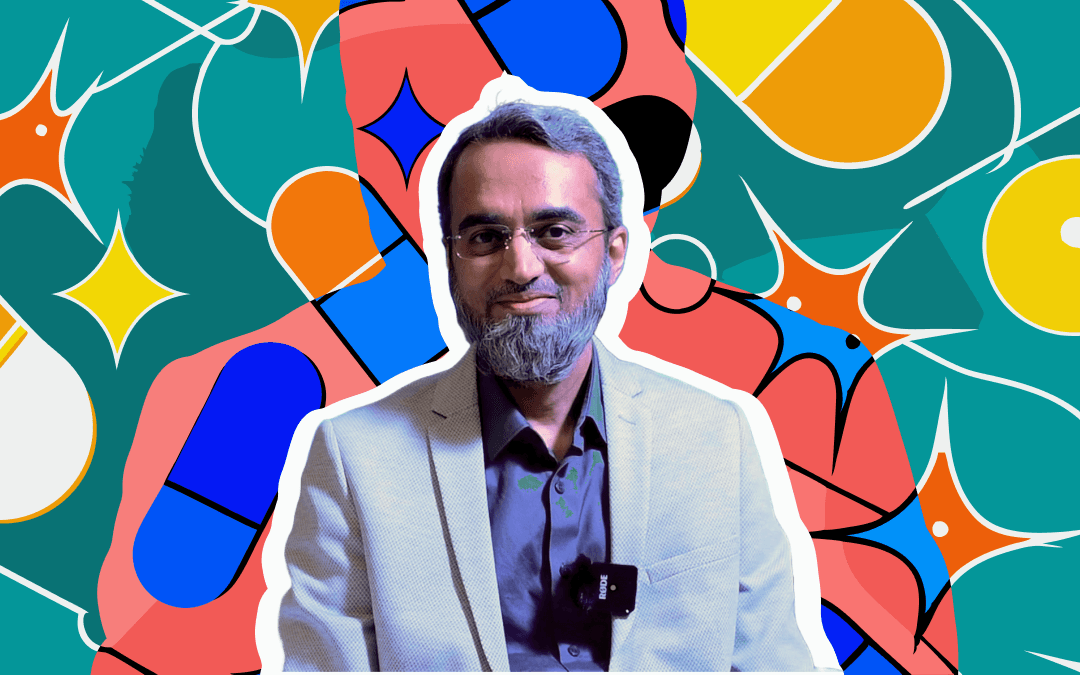
From ₹250 a Month to Building Encube Ethicals: Mehul Shah on Entrepreneurship, Culture, Quality, and Pharma Leadership
Mehul Shah took 11 years to hit Rs 25 crore in turnover, then waited again before owning his own R&D. On the ₹250 stipend, building Volini, the PACO framework, and why patience beats speed in pharma.

Pharma Now: Welcome to Pharma Now. For today’s conversation, we have with us the Chairman and Managing Director of Encube Ethicals, Mr Mehul Shah. We are delighted to have you here. Let’s start with your journey. You began your career in 1986, earning ₹250 a month on the shop floor. Tell us more about how it all started.
Mr Mehul Shah: I completed my pharmacy degree in June 1986, and as we speak, this June marks 40 years in the pharmaceutical industry.
My father had a small pharmaceutical unit in Marol. Before joining him, I wanted to gain some industry experience. I joined a company called Elegant Pharmaceuticals, a contract manufacturing organisation. I am very grateful to them because they gave me an opportunity to learn for six months. I received a stipend of ₹250 per month, and that first income was extremely precious to my family and me.
In January 1987, I joined my father’s business. At the time, we were involved in contract manufacturing of liquid orals and capsules. Around then, we came across a customer called Crosslands Research. It was their first year of operations, and the company was led by two directors, Mr G. Ram Murti and Dr V. Shankar.
They wanted to manufacture creams and ointments, so they approached my father. We set up a small 825-square-foot unit in Marol for them to begin manufacturing 300 kilograms of creams and ointments. From that day onward, for nearly four decades, my entire organisation has remained primarily focused on skincare and topical products.
For almost ten years, we operated a small company called Ciens Laboratories, mainly serving Crosslands. Later, in 1994 and 1995, when they were setting up a facility in Goa, I was 29 years old and accompanied Dr V. Shankar there. During that trip, I candidly asked him whether I could also start a small unit in Goa. I had not even discussed it with my father, my wife, or anyone else.
He agreed. In April 1996, I purchased two acres of land in Goa for ₹14 lakh. That was the beginning of a new dream called Encube Ethicals. The plant began operations in March 1998, after about 1.5 years of development.
Ironically, by the time we started, Crosslands had merged with Ranbaxy. Our 45,000-square-foot facility, located near their plant, felt like an air-conditioned college campus with no clear direction. I was 31, and that was where the real journey began.
The early days were extremely challenging. The facility was located in Madkai, near the Mangeshi Temple. There were no proper roads, no water supply, no electricity, and no telephone connectivity. You can imagine what it took to establish a manufacturing unit under those conditions.
At that time, making an STD call from Goa to Mumbai cost ₹16 per minute during the day. After 11 p.m., the rate dropped to ₹4 per minute. So I would wait until late at night to call vendors and suppliers. There were no mobile phones then. I used to sit in a tiny cabin inside a communication centre and make all my business calls from there.
To cut a long story short, those were very different times, and it took a lot of effort to establish ourselves. Fortunately, three great customers came into our journey—Microlabs, Sanofi, and Galderma, a French company that was setting up its own subsidiary in India. We connected well, they trusted us, and that trust became the foundation of our growth.
With those three customers, the journey truly began, and it was entirely focused on topical products. The Goa facility was built specifically for topicals because my experience in Mumbai had already been centred around that segment.
Some memorable products were developed during those years. You may know Moisturex. Even more interestingly, the famous brand Volini was developed in 1988 in what was essentially a garage setup. My office was next door, and a small laboratory operated alongside it, supported by consultants and the Crosslands team.
Everything always revolved around topicals, and that gave me the confidence and passion to believe we could build something significant in this space.
When you're young, you don't know everything. There was no internet, limited access to information, and far fewer learning resources than today. What really mattered was your zeal and determination to do something meaningful.
Back then, as it does today, the topical pharmaceutical market accounted for only about 3.5% to 4% of the total pharma market. For most companies, topical products were just another division or department. Very few focused exclusively on topicals.
We felt that if we followed the same path as everyone else, we would never stand out. Most contract manufacturers operated multiple dosage forms under one roof—liquid orals, capsules, oral solids, and perhaps a small topical line. I believed that approach would never do justice to the potential of topical products.
So we decided to dream bigger. As a Gujarati entrepreneur, thinking beyond the obvious was always part of my mindset. If I tell you today that I knew exactly what I was doing, that would not be true. A lot of it was luck, destiny, timing, and faith.
However, one thing was very clear in our family culture focus. We never allowed ourselves to be distracted by topline numbers, bottom-line figures, or backup plans. We believed in committing fully to what we had chosen.
I felt there was not much to lose. If we could manage the fundamentals of running the company properly, time would eventually reveal whether we could truly make a mark.
It took us 11 years to reach a turnover of ₹25 crore. By March 2009, we had become a ₹25 crore company. That gives you an idea of the challenges and hardships we experienced during those years.
The pharmaceutical industry has always been highly competitive. At any given point in time, there is intense competition. Unless you establish yourself properly and demonstrate consistency over a long period, people do not trust you. In my view, it takes at least a decade before the industry to truly begin to trust a company.
Thankfully, the three customers who believed in us from the beginning stayed with us, and I am happy to say they are still with us today. That is the real testimony to the organisation's culture.
It took a long time to establish ourselves, but I always believed that building a pharmaceutical company is not a T20 match or a one-day game. It is a Test match, perhaps even more than that. It is a marathon.
Pharma Now: You mentioned destiny, so let me take you back to the 1980s. You completed your pharmacy degree, but was that entirely your choice? Or did your father’s involvement in the pharmaceutical business influence that decision?
Mr Mehul Shah: My father was already in the pharmaceutical business, and I had chosen the science stream from the beginning. I was never interested in pursuing medicine. In any case, I did not have the kind of marks required for that path.
I still remember scoring around 86%. My name appeared on the third admission list at the Kundanani College of Pharmacy, and I took admission there. The primary reason was that my father was already in the industry. The entire environment around me revolved around pharmaceutical manufacturing and a small-scale pharma business.
So, for me, it felt natural. I never struggled with the decision or seriously considered doing something completely different. It was both a choice and, in some ways, a default path because of the environment I grew up in.
Pharma Now: Let’s go back to the days when you were building the company. You mentioned there was no electricity or water, and the project you initially expected to support the facility had disappeared by the time the plant started in 1998.
How did you feel during those early days in Goa? You spoke about sitting in a small communication cabin and running operations from there. As an entrepreneur, have you ever questioned whether you were doing the right thing or wondered if you had made the wrong decision?
Mr Mehul Shah: There was always a certain amount of fear. Naturally, I would think about how I would run the company and make it successful. But I learned to convert that fear into energy. The question was never about fear itself; it was about how to work harder, channel that insecurity into effort, and make a difference through perseverance.
I think that comes from my family. My father, who is now 91 and still with us, has always been a role model for me. I have seen him work incredibly hard throughout his life. Nothing came easy to him. We come from a simple, middle-class Gujarati family, and I witnessed hard work every day while growing up.
Over time, that hard work becomes ingrained in your mind, body, and soul.
We also kept our expenditures extremely limited. In those days, attracting talent was very difficult. Many people took pride in working for multinational companies and would proudly display their company identity wherever they went. Convincing qualified pharmacy professionals to join a small company in Goa was not easy.
As a result, you become an all-rounder. You fill every gap yourself and take on responsibilities across all functions of the business. We hired many freshers because experienced professionals were difficult to attract. We did not have ready-made teams or highly experienced people, so we learned everything the hard way.
That is one of the reasons it took us 11 years to reach a turnover of ₹25 crore. We did not increase expenditure aggressively or take large risks that could result in major losses. Everything was done with the bare minimum—minimum expenses, controlled losses, and modest production levels. We simply kept moving forward.
It required patience. Looking back today, I often ask myself whether I could build a company the same way in the current environment. The answer is probably no. Today, very few people have the patience to wait 10 or 11 years for results.
Those times were different. If you speak to entrepreneurs from my generation, especially within Indian pharma, you will find that almost all of them have stories filled with struggle. Many of today's industry leaders started as entrepreneurs, and their journeys were built on persistence and hard work.
Alongside that, my personal philosophy and the values of Jainism played an important role. As a family, we always kept our needs limited. We never allowed our personal lifestyle or expectations to grow faster than the business. Instead, we focused our energy on hard work and building the company.
I have also observed that people who maintain the same values at home and at work are more likely to succeed. If you are the same person at home and in the office and willing to work hard, your chances of succeeding increase significantly.
Even today, young entrepreneurs are extremely hardworking. The difference is that they have access to far more technology, knowledge, and information-sharing platforms than we did. Back then, everything was limited. Information, resources, and opportunities were all scarce.
Building a business in an environment of scarcity required a different kind of entrepreneurship.
Sometimes, I feel the modern world is overwhelmed by too many options and too much information. That is why I always tell people in my organisation that I do not want confusion in the workplace. Clarity is one of the most important elements in life, and we have always worked hard to maintain it.
Pharma Now: You spoke about culture. Could you elaborate a little more on your philosophy and what culture means to you?
Mr Mehul Shah: My philosophy of culture begins with humility. Humility means respecting, trusting, and valuing people. That is the foundation of culture.
Today, many organisations operate with a hire-and-fire mindset, driven primarily by topline and bottom-line numbers. Our organisation has always been different in one important way: we value process more than outcomes. Outcomes can be temporary and keep changing, but what remains constant is how strong your foundation is.
For me, the key pillars of culture are humility, a learning mindset, trust in people, and a focus on process rather than outcomes.
The second element is continuous learning. You have to keep learning throughout your life. The third is empowering people and allowing them to fail. Unless people experience failure themselves, they will never develop the confidence to make bigger decisions in life.
In many medium-sized organisations, most key decisions are taken by the entrepreneur. To some extent, that works, but beyond a point, it becomes a limitation. If you want people to grow, you have to trust them with responsibility.
As the organisation grew in size and relevance, we focused on strengthening our core. And your core is always your values and culture. At Encube, we summarise our values through PACO.
P stands for Passion, A for Agility, C for Courage, and O for Ownership.
In the pharmaceutical industry, integrity and discipline are expected. They are fundamental. But the real umbrella that holds everything together is the strength of your culture and values. Every action within the organisation should reflect those values.
In good times, demonstrating values is easy. The real test comes during difficult times. That is what determines your organisation's altitude.
I am not claiming that we follow these principles perfectly all the time. However, one of the most important aspects of culture is reflection. Regardless of position or authority, everyone should reflect on what went well, what did not and what could have been improved.
Once you develop a culture of reflection, it changes your behaviour. For example, if I become angry during a difficult meeting, I should have the humility to apologise to my team member the next day and admit that I lost my temper. That is culture.
Culture is not an ideal state that you achieve once. It is something you practice every day, month after month, until it becomes ingrained. And eventually, you have to demonstrate it during adversity.
Many organisations talk about ownership in terms of targets. They say, “This is your target, and you must own it.” That is not the ownership I am referring to. What I mean is that when someone is given a responsibility, along with the necessary guardrails, checks, balances, and support systems, how do they demonstrate passion first?
Passion is a word that is often used loosely. People say they are passionate, but very few define what it really means. My definition is simple. Everyone has a desire to grow. Every person wants to progress in life. But your best performance will never emerge from desire alone. It requires intensity.
An intense desire is what I call passion. That is why Passion is the first value in PACO.
The second value is Agility. In today's world, nobody is going to wait for you. You must be agile, but in pharmaceuticals, agility must coexist with compliance. You must follow regulations, processes, and quality systems while still moving quickly.
True agility comes only when you think comprehensively. If you do not assess risks properly or think through all dimensions of a decision, your agility will be short-lived because mistakes will eventually catch up with you.
To consistently achieve results, you need clarity of objectives, clarity of guardrails, and risk assessment. Once those are in place, agility becomes sustainable.
The third value is Courage. No company can grow if people stop taking calculated risks.
We are still a relatively small company compared to some of the industry's largest organisations. For growth, we need people who are willing to take risks, but calculated risks with limited downside and full compliance. However, courage cannot exist if people are constantly afraid of failure.
If employees believe they will be punished every time they fail, they will never develop the courage to make meaningful decisions.
Everything then becomes a checkbox exercise. Life does not provide all the answers in advance. That is why organisations build experienced leadership teams, adopt new technologies, and now leverage artificial intelligence. These tools help reduce uncertainty and mitigate risk.
When people have the right support systems, they develop the confidence to take courageous decisions. And once Passion, Agility, and Courage are practised correctly, Ownership follows naturally.
You do not have to chase ownership. Ownership becomes a natural outcome. And when ownership is genuine, you do not chase numbers—numbers begin to come to you.
Pharma Now: You mentioned mistakes, and I want to pick up on that point. When people read about successful entrepreneurs, they often hear about destiny, achievements, and milestones. What they rarely see are the mistakes made along the way. Many aspiring entrepreneurs get the impression that success is straightforward.
What were some of the mistakes you made as an entrepreneur that you're comfortable sharing today?
Mr Mehul Shah: First, I would like to mention something I once heard from Mr Dilip Shanghvi. He said that he had made many mistakes, but fortunately, he had also taken several very good decisions, and those good decisions compensated for the mistakes and failures.
I can relate to that philosophy to some extent. There is no free lunch, and there is no easy way to build a company. If a company takes 11 years to reach a turnover of ₹25 crore, it is obvious that many mistakes would have been made along the way.
One mistake I clearly remember was from the early days when we had no electricity and very limited resources. I attended an auction and purchased a second-hand generator for around ₹3 lakh. A new 380 KVA generator would have cost about ₹14 lakh, so I was extremely happy with what I thought was a great deal.
I called my father and some colleagues at the company, proudly telling them we finally had a generator. We spent a great deal of effort installing it and bringing it into operation. However, it created endless problems and breakdowns. Eventually, we had to scrap it altogether.
At the time, it felt like a smart decision. In reality, it turned out to be an expensive lesson.
From a business perspective, another significant mistake involved an international customer. To date, we have never had an NPA, except for one instance. It involved a distributor in Japan for an OTC product. Unfortunately, the distributor went bankrupt.
I travelled to Tokyo, met lawyers, and tried to understand the situation. Looking back, I realised that I had entered the Japanese market without fully understanding all the associated risks and complexities. We ended up losing a substantial amount of money.
There were also several mistakes during our R&D journey. We invested heavily in research and development, and while scaling up, I made certain decisions regarding outsourcing. At one point, we attempted to outsource six development projects through a company in the United States.
For various reasons, the arrangement did not work. Ultimately, all six projects had to be scrapped from the outsourcing model, and we brought everything back in-house.
Today, we can handle those projects internally, but at that time, it was another learning experience. There have been many such decisions over the years.
The reality is that unless you fail, you never truly learn how to get back up.
Today, with more experience, better digital tools, and greater access to information, we can make more informed decisions while maintaining agility. We are certainly in a stronger position now, but the journey has included numerous failures and lessons.
Pharma Now: Since you mentioned R&D, let me move to my next question. You started as a contract manufacturer and CDMO, and today you have your own intellectual property, products, and brands.
When did you decide to move beyond contract manufacturing and invest in your own R&D capabilities and product portfolio?
Mr Mehul Shah: Let me go back a little in history.
As I mentioned earlier, we reached ₹25 crore in turnover by 2009. From 2009 to 2016, we experienced rapid growth. In just seven years, we grew almost tenfold and became a company with revenues exceeding ₹260 crore.
By 2016, we had established ourselves well in India and internationally. We had approvals for regulated markets, global customers, and a strong contract manufacturing business in the United States and other regions. At that stage, we asked ourselves a simple question: What next?
We already had a small R&D centre of about 1,800 square feet and a team of fewer than 30 people. However, that facility was focused mainly on contract development. We were developing products for clients, transferring technologies, and manufacturing for others.
We realised that this model would allow us to grow only up to a certain level. If we wanted to create long-term value, we needed to own intellectual property, develop our own products, register them in the U.S., and market them ourselves.
That realisation led to a major transformation.
Between 2016 and 2019, we expanded our R&D team from around 30 to nearly 200 people. It was a remarkable phase for the company. We invested heavily in research and development and rapidly scaled our capabilities.
During that period, we also made some mistakes. As I mentioned earlier, some outsourcing decisions did not work as expected. Initially, we outsourced certain activities with the intention of bringing them in-house later. Some initiatives succeeded, while others did not.
Our first ANDA approvals came at the end of 2018 and the beginning of 2019. From that point onward, there was really no looking back.
Today, we have an R&D team of nearly 280 professionals, and our state-of-the-art R&D centre at Palava, inaugurated about a year ago, has become one of the organisation's most important pillars.
I would describe this move as a calculated risk. By 2016, I had already spent almost 30 years working exclusively in topical products. We had deep experience in developing and manufacturing products for others, but we had never taken the risk of investing in our own pipeline. So it was a courageous decision, but it was backed by knowledge, experience, and conviction.
I would also like to acknowledge one person who played a significant role during that phase. Our private equity partner joined us in 2016, and Ms Renuka Ramnath was on the board. She strongly supported this transformation.
For nearly 4 years, we incurred significant losses due to the investments we made. In one year, our R&D expenditure was almost 50% of our topline revenue.
That level of investment requires patience and belief. Renuka supported the strategy throughout that period.
It was a calculated risk, built on decades of experience in topicals, technology, and contract manufacturing. We were slow to start, but once the foundation was established, there was no turning back.
Pharma Now: I want to go back to something you've said before. In one of your interviews, you mentioned that you chose to focus on and do one thing ten times better rather than doing many things. How difficult was it to say no to opportunities that may have looked very attractive or lucrative at the time?
Mr Mehul Shah: We were in contract manufacturing, and in that business, you have to understand your position from the customer's perspective. For most customers, contract manufacturing represents perhaps the last 10% of their P&L. Whether it was Sanofi, Microlabs, Galderma, GSK, or any other company, we were one of many suppliers.
For them, quality is a prerequisite. Once quality is assured, cost becomes an important factor. So the question was always: how do you differentiate yourself? My belief has always been that you have to go deeper and wider into your chosen subject. You must learn to do ordinary things extraordinarily.
If you do ordinary things reasonably well, you will only reach a certain level. But when you do them extraordinarily well, people begin to feel that you are providing much more value than what you are being paid for.
If you consistently create value for customers, consumers, and patients, the world will eventually come to you.
That has always been my thought process and my message within the organisation. Customer-first has been a core philosophy. I often refer to the Amazon principle that the customer is always right. You must approach every customer interaction with humility.
Customers teach you a great deal. Think about it—some of the best pharmaceutical companies in the world send their most experienced quality professionals to audit your facility. Initially, you may feel overwhelmed. You might wonder how, for the amount of business they give you, they can expect so much from you.
But if you look at it differently, it is an incredible learning opportunity. Someone audits your systems, gives you feedback, shares best practices, and helps you improve. Over time, you build stronger systems and processes that become applicable across your entire organisation.
Contract manufacturing, when done genuinely and professionally, becomes one of the best learning platforms for building a sustainable company.
That is why our focus remained on topicals. We kept going deeper into the science, strengthening our R&D capabilities, supporting customers with line extensions, lifecycle management, regulatory assistance, and any other support they required.
For us, contract manufacturing was never just about delivering quality products on time. It was always about creating value.
The conversation within the organisation should always lead to one question: How can we add more value for the customer?
That remains one of the most important philosophies at Encube.
Pharma Now: You mentioned regulators. Over the years, you have successfully navigated inspections and requirements from the US FDA, Japan's PMDA, and several other global regulatory agencies.
As a founder, how did you build a culture where quality is not viewed merely as compliance, but as a fundamental part of the organisation?
Mr Mehul Shah: The answer lies in why we focused exclusively on topicals. It is very difficult to master everything. We realised early on that, to satisfy global customers and regulators, we needed deep expertise and insight into our chosen field.
There is a saying that if you want true sight, you must first develop insight. That journey of gaining deeper knowledge and understanding became central to our approach.
For me, quality is not confined to manufacturing or a single department. From the security gate to the Chairman and Managing Director's office, everyone should speak the same language of quality.
Quality is not a department. It is an organisational mindset.
Building that mindset requires strengthening the foundation across every function. It is not about one machine, one process, or one team. It is about ensuring that every department contributes to the same objective.
I would not claim that we are perfect, but we have worked very hard to create an environment where people are encouraged to think clearly, deeply, broadly, and remain insightful.
As organisations grow, another challenge emerges. More layers of automation, digitalisation, systems, and SOPs are added. While these are necessary, they can sometimes create distance from the people who are actually doing the work on the ground.
That is why I always tell my team: remain connected to the ground reality.
One common issue in growing organisations is that we continue adding procedures and layers, while the people operating the systems experience increasing pressure. We have therefore spent a lot of time focusing on one major theme, making things simple.
However, simplicity is not easy. You can simplify only when you truly understand a subject in depth.
You need robust compliance systems, robust processes, robust technology, and robust analytical methods. You have to strengthen every element while staying continuously connected to the people who execute those processes day in and day out. A quality culture is built through continuous effort.
In our business, technology transfer is also a critical component. From raw material sourcing to technology transfer, manufacturing, testing, release, and dispatch, the same philosophy must remain consistent throughout the entire value chain.
Quality cannot exist in one department while being absent elsewhere. The entire organisation has to demonstrate it consistently.
Building such a culture requires significant effort. It requires purposeful digitalisation, effective use of new technologies, and now the thoughtful adoption of AI tools. But technology alone is not enough.
One of our key principles is that no new machine, technology, or product should be implemented without involving the people who will actually use it. Decisions should not be made only in boardrooms and meeting rooms, only to be followed by disconnected implementation.
The people closest to the process must remain involved.
It is not easy, but it is possible. I am not saying we have achieved it completely, but we are continuously working in that direction.
That is why I often say quality has no final destination.
Quality is not a destination; it is a journey.
There will always be new regulations, new expectations, and new standards. The only way to remain relevant is to maintain a learning mindset, preserve the human touch, stay grounded and approach everything holistically.
Ultimately, an organisation's philosophy has to be cohesive. Only a cohesive approach can institutionalise the behaviours and culture required for long-term success.
Pharma Now: One of the most important aspects of building a large organisation is people. When you hire someone at a senior level at Encube, what is the first thing you look for in that person?
Mr Mehul Shah: The first and foremost thing is the person's culture and value system.
We look for people who live simply because we ourselves come from a simple background. Throughout my journey, I have found that individuals with the right values, often shaped by their family upbringing, tend to connect naturally with the organisation.
Technical knowledge and content expertise can always be developed or augmented over time. However, values and culture are much harder to change. Skills can be taught, but values are deeply ingrained.
I am not saying we are perfect, but I believe we have been fairly successful in identifying people who align with our culture. I am extremely proud of our team. We proudly call ourselves Encubeians, and the people in this organisation are very close to my heart.
A lot of effort goes into understanding people. Today, excellent HR tools are available, including psychometric assessments, particularly for leadership-level positions. If the intent is right and the evaluation process is thoughtful, identifying the right talent is not as difficult as it once was.
One common mistake organisations make is spending too much time evaluating technical capabilities while paying less attention to cultural alignment. If you can put together the right jigsaw puzzle of talent, values, and attitude, you can achieve extraordinary results.
At Encube, we have never believed in simply buying talent. We trust people, invest in them, and develop many leaders internally. Several of them have gone on to do phenomenal work.
However, that approach requires patience. You need to be patient if you want to build people.
Pharma Now: You have also served in leadership roles at IDMA, one of the key organisations shaping the Indian pharmaceutical industry. What do you think Indian pharma most urgently needs to address today?
Mr Mehul Shah: I am currently the Vice President of IDMA Western Region. Before that, I served as the Honorary General Secretary for three years.
One of our key priorities is ensuring that the country continues to receive quality medicines at affordable prices. Export growth is important, but before anything else, we must remain mindful of serving India's 1.4 billion people.
IDMA represents a very diverse membership base. We have small manufacturers, medium-sized companies, and even large organisations. Companies such as Sun Pharma continue to maintain strong ties with IDMA, even though they are also associated with larger industry bodies.
The challenge today is not simply growth. One of the key issues is perception regarding the quality of pharmaceutical products. Therefore, our focus is on helping improve manufacturing quality standards across the industry.
We work closely with the government, manufacturers, and other stakeholders to support initiatives such as implementing revised Schedule M requirements. The objective is to help more companies become compliant and strengthen quality systems across the board.
Several IDMA committees volunteer to provide technical and regulatory guidance to manufacturers.
Our primary goal is to help every manufacturer become more compliant so that India can continue to provide quality medicines at affordable prices.
Pharma Now: My final question. If a 25-year-old pharmaceutical professional came to you and said, "I want to build a company like Encube one day," what advice would you give them?
Mr Mehul Shah: I mentor a few young professionals, and the first thing I tell them is simple: don't be in a hurry.
Today, we often assume that a professional career lasts until the age of 60. However, as life expectancy increases, that assumption is changing rapidly. I remember hearing Mr N. Chandrasekaran say during a convocation address that future careers may extend well into a person's eighties.
If that is the case, then someone starting their career in their early twenties has a very long journey ahead.
My first advice is to focus on culture and values. That is the foundation.
Second, do not believe that there is only one industry, one specialisation, or one path to success. Opportunities exist everywhere. Whatever field you choose, go deeper and wider into it. Do more groundwork. Do more homework.
Today's generation is fortunate. They have access to an enormous amount of information through digital platforms and AI tools. We had to rely on newspaper clippings, reports, and limited sources of information. Today's professionals are far more informed from day one.
If they can use that information wisely, build the right ecosystem around themselves, seek good advisors, and prepare thoroughly before taking entrepreneurial risks, they can achieve results much faster than previous generations.
What took me 11 years to achieve may take a young entrepreneur only 1, 2, or 3 years today.
Once that foundation is established, they can go on to build something much larger.
I am extremely optimistic about the future. We are part of an incredible growth story. India's pharmaceutical industry has grown into a major global force, and with the Vision 2047 aspiration, the industry has the potential to expand dramatically over the next two decades.
Just look at the scale of opportunity ahead.
With the tools, technology, and opportunities available today, I believe young professionals need to focus on only a few things.
Have patience. Learn to absorb failures. And keep working hard. If they can develop those qualities, growth is almost inevitable regardless of the field they choose.
Pharma Now: Thank you so much, sir. You have shared incredible wisdom and valuable insights with us today. We truly appreciate your time and thank you once again for joining us and sharing your journey.
Mr Mehul Shah: Thank you. It was a pleasure speaking with you.
Mehul Shah is Founder, Chairman, and Managing Director of Encube Ethicals, with nearly four decades in pharma, focused on dermatology and topical drug delivery.
He began his career in 1986 on a manufacturing shop floor, earning Rs 250 a month, before establishing Encube Ethicals in Goa in 1998, built on deep topical formulation expertise.
His leadership rests on culture and long-term thinking, reflected in Encube PACO framework: Passion, Agility, Courage, and Ownership. He has also held leadership roles at IDMA.
More interviews
All interviews →
The Untold Story of COVID-19 Vaccine Development: Dr. Subhash Thuluva Speaks
Mastering Pharma Regulations: Rajni Jha's Guide to Global Compliance Success