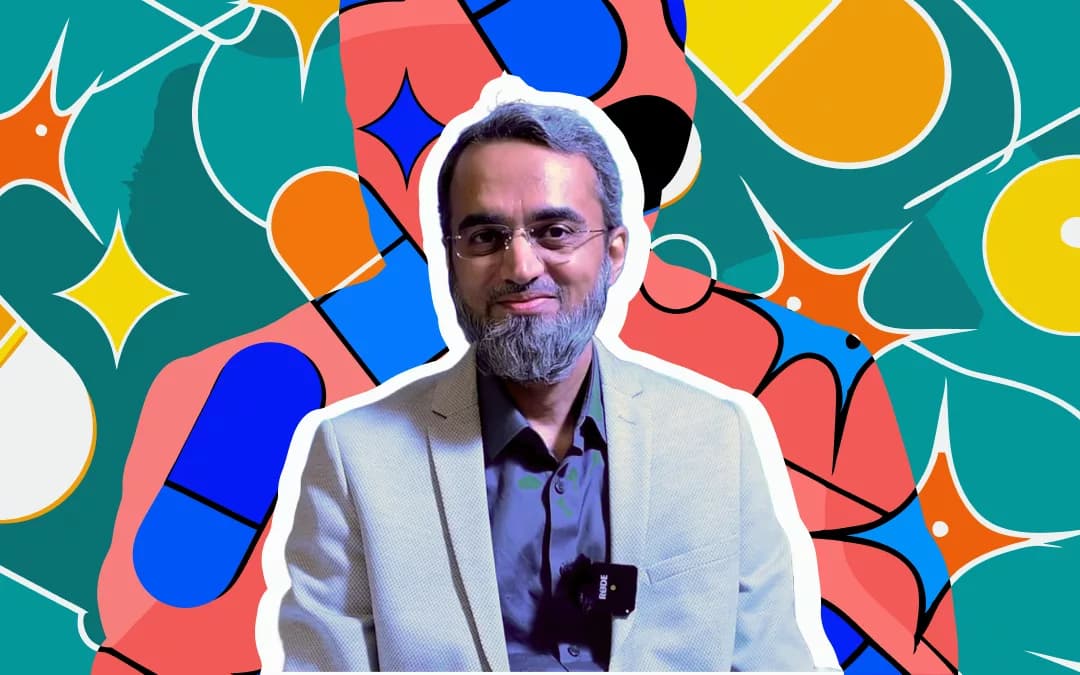
From Paperless QC to AI: The Future of Analytical Science
Paperless labs, AI-ready teams, and 11 years at one company, Dr Rupesh Kelaskar on why staying long, thinking like an analyst, and understanding AI (not fearing it) defines the future of pharma QC.

Pharma Now: Today, we have Dr Rupesh Kelaskar, Vice President – Corporate Quality Control and Analytical R&D at FDC Limited. You have completed your PhD in Analytical Chemistry and have driven the transition from academia to industry. Can you tell us about that journey?
Dr Rupesh: I completed my PhD in Analytical Chemistry from the Institute of Science. I completed my MSc and then started my career as a salesperson. Within three months, I was very sure that this was not my field. I started looking for a career that better aligns with my background in analytical chemistry.
I eventually joined Tata Pharma, where I started my career in pharmaceutical testing and analysis in the QC lab as a trainee analyst. Slowly, I shifted to Cipla, where I worked in their testing labs and later in method development. When I joined IVAX, a US-based multinational, it was a hardcore R&D environment focused on formulation development.
At IVAX, I got an opportunity to pursue my PhD. It took me four and a half years to complete. During that period, I changed jobs again and moved to Bangalore. I was able to complete my PhD there, thanks to my guide, who represented me to Mumbai University and helped me secure a position at my workplace in Bangalore while pursuing my PhD through Mumbai University.
I did my PhD primarily in synthesis and characterisation, and then formulation. I worked on oxindole derivatives, carrying out synthesis projects and studying their antimicrobial activities. After identifying the drug that exhibited the highest antimicrobial activity, with support from my formulation development colleagues, I formulated a capsule.
We then carried out characterisation and compared the dissolution characteristics. We also worked on new techniques, including the use of a new HPLC, and developed dissolution, assay, and other analytical methods. Finally, I was able to submit the work. It was a journey from developing the API to developing the drug product and finally developing the analytical methods as well.
The entire process took about four and a half years, from developing the product to compiling the dossier. I was able to submit it, and during the evaluation at the university, I received appreciation because it was considered a different kind of work. It was not limited to simply synthesising compounds and developing derivatives; we took the work in a different direction.
Pharma Now: How much has your PhD helped you to develop yourself into the leadership role that you are in today?
Dr Rupesh: When it comes to heading analytical labs, whether in QC or analytical research and development, the basic thing is how you acquire knowledge and how you mature through that process. When you conduct research or refer to a research paper or journal, you also learn about the scientists who have published that work. We get inspiration from them and learn from their experience.
Fortunately, during my career, I have also had the opportunity to work with a couple of people who were, and are, scientists. They have been role models for us as well.
Pharma Now: Coming to your experience at FDC, you have been with the company for a long time. We live in a scenario where people keep changing companies at a very rapid rate. What is keeping you there, and how would you describe that in your own words?
Dr Rupesh: With FDC, I have now completed almost 11 years, and this is my longest tenure. Before that, I was with Apertex for almost nine years.
I believe in a long-term career rather than constantly changing companies. The one thing that worked very well for me at FDC was that I had the opportunity to handle both areas: my expertise in analytical development and quality control, compliance, and related areas.
That has kept me engaged. FDC is also a company that has grown significantly over the last 10 years. When I joined, we were completely paper-based. Today, we are on the verge of becoming completely paperless, specifically in the laboratory.
Every year, there is a new challenge, a new implementation, or new software to work with, and that has kept me engaged at FDC.
We have even implemented software for computer validation, which is also paperless. Our QC laboratories are now completely paperless for calculations and documentation, and we continue to develop and identify new software to further increase productivity.
When I was an analyst, I spent more time on documentation than on my actual testing or analytical work. Now, our focus is on ensuring our people spend more time on analysis and less on documentation, paperwork, or calculations. Those activities can be handled by software.
This is what has encouraged me to stay with FDC for the long term. Of course, it has paid off as well. I joined FDC as a General Manager and have progressed to Vice President. In every company where I have worked, I have progressed to a higher position through my performance.
Pharma Now: What disadvantages do you see when people spend only a short amount of time in an organisation?
Dr Rupesh: I have been giving guidance and educational support to some students in my native place and elsewhere, particularly those coming from remote areas who have to travel to colleges. I tell them every time that, during the first five years of your career, you should not think about money or position. You should simply assimilate everything that comes your way.
I have shared my experience with them many times—how I have travelled through my career and how I have reached this level. When you stay in a company for a very short period, you do not even get a complete understanding of the work you are doing. You may take responsibility, but to execute that responsibility and see the results of what you have invested in, you need to stay long enough.
If you are genuinely interested in investing in your work and developing yourself, you would want to stay back. Currently, my directors are very supportive, particularly when it comes to investing in techniques and technology. We are developing new techniques and technologies, and we have been assigned to implement further improvements to become more productive and ensure we provide affordable medicines.
If you look at FDC's product prices, they reflect this objective, as our management aims to ensure we manufacture efficacious medicines while keeping them affordable. As leaders, we are also encouraged to participate in management decisions. It is not limited to laboratory decisions; whenever decisions are taken at the organisational level, we are definitely involved.
I have handled quality control, particularly analytical functions, and both are related to the laboratories. If you look at the current scenario with FDA inspections and the requirements of different agencies, the expectations are largely the same. The guidelines and requirements are becoming harmonised, and inspectors' thinking is too.
There is also mutual recognition between different regulatory agencies. Because of this, it becomes much easier if you adopt a common system everywhere. The basic requirement of the FDA or any other agency is that whatever you do, you have to document it. If any experiment is conducted in analytical research and you document it properly, there is very little left to address from a compliance perspective.
Our analytical R&D laboratories are also paperless. We have software that handles recording instrument data, observations, and everything related to the work being conducted. Finally, even if you go back after 10 years, you will have a record of all the experiments that were conducted.
That is one reason it was relatively simple for us to implement these systems. My knowledge of analytical R&D and QC gave me confidence that we could do it.
Pharma Now: How do you manage analytical scientists who, earlier in their careers, are very precision-specific? They place importance on depth and seek evidence. When it comes to leadership and management, how do you actually handle them? I'm sure there must be differences of opinion and clashes at work.
Dr Rupesh: There are always differences of opinion everywhere. Even at my current level, whenever I go to my sites or my R&D laboratories, I always interact with the last-end user, who is the analyst.
Whenever I go into the laboratory, I consider myself an analyst. I put myself on the shop floor and try to identify the issues they face, the problems they encounter, and the difficulties they experience. Then I try to resolve those issues.
Once you resolve their problems, they also see that somebody is there not just to take work from them, but to understand and address the difficulties they are facing. This makes it much easier to manage people and build trust within the team.
There are conflicts, and people do come forward with complaints. Someone may say, "He is being partial to me," or "My boss is partial to me." When that happens, we literally conduct an exercise where we bring the people together and sit with the concerned boss. We say, "Okay, let's discuss this and resolve it."
We do not want conflicts to continue because, if conflicts remain, they definitely do not create a good culture in the laboratory. So, when you talk about leadership, this is what leadership means to me.
When I am at a leadership level, I sit at my desk and think about policy. But when I am on the ground floor, on the shop floor, I think as an analyst. The first thing that comes to mind is that I am an analyst. I am not a VP or a leader. That makes it easier.
Pharma Now: What is one common mistake that people make when it comes to quality control? Something they assume when they join, but eventually learn and understand what it actually means.
Dr Rupesh: Currently, I'm not sure whether it is a generation gap or what people would call it, but I have seen over the years that knowledge and skill sets are missing. In the past, whenever we were given any new work, we were always ready to do it. It did not matter what time or day it was.
Nowadays, that is missing completely, and it is really troublesome for the entire pharmaceutical industry. I have discussed this with people from other industries as well. Even our instrument manufacturers are facing the same issue, and their service engineers are facing it too.
Nobody is ready to assimilate new information. Everybody wants, I would say, a 9-to-5 job. That is going to create trouble. When we say that tomorrow we want to become the pharmacy of the world, we are preparing, adopting high-tech technologies, bringing in new developments, and doing everything we can.
But we may be missing the basic skill set. We need to focus on developing those fundamental skills as well. Only then can we achieve what we are setting out to accomplish.
If I have a person who is dedicated to doing only one particular type of analysis, and over 10, 12, or 15 years that person gains experience, I may eventually want to give that person a leadership role. But if that person is not knowledgeable and their spectrum of knowledge is not broad enough, how can we assign that responsibility?
Some organisations—I will not take any names—have confined people's roles because they need to retain them. What happened was that, as you said, people would stay for two years, learn a new technique or technology, and immediately change jobs because they had added another technique to their CV.
So companies started thinking, "We will not give them anything." Ultimately, investors are there to get the product out into the market. If people keep changing, there is always a gap, vacancies remain, and productivity suffers. People struggled because of this.
That is why there was a shift in between, where organisations started thinking differently. We tried to do the same thing in our company as well. However, our management was not really of the view that we should hold back knowledge.
We believe we should teach people and let them gain knowledge. If they want to stay with us, they will stay. If they do not want to stay, we cannot tie them up.
This is how we approach it. FDC continues to train people as they are ready. We do not want to dump responsibility on them, but if they are ready to learn and assimilate any technique and every technique, we are there to help them.
Pharma Now: So, in 2019, FDC moved to 100% paperless validation. Can you tell us more about that?
Dr Rupesh: We implemented software specifically for paperless documentation, and we primarily used it for computer system validation. At FDC, we have a policy that whenever we adopt any new technique, technology, or software, it is thoroughly tested and tried at either our analytical lab or by our Corporate Quality Control group, where we have people with expertise in these areas.
We follow that approach consistently. We test everything rigorously and then move ahead. We followed the same process when we implemented this software. As I mentioned earlier, our R&D is also working within the same kind of system, so there is no difference between the quality control and analytical research laboratories in this regard.
We wanted to create this kind of environment, so we started with validation. We carried out all the instrument qualifications and other activities through this software, and it was quite successful. We then started developing templates for method validation, and we were successful with that as well.
We are now on the verge of rolling all of this out to our site level. The sites will have everything ready; they just have to implement it and start using it. They do not have to develop everything from scratch.
That is the main advantage of working in an Indian company, particularly an Indian multinational company. We have the challenge of working with limited resources, but that also pushes us to find smarter and more productive ways of doing things.
When I was at a junior level, I used to wonder why a company could not spend more. But when I started sitting at a leadership and decision-making level, I could understand why. We have to make affordable medicines, so we have to look at how we can do that.
Wherever we can reduce costs or make even a small saving, it matters. This is where we started thinking about where we could save, how we could improve productivity, and how we could save manpower through automation.
However, at FDC, there has never been a policy of laying off people. Wherever we introduce automation, we try to use people in one way or another. We give them assignments or responsibilities, but we continue with them.
Pharma Now: So, after making the validation process paperless, how much improvement has happened, and how far have you come?
Dr Rupesh: The first and most important advantage is that when you go paperless, during an inspection, you do not have to keep searching for documents. You are sure that all the pages are there, and you are sure that everything has been signed. There is no concern about missing documentation.
Earlier, when I used to face inspections, we would have huge files containing the complete qualification documents of an HPLC or other equipment. Before meeting the inspectors, we would go through everything and check whether the file was there and whether all the required documents were available.
With paperless validation, that fear is not there anymore. Every piece of data is available at the click of a button, and that is the most important advantage of paperless documentation.
In the laboratory, I would say that people are an important part of the implementation. As I mentioned earlier, I always think first as an analyst. Whenever we wanted to implement something and finalised that we needed software, we presented it to our entire group of analysts.
We explained what was going to be implemented and assured them that it was not complicated and that we would take care of everything. For example, if you have to enter the batch number of a chemical that is 16 or 17 digits long, there is a 90% probability of making a mistake and missing a digit.
But if you tell the analyst, "You just have to scan the barcode," and all the information becomes available automatically, the response is much more positive. When you reach the people who are the actual implementers and end users, it becomes much easier for them to adopt the technology and build confidence in it.
If you try to enforce technology directly, people can resist it. Rather than going into a resistance mode, we should take a supportive and adaptive approach. That helps us achieve compliance more effectively.
We did receive feedback on how the software was implemented and what issues people faced. We also shared the real advantages, disadvantages, and pain points that came up during the implementation.
Implementing any software, particularly software used by people, is not a simple task. It takes a lot of effort, understanding, and knowledge about the technology, as well as a complete understanding of the systems and processes within the company.
Once you have that understanding, implementation becomes easier. Similar kinds of responses were given to all the other members who came forward and provided their inputs.
For our site QC operations, the entire process took almost three and a half years because we started from scratch. We went through development, testing, and then further development. That is how our journey progressed.
Pharma Now: So now you're into IT automation as well. Given AI is now in the picture, how can you connect these two, and how do you see the future of FDC?
Dr Rupesh: As I said, when I joined FDC 10 or 11 years ago, everything was paper-based. Today, we are talking about going paperless. We are on the verge of introducing more and more automation to increase productivity, reach more people, and grow in the market. Ultimately, that is our goal with automation.
As I have mentioned in my earlier presentations, AI is already here. You have to understand AI; you cannot be away from it because AI is going to be a part of your life. But humans will always be a part of AI. AI is not going to replace humans anywhere.
That is what I have been telling everyone. This is also why it is important to understand AI when implementing AI or software. I have completed my postgraduate studies in AI and Machine Learning, and I am still pursuing my MSc in Data Science.
Pharma Now: So, do you see certain threats with the introduction of AI?
Dr Rupesh: As I said, if you are not going to understand AI, then definitely there is a threat for you. But if you understand it, assimilate it, and work with it, it is definitely going to be a friend for you. AI is always going to be an assistant. It is not going to replace you.
Pharma Now: But with its introduction, do you see the number of employees being reduced or the attitude of employees changing because tasks are becoming more automated?
Dr Rupesh: That's a good question. When I started my career in 1997, or I would say when I was doing my MSc, I was also doing a basic computer applications course. At that time, there was a fear among people that computers were coming and that only people with computer knowledge would survive, while everyone else would lose their jobs.
But in fact, when computers came in, the number of job opportunities increased manifold. I would say that when you assimilate a technology, that technology becomes part of your skill set. The same thing is going to happen with AI.
Robotics and everything else are also coming in, but people need to be trained to work with these technologies. When you talk about AI, it is just one layer. There are multiple other layers below it. You need continuous training, continuous learning, and different scenarios to be given to people so that they can understand how to work with it.
And who will provide that training? We will. When we talk about AI, particularly in analytical laboratories, analytical R&D, or QC labs, it is largely about predictive analytics.
For example, we can use predictive analytics to reduce instrument downtime. Before an instrument breaks down and we lose productive time, it can already be maintained properly, allowing us to continue our work.
Similarly, if you talk about method development, AI tools can definitely help us understand molecules and their behaviour. If we provide the right information and feed it properly, it can give us a definite output. However, those trials still need to be performed before we proceed with them.
Pharma Now: What kind of analytical instruments do you think would be more conducive to AI implementation?
Dr Rupesh: I think most of them can be. If I talk about any laboratory, around 80% of the analysis is carried out using HPLCs, UPLCs, or chromatography-based techniques. So, I think more automation will be focused on chromatography-type instruments.
Pharma Now: Coming to chromatography, since you've been in the chemistry field and in pharma, how do you see the landscape of such analytical instruments changing?
Dr Rupesh: When we talk about HPLCs, we are already talking about what comes next. Maybe further developments in UPLC or something else will be waiting for us. There may be technologies that are currently under development, or something new may emerge. It may also happen that some of the other techniques that have been less explored will develop further.
If I talk about Raman spectroscopy, for example, it has been explored as an identification tool. Going back to conventional IR, you would take the samples and prepare pellets or use ATR, whatever the technique requires.
But with Raman, you can simply go to the warehouse and perform the analysis. The identification can be completed there itself. Similar developments will happen with other instruments and techniques as well. They will evolve and reach a level where AI can become integrated into them.
But AI will always depend on the information that is fed into it. It will not act entirely on its own; the quality of the information provided will determine what it can do.
Pharma Now: So, you've worked across different sites throughout your career. What are the changes that you see, and what are the changes you have implemented in your own organisation?
Dr Rupesh: At the site level, the most important thing is the culture. We have seen a drastic shift in culture. When I was an analyst, we were never used to being afraid of work. We were always ready to take on whatever work was given to us.
Over the period, however, we have seen that people are not always ready to work. So, how do you make them work? How do you get the work done? That is one of the most important things happening now. We need to make people understand the technique and give them examples of how to do the work.
There is also a trend that once a person becomes a manager or reaches a senior level, they do not work at the table anymore. But at my level, if anybody challenges me and says, "This is not going to happen," I will say, "Let's do it together. It will happen." If you are participative and work alongside your people, that itself becomes an encouragement for them.
If this kind of shift is seen everywhere, not just at FDC but across organisations, people can understand the importance of being participative. The change is about being involved and participating in the work. When you become participative, you get the output from that involvement.
Pharma Now: Moving more into this, when you see newcomers in the organisation, do you see them as candidates who have just come to work, or do you see them as people who have come to work, learn, and grow?
Dr Rupesh: I have now spent around 20 to 30 years in the industry, and when people come in, we generally understand what kind of attitude they have. We interact with every newcomer. We have a very short time to interact with them during the interviews, so once they join, we continuously interact with them whenever we get the opportunity, through our managers or otherwise.
This is how we identify talent. Every person is not the same. People have different talents and different levels of understanding. Accordingly, we try to utilise their strengths. Someone may be very good at wet chemistry analysis, while someone else may be very good at instrumental analysis.
Accordingly, we try to utilise their skills and get the required productivity from them. At the same time, we try to teach them other techniques so that they are not limited to only one area. Fortunately, at FDC, the number of people leaving is not very high, and we have been able to retain people in this way.
After a certain point, however, everyone has aspirations to move ahead. We cannot stop people from pursuing their aspirations. At that point, we have to accept it and move on. New people will come in, and we have to train them. Our role is to continuously train people and then give them the opportunity to work and grow.
When I say that a person has worked as an analyst, their basic job is to complete the testing and give us the output. The first thing we tell the leaders working with them is that they are also analysts first.
They need to plan the work accordingly. If a person is expected to complete their work within eight or nine hours, assignments should be planned in a way that allows them to do that. Project work should be planned accordingly, and deadlines should be set based on practical considerations.
Don't give an idealistic timeline that cannot realistically be achieved just to please somebody. Whenever timelines are given, we also sit together and assess what is actually possible. We apply practical thinking when setting those timelines.
There are certain cases where we have to put in additional manpower or find other ways of working together to get things completed. It always remains a challenge to plan the work properly and then execute it effectively.
Pharma Now: We have a few rapid-fire questions. What is one thing that tells you a QC lab has a real scientific culture before you have seen a single result?
Dr Rupesh: I would say yes.
Pharma Now: What is the biggest mistake Indian pharma companies make in analytical method validation?
Dr Rupesh: Coming to decisions too quickly without completely reviewing the results, and then concluding that the method is validated. Whether it is paper or digital validation, you need to review everything properly before reaching that conclusion.
Pharma Now: What does the industry still get wrong about this transition?
Dr Rupesh: Digital validation. Unless you understand what digital validation is, you will not be able to implement it completely. The requirements of the guidelines are that whatever you have done on paper should be replicated in your digital validation.
If it is more, that is much more acceptable. It cannot be less. I give the example that 2 × 2 is four and 2 + 2 is four. But the minute you change the figures, the result changes.
Pharma Now: What is the one instrument or technology that has most changed analytical quality control during your career?
Dr Rupesh: HPLC.
Pharma Now: What has a PhD in analytical chemistry taught you that, if you had not done it, you would have never learned?
Dr Rupesh: Continuous learning. This is how you explore yourself and understand how deeply you can go. I have not reached my depth yet, so I am still learning.
Pharma Now: What is one thing that the next generation of analytical scientists needs to understand about quality leadership?
Dr Rupesh: When you talk about quality leadership, a person needs to understand how far they can work and what level they can reach. Understand your own capability and then take the responsibility.
Rather than taking responsibility and then facing failure, it is better to understand your own capabilities first and then take the responsibility. Knowing your own capability before taking responsibility is an important part of quality leadership.
Pharma Now: Where will pharmaceutical analytical science be in the next 10 years?
Dr Rupesh: That is a very difficult question because I can say what is going to happen in the next five years, but predicting the next 10 years is very difficult. If you had asked me this question 11 years ago, it would have been very easy to answer.
When I had my first appraisal, my manager asked me where I wanted to be in the next 10 years. I said, "I want to be in the next office." He said, "In 10 years, you'll get a promotion every two years." I said, "Why not?"
But in nine years, I was already at that level. That is the way I look at it. It may not always seem possible, but it has to be possible.
Pharma Now: What suggestions or advice would you give to the next generation who would like to take on the same role that you have today?
Dr Rupesh: Keep assimilating knowledge. Focus on the work that you have been assigned, and don't get distracted by the feedback or opinions given by others.
Then you can move much further. Not everyone can be a leader, but definitely, anyone who wants to be a leader can always become one.
Pharma Now: Okay. Thank you so much for being patient and answering all my questions.
Dr Rupesh: Thank you. Thank you very much.
Dr. Rupesh Kelaskar is a senior pharma quality and analytical sciences leader with over three decades of experience in analytical R&D, quality control, and method development. He is Vice President, Corporate Quality Control & Analytical R&D at FDC Limited, overseeing analytical functions and lab systems.
A PhD in Analytical Chemistry, Dr. Kelaskar has led FDC's shift from paper-based operations to paperless validation and digital documentation, focusing on productivity and readiness for AI and predictive analytics.
His leadership philosophy centres on continuous learning and hands-on involvement, staying close to the shop floor and the analyst's perspective. He is a strong voice on digital transformation and AI's role in analytical labs.
More interviews
All interviews →
The Untold Story of COVID-19 Vaccine Development: Dr. Subhash Thuluva Speaks

Mastering Pharma Regulations: Rajni Jha's Guide to Global Compliance Success