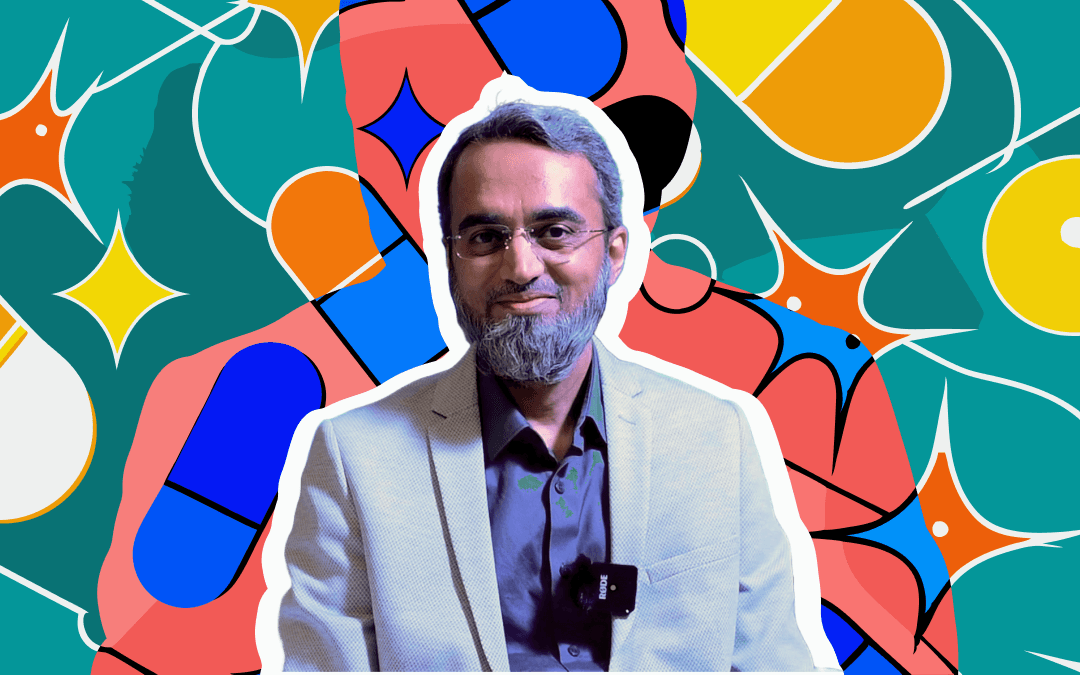
Turning Purpose Into Performance: Mr Pathak On The Real Role of L&D
Most pharma training fails not because of lack of effort — but poor design. Pathak makes a sharp case for learning built around field reality, not aspiration. His AI warning is blunter still.


Pharma Now: Today, we are delighted to welcome Mr Prithwish Pathak, Associate Vice President and Head of Learning & Development. A certified learning architect and NLP practitioner, he brings deep expertise in designing, scaling, and transforming learning ecosystems, with a strong track record of building structured, future-ready L&D frameworks in complex organisations.
Mr Prithwish, we really excited to have you with us. Can you share your journey, what drew you into L&D, and how you evolved into becoming a learning architect and Head of L&D?
Mr Pathak: It has been a long journey, about 27 years in the industry. I began my career in sales and worked my way through the entire sales hierarchy. While working in sales, I realised something unique about the pharmaceutical industry. It is one of the most knowledge-driven sectors. In fact, it’s perhaps the only industry where the customer often knows more than you.
In most industries, you know more than the customer. In pharma, doctors are highly knowledgeable. So if you’re not preparing your people well, you cannot succeed. It’s also a highly regulated market; you can’t run advertisements or make aggressive product claims. You cannot say, “Take this antibiotic, and you’ll be cured in two days.” That’s not how pharma works.
Ultimately, your medium is the medical representative who meets the doctor. If that person is not skilled enough to communicate the message effectively and capture the customer’s attention, you lose the opportunity. That’s where I began to understand the critical importance of training.
Beyond sales, the entire ecosystem, marketing, HR, and other functions, requires continuous learning. Once I realised how central learning was to success in pharma, I developed a strong interest in L&D. I was doing well in sales and understood both customer expectations and internal capability gaps. That insight motivated me to transition into L&D and build my career there.
Once I moved into L&D, I realised it is a highly knowledge-based domain. You cannot simply stand in front of people and speak without credibility. You need strong credentials and expertise. So I invested in building certifications and expanding my knowledge base. Gradually, I moved into the role of L&D Head.
Over the years, I’ve worked with three major organisations: Bayer, a German multinational; Abbott, an American multinational, where I spent about 16 and a half years leading the L&D space; and now Alkem, an Indian multinational.
Throughout this journey, L&D has been deeply fulfilling for me. Alongside my core L&D responsibilities, I also took on stretch roles, brand management, sales force excellence, EHS, and other cross-functional assignments. These experiences helped me understand what each function truly requires. Understanding the needs of every function makes it much easier to design the right learning architecture for the organisation.
Interestingly, the transition into L&D happened during a field visit. At that time, my Managing Director, Mr Sanjay, observed how I worked, how I understood, and how I coached and guided people. He told me, “I think you are more suited for an L&D role. You would make a great career there.”
That conversation became the turning point. Sometimes, others see your strengths before you do, and that insight can redefine your career path.
Pharma Now: Absolutely amazing story. It’s truly powerful when people enter our lives, recognise our strengths, and guide us toward a new direction. Sometimes we begin in one domain, and a coach, director, or leader helps us see a different path. You mentioned that your role is very fulfilling. Could you elaborate on that?
Mr Pathak: Many times, I receive calls from people, either from my current organisation or from places where I’ve worked earlier. These calls are of two kinds.
The first type comes when someone is preparing for a senior-level interview. They want to understand the role, possible questions, and how to prepare. When they call me for that guidance, I realise there’s a reason they’re reaching out. That trust itself is meaningful.
The second type of call is even more satisfying. Someone calls to say they’ve been promoted, or they’ve taken on a bigger role and are doing well. They simply want to share the news. That gives immense satisfaction because you feel that somewhere you’ve contributed to their journey.
And this is not limited to junior professionals. I receive calls from people who have moved from VP roles to CEO positions. They still remember specific feedback. I recall one member of the sales team who was performing extremely well but wasn’t advancing in his career. He once asked me what he should do differently. I told him, “Work on your executive presence. That’s the missing piece.” He took that feedback seriously. Today, he is a CEO.
When you see someone grow because of a small but timely intervention, it gives you deep professional fulfilment.
Another reason this role is fulfilling is that learning is a two-way process. It’s not just about designing programs or delivering knowledge. You learn continuously from the people you train. To remain relevant, you must stay ahead of trends.
Take AI, for example. It’s the topic of discussion everywhere. As an L&D leader, if I don’t know more than the average employee, I cannot add value. So I must constantly read, explore, and stay up to date. That habit of continuous learning keeps the role dynamic and intellectually stimulating.
When you take new knowledge, synthesise it, and weave it into the organisation’s learning architecture, it creates impact. That creative process itself is satisfying. I often compare the L&D function to salt in food. If there is no salt, the food tastes bland. If there is too much salt, it becomes unpleasant. L&D is essential, but it must be applied in the right proportion.
I’ve seen L&D professionals fail because they try to do too many things at once. That doesn’t work. You must step into your stakeholders' shoes, understand what they truly need, and design solutions accordingly. When learning is aligned to real business needs, it creates meaningful results.
Pharma Now: L&D is often seen as a compliance or checkbox function, especially in regulated industries. You’ve worked to shift that mindset. What are the biggest cultural or mindset shifts required to make learning and development a strategic advantage rather than just an obligation?
Mr Pathak: That’s a very important question, and it’s on the mind of many L&D leaders today. To shift this perception, you need to understand the game clearly. The first step is understanding your stakeholders, especially the top leadership. If you’re heading L&D, you must know what your Managing Director, CEO, or CXO wants to achieve. What are they trying to drive? Profitability? Culture transformation? Brand positioning? Discipline? Operational excellence? They all have a vision and mission for the organisation.
If you truly understand that vision and design your learning strategy aligned with their thinking, the initiative automatically gains ownership. It stops being an “L&D program” and becomes an “organisational initiative.”
Most L&D efforts fail when leaders design programs in isolation, believing that something is good for the organisation without validating the need. It may be a great idea, but the approach is wrong. The right approach is to first engage stakeholders, understand their drivers, and then co-create the learning agenda. The moment leadership feels they own the program with you, it stops being a checkbox exercise.
Another critical shift is perception. Participants should not feel that “this is an L&D activity.” The day people say, “This is coming from L&D,” you’ve already lost half the battle. That’s when you need to push attendance, send reminders, and use carrot-and-stick methods. Instead, learning must be positioned as a business imperative. It should feel like an organisational movement, not a departmental initiative.
There’s also another dimension. Sometimes, as an L&D leader, you may see a capability gap that others don’t recognise. In that case, don’t rush to roll out a program. First, create awareness of the need. Help stakeholders see why it matters. Once the need is established and accepted, implementation becomes smooth.
L&D succeeds when it moves from “training delivery” to “business partnership.” And this principle is not limited to pharma; it applies across industries. When L&D leaders align deeply with business priorities and build shared ownership, learning transforms from compliance to competitive advantage.
Pharma Now: I believe there is often a gap between the stakeholders’ vision and the lower levels of the organisation. At that point, the L&D expert must bridge that gap so the vision flows through every layer. And as you mentioned, awareness is critical. You may create multiple programs, but unless people understand why they are being done and why they matter, they won’t have an impact.
Mr Pathak: Let me share an example. One of my CEOs once said, “I want customer obsession to become a behavioural trait of every employee in the organisation.” As an L&D leader, my first question to him was: “How will you define success? How will you know that customer obsession is not just a slogan or a quote, but something people genuinely live by?” He reflected and said, “It’s when even the last-level employee understands it.”
He gave an example. If we were in the hotel industry and the housekeeping staff, after preparing the room, added a thoughtful decorative touch to the bed before leaving, because they want the guest to smile when they enter, that would be customer obsession. At that moment, it is no longer a statement. It is behaviour.
That is the level of understanding we need. At senior levels, leaders often clearly understand the vision. The real challenge lies at the execution level. Does the person sweeping the floor understand that the quality of his work directly impacts customer happiness? When that connection is internalised, the vision has truly cascaded. I told him, “Wonderful. Let’s build from there.”
We designed a structured set of initiatives to translate that vision into everyday actions. It worked remarkably well. It stopped being a tick-box exercise. Stakeholders owned it. In fact, at times, they drove the initiative more passionately than I did. The key is defining what success looks like before designing the program.
Every employee should feel there is a purpose behind coming to work. If someone says, “I don’t feel like going to the office,” or a sales representative says, “We’ll visit those doctors tomorrow,” that is where purpose has already weakened.
Most organisations fail not because of a lack of rules, but because they fail to create purpose. We rely on directives, “Call this many doctors,” “Achieve this target,” “Follow this regulation.” But compliance driven only by instruction is fragile.
You never truly know what a person is doing when you’re not there. Even if someone reports meeting three doctors, you cannot always verify the quality of those engagements. Real execution happens only when people believe in what they are doing.
When employees understand what success looks like and what’s in it for them, performance becomes self-driven. That is where L&D can build a powerful partnership with stakeholders by helping translate vision into belief, and belief into behaviour.
Pharma Now: Moving on, designing scalable and effective learning in large organisations isn’t easy. There are too many people, too many programs, and often too many competing visions. What’s your approach to balancing structured learning with flexibility? And how do you ensure people actually apply what they learn?
Mr Pathak: That’s a very powerful question. Let me simplify it with an example from the pharma industry. If you look back 20–30 years, the kind and quality of sales representatives we used to get were very different from what we get today. It’s not that organisations want lower-quality talent; it’s simply that the talent landscape has changed.
Today’s Gen Z graduates have at least 8–10 career options. Thirty years ago, choices were limited: engineering, medicine, sales, maybe finance or accounting. Because options were fewer, the talent pool entering pharma sales often had a baseline level of capability and communication skills. Today, the competition for talent is intense. So when we design learning programs, we cannot assume the same starting capability that existed decades ago.
For example, suppose you built a sophisticated selling skills model 30 years ago. At that time, the representatives could absorb it, practice it, and reproduce it effectively in the field. Now, if you continue using the same model, without adapting it, you may be giving today’s representatives something that is simply too heavy for their current skill level.
If someone is still developing basic communication confidence, you cannot expect them to demonstrate highly advanced probing and consultative selling skills overnight. That gap creates fear. And when people feel incapable, they don’t apply. That’s the key: When designing content, you must deeply understand your participant.
You can stretch them, maybe 10–15% beyond their current level, but not drastically beyond that. If you overload them, they may appreciate the content in the classroom, but they will not reproduce it in the field.
Let me give you another practical example. A marketer designs a five-page product detailing aid. But today, a sales representative might get only 10 to 30 seconds with a doctor because competition has increased and access has shrunk. In 30 seconds, you expect the rep to communicate five pages for one brand, and maybe four more brands in the same visit? It’s unrealistic.
Instead, marketers should distil those five pages into one powerful, sharp message. That is something a rep can actually execute in real-world conditions. Otherwise, what happens? The rep simply gives a brand reminder and exits. The intended message never lands. The curriculum was heavy. The reality was different.
This is where many organisations fail. They design learning based on ideal scenarios, not practical constraints. If the content is not practical, people won’t apply it. They may say, “What great content,” but application requires confidence. And confidence comes when the skill feels achievable.
You cannot suddenly expect someone to perform like a professional actor if that’s not their capability. But you can train them for something within reach, maybe a simple role-play, a structured conversation model, or a short, impactful pitch.
So balancing structure with flexibility is about this:
- Understand your participant’s capability.
- Understand the field reality.
- Design learning that is slightly aspirational but highly practical.
Only then will the application happen. Otherwise, learning remains in the classroom, not in behaviour.
Pharma Now: As talent expectations evolve with hybrid work, rapid skill shifts, and digital tools, how do you see L&D and HR roles evolving in the next three to five years in pharma and related industries? What should organisations start preparing for now?
Mr Pathak: This is a very important question. With AI and technology evolving so rapidly, if L&D and HR professionals fail to recognise the transformation happening in the job market, they risk falling behind. I always say, AI will not take your job. You will be replaced by someone who knows how to use AI better than you.
AI itself doesn’t eliminate jobs in most functional roles. The real shift happens when one professional adopts AI and becomes more efficient, while another resists it. There is a misconception that AI will drastically cut jobs. In reality, it may automate certain routine or repetitive tasks, particularly in IT or administrative areas, but for most roles, AI will be an enhancement tool. The risk lies in non-adoption.
From an HR perspective, this means job descriptions need to be rewritten. HR teams should revisit every role and ask:
- Where can AI add value in this job?
- What level of AI literacy should this role require?
When scouting CVs or working with headhunters, HR must prioritise candidates who can integrate AI tools into their workflows. From an L&D perspective, the shift is equally critical. If L&D professionals refuse to adopt AI, their content creation and program design may become outdated. Today, with AI assistance, you can design engaging content, frameworks, or even psychometric tools far more efficiently.
For example, something that might have taken four hours to develop manually can now be structured in 15 minutes using AI, and then fine-tuned by you in another 30 minutes. That’s the advantage. However, AI cannot replace human judgment. It cannot replace human intuition. It cannot replace contextual understanding.
It’s similar to an eye specialist using a diagnostic machine. The machine measures your eye power, but the doctor fine-tunes the prescription. The final decision remains human. The future is not AI versus humans. It is AI working in tandem with humans. HR and L&D leaders must embrace that partnership model.
Pharma Now: For HR and L&D leaders listening to us today, if you had to give one actionable piece of advice to begin building a learning-first culture, what would it be?
Mr Pathak: I would say two things. First, deeply understand your audience’s needs. Without that clarity, no learning initiative will succeed. Second, give people what they can realistically absorb and apply. Do not overload. In learning, more is not better. Appropriate is better. If you keep these two principles in mind, most challenges will resolve themselves.
Rapid Fire Round
Pharma Now: If you could instantly master one new skill, work-related or personal, what would it be?
Mr Pathak: Understanding more AI tools.
Pharma Now: Favourite learning format, book, video, podcast, or peer conversation?
Mr Pathak: Currently, podcasts.
Pharma Now: One professional habit that helps you stay productive?
Mr Pathak: Every night before I sleep, I introspect. I ask myself, “What new thing did I learn today?” It could be a small article, a new skill, or even a piece of general knowledge. As long as I’ve added something new to my understanding, I feel satisfied.
Pharma Now: What’s a non-work hobby that helps you recharge?
Mr Pathak: Listening to music and podcasts.
Pharma Now: If you had to describe yourself in one word?
Mr Pathak: Fast learner.
Pharma Now: Thank you so much. It was truly insightful speaking with you. We’ve learned a great deal, and I’m sure many of our listeners will apply these insights in their own organisations. Thank you again for your time.
Prithwish Pathak is a certified learning architect and NLP practitioner with over 27 years in pharma. Starting in sales, he transitioned into L&D after a Managing Director recognised his coaching instinct — a move that shaped his entire career.
He has held senior L&D roles at Bayer, Abbott, and currently Alkem, where he serves as Associate Vice President and Head of Learning & Development. His work spans designing learning ecosystems, building future-ready frameworks, and aligning learning strategy with business priorities in complex, regulated environments.
He has also taken on stretch roles in brand management, sales force excellence, and EHS — giving him a well-rounded view of what every function truly needs from a learning architecture standpoint.
More interviews
All interviews →
The Untold Story of COVID-19 Vaccine Development: Dr. Subhash Thuluva Speaks

Mastering Pharma Regulations: Rajni Jha's Guide to Global Compliance Success