RAG In Pharma For GMP Knowledge Management
RAG In Pharma For GMP Knowledge Management helps employees get fast, document-grounded answers instead of digging through SOPs manually.


Introduction
Pharmaceutical manufacturing runs on paperwork — and lots of it. Standard Operating Procedures (SOPs), batch records, deviation reports, validation protocols, quality manuals, and regulatory guidance documents pile up by the thousands across a single facility, let alone across a global company.
When an operator needs to quickly check the correct procedure for a specific piece of equipment, or a quality manager needs to find every past deviation related to a particular process step, searching through this mountain of documents can be slow, frustrating, and prone to human error.
This is the exact problem that Retrieval-Augmented Generation, or RAG, is designed to solve. RAG is an approach that combines the conversational, easy-to-understand answers of an AI language model with the ability to pull real, verified information directly from a company's own trusted documents — instead of relying purely on what the AI model already "knows" from its general training.
In simple terms, RAG gives an AI assistant a library card to your company's actual Good Manufacturing Practice (GMP) documents, so instead of guessing an answer, it looks up the real source and answers based on that.
This article explains what RAG is, why it's becoming an important tool for managing GMP knowledge in pharma, how it actually works, and what challenges companies need to navigate as they bring this technology into a heavily regulated environment.
What Is RAG, In Plain Terms?
A standard AI language model generates answers based only on patterns it learned during training, which happened at some point in the past. This creates two problems in a pharma setting:
The model's knowledge can be outdated, since it isn't automatically aware of a company's latest SOP revision or a newly issued regulatory guidance.
The model may "hallucinate" — confidently generating an answer that sounds correct but isn't actually grounded in any real document.
RAG addresses both issues by adding a retrieval step before the AI generates its answer. Instead of answering purely from memory, the system first searches through an approved, up-to-date collection of documents to find the most relevant material, and then uses that retrieved content to generate a grounded, evidence-based response.
A Simple Way To Picture The Difference:
A regular AI model is like asking a knowledgeable colleague a question from memory — helpful, but occasionally wrong or outdated.
A RAG-powered system is like asking that same colleague to first pull the actual current SOP off the shelf, read the relevant section, and then answer your question based on exactly what it says.
How RAG Works In A GMP Environment?
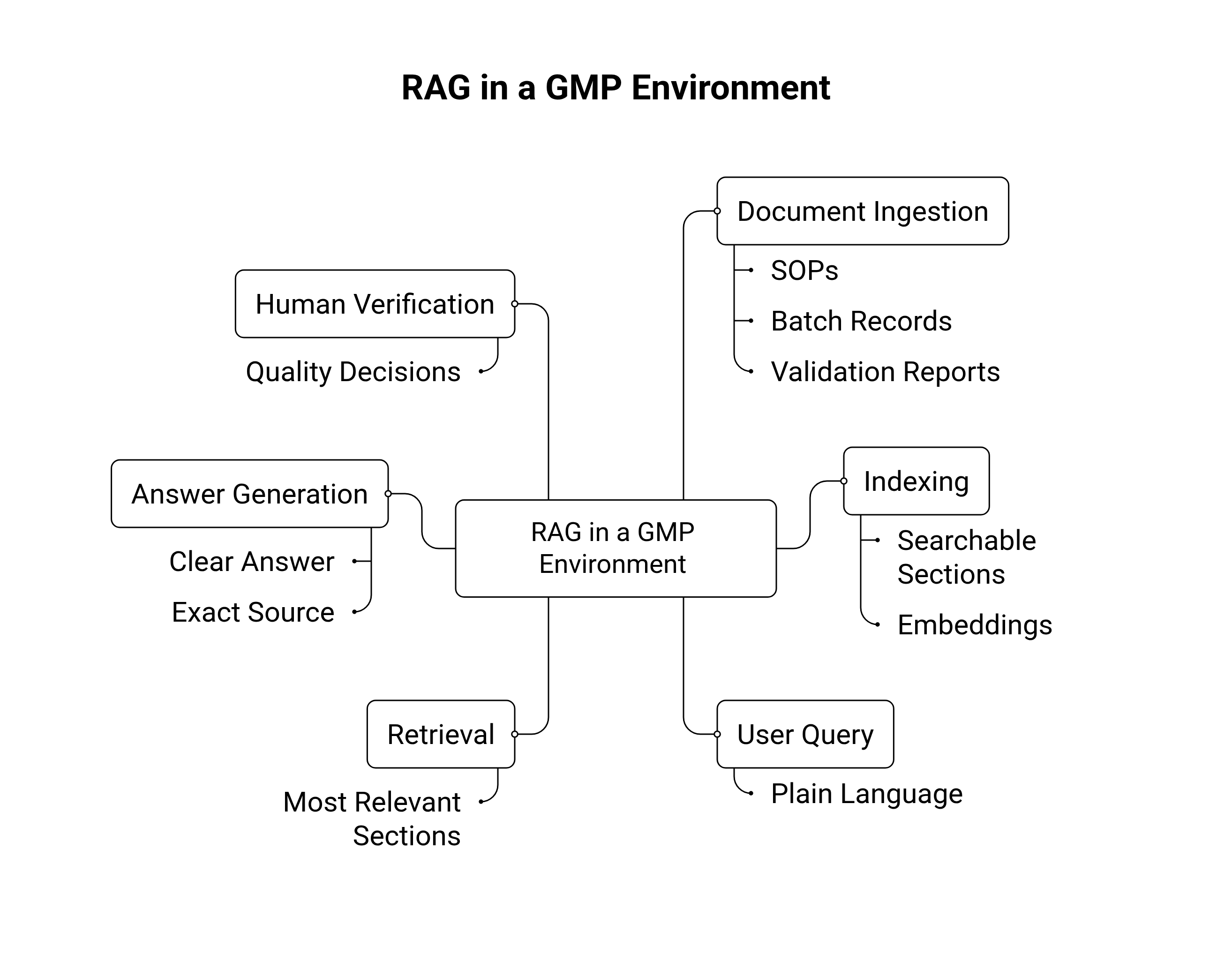
While the underlying technology is sophisticated, the basic workflow of a RAG system used for GMP knowledge management generally follows these steps:
a) Document Ingestion: Approved GMP documents — SOPs, batch records, validation reports, regulatory guidance, deviation logs, and training materials are loaded into the system.
b) Indexing: The system breaks these documents into smaller, searchable sections and converts them into a mathematical format (often called embeddings) that allows the software to understand meaning, not just keywords.
c) User Query: An employee asks a question in plain language, such as "What's the current cleaning procedure for Reactor 3?"
d) Retrieval: The system searches the indexed document library and pulls out the most relevant sections related to that specific question.
e) Answer Generation: The AI model then uses those retrieved sections to generate a clear, conversational answer, often citing exactly which document and section the information came from.
f) Human Verification: In a regulated environment, especially for anything tied to quality or compliance decisions, the retrieved source and generated answer are expected to be reviewed by a qualified person before being acted upon.
Why Are Pharma Companies Interested In RAG For GMP Knowledge Management?
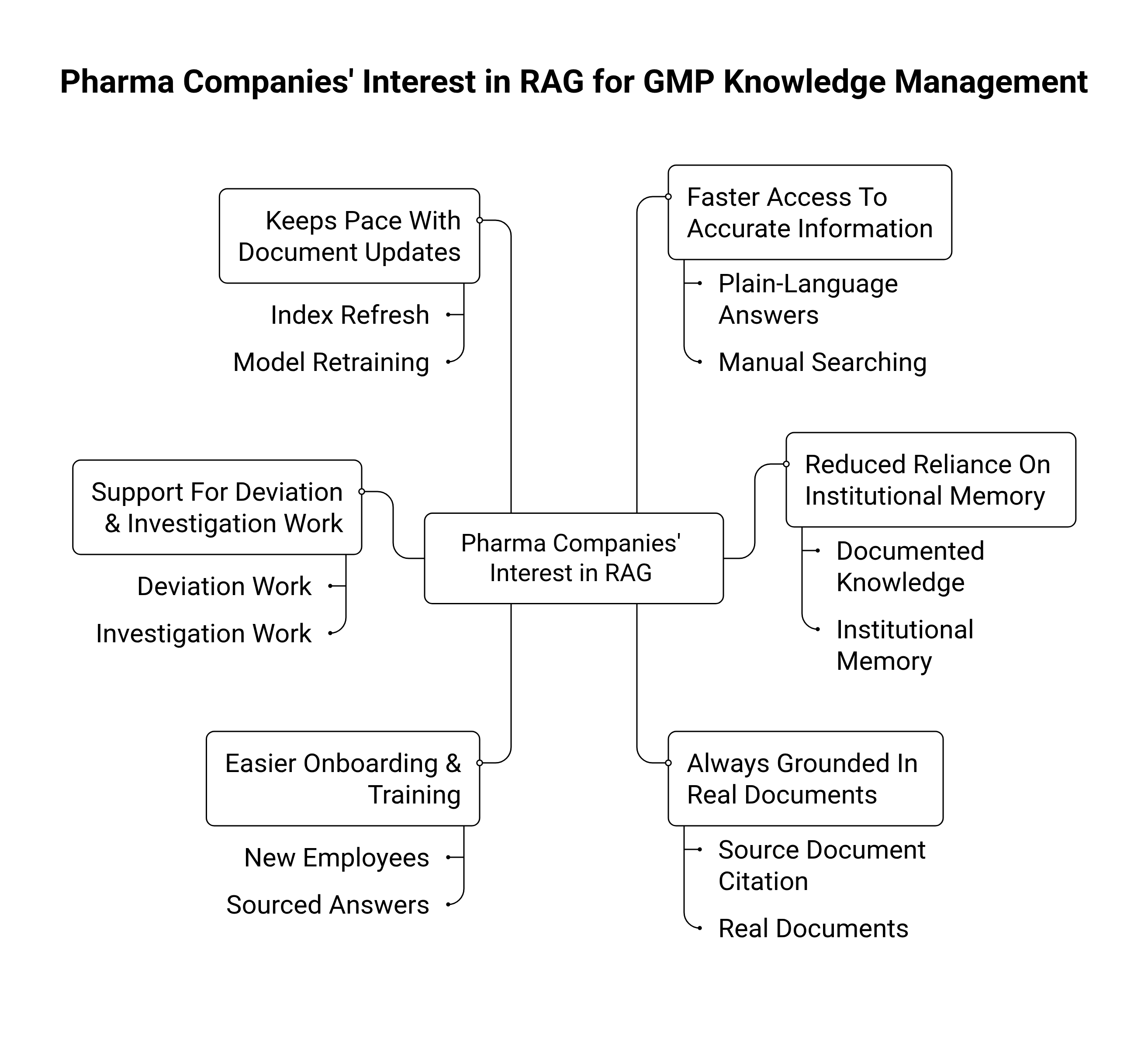
Several practical benefits are driving growing interest in RAG within quality and manufacturing functions:
1) Faster Access To Accurate Information — Employees can get quick, plain-language answers instead of manually digging through lengthy document management systems.
2) Reduced Reliance On Institutional Memory — Critical knowledge often lives in the heads of experienced staff; RAG systems help make documented knowledge more accessible to everyone, reducing risk when experienced employees retire or move on.
3) Always Grounded In Real Documents — Because answers are generated from actual retrieved content rather than general AI training data, responses can include direct references back to the source document, which is especially valuable in an audit-focused industry.
4) Easier Onboarding & Training — New employees can quickly get accurate, sourced answers to procedural questions rather than needing to interrupt busy colleagues or search through unfamiliar systems.
5) Support For Deviation & Investigation Work — Quality teams can more quickly locate relevant historical deviations, root cause analyses, or corrective actions related to a current issue, speeding up investigations.
6) Keeps Pace With Document Updates — Unlike a model that would need expensive retraining to reflect a new SOP version, a RAG system can be updated simply by refreshing its document index, allowing much faster adaptation to new or revised guidance.
Real-World Applications Taking Shape
RAG-based tools are already being explored and piloted across several areas of pharmaceutical operations, including:
SOP & Batch Record Assistance: Helping operators quickly find the exact procedural step relevant to a task at hand.
Regulatory Guidance Navigation: Assisting quality and regulatory affairs teams in locating relevant sections of complex guidance documents from agencies like the FDA or EMA.
Deviation & CAPA Support: Surfacing similar past deviations and their corrective actions to help investigators identify patterns more quickly.
Drug Discovery & Lab Knowledge Management: Connecting data from electronic lab notebooks (ELNs) and laboratory information management systems (LIMS) so researchers can query institutional knowledge more efficiently.
Training & Compliance Support: Helping employees quickly clarify procedural questions in a way that's grounded in the company's actual approved documentation, rather than general knowledge.
RAG is one part of a bigger compliance toolkit, see the full range of digital platforms pharma companies use to centralize documentation and stay audit-ready.
Read: Best Compliance Tools for Pharmaceutical Companies
The Unique Challenge: Validating A System That Isn't Always Predictable
Here's where pharma's use of RAG runs into something genuinely tricky. Pharmaceutical companies operate under GxP principles, which traditionally expect systems to be validated by confirming they produce the same, predictable result every time given the same input. AI language models, however, work probabilistically — meaning they don't always generate the exact same wording for the same question, even when the underlying retrieved information is identical.
Industry experts preparing to address this challenge at recent pharmaceutical quality conferences have pointed out that this isn't entirely new territory. GMP processes that already involve natural variability — such as manual visual inspection of products — are validated using appropriate statistical methods rather than expecting a single fixed outcome every time. A similar risk-based mindset is being applied to RAG systems, where validation efforts are scaled according to how critical the underlying data is and how much impact a given answer could have on product quality or patient safety.
This generally means that:
Low-risk uses, such as helping an employee quickly locate a document, may require lighter validation.
Higher-risk uses, such as any system output that could directly influence a quality decision, require stronger human oversight, more rigorous testing, and clear traceability back to source documents.
Regulators in both the US and EU appear to be moving toward broadly aligned expectations on this point, even as detailed frameworks are still being finalized.
RAG isn't the only AI application facing GxP validation questions, quality assurance itself is being reshaped by similar risk-based thinking. See how AI is changing QA validation more broadly.
Read: How AI Is Transforming Quality Assurance In Pharma
Other Practical Challenges To Keep In Mind
Beyond validation, a few other considerations matter when introducing RAG into a GMP environment:
Data Quality & Document Control: A RAG system is only as reliable as the documents it retrieves from; outdated or improperly controlled documents in the index can lead to incorrect answers.
Access Control & Data Security: Sensitive quality and manufacturing documents need strict permission controls to ensure only authorized personnel can query certain information.
Change Management: Document indexes need to be kept in sync with the latest approved document versions, requiring clear processes for updating the system whenever an SOP or protocol changes.
User Trust & Adoption: Employees need training on how to use these tools appropriately, including understanding that AI-generated answers should support, not replace, professional judgment and formal document review.
In Conclusion
Retrieval-Augmented Generation offers a genuinely practical solution to one of pharma's most persistent operational headaches: making sense of enormous volumes of GMP documentation quickly and accurately.
By grounding AI-generated answers in real, verified company documents rather than general training data, RAG systems can help employees find accurate information faster, support smoother onboarding, speed up investigations, and reduce dependence on institutional memory.
At the same time, bringing this technology into a heavily regulated environment isn't as simple as switching on a chatbot. Because AI models behave probabilistically, pharma companies are having to rethink validation approaches, borrowing lessons from how variability is already managed in other GMP processes, and applying a risk-based lens to decide how much oversight each use case truly needs.
As regulatory expectations continue taking clearer shape, RAG is well positioned to become a standard, trusted tool for GMP knowledge management — not as a replacement for human expertise, but as a fast, reliable way to put a company's own documented knowledge directly into the hands of the people who need it.
FAQs
1) What Is RAG In Pharmaceutical GMP Knowledge Management?
RAG, or Retrieval-Augmented Generation, is an AI approach that retrieves information from approved GMP documents and uses it to provide accurate, source-based answers. It helps employees quickly find information from SOPs, batch records, deviation reports, validation documents, and other controlled resources.
2) How Does RAG Help Pharma Companies Manage GMP Knowledge?
RAG makes it easier and faster to find relevant information from large volumes of GMP documentation. It can support tasks such as locating SOP instructions, finding similar past deviations, accessing regulatory guidance, and helping employees with training and onboarding.
3) Can RAG Provide Reliable Answers For GMP-Related Questions?
RAG can provide more reliable, document-grounded answers by retrieving information from approved sources rather than relying only on an AI model's general knowledge. However, the quality of the answer depends on the accuracy, currency, and control of the documents in the system, and important quality decisions still require appropriate human review.
4) What Are The Main Challenges Of Using RAG In A GMP Environment?
Key challenges include validating probabilistic AI outputs, maintaining accurate and up-to-date document indexes, controlling access to sensitive information, ensuring data security, and keeping the system aligned with document changes and GMP requirements.
5) Can RAG Replace Human Expertise In Pharmaceutical Operations?
No. RAG is designed to support employees by helping them find and understand relevant GMP information faster. It should complement professional expertise and formal document review, particularly when the information could affect quality, compliance, or patient safety.
Reporting on the science, business and regulation shaping the pharmaceutical industry.



Discussion