How To Write a CAPA Report That Stands Up To Any Audit
A practical guide to writing CAPA reports that meet GMP, FDA, and ISO standards with strong root cause analysis.


If you work in pharma or medical devices, you already know that a CAPA (Corrective and Preventive Action) is not just a form you fill out and file away. It is one of the most closely examined documents during any regulatory inspection. The FDA, ISO 13485, and GMP guidelines all place enormous weight on how well an organisation investigates quality issues, addresses root causes, and prevents problems from returning.
Yet, despite how critical CAPA documentation is, many teams still get it wrong. Not because they don't care, but because they treat the CAPA report as a box-ticking exercise rather than a coherent, evidence-based story. And that's exactly what auditors can smell from a mile away.
This guide will walk you through what a strong CAPA report actually looks like, how to build each section with precision, and what common mistakes to avoid so your documentation holds up under the toughest regulatory scrutiny.
What Actually Is a CAPA Report
Before anything else, let's be clear about what we're talking about. There's a lot of confusion in practice between a CAPA form, a CAPA action plan, and a CAPA report, and handing over the wrong one during an audit can create immediate red flags.
- A CAPA form is the structural framework. It captures the necessary fields and information in an organised way.
- A CAPA action plan goes a layer deeper: it details the specific actions to be taken, who is responsible, and when each step will be completed.
- The CAPA report is the full, top-level document. It tells the complete story from problem identification through verified resolution.
It includes investigation findings, root cause analysis, the rationale for the chosen actions, proof of implementation, and confirmation that those actions actually worked.
Think of it as a stack. The form organises, the action plan plans, and the report proves. Regulators are not interested in how neatly you filled out a template. They want to see that you understood the problem, dug into why it happened, took actions that genuinely addressed the root cause, and then confirmed through data that the issue won't return. That's the standard a good CAPA report is held to.
Start with a Precise Problem Statement
Every strong CAPA report begins with a clear, specific, evidence-based problem statement. This is where many reports fall apart before they've even started. Writing something like "process failure observed" or "deviation in batch production" tells an auditor almost nothing. It doesn't tell them what failed, where it happened, when it was detected, how it was caught, or what data confirmed it.
A proper problem statement should answer all of those questions. For example, instead of writing "tablet coating non-conformance," you would write something like: "During in-process quality checks on Batch 2204-B on 14 March 2025, the coating thickness on approximately 8% of tablets was found to be below the validated specification of 0.2 mm, as measured by micrometre at three sampling points. The deviation was detected during the mid-point inspection by QC personnel and was not observed in the previous batch."
That level of specificity serves two purposes. It shows the auditor that you correctly identified the problem, and it lays the foundation for a root cause investigation that targets the right issue.
Conduct a Structured Root Cause Analysis
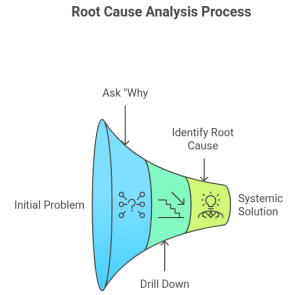
Root cause analysis is the backbone of any CAPA. Regulators don't require you to use a specific methodology. Whether you use the 5 Whys, Fishbone diagrams, Failure Mode and Effects Analysis (FMEA), or fault tree analysis, what matters is that the process is structured, documented, and supported by evidence.
The 5 Whys technique is commonly used in pharma because it's straightforward to document and follow. You start with the problem and ask "why" it happened, then ask "why" again for each subsequent answer, usually drilling down through five levels until you reach a systemic root cause rather than a surface symptom. The key is to keep pushing past the first or second level, where most investigations stop too early.
For instance, if the tablet coating was out of spec, the first "why" might reveal that the spray rate fluctuated. The second "why" might show that the coating gun was partially blocked. The third "why" might reveal that the coating gun cleaning SOP lacked a step to inspect nozzle integrity after cleaning. That's a root cause worth correcting.
Whatever tool you use, the output must be documented in detail. Auditors want to see the reasoning, not just the conclusion. They need to follow your thinking from the problem back to its source, and any gap in that logic will attract follow-up questions.
Define Corrective and Preventive Actions That Match the Root Cause
Once the root cause is established, every action you specify must flow logically from it. This sounds obvious, but it's one of the most frequently flagged issues during inspections. Actions that address the symptom but not the root cause are a clear signal that the CAPA is ineffective.
There are two layers to address here:
- The corrective action addresses the immediate problem, fixing what went wrong in that specific batch or event.
- The preventive action addresses the systemic issue, so it doesn't happen again anywhere in the process. Both must be explicitly documented.
Using the coating gun example, the corrective action might be to re-inspect and clean all coating guns in the facility and put the affected batch on hold pending review. The preventive action might include revising the cleaning SOP to add a mandatory nozzle inspection step, validating the updated procedure, retraining all relevant operators, and adding a verification checkpoint to the batch record.
Each action should have a clearly assigned owner, a realistic completion date, and a reference to supporting documents such as SOPs, validation protocols, or training records. Vague actions with no accountability don't just look bad; they make your quality system seem dysfunctional.
Risk Assessment Belongs in the Report
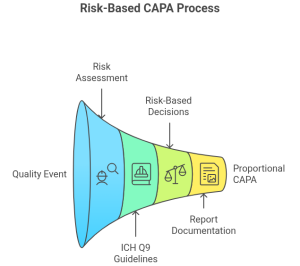
A CAPA report should also include a risk assessment tied to the quality event. Regulators expect to see that you considered the potential impact on product quality, patient safety, and regulatory compliance when scoping the CAPA.
Under ICH Q9 guidelines, which inform quality risk management across GMP-regulated industries, decisions about the extent of investigation and the breadth of corrective actions should be proportional to the level of risk. If a deviation poses a low risk to product safety or quality, your actions can be more targeted. If the risk is significant, your investigation and actions need to be broader and more rigorous.
This risk-based thinking should be visible in the CAPA report. Simply stating that a risk assessment was performed is not enough. The report should show which risk factors were evaluated, which risk tools or matrices were applied (e.g., probability and severity scoring), and how the assessment outcome shaped the scope of the CAPA.
Document Implementation Evidence
Writing down that you will take an action is not the same as proving that you did. Implementation evidence is what transforms a plan into a verifiable fact, and regulators are very clear that they want to see both.
For every action listed in your CAPA, there should be corresponding evidence of completion. If an SOP was revised, include the document reference and the version number. If training was conducted, reference the training records and attendance logs. If equipment was repaired or modified, include the maintenance or change control documentation. If a process was re-validated, link to the validation protocol and the approved summary report.
All of this documentation should be linked directly to the CAPA record, not just mentioned in passing. Auditors will ask to see it, and if they have to go hunting for it, the impression it creates is that your quality system lacks traceability.
Verify Effectiveness with Data, Not Just Task Completion
Closing a CAPA when all tasks are complete is one of the most common audit findings in the pharma industry. Closing a CAPA because you've verified that the actions actually prevented recurrence, that's what compliance looks like.
Effectiveness checks are a formal verification step that regulators expect to see in every CAPA report. They should be defined before the CAPA is even implemented, so there is a predetermined measure of success. After implementation, you collect data over a defined monitoring period and compare outcomes against the criteria you set.
For example, if your CAPA addressed a recurring documentation error in batch records, your effectiveness check might state: "Zero recurrence of the same error type over 30 consecutive batch reviews conducted within 90 days post-implementation." If the data shows no recurrence, the effectiveness check is passed and the CAPA can be formally closed. If recurrences are observed, the CAPA must be reopened and the root cause revisited.
Measuring task completion rather than outcome is the single biggest weakness in effectiveness verification. The whole point of a CAPA is that the problem doesn't come back. Your report needs to prove that it hasn't.
Make Traceability the Spine of Your Report
Throughout every section of the CAPA report, traceability is what holds everything together. An auditor should be able to start at any point in the report, the root cause, the action plan, or the effectiveness check, and trace logically backwards and forward through the entire document.
This means the problem statement should connect to the investigation. The investigation should lead to the root cause. The root cause should drive the actions. The actions should reference implementation evidence. The evidence should feed into the effectiveness check. And the effectiveness check should directly link back to the original problem statement.
When that chain is intact and visible, auditors can move through your report with confidence. When there are gaps, attachments that aren't referenced in the narrative, actions that don't map to any root cause, effectiveness checks that measure the wrong thing, the questions multiply.
20260413130258.svg)
Common Mistakes That Flag Auditors Immediately
Even experienced quality teams make these errors, so it's worth naming them directly. Vague or generic problem statements are the most frequent starting point for weak CAPAs. Root cause analysis that stops at "human error" or "training issue" without explaining the systemic failure underneath those labels is another persistent problem.
Actions that fix the symptom but ignore the underlying cause are considered ineffective CAPAs by regulators. Effectiveness checks that only confirm task completion, rather than confirming the problem is solved, are a missed step. And disconnected documentation, where evidence exists but isn't linked to the CAPA record, creates traceability gaps that undermine the entire report.
Fixing these issues is not complicated. It requires discipline, structure, and a genuine commitment to understanding what went wrong, not just documenting that something did.
The Role of Your Quality System in CAPA Reporting
A CAPA report is only as strong as the system that supports it. When CAPA documentation is managed in a modern electronic Quality Management System (eQMS), the report is automatically linked to its triggering event, a deviation, complaint, audit finding, or nonconformance. Every step carries an audit trail. Version control ensures that changes to the CAPA are captured. Effectiveness checks can be built into workflows so they aren't skipped. And because CAPAs are connected to related quality events, trends become visible at a systemic level rather than being buried in individual records.
Whether you're managing CAPAs in a digital system or a structured paper-based process, the standard is the same: every element of the report must be traceable, logical, and verifiable. The goal isn't to impress an auditor. The goal is to demonstrate that your quality system learns, corrects, and prevents, and that you can prove all three.
Reporting on the science, business and regulation shaping the pharmaceutical industry.
More in Pharma Manufacturing
All articles →
Compliance In Pharma Manufacturing 2025: Key Regulations And Best Practices You Need to Know

Improving Pharmaceutical Manufacturing Flexibility: Agile Manufacturing and Rapid Scale-Up

Discussion