Beyond Compliance: How AltiusHub Is Rebuilding Trust in Drug Safety and Traceability
How unit-level traceability and authentication can strengthen drug safety and reduce counterfeit medicines in pharma supply chains.

In the global pharmaceutical ecosystem, drug safety has long been framed as a matter of regulatory compliance. Serialization mandates, track-and-trace systems, and QR codes have become standard fixtures across production lines and packaging halls.
Yet, as recent experience in India has shown, compliance alone does not guarantee protection. Counterfeit medicines continue to infiltrate legitimate supply chains, often hidden behind the very technologies meant to stop them.
This reality is the starting point for AltiusHub, a next-generation supply chain traceability company that is challenging the industry to think beyond audits, mandates, and checklists. Drawing on deep technical expertise and real-world regulatory experience, AltiusHub reframes traceability not as a regulatory burden but as critical infrastructure for patient safety, brand trust, and long-term resilience.
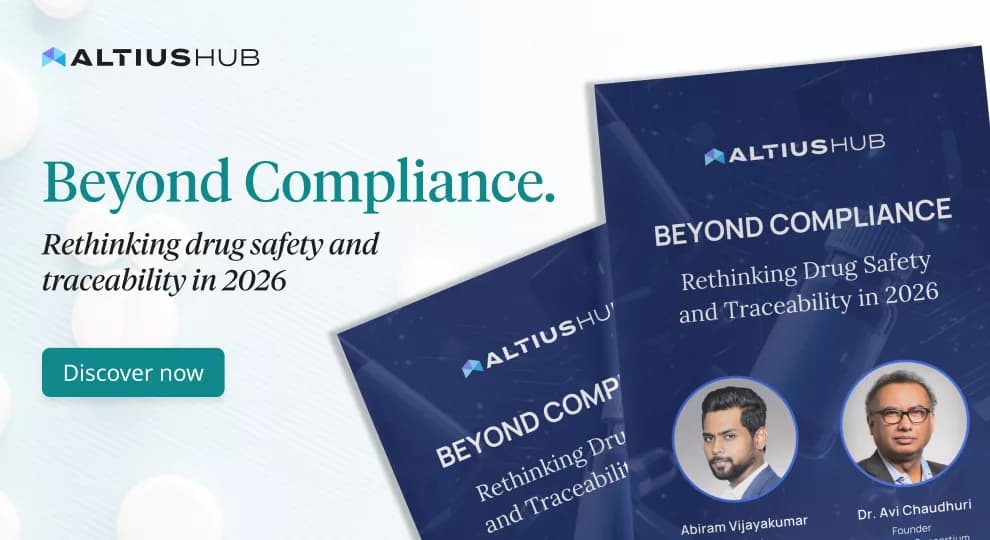
These insights are explored in depth in its expert discussion, “Beyond Compliance: Rethinking Drug Safety and Traceability in 2026,” which examines how advanced, unit-level traceability can transform supply chain operations. Here’s a glimpse of the key perspectives it offers to help industry leaders navigate these challenges.

The Compliance Illusion and the QR Code Paradox
India’s QR code mandate, introduced by the Ministry of Health and Family Welfare, was widely welcomed as a turning point in the fight against counterfeit medicines. For many manufacturers, this announcement felt like a finish line. Once QR codes were printed and systems were technically compliant, the assumption was that the problem had been solved.
In practice, the opposite has often occurred. In the discussion, Dr. Chaudhuri noted that the regulatory loopholes and inconsistent implementation have created a dangerous environment of false reassurance. QR codes printed on secondary cartons instead of primary packs, and batch-level codes used as authentication tools, have made it easier for counterfeit products to blend in rather than be identified.
For patients, this means scanning a code that appears legitimate but provides no meaningful confirmation of authenticity. For brands, it means erosion of trust and growing exposure to reputational and legal risk. Although the system checks the compliance box, it quietly fails its core purpose.
Authentication and Traceability: Different Problems, One Outcome
One of the central arguments advanced by Dr. Avi Chaudhuri, former Chief Scientist at Systech and Founder of The Kulinda Consortium, is that the pharmaceutical industry has blurred two fundamentally different concepts: traceability and authentication.
Traceability answers a logistical question: Where has this product been?
Whereas, Authentication answers a far more urgent one: Is this product genuine?
While batch-level traceability systems support reporting, recalls, and supply-chain visibility, they cannot establish authenticity at the point of use. Without a unique, non-repeating identifier on every saleable unit, true authentication is impossible.
As Dr. Chaudhuri emphasizes:
"Batch data can support logistics and regulatory reporting, but it cannot establish authenticity. If you do not know which specific unit you are looking at, you cannot know whether it is genuine."
This distinction underpins many failures in drug verification programs, where batch-level identifiers are mistaken for proof of authenticity, leaving room for counterfeit products to exploit the system. AltiusHub addresses this by generating globally unique unit-level identifiers using an advanced AI-first architecture.
Each pack carries a distinct, verifiable identity that can be independently authenticated and traced meaningfully throughout its lifecycle. Authentication and traceability converge into a single, reinforcing system that delivers compliance, patient safety, brand protection, and long-term trust.
For AltiusHub’s Co-Founder, Abiram Vijayakumar, regulations define minimum guardrails, but counterfeiters operate outside them.
"If systems are designed only to satisfy audits, they will always lag behind real-world threats."
Built in the AI era, AltiusHub separates core verification data from reporting layers, prioritizing interoperability, adaptability, and practical deployment, enabling meaningful authentication and traceability without imposing unsustainable operational burdens, even in vast, fragmented markets like India.
The Consumer as the Final Line of Defence
Technology alone, however, cannot win the fight against counterfeiting. Dr. Chaudhuri emphasizes a critical but often overlooked dimension: CONSUMER ADOPTION.
Even the most robust authentication system fails if patients are unaware of it, distrust it, or find it cumbersome to use.
Effective consumer empowerment requires three things:
- Immediate authentication feedback
- Visible differentiation that cannot be cloned onto fake products
- Sustained public awareness.
When these elements align, patients are far more likely to verify medicines at the point of purchase. In healthcare, where the stakes are deeply personal, once trust is built, even small habits can compound quickly.
AltiusHub’s philosophy does not offload responsibility onto consumers. Instead, it recognizes them as a critical checkpoint within a broader ecosystem, supported by technology, industry accountability, and regulatory oversight.
Looking Ahead: Quiet Progress, Real Impact
If we fast-forward five to seven years, meaningful progress in drug safety may not be marked by dramatic policy announcements or the introduction of complex new mandates. Instead, success will look quieter and more practical. Counterfeit medicines will struggle to enter supply chains, and if they do, they will be identified and removed before they reach patients.
Unit-level authentication will work reliably. Systems will stop generating false reassurance. And trust, once weakened, will be rebuilt through consistent action rather than rules that exist only on paper.
AltiusHub is building the future, not with shortcuts, but with careful, steady work that mirrors the realities of pharma. In drug safety, although the rules lay the foundation, trust grows only through consistent practice.
Click below to explore the insights shared by Abiram Vijayakumar and Dr. Avi Chaudhuri on the forces shaping the future of drug safety and traceability.

Reporting on the science, business and regulation shaping the pharmaceutical industry.
More in Pharma Manufacturing
All articles →
Compliance In Pharma Manufacturing 2025: Key Regulations And Best Practices You Need to Know

Improving Pharmaceutical Manufacturing Flexibility: Agile Manufacturing and Rapid Scale-Up
Discussion