Green Chemistry: Designing Sustainability Into Drug Development
Healthcare saves lives but leaves a hidden environmental cost. Here's how green chemistry is redesigning drug development from the ground up.

TABLE OF CONTENTS:
- The Hidden Environmental Cost of Medicine
- Green Chemistry: More Than an Environmental Initiative
- Why Drug Development Needs a Green Revolution
- Measuring Sustainability: The Green Metrics That Matter
- Embedding Green Chemistry across the Drug Development Lifecycle
- Technologies Accelerating Sustainable Drug Development
- Real-World Success Stories in Green Chemistry
- Regulatory Momentum and Industry Commitments
- Challenges on the Road to Sustainable Pharma
- The Future of Green Drug Development
- Emerging Trends
- What Success Will Look Like
- Conclusion
- FAQs
Healthcare saves millions of lives every year, but its adverse effect on the environment is often overlooked.
Statistics published across various platforms reveal the grave reality:
- For every kg of drug produced, pharma manufacturing generates waste of around 200kg, and a major part of it is hazardous.
- Per dollar of revenue, manufacturing units emit approximately 55% more greenhouse gases than the automotive industry - an industry built on extensive fossil fuel consumption.
- 1052 river sites tested across 104 countries contain pharmaceutical contaminants
And, these are only a part of the problem.
The extensive energy and water consumption, inevitable use of non-recyclable packaging materials and complex supply chains for raw material sourcing in pharmaceutical manufacturing deplete useful resources and play a significant role in adding to the environmental footprint.
This presents one of the biggest paradoxes of the healthcare system - the system that saves lives also threatens the environment that sustains them.
The question then becomes – is environmental damage an inevitable trade-off for better health?
The industry constantly adopts processes that lead to sustainable innovation and reduction in the hidden environmental cost of medicine. Green Chemistry is one of the most impactful initiatives driving this evolution.
This article describes the fundamental aspects of Green Chemistry, its implementation in pharmaceutical manufacturing, and its impact in defining the future of sustainable drug development.
Green Chemistry: More Than an Environmental Initiative
Green Chemistry is defined by the U.S. Environmental Protection Agency (EPA), as the design of chemical products or processes that reduce or eliminate the use or generation of hazardous substances. It focuses on managing pollution and preventing it at the molecular level, which forms the foundation of the 12 principles of Green Chemistry.
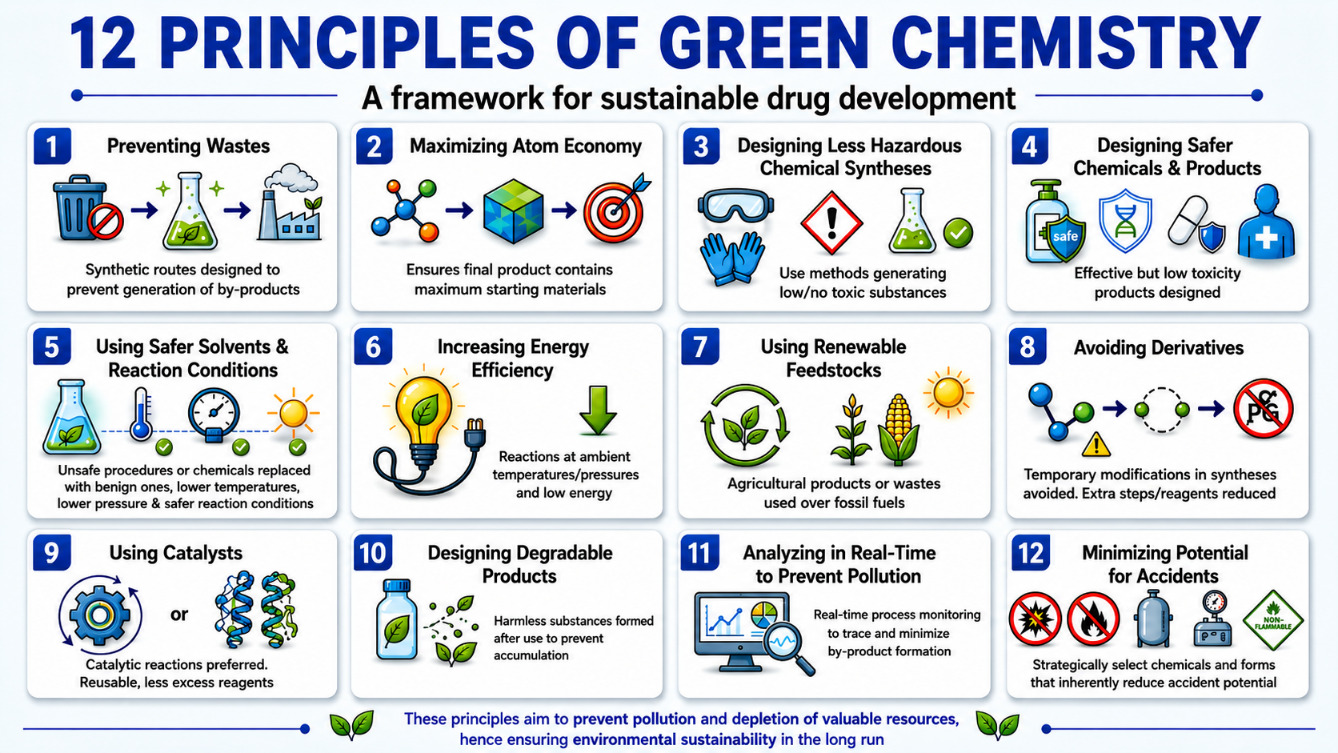
Pharmaceutical manufacturing is one of the most pollution-intensive industries due to the toxic chemicals and aggressive reaction set-ups required for drug development. The Green Chemistry principles, thus, become particularly pertinent to the pharma industry.
Beyond an environmental sustainability initiative, Green Chemistry has also proven to be a strategic imperative for sustaining the pharmaceutical business in the long run. The business benefits of environmental responsibility for companies include:
- Better health and safety of employees
- Lower operational costs
- Compliance with regulatory mandates on environmental protection
- Attention of institutional investors and better manufacturing capital
- Strong market reputation and consumer trust
This balance of environmental protection and business value makes Green Chemistry the foundation of the Green Revolution that the industry is witnessing.
Why Drug Development Needs a Green Revolution
Green Chemistry has been particularly impactful for the pharma industry due to the nature and extent of hazardous substances inherently required in drug development.
Drug development is a complex process which constitutes:
- Multi-step synthesis of complex APIs
- Protection – deprotection steps to obtain the effective isomer of the API
- Large excess of toxic reagents for synthesis
- Huge amounts of solvents during synthesis and purification of compounds
- Inflammable or highly reactive intermediates
- Aggressive reaction conditions like cryogenic temperatures or high-pressure reactions
- Energy-intensive apparatus, which can run for hours or even days at a stretch
All of these generate harmful wastes in the form of hazardous by-products, toxic solvents and their vapours, carbon emissions, API residues in wastes or unmetabolized drugs in patient excreta, etc. Beyond this, drug development itself is a complex, well-structured process, which can take more than 10-15 years and investment worth billions of dollars, spanning across several stages of development. A single inefficient, non-compliant step could lead to huge losses in revenue, in addition to erosion of patient trust and hard-earned market credibility for the company.
These environmental and economic implications of pharma manufacturing make adoption of green principles non-negotiable and require massive transformation of the industry towards sustainable, greener strategies for drug development. The green revolution is the need of the hour and will shape the future of pharmaceutical innovation and manufacturing.
Measuring Sustainability: The Green Metrics That Matter
One imperative aspect of sustainability through the green revolution in pharma is not just being aware of the intensity of existing damage but to identify the steps that need reformation, measure the extent of damage they create, and then engineer strategies to prevent that damage. Any strategy without action is just a claim, and quantifiable metrics generate the evidence for these actions.
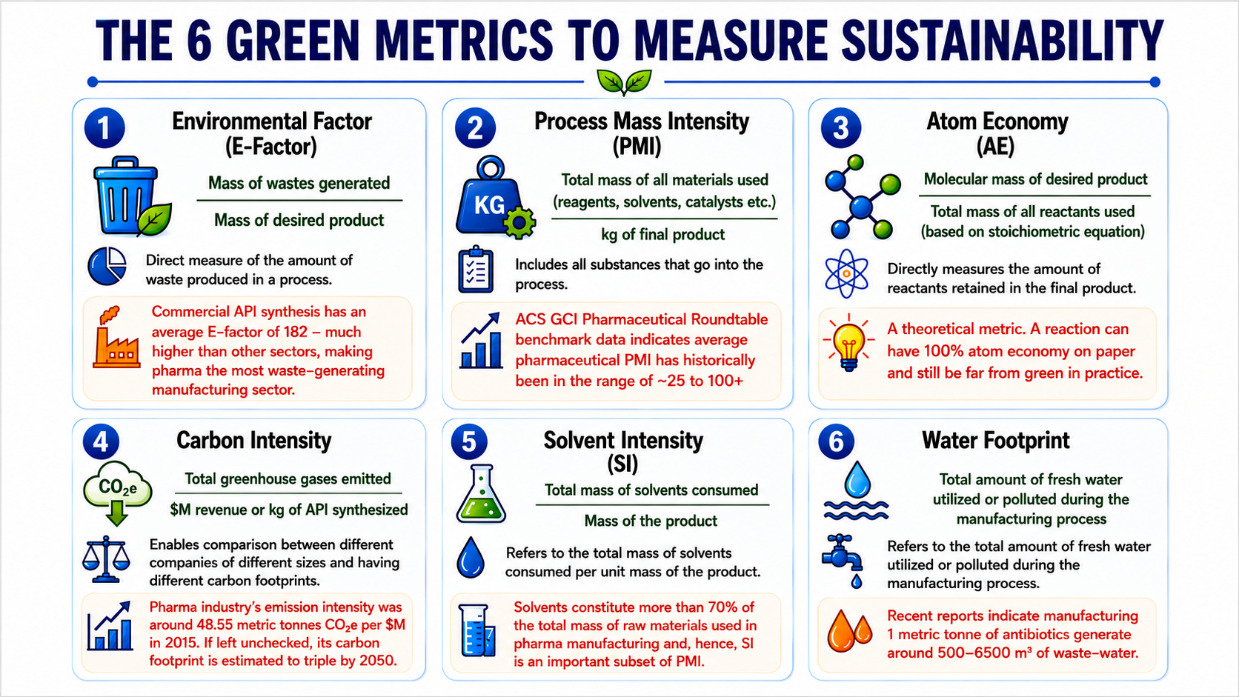
Purity and yield are consistently used for comparing the efficiency of processes and the quality of products, while the metrics of Green Chemistry are a direct measure of sustainability in pharmaceutical manufacturing.
These metrics provide a standardized benchmark which can be measured and tracked across different stages of drug development. They enable companies to identify or predict the sources of waste generation, cost inefficiency and resource depletion. These measurements support evidence-based decision-making and become the key performance indicators in pharmaceutical manufacturing.
Embedding Green Chemistry across the Drug Development Lifecycle
The lifecycle of a drug from molecule to medicine spans across multiple stages of development. Every stage requires significant resources, involves operational costs, generates wastes and contributes to the environmental footprint of the drug. It thus becomes critical to embed Green Chemistry principles from the very beginning of drug development.
Different stages of the drug development pipeline require different Green Chemistry interventions:
1) Drug Discovery and Lead Optimisation – This is the stage where drug candidates (potential therapeutic agents) are identified and designed. The efficacy and environmental footprint of the final drug product depend on leads selected and decisions made at this stage, making it inevitable to select greener options from here itself. This is done by:
- Selecting molecules which can be synthesized in fewer steps without using protecting groups and reactions with low atom economy
- Evaluating efficacy of existing scaffolds and devising ways to build on them, rather than working on a totally new set of molecules
2) Route Scouting and Process Research – Process chemists design, optimize and scale the synthetic route for the identified candidate. Tools like PMI and SI help scientists to predict wastes and strategize methods to minimize them. The strategies include selecting:
- Synthetic routes with catalysts
- Reactions with no or minimum solvent requirement
- Non-toxic or less hazardous reagents
- Processes that need low energy and ambient reaction conditions
- Renewable raw materials where possible
- Syntheses with fewer steps and fewer protection-deprotection reactions
3) Clinical Manufacturing – At this stage, chemists scale up the synthesis for clinical trials, and optimize for low PMI and E-factor. Pilot or kilo-scale syntheses magnify both risks and wastes associated with them. It is, thus, necessary to ensure:
- Maximum yield for every step of production
- Quality control at every step to maintain data integrity compliant with regulatory requirements
- Controlled water use and wastage
- Solvent recycling networks to reuse solvents rather than disposing them
- Systematic management of hazardous wastes
4) Commercial Manufacturing – For mass production of drugs, economic viability along with efficient waste management become crucial. Green processes which mitigate high carbon intensity through GHG emissions, AMR due to API release in the environment or high water footprint are strictly monitored and optimized for. This involves:
- Real-time monitoring of production processes
- Continuous flow reactors that reduce energy consumption and solvent volume, while improving safety
- Transforming by-products to reusable materials
- Managing supply chain and disposal
Technologies Accelerating Sustainable Drug Development
Advanced chemical and digital technologies are actively being used to accelerate drug development and design processes that maximize efficacy while reducing waste generation. They enable companies to incorporate and optimize for Green Chemistry metrics from the very initial stages of development. Some of these technologies are as follows:
- Biocatalysts – Reactions driven by enzymes, rather than toxic reagents, are highly selective, require ambient temperature and pressure, and are carried out in aqueous medium, hence reducing hazardous by-products and energy use significantly.
- Flow Chemistry – Chemicals flow continuously through narrow tubes rather than mixing in huge reactors, which allows efficient heat and mass transfer, enables better mixing and reduces solvent use. This in turn improves reaction yield and selectivity, and generates lower amounts of waste.
- Continuous manufacturing – Several manufacturing steps like reaction and purification are integrated into one single production line, rather than completing one step at a time. This reduces energy consumption, solvent use, and carbon and water footprint significantly.
- AI and Digital Tools – Computational tools at the drug discovery and route scouting stage significantly reduce time to discover effective and potentially therapeutic candidates. They are used to analyze multiple available synthetic routes and predict routes with lower atom economy, fewer steps and non-toxic reagents and by-products, hence allowing optimization for green metrics at the molecule selection stage. Life Cycle Assessment (LCA) simulation tools predict the environmental impact of processes before synthesis begins.
- Green solvents and Solvent Recovery – Solvents constitute over 50% of the total mass of raw materials used, and above 70% of the mass of wastes generated in pharma manufacturing. Tools like the CHEM21 Guide for Solvent Selection by ACS suggest replacement of toxic solvents (like DCM, THF or DMF) with safer alternatives (like water, ethanol or 2MeTHF), and evaluate the environmental impact of solvents used.
Green chemistry redesigns the molecule, but the plant floor needs its own overhaul too. See the green manufacturing technologies cutting emissions and waste at scale.
→ Read: Green Manufacturing & Environmental Stewardship in Pharmaceuticals
Real-World Success Stories in Green Chemistry
Pharma companies that successfully adopted the green principles have seen significant improvements in productivity, production costs and waste reduction over the years. They are examples of how environmental sustainability and process efficiency go hand-in-hand, and one does not need to be achieved at the cost of the other. Some stories worth mentioning are those of Pfizer’s Sertraline, Merck’s & Codexis’ Sitagliptin, and Merck's linker for its Antibody-Drug Conjugate (ADC) drug Sacituzumab Tirummotecan.
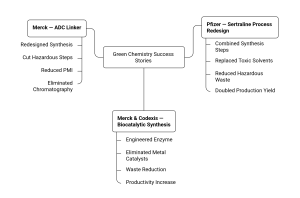
Pfizer — Sertraline Process Redesign
Commercial production of Sertraline (API of Zoloft - a commonly used antidepressant) generated above 453 tons of hazardous Titanium dioxide by-product every year, which required specialized waste disposal techniques and incurred additional waste management costs.
Pfizer redesigned the process, combining the 3 steps of synthesis into a single step and replacing toxic solvents with Ethanol.
The redesigned process resulted in:
- Reduction in hazardous wastes by approximately 1.8 million pounds
- 10-fold decrease in solvent wastes from 60,000 gallons of solvent per ton of API to 6000 gallons
- Doubled yield of production
- Contraction in raw material cost by 20-60%
The initiative earned Pfizer the US EPA’s Presidential Green Chemistry Challenge Award for Alternative Synthetic Pathways in 2002.
Merck & Codexis —Biocatalytic Synthesis of Sitagliptin
Synthesis of Sitagliptin (the API of Januvia – a type-2 diabetes drug) required hydrogenation under high pressure, expensive an Rhodium metal catalyst and an additional step to purify the active enantiomer of the product – all of which were resource-intensive processes and against the major principles of Green Chemistry.
Merck, in partnership with Codexis, engineered a new custom enzyme to replace the synthesis with a biocatalytic one, and eventually optimized the enzyme to achieve 25k-fold better activity of the biocatalyst.
The results observed were:
- Metal catalysts and additional chiral purification step were totally omitted
- 19% reduction in wastes
- 56% enhancement in productivity
- 10-13% increase in yield of the overall synthesis
- Significant contraction in material and equipment costs
The enzyme engineering was published in Science, 2010 and won the companies the US EPA “2010 Greener Reaction Conditions Award”.
Merck’s Antibody Drug Conjugate (ADC) Linker
The 20-step synthesis of a linker for its ADC drug, Sacituzumab Tirumotecan, presented a severe bottleneck before Merck during the final purification of the product, which limited its production to less than 100 g per month and required the use of a high power-consuming chromatographic set-up 24/7.
The team at Merck redesigned the synthesis using a naturally available starting material and reduced 7 hazardous synthetic steps to just 3, hence making the process scalable and sustainable simultaneously.
The outcome of this was:
- 75% reduction in PMI
- Energy-intensive chromatographic bottleneck was eliminated
- Prevention of the use of toxic substances by the 4 hazardous synthetic steps
The redesigned route won Merck the “2025 Peter J.Dunn Award for Green Chemistry and Engineering Impact” from the ACS GCI Pharmaceutical Roundtable.
Regulatory Momentum and Industry Commitments
The pharmaceutical industry, regulatory bodies and investors are the three pillars which drive environmental sustainability in drug development.
Regulatory Drivers
The environmental protection agencies monitor the pollutants generated from manufacturing, and the drug development regulatory bodies ensure the manufacturing practices adhere to both environmental and patient safety.
The US EPA is the oldest pharma-specific environmental regulatory body, which particularly regulates pharma wastewater discharge. Other agencies which formulate and ensure compliance with guidelines related to environmental preservation, hazardous waste management, and API residues in wastes include the European Commission and the European Chemicals Agency (ECHA) in Europe, and the Central and State Pollution Control Boards (CPCB and SPCB) in India.
The US FDA, European Medicines Agency (EMA) and the Central Drugs Standard Control Organization (CDSCO) in India evaluate the environmental impact of drug development and ensure the environment is protected without compromising on the drug efficacy or safety.
Some recent regulatory developments across the globe include:
- EU Urban Wastewater Directive (2025): Introduced additional guidelines for wastewater treatment to remove pharma micro-pollutants and indicates that the pollutant-producing companies must bear the majority of the management costs.
- WHO Guidance (2025): Published the first guidance on waste and wastewater management in pharmaceutical manufacturing, with a focus on antibiotic production.
- The EMA Guidelines and EU Package (2024-2025): The updated Environmental Risk Assessment (ERA) guidelines were published by the EMA in 2024. The EU Pharma Package mandated the incorporation of ERA guidelines throughout the drug development cycle and suggested review of the products authorized before the ERA guidelines.
- The Ministry of Environment, Forest and Climate Change (MoEFCC) Draft Rules (2020): Proposed legal enforcement of antibiotic limits in effluents from pharma manufacturers under the Environment (Protection) Amendment Rules, but the guidelines are yet to be finalized.
Industry Commitments
The pharma companies globally are actively adopting Green Chemistry and shifting towards environment-friendly and sustainable manufacturing practices. Some notable initiatives by companies worldwide are as follows:
- 18 large-cap pharma companies (including Merck, AstraZeneca, GSK, AbbVie, J&J, Roche, Pfizer, Novartis, and Sanofi) have committed to reducing emissions or achieving net-zero targets, and publicly report their emissions since 2019.
- In 2025, Novartis reported a 75% reduction in carbon emissions, 100% usage of renewable electricity and a 59% reduction in water consumption since 2016.
- Dr. Reddy’s Laboratories started its first Zero Liquid Effluent Discharge (ZLED) facility two decades ago and now has ZLD across all its API manufacturing facilities in India, hence ensuring 100% wastewater treatment and recycling. The company also reported zero toxic waste disposal to landfills and reduction in water intensity between 2019 and 2022. It became a “water-positive” company in 2023.
Investor Perspectives
With environmental protection regulations and Green Chemistry compliance becoming mandatory, and companies actively taking initiatives to adopt greener principles, investors now assess environmental sustainability measures for capital allocation and investing decisions.
- The Access to Medicine Foundation from the Netherlands developed the index that ranked pharma companies based on their environmental, social and governance (ESG) practices. The index is used by major institutional investors worldwide to make informed investment decisions based on their ESG performance.
- Another benchmark launched by the same foundation also tracks AMR-related risk management by pharma companies. The AMR pollutants incur significant additional healthcare costs and, thus, the investors use this benchmark to evaluate companies.
The regulators, companies and investors work in collaboration with each other to achieve the same goal, i.e. reducing the environmental footprint of drug development, while making safe and effective treatments accessible to patients.
Net-zero pledges look great in press releases, but Scope 3 emissions tell a harder story. Here's the gap between pharma's climate claims and reality.
→ Read: The Net-Zero Pharma Myth: Scope 3 & Sustainability Gaps
Challenges on the Road to Sustainable Pharma
Green Chemistry aims at incorporating environmental sustainability in drug development and is reinforced by regulators, investors and companies worldwide. However, the adoption of Green Chemistry principles still remains limited and faces several barriers when it comes to real-world execution.
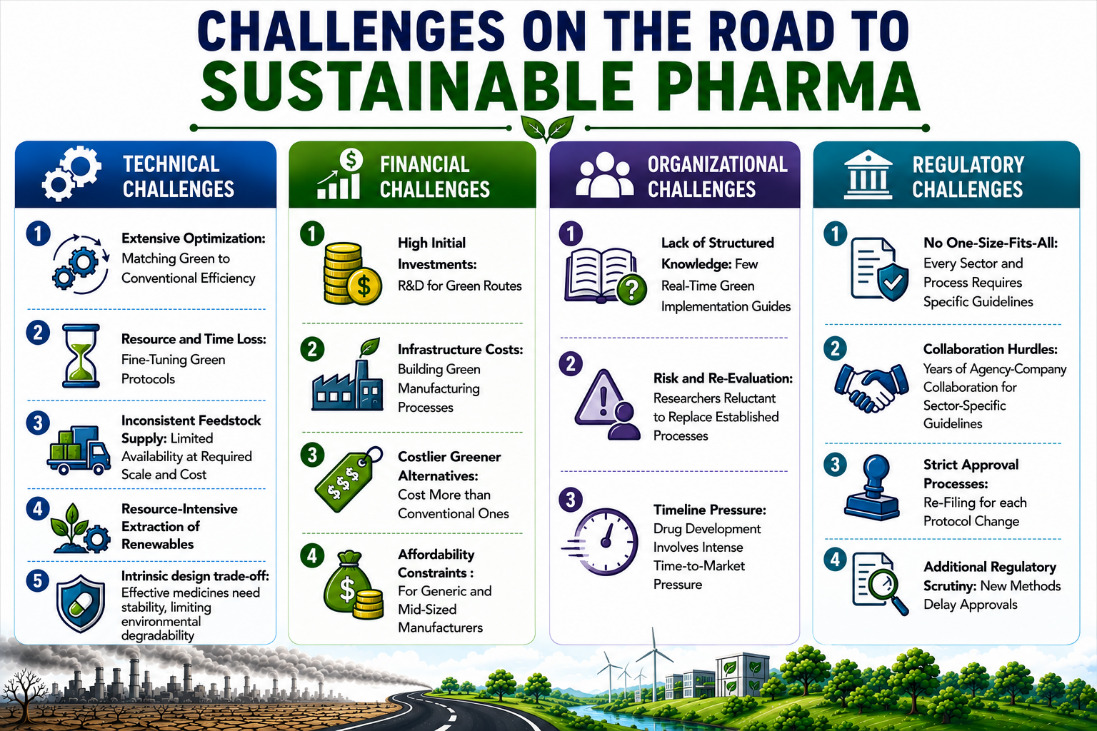
A 2015 industry survey found time pressure and regulatory risks to be two major barriers to the adoption of Green Chemistry. Similar studies in India suggested financial and regulatory barriers to be the most significant ones.
While a majority of these challenges can be overcome with advances in technology and emerging trends, some remain intrinsic to pharma manufacturing. The conflict between therapeutic efficacy and environmental degradability represents one of the most significant scientific constraints, making it a fundamental design challenge of drug development.
The Future of Green Drug Development
Emerging Trends
While guidelines for greener protocols have been widely adopted in pharma manufacturing across multiple stages of development, the newer emerging trends in green drug development further reinforce the idea of shifting sustainable practices into earlier stages rather than fixing the processes after building them.
- AI-designed green synthesis routes -
AI tools are being developed to design synthetic routes from scratch using a computer-assisted retrosynthetic approach, rather than just evaluating and predicting the viability of already known procedures, hence integrating sustainability in the synthetic design itself.
AiZynthFinder is an AI tool developed by AstraZeneca in 2020 which plans the retrosynthesis and maps the synthetic design of complex target molecules, though the chemists still need to evaluate the AI-suggested routes.
- Digital twins for process optimization -
The environmental footprint of a process is optimized on a computer before performing the process in a plant by creating a replica of the manufacturing system, which simulates the solvent use, energy use and waste generation of the process virtually. The digital optimization is also being extended to the entire manufacturing plant rather than a single reaction or process, where facility-wide models are used for simulation.
Digital twin models have been built for the production of salbutamol API by academic researchers from Loughborough University in collaboration with Haleon (formerly part of GSK).
- Synthetic Biology -
Microorganisms are engineered to biologically manufacture desired drug molecules, hence removing chemical synthesis altogether.
Sanofi, in partnership with UC Berkeley and Amyris, designed a method for semi-synthesis of artemisinin (antimalarial) using genetically engineered yeast.
- Carbon-Neutral Manufacturing Facilities -
Manufacturing facilities are being designed to run entirely on renewable electricity and produce net-zero emissions.
Roche reported nearly 100% renewable electricity use across all its facilities in 2015, and AstraZeneca has reduced its Scope 1+2 carbon emissions by 98% since 2015 with the aim to achieve 100% carbon-neutral operations.
- Circular Pharma Ecosystems -
Companies are designing systems to recover, recycle and reuse the materials as many times as possible, rather than using them once and discarding the waste immediately.
Dr. Reddy’s Laboratories developed the Zero Liquid Discharge (ZLD) facilities.
As these trends are emerging, the industry aims to develop them further to deal with the aforesaid challenges and advance towards greener manufacturing.
What Success Will Look Like
Currently, Green Chemistry principles are used to improve the already developed synthetic routes and processes. Also, the success of a drug depends on factors like yield, purity, safety, costs, efficacy and regulatory approvals, while the Green Chemistry metrics still remain as the supporting sustainability data.
The true success of Green Chemistry as a sustainable initiative would mean incorporation of the green principles from the very drug discovery stage and sustainability, along with safety, being the key decision-making metric from day one of drug development. This would not only allow companies to significantly overcome the regulatory, financial and time-related barriers they currently face, but also efficiently engineer sustainability into drug development.
Conclusion
Every single drug is developed with the aim to provide safe and effective treatment to the patients, but it remains associated with a hidden environmental cost of medicine. Green Chemistry is a transformative initiative which efficiently integrates environmental responsibility with Chemistry. It has emerged as the strategic driver for both environmental and business sustainability in pharma, the green metrics being the tools to measure this sustainability. The collaborative efforts of regulatory bodies, companies and investors catalyse the ‘green revolution in pharma’. While technological advancements and emerging trends in drug development assist the industry to advance towards greener manufacturing, certain roadblocks are intrinsic to drug development. Designing a drug which is therapeutically stable while being environmentally degradable remains a constraint, while the industry’s approach to solving this evolves. As the industry moves towards sustainable drug development, the future would view Green Chemistry at the core of the decision matrix for pharmaceutical manufacturing.
FAQs
Q1. Why are the principles of Green Chemistry important for pharmaceutical manufacturing?
Ans. The principles provide a structured guide for reduction of wastes, use of hazardous substances and resource intensity from the drug design stage itself. This reduces the environmental footprint of drug development, while improving safety and efficiency of drug design, and driving commercial growth.
Q2. Who is the founder of Green Chemistry and who are leading figures currently?
Ans. Paul Anastas and John Warner co-founded Green Chemistry in 1998, and published the book Green Chemistry: Theory and Practice. Anastas is popularly called the “The Father of Green Chemistry”. Organizations like ACS Green Chemistry Institute drive its application in modern pharma.
Q3. Which commonly used drug is the example of Green Chemistry in manufacturing?
Ans. The commonly used painkiller Ibuprofen, produced by BHC in 1992, won EPA’s first Presidential Green Chemistry Challenge Award in 1997, for eliminating 3 synthetic steps and raising the atom economy by 77-79%.
Q4. Where does India stand in the global Green Chemistry race?
Ans. India produces one-fifth of the world’s generic drugs, making it a major contributor in drug development’s environmental footprint. Meanwhile, India published the world's first draft for legally enforceable antibiotic-waste discharge limits in 2020, establishing it to be an emerging leader in Green Chemistry.
Q5. What role do scientific communicators play in advancing sustainable drug development?
Ans. Scientific communicators enable effective cross-functional communication among all the stakeholders, while translating complex metrics and scientific data for them. This drives industry-wide collaboration and makes scientific research accessible to wide audiences.
Reporting on the science, business and regulation shaping the pharmaceutical industry.
More in Pharma Manufacturing
All articles →
Compliance In Pharma Manufacturing 2025: Key Regulations And Best Practices You Need to Know

Improving Pharmaceutical Manufacturing Flexibility: Agile Manufacturing and Rapid Scale-Up

Discussion