What Are The Regulatory Challenges In Nanotechnology-Based Therapeutics?
1,200+ nanomedicine trials are active globally, yet only 50-80 have reached approval. The regulatory gaps pharma must solve.

Nanotechnology-based therapeutics represent one of the most transformative frontiers in modern medicine. By engineering drug delivery systems at the nanoscale, typically between 1 and 1,000 nanometers, scientists can direct medicines to precise disease sites, reduce systemic toxicity, improve bioavailability, and unlock therapeutic potential in molecules that would otherwise fail in conventional formulations.
From the first FDA-approved nanomedicine in 1995 — Doxil, a PEGylated liposomal form of doxorubicin in order to the lipid nanoparticle platforms behind mRNA COVID-19 vaccines, nanomedicine has proven its clinical value. And yet, the regulatory machinery built to evaluate conventional pharmaceuticals is struggling to keep pace.
A few numbers reveal exactly how significant the gap is:
- Over 1,200 nanopharmaceutical clinical trials are active globally as of 2025
- Despite thousands of preclinical candidates, only an estimated 50–80 nanomedicines have achieved global regulatory approval for clinical use
- Approximately 40% of all approved nanomedicines utilize liposomal formulations, making them the most clinically validated nanoplatform to date
- Over 18 FDA-approved liposomal formulations are currently in clinical use in the United States alone
The gap between the pipeline and approvals is not primarily a scientific failure. It is largely a regulatory one. Existing frameworks were not designed for materials that behave fundamentally differently at the nanoscale from their bulk counterparts, and that gap has real consequences for patients waiting for medicines already proven in the laboratory.
Nanomedicine's clinical value is already proven.
Here's how nanotechnology is reshaping pharma's entire drug delivery landscape.
→ Exploring Nanotechnology in Pharmaceuticals
The Core Problem: Old Rules For New Science
The foundational challenge in regulating nanotechnology-based therapeutics is that current frameworks were built for small molecules and biologics. The FDA and EMA have made important strides, the FDA issued updated draft guidance for nanomaterials in 2017 and has expanded its advisory outputs.
While the EMA released its EU Horizon Scanning Report EMA/20989/2025/Rev.1 on nanotechnology-based medicinal products in 2025 but both agencies still evaluate nanomedicines under existing pharmaceutical and biological product frameworks rather than a dedicated, nanotechnology-specific regulatory category.
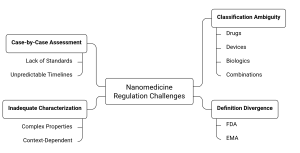
This creates four structural problems that manifest in every nanomedicine development programme:
1) Classification Ambiguity — Is a given nanoformulation a drug, a device, a biologic, or a combination product? The answer determines which regulatory pathway, which safety tests, and which approval standards apply. Many nanoparticle-drug conjugates and theranostic platforms, which combine imaging agents and therapeutic payloads, defy clean classification entirely.
2) Definition Divergence Between Agencies — The FDA defines nanomaterials by both size (1–100 nm primarily) and function, extending consideration up to 1,000 nm where relevant properties arise. The EMA defines nanomedicine more broadly as the application of nanotechnology to diagnosis or treatment of disease. This definitional gap means a product may be regulated as a nanomedicine in the EU but evaluated as a conventional pharmaceutical by the FDA, creating fundamentally inconsistent development requirements for manufacturers operating globally.
3) Inadequate Characterization Standards — Regulatory authorities require physicochemical characterization including particle size distribution, chemical composition, drug loading, surface charge, and release kinetics. However, standardized methods remain inadequate for innovative nanoformulations. Properties that are straightforward to measure in conventional drugs become complex, context-dependent variables at the nanoscale, where minor manufacturing changes can produce significant shifts in biodistribution, immunogenicity, and therapeutic behavior.
4) Case-By-case Assessment Burden — In the absence of category-specific standards, regulators assess each nanomedicine individually. While scientifically appropriate, this approach is inefficient and unpredictable. Developers face inconsistent expectations across regulatory submissions, making it difficult to build robust regulatory strategies early in development.
The Characterization And Safety Evaluation Challenge
One of the most technically demanding aspects of nanomedicine regulation is that safety and efficacy cannot be determined from composition alone. Two nanoparticles with identical chemical formulations can behave entirely differently in the body depending on particle size, surface modification, shape, and aggregation state under physiological conditions.
Regulators must therefore demand characterization data across a range of parameters that conventional pharmaceutical testing was never designed to capture. The critical quality attributes that regulatory agencies currently require or are moving toward standardizing include:
- Particle Size & Size Distribution: assessed under multiple measurement techniques, since different methods (dynamic light scattering, electron microscopy, nanoparticle tracking analysis) can yield different results for the same sample
- Surface Charge (zeta potential): Determines circulation half-life, cellular uptake, and protein corona formation, which directly affects biodistribution and immune activation
- Drug Encapsulation Efficiency And Release Kinetics: Critical for predicting therapeutic windows and avoiding both under-dosing and toxicity
- Stability Under Physiological Conditions: Nanoparticles that are stable in the vial may aggregate, degrade, or alter surface properties in blood, synovial fluid, or intracellular environments
- Immunogenicity Profiling: Nanoparticles frequently interact with the immune system in ways that are not predicted by conventional immunotoxicology testing, including complement activation and cytokine storm induction
The safety concern regulators must confront most carefully is the potential for nano-specific toxicities. Nanoparticles can penetrate biological barriers, the blood-brain barrier, the placental barrier, cell membranes that conventional drugs cannot cross. The same property that makes them powerful delivery tools also creates potential for off-target accumulation in unintended tissues.
Global Regulatory Fragmentation: A Barrier To Access And Innovation
Regulatory inconsistency across major jurisdictions is one of the most practically damaging challenges in the nanomedicine field. A developer seeking approval in the United States, the European Union, Japan, and China currently faces four meaningfully different regulatory frameworks, each with different definitions, classification systems, required characterization data packages, and preclinical study expectations.
The key agencies and their current stances illustrate this fragmentation clearly:
- FDA (United States) — Follows a risk-based, case-by-case approach. Updated guidance addresses quality, nonclinical, and clinical considerations for nanomedicines but stops short of a dedicated nanomedicine regulatory category.
- EMA (European Union) — Evaluates nanomedicines under existing pharmaceutical and biological frameworks, with the 2025 Horizon Scanning Report recommending expansion of existing EU guidance to include both marketing authorisations and clinical trial requirements specifically for nanotechnology-based products.
- PMDA (Japan) — Has issued specific reflection papers on nanoparticle drug products but remains aligned with pharmaceutical rather than nanospecific standards.
- NMPA (China) — Has introduced accelerated pathways for innovative nanomedicines, and with $48.5 billion committed to Chinese biotech in 2025, is rapidly increasing its nanomedicine regulatory capacity.
- Health Canada — Aligned broadly with FDA principles but lacking equivalent nanotechnology-specific guidance depth.
The practical consequence of this fragmentation is significant. Companies must submit different data packages to each jurisdiction, conduct duplicative studies, and navigate inconsistent timelines. The EMA has called for a European Platform for Regulatory Science Research to be launched specifically to strengthen international harmonization, a recognition that the current state is inadequate.
Four agencies, four rulebooks, that's not just a nanomedicine problem. Here's how regulatory strategy gets built for any global pharma project.
→ Pharma Project Management & Regulatory Compliance
The Manufacturing Scale-Up Problem
Regulatory challenges do not end at the characterization or classification stage. Manufacturing nanomedicines at clinical and commercial scale introduces additional regulatory complexity that is distinct from anything encountered with conventional drugs.
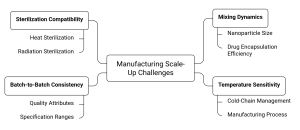
The fundamental difficulty is reproducibility. Nanoparticle properties that are tightly controlled in a laboratory setting can vary significantly when batch sizes increase. Parameters including:
a) Mixing Dynamics — Fluid dynamics at larger scales change nanoparticle formation conditions, altering size distributions and encapsulation efficiency
b) Temperature Sensitivity — Many lipid nanoparticle formulations are exquisitely temperature-sensitive, requiring cold-chain validation across manufacturing and distribution
3. Batch-To-Batch Consistency — Regulators require demonstration that critical quality attributes remain within pre-specified ranges across batches, but there are no universally agreed specifications for what those ranges should be
4) Sterilization Compatibility — conventional sterilization methods like heat or gamma radiation can alter nanoparticle integrity, requiring validated alternative approaches
These manufacturing challenges directly translate into regulatory risk. A nanomedicine that passes all safety and efficacy evaluations in clinical trials may still face significant delays at the point of manufacturing approval if scale-up data is insufficient or inconsistent.
Conclusion: The Path Forward Requires Framework Reform
The regulatory landscape for nanotechnology-based therapeutics is not fundamentally hostile to innovation — it is simply behind it! With over 1,200 active clinical trials and a nanopharmaceuticals market growing steadily across oncology, infectious disease, gene therapy, and metabolic conditions, the pressure to modernize regulatory frameworks is intensifying from every direction.
What the field urgently needs is a coordinated, science-driven set of reforms:
- A dedicated nanomedicine regulatory category at both FDA and EMA, with classification criteria that reflect nanoscale properties rather than fitting nanoparticles into conventional pharmaceutical or biologic boxes
- Harmonized global standards for physicochemical characterization and preclinical safety testing, reducing the redundancy and inconsistency that currently burden global development programmes
- Early and iterative regulatory engagement both the FDA and EMA have signaled willingness to collaborate with developers during preclinical and early clinical stages, and the 2025 EMA guidance explicitly encourages this approach
- Validated in vitro and in silico testing methods that can replace or reduce animal testing while providing better prediction of nanoscale behavior in human physiology
Nanotechnology-based therapeutics have already delivered some of the most consequential medicines of the past three decades. The question is no longer whether nanomedicine works, the existing clinical evidence answers that conclusively. The real question is whether regulatory science can evolve quickly enough to allow the next generation of nanomedicines to reach the patients who need them.
Frequently Asked Questions
1) Why Are Nanotechnology-Based Therapeutics Difficult To Regulate?
Nanotechnology-based therapeutics behave differently from conventional drugs because their size, surface properties, and structure can significantly influence how they interact with the body. Existing regulatory frameworks were primarily designed for traditional pharmaceuticals and biologics, creating challenges in classification, characterization, and safety evaluation. As a result, regulatory agencies often assess nanomedicines on a case-by-case basis. This can increase development complexity and create uncertainty for manufacturers seeking approval.
2) What Are The Main Safety Concerns Associated With Nanomedicines?
One of the biggest concerns is that nanoparticles can cross biological barriers and accumulate in tissues that conventional drugs may not reach. Their unique properties can also trigger unexpected immune responses, alter biodistribution patterns, or cause nano-specific toxicities that are difficult to predict using traditional testing methods. Regulators therefore require extensive characterization and safety data before approving these therapies. Ongoing research is focused on improving testing standards to better evaluate long-term safety and efficacy.
3) How Can Regulatory Frameworks Better Support Nanomedicine Innovation?
Experts believe that dedicated nanomedicine regulatory pathways and globally harmonized standards could significantly improve the approval process. Clearer guidance on characterization, manufacturing, and safety testing would help developers navigate regulatory requirements more efficiently while maintaining patient safety. Greater collaboration between regulators, researchers, and industry stakeholders can also accelerate the development of science-based policies. These reforms could help bring innovative nanotechnology-based therapies to patients faster without compromising quality or regulatory oversight.
Reporting on the science, business and regulation shaping the pharmaceutical industry.
More in Pharma Manufacturing
All articles →
Compliance In Pharma Manufacturing 2025: Key Regulations And Best Practices You Need to Know

Improving Pharmaceutical Manufacturing Flexibility: Agile Manufacturing and Rapid Scale-Up

Discussion