What Direct-To-Consumer Pricing Platforms Change For Pharma
DTC pricing platforms are turning patients into paying customers — here's what it means for pharma commercial teams' roles, skills, and leadership.

Introduction
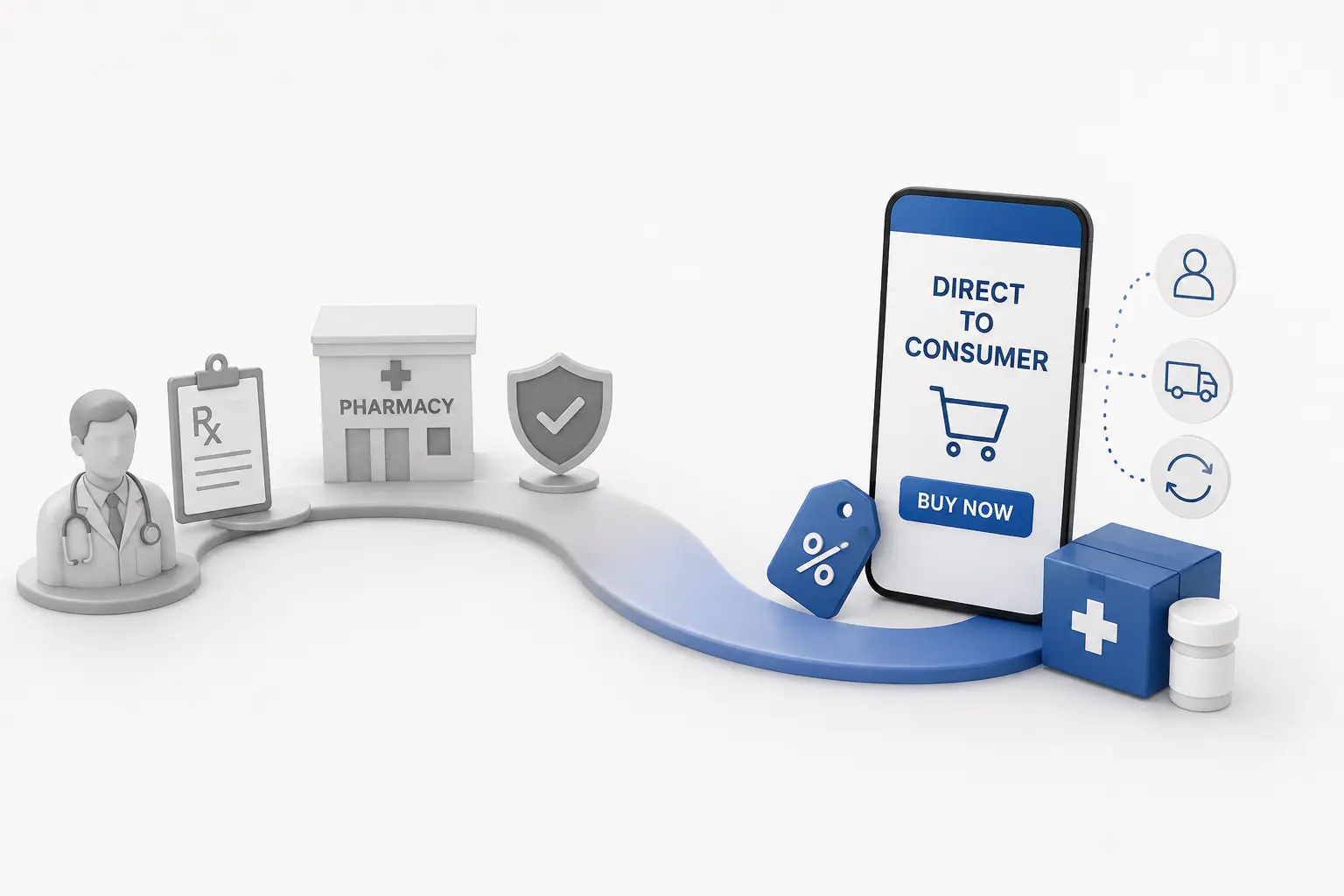
A few years ago, if a patient wanted a prescription drug, they went to their doctor, got a script, walked into a pharmacy, and hoped their insurance covered most of the bill. That chain had a lot of links, and pharma's commercial teams were built to influence just one or two of them: the doctor's prescribing habit and, occasionally, a coupon at the pharmacy counter.
That chain is breaking apart. Big names in the industry, including Amgen, Bristol Myers Squibb, AstraZeneca, Genentech, Novartis, and Boehringer Ingelheim, have all rolled out direct-to-patient services with discounts for self-pay patients on certain popular medications in just the last few months.
Add to that the federal government's own push, with a national platform set to steer patients toward manufacturer pricing sites in early 2026, and you get a simple picture: pharma companies are starting to sell straight to people, not just to the healthcare system around them.
For commercial teams, this isn't a new marketing channel to bolt onto the old playbook. It's a different job altogether. Here's what actually changes, and why leadership and talent strategy need to catch up fast.
Why Is This Shift Happening Now?
Two forces are pushing pharma toward direct pricing at the same time.
First, there's policy pressure. Medicare's negotiated prices for a set of high-cost drugs take effect in 2026, and the discounts involved range from roughly 38% to 79% off 2023 list prices. Once a "fair price" exists for Medicare, it quietly becomes a reference point for what everyone else expects to pay too, whether they're on Medicare or not.
Second, there's consumer expectation. People are used to ordering almost anything online with a few taps, and they're starting to expect the same from healthcare. Patients increasingly want a consumer-like experience and are more willing to pay directly for the medicines they need, especially when insurance friction gets in the way.
Obesity medicines are the clearest proof of this: they've shown that a real chunk of new prescriptions can now start outside the traditional doctor-pharmacy-insurer path entirely, driven almost entirely by patient demand.
Put those two forces together, and direct pricing stops being a side experiment. It becomes core business, and commercial teams are the ones expected to make it work, often with very little precedent to guide them.
DTC pricing isn't the only channel shift redrawing pharma commercial strategy. Direct-to-pharmacy sales are reshaping marketing too.
→ Read: Direct-to-Pharmacy Sales in Pharma: How DTP Is Reshaping Marketing in 2026
What Changes For Commercial Teams: The Practical Shifts?

Here's a rundown of the concrete changes commercial leaders are dealing with right now:
1) The customer is no longer just the prescriber. Commercial strategy used to revolve around influencing physicians. Now, the patient is a paying customer with a checkout cart, and that requires an entirely different kind of message, tone, and journey mapping, closer to retail than to traditional medical marketing.
2) Pricing becomes a marketing decision, not just a finance one. When Amgen discounted its cholesterol drug Repatha by 60% through its direct program, that wasn't just a pricing call, it was a growth strategy that reportedly gave the drug one of the lowest net prices in the developed world, pulling in cost-sensitive patients who might have skipped treatment otherwise. Bristol Myers Squibb did something similar with Sotyktu, its psoriasis drug, offering an 80% discount through a cash-pay portal aimed at patients facing insurance denials.
3) The funnel gets longer and more personal. Traditional DTC advertising stopped at brand awareness. Direct-to-patient platforms own the whole journey: awareness, telehealth consult, prescription, fulfillment, and refill reminders. Commercial teams now have to think end to end, not just about the first impression.
4) Revenue impact is measurable and material. Industry estimates suggest a strong direct-to-patient program can capture somewhere between 15% and 25% of total script volume for a brand, simply by removing access hurdles. For a blockbuster drug, that can translate into hundreds of millions of dollars, either gained or protected from erosion.
5) Attribution gets harder, and more important. With patients coming through new digital doors, teams need sharper analytics to know which campaigns, price points, or platform features are actually driving new prescriptions, rather than simply shifting patients who would have filled the prescription anyway.
6) Compliance and legal review move earlier into the process. Pricing that's visible to consumers, and easy to compare across brands, invites a level of scrutiny that pricing negotiated quietly behind the scenes with payers never had to face.
Where Leadership And Talent Actually Feel The Pressure?

This is the part that doesn't always get enough attention: DTC pricing platforms aren't just a marketing project. They're an organizational one!
A recent industry survey found that more than 60% of pharma executives cited internal silos as a major barrier to patient-centric initiatives like these. That statistic tells you the real bottleneck usually isn't technology or budget. It's people, structure, and who owns what.
Getting a direct-to-patient program right typically means coordinating commercial, medical affairs, supply chain, IT, legal, and patient support teams around one seamless experience. Commercial might sponsor the idea, but it falls apart without supply chain handling fulfillment, or IT actually building a platform that works reliably at scale.
This is exactly why many companies now form a cross-functional steering committee for these launches, usually led by someone senior enough to break ties across departments, such as a Chief Digital Officer or a Head of Commercial Innovation.
For commercial leaders specifically, here's what this means in practice:
New roles are emerging inside marketing teams, including consumer growth leads, e-commerce and digital fulfillment managers, and patient experience owners, none of which existed in a traditional brand team structure just a few years ago.
Talent needs are shifting toward consumer-side skills. Pharma is now competing with retail, e-commerce, and telehealth companies for people who understand conversion funnels, subscription pricing, and direct-response marketing, skills that weren't traditionally part of a pharma marketer's toolkit.
Cross-functional fluency matters more than deep specialization. A commercial leader running a DTC pricing initiative needs to speak the language of legal, supply chain, and IT well enough to keep a project moving, not just understand their own function in isolation.
Decision rights need to be clarified early. Who approves a price change on a consumer-facing platform? Commercial, market access, or legal? Companies that answer this question before launch tend to move faster than those figuring it out in the middle of a crisis.
Change management becomes a leadership skill, not an HR checkbox. Teams built around influencing prescribers for twenty years don't automatically know how to sell like a consumer brand. That takes real training, new incentive structures, and visible, patient leadership from the top of the organization.
A Simple Way To Think About It
If you're leading a commercial team right now, it helps to picture your organization on a spectrum. On one end sits the traditional model, built entirely around physician influence and payer negotiation. On the other end sits a consumer commerce model, built around direct pricing, checkout experience, and long-term retention.
Most pharma companies aren't fully at either end today. They're somewhere in the middle, running both models at once, and that's exactly why the talent and leadership questions matter so much right now.
You can't simply bolt on a small "DTC team" as a side unit and expect it to work well. The skills, incentives, and reporting lines all need to genuinely shift, or the new platform ends up fighting the old org chart instead of working with it.
Talent and leadership pressure isn't unique to DTC pricing — it's part of a wider execution gap facing pharma commercial teams.
→ Read: The Strategy–Execution Gap in Pharma Explained
Wrapping It Up!
Direct-to-consumer pricing platforms aren't a passing trend tied to one administration's policy or one blockbuster drug class. They reflect a real shift in how patients want to access medicine, and how much control manufacturers want over that relationship going forward.
Commercial teams that treat this as a temporary marketing tactic will likely fall behind their competitors. The ones that treat it as a genuine leadership and talent challenge, building the right roles, breaking down the right silos, and giving the right people decision-making authority early, are the ones best positioned to actually capture the revenue this shift makes possible.
The message for commercial leadership is straightforward: this isn't about adding a new channel to an old team. It's about building a team that can operate two different businesses at once, and doing it well enough that patients never notice the difference.
FAQs
1) What Do Direct-To-Consumer Pricing Platforms Change For Pharma Commercial Teams?
Direct-to-consumer pricing platforms expand the focus of pharma commercial teams beyond physicians and payers to include patients as direct customers. Teams now need to manage the full patient journey, from awareness and pricing to prescription, fulfillment, and refills.
2) Why Is Pricing Becoming A Commercial Strategy?
Consumer-facing prices are now more visible and can directly influence whether patients start or continue treatment. Competitive pricing can help reduce access barriers, attract self-pay patients, and support prescription growth, making pricing an important part of commercial planning.
3) What New Skills Do Commercial Teams Need?
Commercial teams increasingly need skills in consumer marketing, e-commerce, digital analytics, patient experience, and direct-response marketing. Pharma companies may also need to attract talent from retail, e-commerce, and telehealth industries.
4) How Do DTC Pricing Platforms Affect Leadership And Organizational Structure?
DTC pricing platforms require closer collaboration across commercial, medical affairs, legal, IT, supply chain, and patient support teams. Companies may need cross-functional leadership, clearer decision rights, and new roles focused on consumer growth and patient experience.
5) Why Can't Pharma Companies Simply Add A Small DTC Team?
Because DTC pricing changes more than marketing, it changes how the business operates. Without aligned incentives, clear ownership, cross-functional collaboration, and the right talent, a DTC team can end up working against the traditional commercial structure instead of complementing it.
Reporting on the science, business and regulation shaping the pharmaceutical industry.
More in Pharma Marketing
All articles →
The Importance of Personalization in Pharmaceutical Marketing Campaigns

The Power of Storytelling in Pharma Marketing: Engaging Customers with Your Brand

Discussion