Managing "Bleeding Eye Virus" Risks & Vaccine Pipelines
Marburg virus: 20–90% fatality rate, transmission routes, healthcare worker risks, IAVI vaccine pipeline (Phase 1 2026) and infection control.


AT A GLANCE
1. What Is the 'Bleeding Eye Virus'?
Marburg virus disease (MVD) is a rare but extremely dangerous viral hemorrhagic fever. It gets its alarming nickname 'bleeding eye virus' because, in severe cases, the body can start bleeding from the eyes, nose, mouth, and gut. It belongs to the Filoviridae family, the same virus family as Ebola, and can be just as deadly.
The virus was first identified in 1967 in Marburg, Germany, when laboratory workers became ill after handling monkeys imported from Uganda. Since then, sporadic outbreaks have been recorded across sub-Saharan Africa. Two types of orthomarburgviruses cause the disease: Marburg virus and Ravn virus.
The natural host for the virus is the Egyptian rousette bat (Rousettus aegyptiacus). People can get infected through direct contact with these bats or their body waste. Once the virus 'spills over' into humans, it can spread from person to person through contact with infected individuals' body fluids.
2. How Does It Spread & Who Is at Risk?
Transmission Routes
Marburg spreads through direct contact, not through the air like the flu. The key routes of transmission are:
- Contact with body fluids (blood, saliva, urine, semen) of a sick or deceased person
- Handling items contaminated with an infected person's fluids (bedding, needles, clothing)
- Contact with infected Egyptian rousette bats or their excretions in caves or mines
- Sexual transmission is possible: the virus can persist in the semen of recovered male patients
Who Is Most at Risk?
3. Clinical Picture: What Happens in the Body?
MVD develops in stages. Understanding these stages is critical for early detection, isolation, and treatment decisions.
A key clinical challenge is that early symptoms closely mimic malaria, typhoid fever, and bacterial pneumonia. This makes early diagnosis extremely difficult, especially in resource-limited settings in Africa. Clinicians must rule out these more common diseases while simultaneously taking infection control precautions.
Survivors can face long-lasting complications, including inflammation of the testicles, liver, and eye (uveitis), as well as psychiatric symptoms. Importantly, the virus can persist in immune-privileged sites, including the eyes and semen, even after full recovery.
4. History of Outbreaks: A Rising Concern
MVD has been recorded in 14 countries across four decades, with outbreaks becoming more frequent in recent years.
The 2024 Rwanda outbreak was particularly alarming for the pharmaceutical and healthcare sector: 80% of confirmed cases were healthcare workers in Kigali hospitals. This highlighted how hospital-acquired (nosocomial) transmission can rapidly amplify an outbreak when infection control protocols are not strictly followed.
Ethiopia's 2025–2026 outbreak, the country's first ever, was declared over on January 26, 2026, with 14 laboratory-confirmed cases and 9 deaths. Ethiopia is now in a 90-day enhanced surveillance period.
5. Current Risk Level: What Pharma & Healthcare Organisations Need to Know
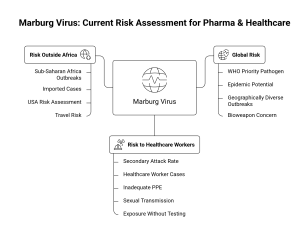
Global Risk
The World Health Organisation (WHO) has listed the Marburg virus as a priority pathogen requiring urgent research and countermeasure development, citing its epidemic potential and potential as a bioweapon. Outbreaks are becoming more geographically diverse. In 2025 alone, Ethiopia became the sixth new country in four years to report its first outbreak.
Risk to Healthcare Workers
The secondary attack rate of Marburg is estimated at 21%. For healthcare organisations, key risks include:
- Inadequate PPE during patient care, full PPE, including gown, gloves, face shield, and respirator, is required
- Insufficient isolation facilities in hospitals treating suspected or confirmed cases
- Post-recovery sexual transmission risk in male survivors, viral persistence in semen
- Staff managing recovered patients may still face exposure without testing confirmation
Risk Outside Africa
So far, all major outbreaks have been in sub-Saharan Africa. However, imported cases have occurred in the USA (2008) and the Netherlands (2008) in returning travellers. The CDC currently assesses the risk to the United States as low but continues active monitoring.
Vaccine candidates must navigate complex regulatory pathways before reaching patients. Understanding IND applications, clinical trial phases, and marketing authorization is critical for vaccine developers.
Learn how biopharmaceuticals move from discovery through regulatory approval and market access.
→ Read: Exploring Biopharmaceuticals Regulatory Pathways
6. Vaccine Pipeline: Where Does the Science Stand?
As of 2026, there are no licensed vaccines or approved specific treatments for Marburg virus disease. This represents a significant gap in global health preparedness. However, multiple candidates are in the pipeline:
IAVI's Candidate: Key Data Points
- Platform: Built on the same rVSV backbone as ERVEBO® (licensed Ebola vaccine), giving it regulatory precedent
- Animal data: A single intramuscular dose fully protected non-human primates against lethal MARV challenge
- Intranasal route: Animals vaccinated via the nasal route were also fully protected against aerosolised MARV, which is important for biodefence scenarios
- Funding: Supported by BARDA and the U.S. Department of Defence's Defence Threat Reduction Agency
- Human trials: Phase 1 clinical trial (IAVI C104) planned to begin in early 2026
The use of a proven platform (rVSV) is significant, as it reduces the regulatory and manufacturing uncertainty compared to completely novel technologies. If Phase 1 safety data are favourable, this candidate could move rapidly to Phase 2/3 trials, especially if an outbreak creates an emergency use context.
7. Current Treatment: Supportive Care Only
There are no approved antivirals or specific drugs for MVD. Current clinical management is entirely supportive, meaning the goal is to keep the patient alive and stable while the body fights the virus. Supportive care includes:
- Intravenous fluid replacement to prevent dehydration from vomiting and diarrhoea
- Maintaining oxygen levels and blood pressure
- Treating secondary bacterial infections with antibiotics
- Pain and fever management
- Electrolyte balancing
Research into specific treatments is ongoing. Experimental approaches include monoclonal antibodies, small-molecule antivirals (such as remdesivir analogues), and RNA interference, but none have reached the approval stage for MVD.
Marburg has no approved treatment, but regulatory affairs teams are orchestrating the approval pathway for experimental antivirals and vaccines.
Discover how pharmaceutical companies navigate regulatory requirements to bring life-saving therapeutics to market during global health emergencies.
→ Read: The Vital Role of Regulatory Affairs in the Pharmaceutical Industry
8. Infection Control: What Healthcare Facilities Must Do
Strict infection prevention and control (IPC) is the primary defence until a vaccine is available.
9. Key Takeaways for Pharma & Healthcare Stakeholders
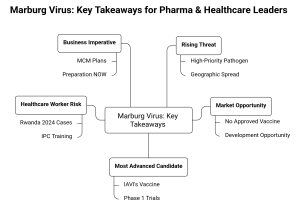
- Marburg is a high-priority pathogen; outbreaks are increasing in frequency and geographic spread.
- No approved vaccine or treatment exists; this is both a public health gap and a significant market opportunity for developers.
- IAVI's rVSV-based candidate is the most advanced, entering Phase 1 human trials in 2026, with strong preclinical data
- Healthcare workers are disproportionately affected; robust IPC training and PPE supply chains are critical investments.
- The pharma industry should prepare medical countermeasure (MCM) plans for MVD, particularly organisations operating in or sourcing from sub-Saharan Africa.
- Regulatory agencies (FDA, EMA) have emergency use and accelerated approval pathways that could be triggered during a large outbreak; vaccine developers should engage early.
References
- African Journal of Biomedical Research. Marburg Virus Disease. https://africanjournalofbiomedicalresearch.com/index.php/AJBR/article/view/5575/4320
- Centres for Disease Control and Prevention. Marburg Virus Disease. https://www.cdc.gov/marburg/index.html
- CDC. Marburg Outbreak in Ethiopia: Current Situation (Updated January 2026). https://www.cdc.gov/marburg/situation-summary/index.html
- CDC. About Marburg Virus Disease. https://www.cdc.gov/marburg/about/index.html
- CDC. History of Marburg Outbreaks. https://www.cdc.gov/marburg/outbreaks/index.html
- CDC. Clinical Overview of Marburg Virus Disease. https://www.cdc.gov/marburg/hcp/clinical-overview/index.html
International AIDS Vaccine Initiative (IAVI). Marburg Virus Vaccine Program. https://www.iavi.org/our-work/emerging-infectious-diseases/marburg-virus-vaccine/
Reporting on the science, business and regulation shaping the pharmaceutical industry.
More in Regulatory Intelligence
All articles →
The Pattern Behind FDA Warning Letters: What Startups & CDMOs Often Miss

ISO 14644 Cleanroom Classes for Pharma (with EM Implications)

Discussion