19 Pharma Startups Shaping AI-Driven Drug Discovery
19 AI startups transforming drug discovery through generative models, data platforms, and predictive biology.


Drug discovery has never suffered from a lack of scientific ambition. What it has lacked is efficiency. Despite decades of progress, the probability that a drug entering clinical trials will reach approval still hovers below 10 per cent. Artificial intelligence is not eliminating this risk, but it is systematically changing where risk is taken, how early failure is identified, and where value is created.
Across the pharmaceutical industry, AI-driven startups are emerging as critical partners and, in some cases, direct competitors to traditional R&D models. Their valuations, funding trajectories, and partnership structures suggest that the industry increasingly views AI not as an experimental tool but as foundational infrastructure.
The following 20 startups represent the most influential players shaping this transition.
1. Recursion Pharmaceuticals
Recursion Pharmaceuticals exemplifies large-scale, industrialised drug discovery. Its platform tightly integrates automated wet labs with deep learning applied to cellular imaging, enabling the company to generate and analyse millions of biological experiments in parallel. Rather than optimising single targets, Recursion focuses on mapping disease biology holistically to identify non-obvious therapeutic opportunities.
With a market capitalisation of approximately $3–4 billion and annual revenue near $200 million, Recursion is one of the few AI biotechs to demonstrate meaningful commercial scale. Revenue is largely driven by long-term partnerships with Roche, Bayer, and NVIDIA, reinforcing confidence in its data-centric approach.
Strategically, Recursion signals a future in which AI platforms function as discovery factories rather than boutique innovation units.
2. Insilico Medicine
Insilico Medicine has positioned itself as a true end-to-end AI drug discovery company. Its generative AI platform spans target discovery, molecule design, and clinical outcome prediction, using deep learning models trained on multi-omics and chemical datasets.
Insilico stands out for advancing AI-designed molecules into Phase II clinical trials, a milestone that has reshaped investor confidence across the sector. With over $400 million raised and estimated revenues of $40–60 million, the company generates income primarily through pharma collaborations and milestone-based agreements.
Insilico’s progress demonstrates that generative AI can move beyond theoretical promise into clinically actionable science.
3. Schrödinger
Schrödinger operates at the intersection of physics-based molecular modeling, computational chemistry, and AI-driven drug discovery. Its platform allows precise molecular simulations to predict binding affinities, solubility, and other critical properties, which are then enhanced by machine learning to optimise drug candidates efficiently. This hybrid approach accelerates the early stages of R&D while improving confidence in candidate selection.
Financially, Schrödinger is one of the most stable companies in the AI drug discovery space. With a market capitalisation of around $2 billion and annual revenue of $180–190 million, roughly 70 per cent of its income comes from recurring software subscriptions. This predictable revenue reduces dependency on clinical outcomes, which is uncommon in early-stage biotech.
The company demonstrates that AI infrastructure itself can be a durable, scalable business, providing value to both internal R&D teams and external pharma partners. Schrödinger’s model also illustrates how software-centric platforms can hedge the inherent risk of drug discovery pipelines, combining science with commercial predictability.
4. Isomorphic Labs
Isomorphic Labs was born from DeepMind’s AlphaFold breakthrough and applies deep learning to understand the behaviour of biological systems at scale. Unlike traditional AI tools, Isomorphic seeks to reimagine the discovery process, building a platform capable of modelling disease pathways, predicting novel targets, and identifying therapeutic candidates holistically.
With an implied valuation of $5–6 billion and undisclosed revenue, the company relies on strategic partnerships with Eli Lilly, Novartis, and other pharma leaders, rather than direct service revenue. This approach reflects investor belief that deep biological insight is defensible intellectual capital, potentially more valuable than short-term monetisation.
Isomorphic represents the next generation of AI in drug discovery, where platforms are as much about understanding biology as they are about producing molecules.
5. Owkin
Owkin specialises in federated learning, a privacy-preserving AI method that allows models to learn from sensitive hospital and clinical datasets without centralising the data. This enables training on diverse patient populations while maintaining compliance with data regulations. Owkin’s approach is particularly valuable in oncology and precision medicine, where patient heterogeneity impacts trial outcomes.
With $300 million in funding and $25–40 million in estimated annual revenue, Owkin demonstrates that clinical relevance can be as strategically valuable as molecular design. Its platform positions data access, interoperability, and governance as key competitive advantages, reflecting the increasing importance of ethical, large-scale data use in AI-driven drug discovery.
6. Atomwise
Atomwise applies deep learning to structure-based drug design, predicting how small molecules interact with protein targets. Its AtomNet platform enables ultra-high-throughput virtual screening, drastically narrowing chemical space and accelerating hit identification.
Backed by $175 million in funding and annual revenue of more than $20 million, Atomwise concentrates on early-stage collaborations with pharmaceutical companies rather than developing its own clinical pipeline. Its core strength lies in speed, scalability, and predictive precision, allowing partners to identify viable leads earlier and minimise costly experimental cycles.
Atomwise exemplifies how AI can act as a force multiplier in early discovery, delivering measurable efficiency gains.
7. Valo Health
Valo Health integrates AI with human genetics and real-world clinical evidence, creating a platform that links discovery decisions directly to patient outcomes. By combining multiple data modalities - genomic, clinical, and phenotypic - Valo improves translational success rates, bridging the gap between computational predictions and clinical reality.
Having raised $380 million and generating $30–50 million in estimated revenue, Valo focuses on long-term platform development rather than short-term transactional deals. Its approach underscores the rise of genetically informed AI discovery, where algorithms go beyond molecule generation to forecast clinical success, giving pharma partners a strategic advantage in tackling complex therapeutic areas.
8. XtalPi
XtalPi stands at the intersection of AI, quantum physics, and computational chemistry, providing predictive insights into molecular structures, crystallisation behaviour, and manufacturability. Its platform allows pharmaceutical companies to anticipate and mitigate challenges before molecules enter large-scale production, effectively bridging the gap between discovery and manufacturing.
With $300 million in funding and revenues under $20 million, XtalPi has rapidly gained adoption across Asia-Pacific pharma manufacturing, particularly among partners seeking to reduce late-stage attrition caused by crystallisation or formulation issues. By combining quantum-informed AI predictions with experimental data, the platform helps companies shorten development timelines and improve reproducibility, giving it strategic value far beyond current revenue.
9. Healx
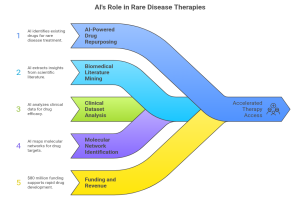
Healx leverages AI to repurpose existing drugs for rare and orphan diseases, mining biomedical literature, clinical datasets, and molecular networks to identify candidates with the highest likelihood of efficacy. This approach bypasses the time and cost of developing entirely new molecules.
Supported by $80 million in funding and generating less than $15 million in revenue, Healx focuses on speed-to-clinic, providing pharma partners with actionable insights that accelerate patient access to therapies. Its work highlights AI’s ability to tackle underserved therapeutic areas, showing how computational platforms can create value in domains that are scientifically important but economically overlooked.
10. BenchSci
BenchSci does not design molecules—it optimises discovery workflows. Its AI platform analyses experimental protocols, reagent data, and scientific literature to identify reproducible, high-quality experiments for research teams. This improves productivity, reproducibility, and early-stage decision-making.
Generating estimated annual revenues of $25–35 million, BenchSci serves as a key infrastructure layer in pharmaceutical R&D. Its growth underscores the rising demand for decision intelligence, helping research teams focus on experiments most likely to deliver translational impact.
In doing so, BenchSci illustrates how data-driven insights are as strategically important as compound design in modern drug discovery.
11. Genesis Molecular AI
Genesis Molecular AI focuses on de novo molecular design using generative AI combined with physics-informed modelling. Its platform simultaneously optimises molecules for efficacy, safety, and manufacturability, enabling a more holistic approach to early-stage drug discovery.
Genesis, supported by $200 million in funding, is focused on building a robust AI platform rather than chasing near-term revenue. Its technology is designed to explore uncharted chemical space, generating innovative molecules that conventional medicinal chemistry might never find, making it a long-term play on algorithmic creativity.
The company exemplifies a deep-tech approach where algorithmic creativity is the differentiator.
12. Anima Biotech
Anima Biotech applies AI to understand mRNA translation mechanisms, identifying previously inaccessible targets relevant to disease. By combining transcriptomics, proteomics, and computational modelling, Anima uncovers therapeutic opportunities that conventional genomics cannot reveal.
Supported by $60 million in funding and with revenues under $10 million, the company concentrates on pioneering first-in-class biology. Its AI-driven platform illuminates previously inaccessible disease mechanisms, opening new avenues in therapeutic areas where conventional discovery efforts have stalled.
13. LifeMine Therapeutics
LifeMine leverages AI to mine fungal genomes for novel natural products, expanding the chemical space beyond what synthetic libraries can offer. Its platform predicts bioactivity, optimises compound prioritisation, and accelerates hit discovery.
With $75 million in funding and limited revenue, LifeMine prioritises biological novelty over immediate commercial returns. Its work highlights AI’s ability to revitalise natural product discovery, uncovering compounds with unique mechanisms of action that could otherwise remain hidden in microbial genomes.
14. Orbit Discovery
Orbit Discovery combines combinatorial peptide libraries with AI-driven screening to design therapeutic peptides with high specificity and stability. Its focus is on modalities where peptides outperform small molecules in efficacy, safety, or target specificity.
Generating under $10 million in revenue, Orbit focuses on specialised areas such as oncology and immune modulation. Its strategy showcases the rise of modality-tailored AI, applying computational tools specifically to tackle the distinct challenges of peptide-based therapeutics.
15. Gero
Gero applies AI to large-scale human datasets to model the biology of ageing and age-related diseases. Rather than targeting a single indication, the platform analyses systemic patterns of cellular and molecular decline to identify interventions that may impact longevity.
Supported by $150 million in funding and with revenue undisclosed, Gero is dedicated to developing a long-term AI platform for longevity therapies. Its approach emphasizes harnessing population-scale biological data to advance preventative medicine and unlock insights into the biology of ageing.
16. Ignota Labs
Ignota Labs leverages AI to analyse failed drug candidates, identify the reasons for failure, and propose modifications to overcome efficacy or safety hurdles. This “drug rescue” model mitigates sunk costs and improves R&D efficiency.
With revenues under $10 million, Ignota demonstrates the power of AI to recover lost value. Its approach underscores that AI can create a strategic advantage without discovering entirely new molecules, simply by salvaging and optimising prior investments.
17. AION Labs
AION Labs operates as a venture studio, spinning out AI-focused biotech startups backed by pharma and cloud partners. Revenue is venture-based, not product-driven, reflecting its ecosystem-oriented strategy.
By incubating multiple AI-driven discovery platforms, AION exemplifies a shift toward networked innovation, where platform expertise is reused across multiple ventures, accelerating time-to-market and diversifying scientific risk.
18. Nanograb
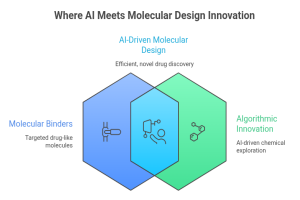
Nanograb uses AI to optimise molecular binders and enhance drug-like properties. Its focus is on early-stage algorithmic innovation rather than immediate commercialisation.
YC-backed and pre-commercial, Nanograb represents the frontier of algorithm-driven molecular design, highlighting how AI can explore chemical space more efficiently than traditional experimental approaches.
19. Profluent
Profluent applies AI to protein design and systems biology, enabling the creation of proteins with novel functionalities or optimised stability. Its work focuses on building a platform for protein therapeutics, rather than short-term revenue.
Profluent illustrates the rise of AI-native protein engineering, where computational tools are used not as an adjunct, but as the primary method of molecular innovation.
Final Perspective
Across these 19 startups, one thing is clear: AI is not replacing drug discovery—it is reshaping where intelligence, risk, and capital converge. By integrating predictive insights, scalable data analysis, and early-stage risk mitigation, these platforms enable researchers and pharma companies to prioritise the most promising candidates, reduce attrition, and accelerate decision-making.
Revenue may still lag for many early-stage companies, but investor and industry conviction remains strong, driven by measurable gains in efficiency, reproducibility, and translational confidence. In an industry defined by uncertainty, these startups are not offering certainty—they are offering better decisions earlier.
By amplifying human expertise with computational power, AI enables drug discovery with greater insight, speed, and strategic precision, turning complex biological and clinical data into actionable intelligence and creating a smarter, more resilient pathway from molecule to medicine.
FAQs
1. What are the top AI startups in drug discovery?
The leading AI-driven drug discovery startups include Recursion Pharmaceuticals, Insilico Medicine, Schrödinger, Exscientia, Isomorphic Labs, Owkin, Atomwise, Valo Health, XtalPi, and Healx. These companies use machine learning, generative AI, and deep learning to accelerate target discovery, molecule design, and clinical prediction.
2. How much revenue do AI drug discovery startups generate?
Revenue varies widely. Companies like Recursion Pharmaceuticals generate around $200 million annually, while Schrödinger earns roughly $180–190 million, mostly from software subscriptions. Many early-stage startups, such as Gero, Nanograb, and Profluent Bio, are pre-commercial or have revenues under $10 million, reflecting a focus on platform development over near-term sales.
3. How do AI startups reduce drug discovery timelines?
AI startups use machine learning and generative models to predict molecular properties, optimise candidate compounds, and identify viable targets faster than traditional methods. Industry data suggests AI can reduce lead identification timelines by up to 60%, lower R&D costs by 25–50%, and improve predictive accuracy for efficacy and toxicity.
4. Are AI-designed drugs in clinical trials yet?
Yes. Companies such as Insilico Medicine and Exscientia have advanced AI-designed molecules into Phase II clinical trials. This demonstrates that AI platforms are transitioning from theoretical models to clinically actionable therapeutics.
5. Why are AI drug discovery startups valued highly despite low revenue?
High valuations reflect the platform potential and optionality of AI systems, not immediate revenue. Investors value early-stage companies for their ability to reduce failure risk, accelerate timelines, and support multiple drug programs simultaneously. Startups like Isomorphic Labs have valuations of $5–6 billion without disclosed revenue because they control foundational AI-driven biological insights.
Reporting on the science, business and regulation shaping the pharmaceutical industry.



Discussion