7 Common API Challenges Solved using AI In Pharma
How AI solves 7 key API manufacturing challenges — from batch variability to compliance and predictive maintenance.


Active Pharmaceutical Ingredients (APIs) form the foundation of every medicine, and their development, scale-up and manufacturing demand extremely high precision. Even with advanced equipment and strong guidelines in place, pharma companies continue to experience challenges related to variability, process control, compliance, speed and operational efficiency. These issues often arise because traditional systems can only process limited data, rely heavily on manual monitoring and struggle to make sense of complex interactions between variables.
Artificial Intelligence has emerged as a powerful tool that helps eliminate these limitations by analysing huge volumes of data, predicting failures, optimising processes and providing real-time insights that human teams alone cannot achieve. As a result, AI does not just improve API quality but strengthens the overall manufacturing ecosystem.
Below Are The 7 Common API Challenges That AI Helps Solve More Effectively In Today's Pharmaceutical Sector!
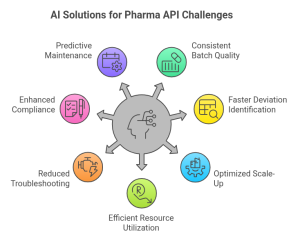
1) Inconsistent Batch Quality & Variability
Achieving consistent batch quality is one of the most difficult parts of API manufacturing. Variability can arise due to raw material differences, environmental fluctuations, slight deviation in reaction conditions or even human interpretation at the shop-floor level. Even when all parameters appear within limits, hidden patterns can still influence outcomes, making the process unpredictable.
AI addresses this issue by analysing years of historical data along with real-time inputs from sensors and equipment. It identifies patterns that are invisible to the human eye and predicts how different parameters interact.
By suggesting adjustments during the process, AI helps maintain uniformity and significantly reduces the chances of batch rejection. Over time, this leads to more stable processes, lower variability and higher reproducibility across multiple production cycles, which is critical for regulatory compliance and commercial success.
2) Slow Identification Of Process Deviations
Traditional process monitoring relies on periodic checks, lab testing and operator oversight. This leaves significant room for delays, because deviations are often detected only after samples are tested or once visible issues appear. By then, it may already be too late to salvage the batch.
AI systems solve this by monitoring every parameter continuously, comparing ongoing data with historical patterns and instantly detecting anomalies that fall outside expected behaviour even if still technically “within range.” This early detection allows teams to intervene immediately, reducing the risk of major deviations, rework or batch failures.
AI also helps classify which anomalies are critical and which can be corrected through minor adjustments, helping teams prioritise their actions. In highly sensitive API processes, where slight deviations can compromise the entire batch, this level of responsiveness becomes invaluable.
3) Limited Process Optimization During Scale-Up
Scaling up an API from laboratory quantity to pilot scale and then to full commercial production is a major challenge in pharma. Conditions that work smoothly in small batches do not always behave the same way at larger volumes. Heat transfer changes, reaction kinetics vary and equipment limitations become more evident.
AI-driven modelling tools simulate different scale-up possibilities and help predict how each parameter will respond at different scales. This allows scientists and engineers to run multiple “what-if” scenarios digitally without risking expensive material or equipment time. AI also identifies the optimal parameters for large-scale batches, reducing the number of trial runs needed.
This accelerates development timelines, improves cost efficiency and ensures safer and more predictable scale-up outcomes. Instead of relying solely on experience and manual calculations, teams can make decisions backed by data-driven insights.
4) Inefficient Raw Material Utilization & High Costs
Raw materials used in APIs are often costly, sensitive and variable in quality. When materials are not optimally utilised, it leads to unnecessary expenditure and increases waste. AI helps pharma companies overcome this by analysing raw material behaviour, supplier data, batch outcomes and procurement patterns.
It identifies which supplier materials consistently perform better, predicts how quality variations may affect the final product and suggests the most cost-effective combinations of materials. AI can also predict the exact quantity of raw materials required for each batch based on historical consumption and real-time conditions.
This leads to reduced wastage, better inventory planning, more accurate budgeting and improved cost control overall. At a time when material costs are rising across the industry, AI-driven optimisation offers a significant competitive advantage.
5) Long Troubleshooting Cycles During Failures
When issues occur in API manufacturing, identifying the root cause can become a lengthy and complex process. Multiple variables influence each other, and it can take weeks of manual data review to determine what went wrong. This increases downtime, delays production and leads to higher investigation costs.
AI dramatically speeds up troubleshooting by scanning thousands of data points within seconds. It compares past deviations, analyses equipment data, assesses environmental conditions and pinpoints the exact source of the problem. This enables teams to implement corrective and preventive actions much faster and with greater accuracy.
AI also helps identify recurring issues that might otherwise go unnoticed, reducing the likelihood of future failures. In an industry where every hour of downtime can have major financial implications, AI-driven diagnostics become extremely valuable.
6) Regulatory Compliance & Documentation Gaps
API manufacturing involves strict documentation requirements, where regulators expect complete traceability, data accuracy and detailed audit trails. Manual documentation is prone to errors, missing entries and inconsistencies, which can create compliance challenges during inspections.
AI helps automate and streamline this process by capturing real-time data directly from equipment, ensuring that documentation is accurate, well-organized and audit-ready. AI tools also validate entries, flag inconsistencies, generate automated reports and maintain detailed change logs.
This reduces human error, strengthens data integrity and ensures that companies are always prepared for regulatory audits. With AI, pharma companies can maintain continuous compliance rather than reacting only during audit periods.
7) Difficulty In Predicting Equipment Maintenance Needs
Unexpected equipment failures can disrupt API production schedules, damage product quality and create avoidable losses. Traditional preventive maintenance schedules are based on fixed time intervals and may not accurately reflect the actual health of equipment. AI-driven predictive maintenance solves this by analysing vibration patterns, temperature fluctuations, pressure changes and historical performance data to foresee when an equipment component is likely to fail.
This enables pharma companies to schedule maintenance at the right time, reducing downtime and preventing sudden breakdowns. As equipment health becomes more transparent, operational planning becomes smoother, production becomes more reliable and maintenance budgets are used more efficiently.
Summing It Up!
API development and manufacturing involve countless variables that interact in complex ways, making it difficult for traditional methods to provide complete visibility or rapid decision-making. AI bridges these gaps by offering predictive insights, optimising processes, enhancing quality and supporting regulatory compliance.
By integrating AI across the API lifecycle, from development to scale-up to commercial production pharma companies can reduce risks, improve efficiency and build a more resilient and future-ready manufacturing ecosystem. AI is no longer an optional upgrade but a vital tool for achieving consistency, reliability and long-term success in the pharmaceutical industry.
FAQs
1) How Does AI Improve API Manufacturing In Pharma?
AI improves API manufacturing by analyzing large amounts of process data, identifying hidden patterns, and detecting deviations early. It helps maintain consistent batch quality, reduces variability, optimizes reaction parameters, and predicts issues before they affect production. This leads to fewer failures, better efficiency, and more reliable outcomes.
2) Can AI help Reduce API Production Costs?
Yes, AI significantly reduces production costs by optimizing raw material usage, minimizing waste, preventing equipment downtime, and reducing the number of failed or inconsistent batches. It also improves planning and process efficiency, which helps pharma companies manage resources more effectively.
3) Is AI Useful During API Scale-Up From Lab To Commercial Production?
AI is extremely useful during scale-up because it simulates different scenarios, predicts how process conditions will change at larger volumes, and identifies the most efficient parameters. This reduces the number of trial-and-error runs, lowers risks, and ensures a smoother transition from small-scale development to full-scale manufacturing.
Reporting on the science, business and regulation shaping the pharmaceutical industry.


Discussion