by Vaibhavi M.
6 minutes
AI For Bioprocess Optimisation In The Pharmaceutical Industry
AI brings predictive control, higher yields, and faster optimisation to modern bioprocessing and biologics manufacturing.
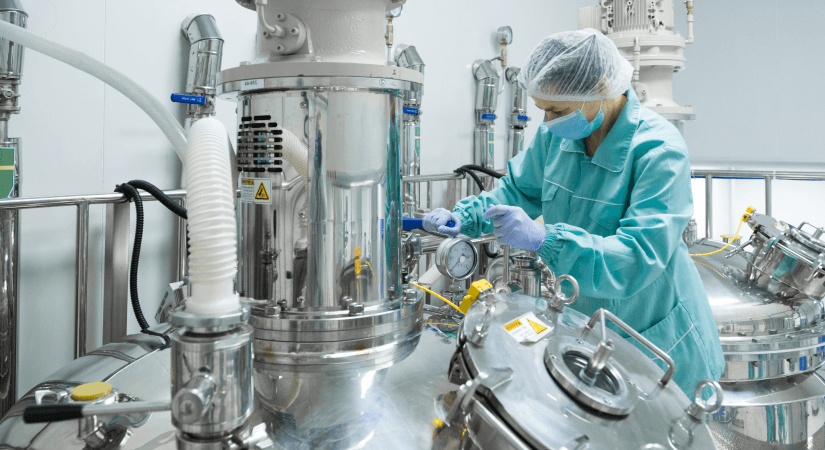
Bioprocessing has always been the engine behind biologics manufacturing, from monoclonal antibodies and vaccines to cell and gene therapies and recombinant proteins. But despite decades of progress, bioprocess development remains one of the most resource-intensive, variable, and time-consuming parts of pharmaceutical manufacturing.
With the growing complexity of biologics pipelines, the demand for large-scale, reliable, and cost-efficient production has never been higher. This is where artificial intelligence is fundamentally reshaping the landscape, enabling data-driven, predictive, and adaptive bioprocess optimisation.
AI in bioprocessing is not an isolated technological add-on; it is becoming a central pillar in digital biomanufacturing. Machine learning (ML), deep learning (DL), digital twins, and real-time analytics are now supporting decision-making across upstream and downstream operations. With increased process control, faster development cycles, and reduced costs, AI-enabled bioprocess optimisation is accelerating how companies scale biologics while maintaining compliance and robustness.
This blog explores how AI transforms bioprocess optimisation, diving into specific applications, technical perspectives, and operational benefits across the biopharmaceutical value chain.
Why Bioprocess Optimisation Needs AI
Traditional bioprocess development relies on Design of Experiments (DoE), empirical testing, and manual data interpretation. While effective, these methods are limited by the inherently complex nature of biological systems. Cell lines, culture media, feed strategies, agitation rates, pH control, purification conditions, and temperature all create a high-dimensional landscape that is difficult to model using conventional statistical tools.
The challenge is not just the volume but the variability and non-linear behaviour of living systems. AI excels in these environments because machine learning models can process huge datasets, capture hidden interactions, predict process deviations, and offer actionable recommendations.
Today, biopharma companies deal with multi-omics datasets, high-throughput screening outputs, sensor data, manufacturing execution system (MES) logs, and quality analytics. AI brings structure and intelligence to this fragmented ecosystem.
Some of the key drivers pushing AI adoption in bioprocess optimisation include:
- Increasing complexity of biologics, such as bispecific antibodies and viral vectors.
- Rising manufacturing costs, especially in cell therapy and microbial fermentation.
- Regulatory emphasis on QbD (Quality by Design) and continuous monitoring.
- Pressure to reduce development timelines, especially for next-gen biologics.
AI solutions help overcome these challenges by enabling predictive modelling, autonomous control loops, and data-driven process development strategies.
AI In Upstream Bioprocess Optimisation
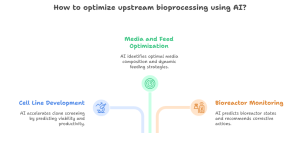
Upstream bioprocessing includes cell line development, culture media formulation, feeding strategies, and bioreactor control. Each of these areas generates huge volumes of time-series and multivariate data, making them ideal for machine learning.
1. Cell Line Development and Clone Screening
AI accelerates early development by analysing genomic, transcriptomic, and phenotypic data to identify high-productivity clones. Traditional clone screening may require evaluating thousands of candidates; machine learning models narrow down the list by predicting viability, titer, and stability.
Deep learning tools can also analyse microscopy images to detect cell morphology patterns that correlate with productivity or glycosylation consistency. This enhances quality in the earliest stages of the process.
2. Media and Feed Optimisation
Media composition affects cell growth, product quality attributes (PQAs), glycosylation profiles, and yield. AI-driven media optimisation uses supervised learning algorithms to identify optimal component concentrations, reducing the need for iterative experimental cycles.
Reinforcement learning is increasingly being used to design dynamic feeding strategies that adapt in real time to nutrient consumption, oxygen demand, and metabolic state.
3. Bioreactor Monitoring and Control
Bioreactors are the heart of upstream bioprocessing, and AI significantly enhances their performance through predictive models and automation.
AI systems monitor parameters such as:
- pH
- dissolved oxygen (DO)
- temperature
- agitation speed
- biomass concentration
- metabolite profiles
By analysing sensor data, AI predicts future states of the bioreactor and recommends corrective actions before deviations occur. Digital twins, virtual replicas of physical bioreactors, simulate process changes and guide optimisation.
Advanced process analytical technology (PAT) tools combined with AI support real-time release testing (RTRT) by monitoring critical quality attributes (CQAs) during fermentation or cultivation.
AI in Downstream Bioprocess Optimisation
Downstream processing involves harvest, clarification, chromatography, filtration, diafiltration, and formulation steps. These operations often face bottlenecks, especially when upstream titers increase. AI brings precision and adaptability to these steps.
1. Chromatography Optimisation
Chromatography is one of the most expensive and sensitive downstream steps. Machine learning models evaluate resin selection, gradient profiles, and flow rates to maximise purity and yield. Instead of running multiple column experiments, predictive models simulate purification performance under different conditions.
AI also optimises multi-column continuous chromatography systems, reducing resin usage and improving throughput in perfusion-based manufacturing.
2. Filtration and Clarification
Deep learning models assess fouling patterns, pressure drop dynamics, and membrane integrity to predict filter performance. AI tools optimise filter sizing, transmembrane pressure, and flux rates to minimise failures during large-scale filtration.
3. Quality Prediction and CQA Modelling
Downstream quality attributes such as charge variants, aggregation, fragment presence, and glycosylation profiles play a vital role in regulatory filings. AI models correlate upstream conditions with downstream CQAs, enabling proactive adjustments and improved batch consistency.
Enter The Bioprocess Digital Twin Era
One of the biggest advancements in AI-driven bioprocessing is the rise of digital twins. These are AI-powered virtual models that mirror the behaviour of real processes using historical, real-time, and predictive data.
Digital twins perform what-if analyses, identify process sensitivities, detect anomalies, and highlight optimisation opportunities long before physical experimentation. For continuous bioprocessing, digital twins act as control hubs, aligning bioreactors, chromatography skids, and filtration units in a unified, adaptive system.
They also support regulatory submissions by improving process understanding, which aligns closely with QbD and ICH Q8/Q9/Q10 expectations.
AI-Enabled PAT (Process Analytical Technology)
PAT has long been recognised as crucial to bioprocess control, but AI elevates its capabilities dramatically. AI algorithms improve the accuracy of spectroscopic techniques, including NIR, Raman, and fluorescence, by reducing noise, enabling multivariate analysis, and predicting metabolites or CQAs that are otherwise difficult to measure.
Real-time AI models make PAT a proactive system rather than a monitoring tool. This supports continuous manufacturing and real-time release strategies.
AI for Scale-Up and Tech Transfer
Scaling from bench-top to pilot and commercial production is one of the most complex aspects of bioprocessing. Small-scale models rarely scale linearly due to differences in shear, mixing, mass transfer, and hydrodynamics.
AI bridges this gap by identifying scale-dependent variables and predicting performance at larger volumes. Scale-up digital twins forecast behaviour under different operational scenarios, reducing experimental trials.
During technology transfer, AI ensures knowledge capture, standardisation, and consistency across sites, which is essential for multinational biologics production.
Regulatory Considerations and Compliance
As biopharma organisations integrate AI into manufacturing, regulatory expectations continue to evolve. Authorities like the FDA and EMA encourage AI adoption under the principles of control, transparency, and continuous process verification.
Key considerations include:
- Evidence of model validity and explainability
- Continuous performance monitoring
- Data integrity and ALCOA+ compliance
- Proper change management procedures
- Versioning and documentation of models
AI does not replace human oversight; instead, it supports regulatory-compliant decision-making with richer process understanding.
Impact on Cost, Speed, and Quality
AI’s biggest value lies in reducing development timelines, enhancing predictability, and enabling leaner manufacturing. Companies leveraging AI-driven bioprocess optimisation report:
- 30–50% reduction in experimental runs
- Significant decrease in batch failures
- Higher yields and reduced variability
- Faster tech transfer and scale-up
- Lower costs for materials, labour, and time
As biologics pipelines grow, particularly in monoclonal antibodies, biosimilars, mRNA, and CGT, AI-enabled processes will become critical for meeting global demand without compromising quality or compliance.
The Future: Autonomous Bioprocessing
The next phase of evolution is the self-optimising bioprocess, where AI, robotics, IoT sensors, and digital twins work together in autonomous control loops. Future biomanufacturing lines will adjust parameters based on predicted outcomes, reducing human intervention and enabling 24/7 continuous bioprocessing.
AI’s role will also expand into sustainability, reducing water, solvent, and energy consumption through efficiency modelling.
With regulatory frameworks maturing and strong industry interest, autonomous bioprocessing is not a distant vision; it is rapidly becoming a realistic operational model.
FAQs
1. How is AI used in bioprocess optimization?
AI analyzes bioprocess data to predict outcomes, optimize parameters, reduce variability, and automate control in upstream and downstream operations.
2. What is a digital twin in bioprocessing?
A digital twin is a virtual model of a bioprocess that simulates real-time behavior, predicts deviations, and supports optimization decisions.
3. How does AI help in upstream bioprocessing?
AI improves cell line selection, media optimization, feeding strategies, and bioreactor control using predictive analytics and machine learning.
4. Can AI support continuous biomanufacturing?
Yes, AI enhances PAT systems, real-time monitoring, and adaptive control, enabling reliable continuous and self-optimizing processes.
5. Is AI in bioprocessing accepted by regulators?
Regulators support AI when it aligns with QbD, data integrity, and process validation requirements, provided models are transparent and well-documented.

Comment your thoughts
Vidyakant Tiwari
nice information, would be great if the examples are also given
5 months ago