by Pharma Now Editorial Team
5 minutes
Key Takeaways from Pharma Now’s Webinar on AI in GxP with Dr. Ajaz Hussain
Watch the biggest takeaways from Pharma Now’s webinar on AI in GxP with Dr. Ajaz Hussain and what pharma IT leaders must do next.
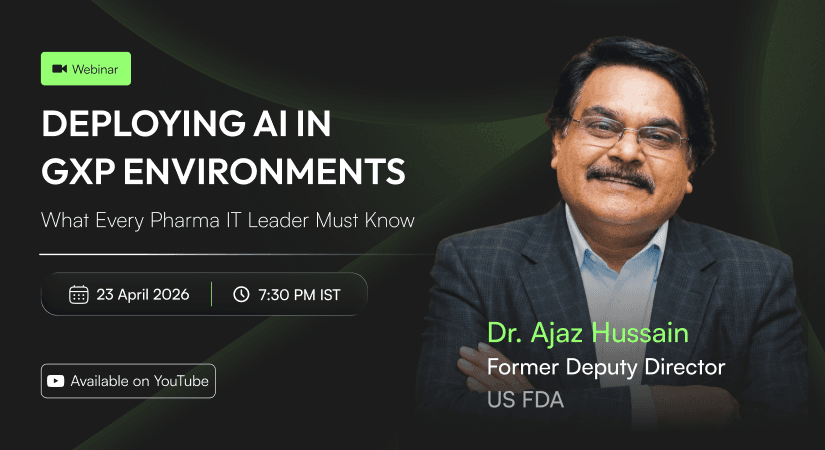
When 115 pharma IT leaders joined Pharma Now’s first GPACTS webinar on the evening of 23 April, the question on most of their minds was predictable: how do we validate AI in a GxP environment? Dr. Ajaz Hussain, who spent years inside the US FDA building the regulatory philosophy that still governs pharmaceutical manufacturing today, had a pointed response. That question, he argued, is itself the problem.
“The company was trapped in what I call compliance theatre. The right question is not ‘how do we validate AI?’, it is ‘can you prove the stability and capability of your personnel, processes, and products?’”
He cited a fresh warning letter issued in April 2026 to a cosmetic company that had used AI agents to write drug product specifications and master production records, and then told regulators it was unaware of the legal requirements. The cautionary point was sharp: if your organisation cannot first demonstrate the foundational capability that the FDA’s 2011 Process Validation Guideline demands, deploying AI into that environment does not solve the problem. It accelerates it.
A Hierarchy That Most Companies Are Skipping
Dr. Hussain offered a layered framework for thinking about AI adoption in pharma, one that demands an honest look at where a company actually sits before any AI conversation begins. At the base, he described what he calls “alien intelligence”: the over-reliance on external consultants, including ex-FDA officials, to write SOPs and warning letter responses on behalf of companies that cannot do it themselves. This dependence, he said, is a sign of organisational immaturity that no AI tool can fix.
Above that sits machine learning, statistical, predictive, and grounded in process data. Dr. Hussain pointed to the FDA’s first NDA approval based on machine learning analysis, a PKPD case he personally contributed to in 2002, as evidence that validation of ML models is not new territory. The principles are well-established. What is missing in most Indian pharma companies, he argued, is the foundational data quality that makes such models meaningful.
Generative AI and agentic AI sit at the top of this hierarchy, and Dr. Hussain was candid about the gap between the industry’s enthusiasm and its readiness. He estimated that fewer than four Indian pharma companies have the quality management maturity to seriously consider smart factory deployments. Most are stuck at a stage where their manufacturing processes are neither statistically stable nor demonstrably capable. Deploying advanced AI into that environment, he warned, is “a warning letter waiting to happen.”
Where AI Can Add Genuine Value, Right Now
Despite the cautionary tone, the session was not a case against AI; it was a case for applying it intelligently. Dr. Hussain identified several areas where pharma companies can begin creating real value without putting their GxP standing at risk.
Predictive maintenance and raw material qualification topped his list. Using machine learning to build a knowledge base of excipient functionality, going beyond the certificate of analysis to understand how materials actually perform in a manufacturing system, is an application with immediate, measurable impact.
The Lonza case study he described was striking: by analysing factory-wide data, including attendance logs, a machine learning model was able to predict the likelihood of sterility failures in injectable manufacturing. Companies that can demonstrate this kind of predictive capability, he noted, are positioned as low-risk by the FDA.
Generative AI, meanwhile, has a specific and underutilised role in helping companies build internal capability. Dr. Hussain’s recommendation: use tools like Claude or Gemini to produce what he calls “draft zero”, an initial response to an FDA warning letter, drawn from a review of all publicly available analogous letters.
That draft is not the submission. It is a structured starting point that forces a cross-functional team to challenge assumptions, take ownership, and ultimately self-author a response, without paying an external consultant to do it for them.
The Data Privacy Warning Nobody Is Talking About
One of the most direct moments in the Q&A came on the subject of data privacy. Dr. Hussain was unambiguous: if your team is using commercial generative AI tools, ChatGPT, Grok, or similar, with proprietary company or patient data, that data is leaving your organisation.
He noted that court cases on IP and patient data breaches are already moving through the US legal system. His recommendation to Indian pharma leaders was to explore private deployments of open-source AI models, or establish closed contractual arrangements with enterprise AI providers that prevent data egress. India, he added, has the technical talent to build proprietary small language models tuned for pharma compliance, and that opportunity is largely untapped.
The Regulatory Rulebook Is Fracturing
Perhaps the most sobering observation of the evening had nothing to do with technology. When asked whether the FDA was developing specific AI guidelines, Dr. Hussain’s response reframed the question entirely. The more urgent issue, he argued, is that the global regulatory architecture on which Indian pharma has relied for decades is now fracturing along geopolitical lines.
“Within a few months, the world will divide,” he said. “All the efforts of international harmonisation, everything is collapsing.” The emerging split between US-led and China-led technology ecosystems, including AI infrastructure, means that the ICH harmonisation model, which has underpinned how Indian generics navigate simultaneous FDA, EMA, and other regulatory submissions for a generation, can no longer be assumed to hold. Companies that have built their compliance strategies around a unified global standard are now building on shifting ground.
For AI specifically, this fracture has a direct consequence. The expectation that a single validated AI framework, one set of principles that satisfies FDA, EMA, and CDSCO simultaneously, will emerge from international bodies is, in his view, increasingly unrealistic. Indian pharma companies that are waiting for regulatory clarity before moving will find that clarity may arrive in the form of divergent, incompatible requirements.
The implication for CIOs and compliance heads is pointed: building AI governance frameworks that are modular and market-specific is no longer a nice-to-have. It is a strategic necessity.
What to Do on Monday Morning
Dr. Hussain closed with a practical directive. Before the next review of any AI system, bring together a cross-functional team: IT lead, QA manager, and end user. Ask three questions. Can someone in this room tell you when the system is giving a wrong answer? Are the failure modes understood? Can the system’s outputs be explained and audited? If no one can answer those questions, the system is not ready for GxP deployment. Full stop.
The message that ran through the entire session was not one of pessimism. It was one of sequencing. Build the statistical foundation first. Achieve process stability and capability. Use AI to accelerate the journey to that baseline. And only then, with clean data, mature processes, and a team that owns its own documentation, consider deploying AI inside a GxP-critical system.
As Dr. Hussain put it in his closing line: “AI is a double-edged sword. Use it properly.”
Conclusion
Pharma Now’s first GPACTS webinar made one thing clear: the conversation Indian pharma needs to be having about AI is fundamentally different from the one it is currently having. Dr. Ajaz Hussain’s session was not a technology briefing; it was a maturity assessment, delivered by someone who spent decades on the other side of the regulatory table.
The companies that will navigate AI in GxP environments successfully are not necessarily the ones moving fastest. They are the ones that have done the foundational work: stable processes, capable systems, clean data, and teams that own their own documentation.
Everything else, the models, the frameworks, the tools, follows from that. For India’s pharma IT leaders, the window to build that foundation, before regulatory expectations and geopolitical fractures make the landscape significantly more complex, is open right now. The question is whether enough organisations are treating it with the urgency it deserves.
The question is whether enough organisations are treating it with the urgency it deserves. Watch the full webinar recording on Pharma Now's YouTube channel to hear Dr. Hussain's complete framework and real-time Q&A.
Pharma Now Editorial Team
Publisher Team