7 Reasons Why AI Strategy Fails In Pharma — And How To Fix It
7 reasons AI strategy fails in pharma — from data gaps to regulatory misalignment — and how to fix each one.


Artificial Intelligence (AI) is no longer a futuristic concept in the pharmaceutical industry. From drug discovery and clinical development to manufacturing, pharmacovigilance, and quality operations, AI promises faster decisions, lower costs, and better patient outcomes. Yet many pharmaceutical companies struggle to move beyond pilot projects. Large investments often fail to translate into measurable value.
AI does not fail because the technology is weak. It fails because strategy, execution, data readiness, and regulatory alignment are often missing. Pharmaceutical environments are highly regulated, data-heavy, and process-driven. If AI initiatives are not designed for this reality, they stall.
Here are seven practical reasons why AI strategy fails in pharma, and what organisations can do to fix each one.
1. AI Projects Are Not Linked to Real Business Problems
Many pharma companies start with technology excitement rather than operational need. Teams launch AI pilots because competitors are doing it or leadership wants “digital transformation.” The result is disconnected proof‑of‑concept projects that do not solve real bottlenecks.
For example, building a machine learning model to predict batch failures has little value if deviation management processes remain manual and corrective actions are slow. Similarly, an AI tool for protocol design will not help if clinical site feasibility and recruitment delays are the true constraints.
How to fix it:
AI initiatives must begin with measurable operational pain points. Define the exact problem in business terms, such as cycle time reduction, deviation recurrence rate, batch release delay, protocol amendment frequency, or pharmacovigilance case processing backlog. AI use cases should be mapped to KPIs that matter to manufacturing heads, quality leaders, regulatory teams, and clinical operations managers.
When AI is tied to metrics like Right First Time (RFT), Overall Equipment Effectiveness (OEE), batch rejection rate, or time-to-market, projects gain executive support and clear success criteria.
2. Poor Data Quality and Fragmented Systems
AI models are only as strong as the data feeding them. In pharma, critical data lives in disconnected systems: LIMS, QMS, MES, ERP, CTMS, EDC, and pharmacovigilance databases, as well as spreadsheets. Data formats differ, terminology is inconsistent, and historical records are often incomplete.
Manufacturing data may contain missing sensor values. Quality records may be stored as scanned PDFs. Clinical data may use inconsistent coding standards. Without clean, structured, and interoperable datasets, AI outputs become unreliable.
This problem is especially severe in regulated environments where audit trails and data integrity requirements apply. Incomplete metadata, poor version control, and manual entries create noise that machine learning models cannot interpret correctly.
How to fix it:
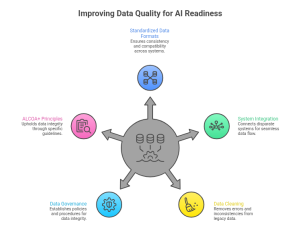
Organisations must invest in data engineering before AI engineering. AI readiness begins with structured, validated, and traceable datasets.
This includes:
- Standardising data formats using controlled vocabularies and harmonised taxonomies
- Integrating systems through validated APIs and data lakes
- Cleaning legacy data and resolving missing or duplicate records
- Implementing data governance frameworks aligned with GxP expectations
- Ensuring ALCOA+ principles for data integrity
3. Lack of Regulatory and Compliance Alignment
Pharmaceutical AI is subject to strict regulatory oversight. Any system that influences product quality, patient safety, or regulatory submissions must comply with applicable standards. Many AI initiatives fail because they are built like consumer tech products rather than regulated systems.
Black-box algorithms, undocumented model changes, and a lack of validation plans create regulatory risk. If teams cannot explain how a model reaches a decision, regulators may reject its use in GMP or GCP environments.
This becomes critical in areas such as:
- AI-supported batch release decisions
- Predictive quality analytics
- Clinical trial patient selection
- Safety signal detection
How to fix it:
AI systems must be developed within validated frameworks. Compliance cannot be added later. It must be designed into the AI lifecycle.
Key steps include:
- Risk-based validation aligned with computerised system validation (CSV)
- Model documentation, version control, and change management
- Explainable AI methods to support auditability
- Clear human oversight for critical decisions
- Early engagement with regulatory and quality teams
4. Siloed Teams and Weak Cross-Functional Collaboration
AI projects often sit within IT or digital innovation teams, disconnected from operations. Data scientists may build models without understanding GMP workflows, deviation handling, validation requirements, or manufacturing constraints.
At the same time, quality and manufacturing teams may lack confidence in algorithm-driven insights. This disconnect leads to tools that look impressive but are impractical for real-world use.
For instance, a predictive maintenance model may flag equipment risks, but if maintenance schedules, spare parts logistics, and change control workflows are not aligned, the alert has little operational impact.
How to fix it:
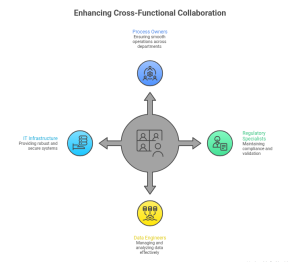
AI programs must be cross-functional from day one. Co-creation ensures that AI solutions fit into existing SOPs, batch records, audit trails, and release workflows.
Effective teams include:
- Process owners from manufacturing, QA, QC, and supply chain
- Regulatory and validation specialists
- Data engineers and data scientists
- IT infrastructure and cybersecurity teams
5. Unrealistic Expectations and Poor Change Management
Leadership often expects AI to deliver immediate transformation. In reality, AI implementation is iterative. Models require training cycles, performance tuning, and operational calibration. Overpromising results creates disappointment and loss of support. Operational teams may also resist AI tools.
Concerns about job displacement, increased oversight, or unfamiliar interfaces slow adoption. If users do not trust the system, they override recommendations or revert to manual methods, causing AI investments to underperform.
How to fix it:
AI deployment must be treated as organizational change, not just a technical upgrade. Training programs should focus on practical use, not theory. Users must understand how AI supports their decisions rather than replaces them.
Set phased milestones such as:
- Pilot in one product line or site
- Parallel runs alongside manual processes
- Performance benchmarking against historical data
- Gradual scale-up after validation

6. Inadequate Infrastructure for Scalable AI
AI workloads require robust digital infrastructure. The legacy of on-premise systems, limited computing power, and poor network architecture restricts model performance and scalability. Real-time analytics in manufacturing require high-frequency sensor data pipelines.
Clinical AI requires secure and high-volume data processing. Pharmacovigilance AI demands text mining across global safety databases. Without cloud readiness, secure data pipelines, and scalable computing environments, AI systems become slow and unreliable.
How to fix it:
Infrastructure strategy must align with long-term AI roadmaps. Pharma companies should modernise digital foundations through:
- Hybrid or cloud infrastructure with validated environments
- Secure data pipelines with encryption and access controls
- High-performance computing for model training
- Edge analytics for real-time manufacturing insights
7. No Clear Value Measurement Framework
AI success is often described in vague terms like “innovation” or “digital maturity.” Without financial and operational metrics, leadership cannot justify continued investment.
Pharma companies need quantifiable evidence, such as:
- Reduction in deviation recurrence
- Faster batch release cycles
- Lower quality investigation backlog
- Improved clinical enrollment timelines
- Reduced adverse event case processing time
How to fix it:
Define value metrics before deployment. Track baseline performance and compare post‑implementation outcomes. Include both direct financial impact and operational efficiency gains.
Dashboards should translate AI outputs into business language that executives understand, such as cost avoidance, productivity improvement, reduced compliance risk, and accelerated time-to-market.

Building an AI Strategy That Works in Pharma
AI in pharmaceuticals is not plug-and-play technology. It must operate within validated systems, regulated workflows, and high-stakes decision environments. Companies that treat AI as a long-term capability, not a short-term experiment, achieve sustainable results. Successful AI strategies share common traits:
- Business-first use case selection
- Strong data foundations
- Built-in regulatory compliance
- Cross-functional ownership
- Scalable infrastructure
- Measurable value delivery
Conclusion
AI holds transformative potential across drug development, manufacturing, quality, and safety. However, technology alone cannot solve structural and operational gaps. Strategy must align with data readiness, regulatory frameworks, infrastructure maturity, and human adoption. Pharma organisations that address these fundamentals can move beyond pilot fatigue and unlock real operational and patient value from AI investments.
Read more in-depth pharma blogs
FAQs
1. Why do AI projects fail in pharmaceutical companies?
AI projects fail due to poor data quality, lack of regulatory alignment, weak infrastructure, unclear business goals, and low user adoption.
2. How can pharma companies make AI systems compliant?
By using risk-based validation, maintaining model documentation, ensuring audit trails, and applying explainable AI methods.
3. What data challenges affect AI in pharma manufacturing?
Disconnected systems, inconsistent formats, missing sensor data, unstructured quality records, and weak data governance.
4. Is AI allowed in GMP-regulated environments?
Yes, if systems are validated, transparent, risk-assessed, and supported by human oversight.
5. What metrics show AI ROI in pharmaceuticals?
Batch release cycle time, deviation reduction rate, investigation backlog, clinical timelines, and pharmacovigilance processing speed.
Reporting on the science, business and regulation shaping the pharmaceutical industry.


Discussion