by Vaibhavi M.
8 minutes
How AI Is Changing the Way Pharma Research Teams Work
AI is reshaping pharma research teams, faster drug discovery, smarter decisions, and real results from companies already leading the shift.
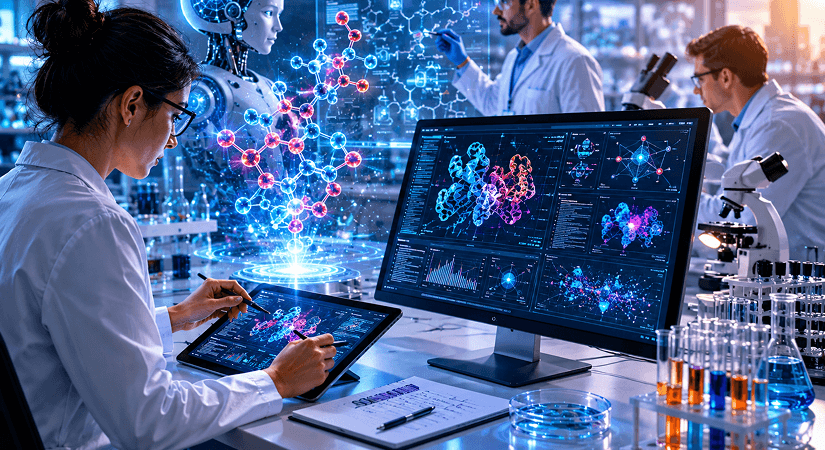
Drug discovery has never been easy. On average, it takes more than 10 years and upwards of $2.5 billion to bring a single new drug to market, and the failure rate in clinical trials still hovers above 90%. For decades, research teams in pharmaceutical and biotech companies have worked under enormous pressure: find the right target, validate it, develop a molecule that works, and do all of this faster than the competition.
Now, artificial intelligence is stepping in, not to replace scientists, but to work alongside them. The model gaining the most traction in drug discovery today is the AI-augmented research team: a hybrid setup in which human scientists and AI tools work together, each doing what they do best.
This shift is not just a technology upgrade. It represents a fundamental change in how pharmaceutical research is organised, how decisions are made, and how quickly new treatments can reach patients.
What Does "AI-Augmented" Actually Mean?
The term "augmented" is important here. It does not mean automated. An AI-augmented research team is one where AI tools are embedded into the day-to-day workflow of scientists, helping them analyse data faster, surface patterns they might miss, and prioritise which experiments to run next.
Think of it like adding a very capable research assistant that never sleeps, can read millions of scientific papers overnight, and can run thousands of simulations in the time it takes a scientist to write a single lab report. The scientist still drives the research. The AI expands what is possible within that scientist's working hours.
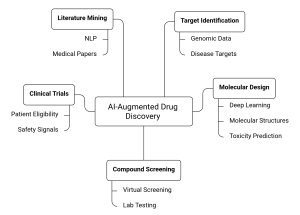
Some of the key areas where AI is now embedded into research team workflows include:
- Target identification and validation: AI models trained on genomic, proteomic, and clinical datasets can identify disease-relevant biological targets much faster than manual literature review.
- Molecular design: Generative AI models, such as those using deep learning architectures like graph neural networks, can propose novel molecular structures with predicted binding affinity, selectivity, and ADMET (absorption, distribution, metabolism, excretion, toxicity) profiles.
- Compound screening: Virtual screening using AI reduces the need to physically test millions of compounds by predicting which candidates are most likely to succeed before they ever enter the lab.
- Clinical trial optimisation: AI tools help teams identify eligible patient populations, predict dropout rates, and flag safety signals earlier in the trial process.
- Literature mining: Natural language processing (NLP) tools can scan and summarise thousands of published papers, flagging the most relevant findings for the research team.
Why Research Teams Are Embracing This Model
The pharmaceutical industry has always generated vast amounts of data. What has changed is the ability to make sense of that data at scale. Traditional bioinformatics tools were powerful but limited. Today's AI systems, particularly large language models and graph-based machine learning, can integrate data from multiple sources simultaneously: genomics, electronic health records, imaging data, biomarker profiles, and published literature.
This multi-modal data integration is something human teams simply cannot do at the same speed or scale.
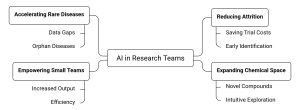
Beyond speed, there are several practical reasons pharma companies are building AI-augmented teams:
- Reducing attrition: One of the highest costs in drug development is late-stage failure. AI-driven early-stage filtering helps identify weak candidates before significant resources are invested.
- Expanding chemical space: Human researchers tend to work within familiar structural classes. AI systems can propose compounds in unexplored chemical spaces that humans would not intuitively consider.
- Enabling smaller teams to do more: With AI tools handling data processing and hypothesis generation, smaller research groups can operate with the output capacity that would previously have required much larger teams.
- Accelerating rare disease research: In orphan disease programs, patient populations are small, and data are scarce. AI models trained on related biological pathways can help fill these data gaps.
Real-World Applications Driving This Shift
The most compelling evidence for AI-augmented research teams comes from what is already happening in the field.
Insilico Medicine used a generative AI platform to identify a novel drug candidate for idiopathic pulmonary fibrosis in roughly 18 months, a process that typically takes 4 to 5 years. The compound moved into clinical trials, demonstrating that AI-designed molecules are not just theoretical exercises.
Recursion Pharmaceuticals has built its entire model around AI-augmented biology. Their platform generates millions of cellular images per week. It uses machine learning to identify disease-relevant phenotypic changes, creating a biological map of drug-disease relationships that human teams could not produce manually.
BenevolentAI applies NLP and knowledge graph technology to connect existing biomedical data in ways that surface non-obvious biological relationships. Their work on baricitinib as a potential COVID-19 treatment, identified through AI-driven literature analysis, is now one of the most cited examples of AI contributing to real clinical outcomes.
These are not pilot programs. These are operating research teams, and their AI tools are central to how they function every day.
Insilico Medicine, Recursion and BenevolentAI are just three of the companies reshaping AI drug discovery.
A complete breakdown of the top AI drug discovery companies leading this transformation in 2026.
→ Read: Top AI Drug Discovery Companies 2026
The Human Role Has Shifted, Not Shrunk
A common concern is that AI will reduce headcount in research teams. The reality, so far, looks different. What is changing is the type of work scientists spend their time on.
In traditional research, a significant portion of a scientist's time is spent on manual tasks: searching the literature, processing raw data, running repetitive assays and building spreadsheets. AI handles much of this now. What it cannot do, at least not reliably, is exercise scientific judgment, design novel experimental strategies, interpret unexpected results, or navigate the regulatory, ethical, and commercial dimensions of drug development.
Senior scientists in AI-augmented teams report that their work has become more intellectually focused. They spend more time on hypothesis generation, experimental design, and interpretation, the higher-order thinking that moves a program forward.
The new skills that are becoming valuable in research teams include:
- Understanding how to frame scientific questions for AI tools
- Being able to critically evaluate AI-generated outputs rather than accepting them uncritically
- Collaborating with data scientists and machine learning engineers
- Understanding the limitations of AI models, particularly around data bias and model interpretability
Challenges That Still Need Solving
AI-augmented research is not without its problems. The field is moving quickly, and there are genuine scientific and operational challenges that teams are still working through.
Data quality and bias remain the most fundamental issues. AI models are only as good as the data they are trained on. In drug discovery, historical datasets often overrepresent certain disease areas, certain patient populations, and certain experimental conditions. Models trained on biased data can produce confident but misleading predictions.
Model interpretability is another unresolved challenge. Many high-performing AI systems in drug discovery, particularly deep learning models, function as black boxes. They produce an output, but the reasoning behind that output is not always clear. For regulatory purposes, and for scientific trust, the ability to explain a prediction matters.
Validation bottlenecks have not disappeared. Even with AI accelerating virtual screening and hit identification, experimental validation still requires time, physical infrastructure, and skilled labour. The bottleneck has moved downstream, but it has not been eliminated.
Integration with regulatory frameworks is still evolving. Regulatory agencies, including the FDA and EMA, have begun publishing guidance on AI and machine learning in drug development, but the frameworks for validating AI-generated evidence in submissions are still being developed.
Data quality, model interpretability and regulatory frameworks are not the only hurdles.
A deeper look at the full spectrum of challenges facing AI-driven drug discovery today.
→ Read: Tackling Drug Discovery Challenges In Pharma
What the Next Five Years Look Like
The trajectory is clear. AI is not going away from pharmaceutical research; it is becoming more deeply embedded in it. Several trends are shaping where this goes next.
Federated learning, where AI models are trained across multiple datasets without sharing raw data, is enabling research teams to access broader training data while respecting data privacy and competitive boundaries. This is particularly relevant for rare disease research, where pooling data across institutions could significantly improve model performance.
Foundation models trained on biological data, sometimes called biological language models, are beginning to show the same kind of versatility in biology that large language models have shown in text. Models like ESMFold (developed at Meta AI) can predict protein structures from sequence data alone, expanding on AlphaFold's work and potentially accelerating structural biology research significantly.
AI agents, autonomous systems that can plan and execute multi-step research tasks with minimal human direction, are beginning to appear in laboratory automation contexts. While fully autonomous drug discovery remains speculative, the integration of AI planning tools with robotic lab systems is already showing early results.
For research teams, the practical implication is straightforward: the organisations that invest in building AI-integrated workflows now and develop the internal expertise to use these tools critically and effectively will have a meaningful head start.
Conclusion
The rise of AI-augmented research teams marks one of the most significant shifts in pharmaceutical science in decades. This is not about replacing scientists. It is about giving them tools that expand what is possible within the limits of time, budget, and human attention.
The teams that are succeeding with this model are the ones treating AI as a collaborator, not a shortcut. They validate its outputs, question its assumptions, and combine its computational power with human scientific judgment. That combination, careful, experienced researchers working alongside powerful AI systems, is where the next generation of medicines is being built.
FAQs
1. What is an AI-augmented research team in pharma?
An AI-augmented research team combines human scientists with artificial intelligence tools to accelerate drug discovery, improve data analysis, and reduce costly trial failures, without replacing scientific judgment.
2. How does AI help in drug discovery?
AI assists with target identification, molecular design, virtual compound screening, clinical trial optimisation, and scientific literature mining, enabling faster, more accurate decisions at every stage of development.
3. Which pharma companies are using AI in research?
Companies like Insilico Medicine, Recursion Pharmaceuticals, and BenevolentAI have integrated AI into their core research workflows, with several AI-designed compounds already advancing into clinical trials.
4. Does AI replace scientists in pharmaceutical research?
No. AI handles data-intensive, repetitive tasks, freeing scientists to focus on higher-level thinking, such as experimental design, result interpretation, and strategic decision-making.
5. What are the biggest challenges of AI in drug discovery?
Key challenges include data quality and bias in training datasets, limited model interpretability, bottlenecks in experimental validation, and evolving regulatory frameworks for AI-generated evidence.