Is Pharma's AI Investment Actually Paying Off? Here's What the Numbers Say
Pharma AI ROI, pharmacovigilance and manufacturing deliver 1-3 year returns. Drug discovery takes 7-12 years. Real data, honest measurement framework.

20260804112352.webp&w=1920&q=75&dpl=dpl_7697WWeWVGtXcWc53V6g8udmACTQ)
The Billion-Dollar Bet That Demands an Answer
The pharmaceutical industry has never been shy about big spending. Research and development costs for a single approved drug can range from $1 billion to $2.6 billion, and those costs keep rising. So when AI entered the picture, promising to cut timelines, reduce failures, and unlock new biological targets, pharma executives opened the chequebook quickly.
Global pharmaceutical AI investment crossed $3 billion in 2023 and is projected to grow at a compound annual growth rate (CAGR) of around 29% through 2030, according to market research estimates. The money is flowing into drug discovery platforms, clinical trial optimisation tools, real-world evidence engines, and manufacturing quality systems.
But somewhere between the press release and the pipeline, a harder question is getting asked in boardrooms and strategy meetings: Is any of this actually working?
The ROI question in pharma AI is not simple. It does not have one answer. It depends on where AI is being used, how success is measured and how honestly companies are willing to acknowledge the gap between pilot projects and production-scale outcomes.
Why ROI in Pharma AI Is So Hard to Measure
Most industries measure ROI with a fairly clean formula: cost in, value out. In pharma, the timeline between investment and return can stretch across a decade. A drug that AI helped discover in 2022 may not reach approval until 2032. How do you assign a dollar value to that contribution today?
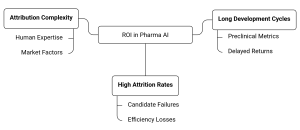
There are three specific reasons why ROI measurement in pharma AI is structurally difficult:
- Long development cycles: Drug development takes 10–15 years on average. AI tools applied in preclinical research will not show financial returns until far down the pipeline, if at all.
- High attrition rates: Roughly 90% of drug candidates that enter clinical trials never reach approval. Even if AI improves target identification, failures in Phase II and Phase III can quickly erase that upstream value.
- Attribution complexity: When a drug succeeds, it is almost impossible to isolate how much of that success came from AI versus experienced scientists, a strong clinical design, or favourable market conditions.
This does not mean ROI cannot be measured. It means pharma companies need better frameworks for thinking about it, not just revenue and cost, but speed, risk reduction, and resource efficiency.
Where AI Is Delivering Measurable Value
Despite the measurement challenges, several areas of pharma AI are delivering quantifiable results today.
1. Drug Discovery and Target Identification
This is where AI has received the most attention, and some of the most credible early data. Machine learning models trained on genomic, proteomic, and clinical datasets can scan millions of molecular interactions in the time it would take a team of researchers to analyse a few hundred.
Insilico Medicine used its AI platform to identify a novel drug target for idiopathic pulmonary fibrosis (IPF) and to develop a candidate compound in approximately 18 months, a process that typically takes four to five years. The company's INS018_055 compound reached Phase II trials, providing one of the first concrete clinical proof points for AI-accelerated discovery.
Recursion Pharmaceuticals and Exscientia have reported similar reductions in cycle time. While none of these candidates has yet cleared full approval, the pipeline progression data is credible and financially meaningful; earlier candidates in Phase II represent hundreds of millions of dollars in potential value.
2. Clinical Trial Design and Patient Recruitment
Clinical trials are where most development costs concentrate. A Phase III trial for a single indication can cost $300 million to $600 million and take three to five years. Delays are expensive; an industry estimate from Tufts Centre for the Study of Drug Development puts the cost of a single day of delay in Phase III at approximately $600,000 to $8 million, depending on the therapeutic area.
AI is helping reduce this cost in two ways: by improving protocol design and by enabling faster patient identification.
Natural language processing (NLP) tools can analyse electronic health records (EHRs), claims data, and biobank data to identify eligible patients more quickly. Companies like Medidata and Veeva have built AI-powered tools that have reduced patient recruitment timelines by 20–40% in reported use cases. Protocol simulation models can also flag design flaws before trials start, reducing costly protocol amendments.
3. Manufacturing and Quality Control
Pharmaceutical manufacturing is tightly regulated, and deviations are costly, both in terms of product loss and regulatory consequences. AI-powered computer vision systems are now being used on production lines to detect defects in tablets, vials, and packaging with greater accuracy and consistency than manual inspection.
Pfizer, Novartis, and several contract manufacturing organisations (CMOs) have reported measurable reductions in batch rejection rates after implementing AI-assisted quality systems. While exact figures are often proprietary, a reduction in batch failures by even 1–2% at scale can represent tens of millions of dollars in recovered product value annually.
4. Pharmacovigilance and Signal Detection
Post-marketing safety surveillance is a regulatory requirement with serious consequences when done poorly. AI tools that process adverse event reports, medical literature, and social media data have demonstrated the ability to detect safety signals faster than traditional manual review.
The ROI Scorecard: A Realistic View
The pattern is clear: AI use cases with shorter feedback loops deliver faster, more measurable ROI. Manufacturing, pharmacovigilance, and operational efficiency return value in months to a few years. Drug discovery and clinical outcomes return value over a decade, if at all.
Pharmacovigilance scores the highest confidence ROI on the board.
Here are the 7 AI tools already delivering it.
→ Read: 7 AI Tools Revolutionizing Pharmacovigilance Workflows
Where AI Is Falling Short of the Hype
Not every pharma AI investment is producing results. Several failure modes are now well documented.
Proof-of-concept fatigue is one of the most common. Companies run successful AI pilot programs, generate impressive internal data, and then struggle to scale. The organisational infrastructure, clean data pipelines, cross-functional workflows, and regulatory compliance needed to deploy AI at enterprise scale are far more complex than running a demonstration project.
Data quality problems are endemic. AI models are only as good as the data they learn from. In pharma, data is often siloed across clinical systems, laboratory databases, EHR platforms, and CRO partnerships. Inconsistent data standards, missing values, and historical datasets with labelling errors all degrade model performance.
Regulatory uncertainty has also slowed adoption, particularly in clinical and regulatory submissions. Neither the FDA nor EMA has finalised comprehensive guidance on how AI-generated evidence should be evaluated. This creates legitimate risk-aversion among compliance teams.
Pilot fatigue and data gaps tell half the story.
These are the companies that pushed past them and built real AI drug discovery pipelines.
→ Read: Top AI Drug Discovery Companies 2026
What a Pharma AI ROI Checklist Looks Like
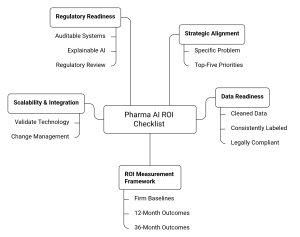
Before committing budget to any AI initiative, pharma organisations should work through this checklist:
Strategic Alignment
- Is there a clearly defined problem this AI is solving?
- Does it align with a top-five operational or scientific priority?
- Is there executive sponsorship beyond the technology team?
Data Readiness
- Is the relevant data accessible, clean, and consistently labelled?
- Are there data governance policies in place?
- Is patient data handling compliant with GDPR, HIPAA, and applicable regional regulations?
ROI Measurement Framework
- Are baseline metrics defined before deployment (cycle time, cost, failure rate)?
- Is there a 12-month and 36-month measurement plan?
- Are downstream pipeline outcomes being tracked, not just model accuracy?
Scalability and Integration
- Has the technology been validated beyond a pilot setting?
- Is there a plan for integration with existing systems (ERP, CTMS, LIMS)?
- Are change management resources allocated?
Regulatory and Compliance Readiness
- Has the relevant regulatory guidance been reviewed?
- Is there a qualified person or compliance lead involved in deployment?
- Is the AI system auditable and explainable to regulators if required?
The Honest Conclusion
The ROI question in pharma AI does not have a single, clear answer, and anyone who sells you one is oversimplifying. What the evidence does show is that AI is delivering real, measurable value in operational applications right now. The deeper scientific applications, better drugs, faster discovery and fewer trial failures are showing early promise, but the financial proof will take years to materialise in full.
The companies that are likely to win in pharma AI are not those that spent the most or deployed the fastest. They are the ones who set honest baselines, measure outcomes rigorously, fix data problems early and build organisational capability to scale what works. That is not a technology story. That is a management story.
Pharma has always operated on long-term horizons. The ROI mindset needs to match.
FAQs
Q1. What is the average ROI timeline for AI in pharma drug discovery?
ROI from AI in drug discovery is typically realised over 7–12 years, tied to pipeline outcomes and eventual regulatory approval. Operational AI tools in manufacturing or pharmacovigilance deliver returns within 1–3 years.
Q2. Which pharma companies are seeing real results from AI?
Companies including Insilico Medicine, Recursion Pharmaceuticals, Exscientia, Pfizer, and Novartis have published or disclosed measurable outcomes from AI deployment across discovery, manufacturing, and clinical operations.
Q3. How is ROI measured for AI in clinical trials?
Key ROI metrics include patient recruitment speed (measured against historical baselines), protocol amendment frequency, site activation timelines, and overall trial cost per patient enrolled.
Q4. What are the biggest barriers to pharma AI ROI?
Data quality and fragmentation, lack of regulatory guidance, difficulty scaling from pilot to enterprise, and the long feedback loops in drug development are the most consistently cited barriers.
Q5. Does the FDA in pharma regulate AI?
The FDA has issued guidance on AI in medical devices and has published an action plan for AI/ML-based software. For drug development applications, guidance is evolving. Companies are expected to document AI use in submissions and demonstrate data integrity and model validation.
Reporting on the science, business and regulation shaping the pharmaceutical industry.


Discussion