Why the Pharma Industry Needs Next-Gen Traceability?
Why the pharma industry must move beyond compliance and build stronger traceability systems to detect counterfeit medicines.
Introduction
A father buys what appears to be a legitimate antibiotic for his daughter. The blister pack seems genuine, complete with a QR code that scans successfully. Three days later, her condition worsens. Lab tests reveal sub-therapeutic levels of the active ingredient. The medicine was fake.
This is not fiction. It is the uncomfortable reality of today's pharmaceutical supply chains, where fraudulent products move undetected through wholesalers, secondary distributors, and parallel trade channels.
Over the past decade, Governments have responded with serialization mandates, track and trace programs, QR-based verification, and reporting frameworks. Despite a strong framework on paper, counterfeit medicines continue to enter the market.
Meeting regulatory requirements does not equal protection. The industry must move beyond box-checking toward resilient, unit-level identity systems capable of real-time authentication and faster anomaly detection. In this article, we examine the true scale of the counterfeit drug problem beneath the regulatory headlines and what it actually takes to build next-generation traceability that truly protects the patients and supply chain operations.
I. The Counterfeit Drug Landscape
Counterfeit medicines today are not crude imitations. The trade has evolved into a well-structured, multi-billion-dollar global enterprise that mimics legitimate supply chain operations. Bad actors build networks, replicate packaging, clone QR codes and exploit gaps in pharmaceutical logistics and regulatory oversight.

Illegitimate products enter genuine channels through parallel trade, secondary wholesalers, or poorly monitored redistribution points. Once inside, they move alongside real inventory, making detection difficult. Emerging markets face greater exposure to pharmaceutical counterfeiting due to fragmented distribution networks, rapid market growth, and uneven regulatory enforcement capacity.
In such situations, verification often becomes a routine step rather than a meaningful safeguard.
The real risk in pharmaceutical traceability is not the lack of regulation. It is false confidence. Serialisation mandates exist, track-and-trace systems operate, and QR programs are in place, yet weaknesses remain. Batch-level QR codes are sometimes mistaken for unit-level authentication, static codes can be cloned, and secondary packaging loopholes persist.
When achieving compliance becomes the goal rather than building defensible systems, supply chains may appear secure even when they are not. Meanwhile, fraudulent networks adapt faster than regulations. The solution is not to abandon serialisation but to strengthen it with pack-level identity, real-time verification, and systems designed for today's technological landscape.
II. Compliance Is the Baseline, Not the Finish Line
Serialisation directives often arrived under tight deadlines and budget pressure. The priority was regulatory readiness, and not long-term durability. Practical compromises emerged: QR codes on secondary packaging, batch identifiers where unit-level serialization was needed, static data formats, partial system integration, and limited point-of-sale verification. These are not regulatory violations, but design compromises exploited by counterfeiters.
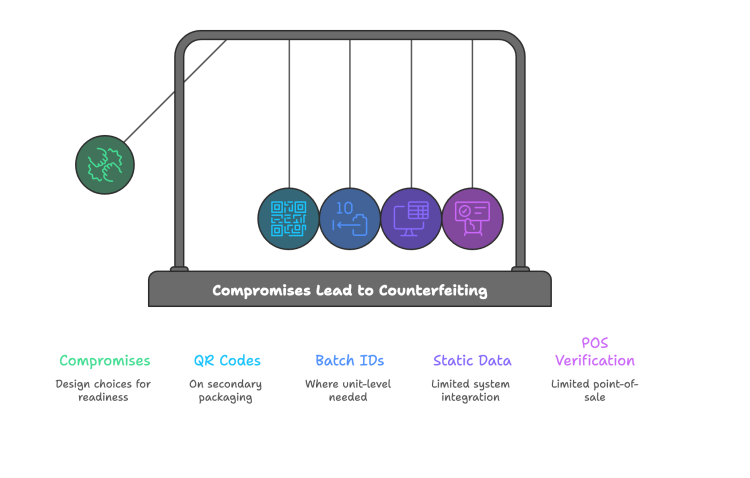
Dashboards record movement across the supply chain, yet documentation alone cannot guarantee authenticity. In many cases, mandate-driven serialisation is designed primarily to meet compliance requirements rather than ensure protection. Compliance, therefore, is only the baseline, not the finish line.
III. Traceability Versus Authentication
Track-and-trace systems answer where a product has been, mapping batches through the supply chain. This supports logistics, recalls, diversion detection, and reporting. But movement does not guarantee authenticity. A product can travel a traceable route and still be counterfeit. Traceability records the journey; authentication verifies the unit. Reliable authentication requires unique identifiers, unit-level serialization, live verification, and clone-resistant architecture.
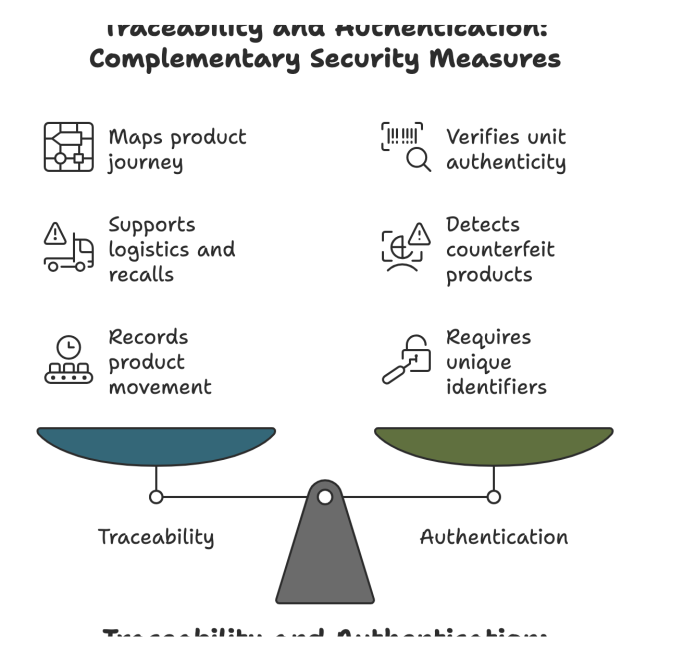
Each pack must carry a unique digital identity. Traceability and authentication are complementary but not interchangeable. Confusing them creates a security gap.
IV. The Technology Myth
Pharma companies invest heavily in serialization and track-and-trace systems. QR codes are created, events are logged, and dashboards are updated, but counterfeit drugs continue to circulate in the market. Technology alone cannot stop them. QR codes don't guarantee proper oversight, and scans don't always confirm authenticity.
Many systems rely on passive scanning, meaning that if pharmacists or consumers don't scan, the counterfeit drugs go unnoticed. Passive serialization ensures compliance, but active identity checks protect integrity.
Trust gaps make the problem worse: consumers trust pharmacies, pharmacies trust distributors, and distributors trust manufacturers. Generic confirmation messages weaken real verification, leading to declining usage over time. For effective security, clone-resistant identifiers, per-unit governance, real-time anomaly detection, and smooth workflow integration are required. Technology is important, but it must be part of a stronger, smarter system.
V. Building Next-Generation Traceability
Next-generation traceability shifts focus from reporting to identity architecture.
Serialization begins not with QR codes but with systems designed to withstand cloning, regulatory changes, and supply chain complexity. It is not louder legislation; it is stronger infrastructure.
Industry experts like Dr. Avi Chaudhuri and Mr. Abiram Vijayakumar, the Co-Founder of AltiusHub, are offering practical frameworks for secure, scalable drug authentication, showing how traceability can move from compliance exercise to enterprise-strength defense.
Durable traceability starts at the unit level. Batch codes are easy to deploy, but cannot prevent large-scale cloning. Each pack must carry a unique identifier to enable duplicate detection, trace geographic anomalies, and track serial-number lifecycles. A batch code shows movement, while a unit-level ID confirms authenticity. That is the difference between recording a journey and verifying identity.
Governance defines strength. Modern systems monitor identity across the lifecycle, including continuous scanning, duplicate detection, anomaly monitoring, and real-time verification. AI plays a critical role in improving traceability. It can spot duplicates in distant markets, abnormal scan clusters, and fraudulent signals earlier than manual audits. Without lifecycle governance, serialization is static. With it, it becomes proactive defence.
Since long-term adaptability matters more than short-term audits, Serialization should be treated as enterprise risk infrastructure rather than just a compliance line item. To support this, identity data must be kept separate from reporting systems, and architecture decisions should consider five- to seven-year horizons.
Compliance may justify the investment, but strong systems ensure it continues to deliver over time.
VI. The Consumer as the Final Firewall
Authentication only matters when it is used. Consumers and pharmacists are the final verification layer. If checks are skipped, counterfeit friction drops. If verification becomes routine, the risk for bad actors rises.
QR verification must be simple, instant, clear, and unambiguous. Scans must provide meaningful results. Duplicates must trigger alerts immediately. Adoption requires awareness campaigns, pharmacist training, and clear communication on packaging. Scanning should feel protective, not symbolic. Technology builds the framework. Human action activates it. When verification becomes habit, the supply chain gains a distributed, living layer of defense that no centralized system alone can replicate.
VII. Conclusion
Counterfeit medicines cannot be stopped by regulation alone. The gap is architectural, behavioral, and strategic. The next generation of serialisation must move beyond compliance, with every unit carrying a unique, clone-resistant identity, actively governed, and verified in real time.
AltiusHub is leading this shift, building scalable traceability platforms that turn compliance into resilience and make unit-level authentication practical across supply chains. Every investment in next-generation traceability is also an investment in the patient, ensuring absolute trust at the pharmacy counter. At the same time, it strengthens pharma brands by protecting and enhancing their reputation.
Every gap in the system is an opportunity for counterfeit drugs. Download the exclusive conversation with Mr. Abiram Vijayakumar, Co-Founder of AltiusHub and Dr. Avi Chaudhuri to explore how these gaps can be closed to strengthen drug safety and traceability.

More Editor's Choice guides
All guides →
GAMP 5 Second Edition: A Risk-Based Approach to Computerised System Validation
Blister Packaging in Pharmaceuticals: A Comprehensive Guide