Emotional Intelligence in Quality Management: The Most Important GMP Skill Nobody Talks About
Recurring deviations, defensive CAPAs, silent teams, the root cause is often emotional. Why EI is becoming a vital GMP skill in pharma quality.

Imagine this: An FDA investigator walks into a pharmaceutical manufacturing facility for an unannounced inspection. The documentation is in order. The SOPs are current. Batch records appear complete. On paper, everything looks inspection-ready.
Yet within a few hours, the investigator uncovers a pattern of incomplete deviation investigations. Operators knew something was wrong. Supervisors sensed recurring issues. But concerns were never escalated.
Not because the systems failed, because people were afraid. Afraid of blame. Afraid of criticism. Afraid of becoming the next subject of a deviation investigation. For decades, the pharmaceutical industry has invested billions in technology, automation, validation, digital quality systems, and regulatory compliance frameworks. Yet some of the most persistent quality failures continue to emerge from a place that no software platform can fix: human behavior.
The uncomfortable truth is that many quality issues are not rooted in technical incompetence. They originate in communication breakdowns, defensive leadership, lack of trust, poor listening, and cultures where people feel safer staying silent than speaking up.
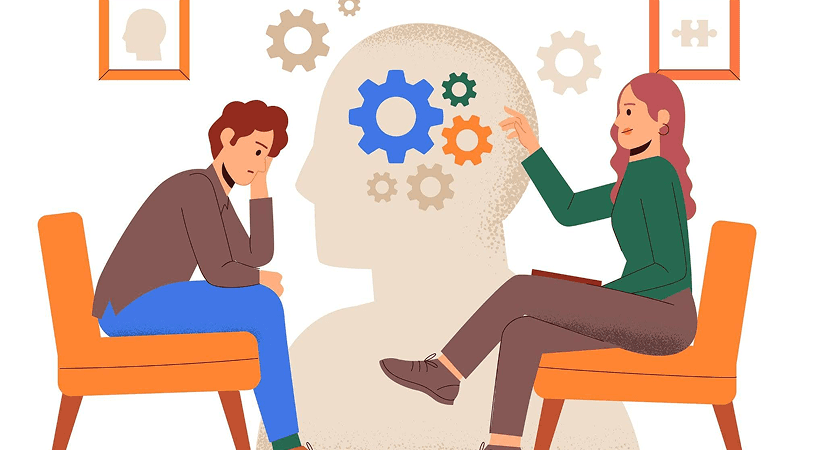
This is where emotional intelligence enters the conversation. Often dismissed as a "soft skill," emotional intelligence may be one of the most important and least understood drivers of quality excellence in pharmaceutical manufacturing. In an industry where every decision ultimately impacts patient safety, emotional intelligence is no longer a leadership luxury. It is becoming a quality imperative.
Beyond IQ: Why Emotional Intelligence Matters in Pharma
The pharmaceutical industry has traditionally rewarded technical expertise. We celebrate professionals who understand regulatory requirements, master validation protocols, interpret complex analytical data, and navigate evolving GMP expectations. These competencies remain essential. However, technical competence alone does not create a quality culture.
A quality system can identify deviations. Only people can decide whether they feel safe reporting them. A CAPA process can define investigation steps. Only emotionally intelligent leaders can create the environment necessary for honest root cause discussions.
An SOP can describe expected behavior. Only culture determines whether people follow it when nobody is watching.
This distinction is becoming increasingly important as regulators shift their attention from procedural compliance toward quality culture and leadership accountability. Regulatory agencies today are asking a deeper question: Does this organization genuinely live quality, or does it merely document it?
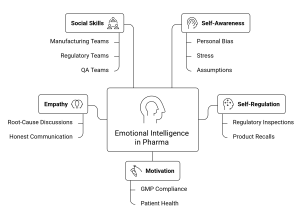
The answer often lies in emotional intelligence. Daniel Goleman's influential framework identifies five interconnected components of emotional intelligence: self-awareness, self-regulation, motivation, empathy, and social skills.
For pharmaceutical quality professionals, these competencies are far from abstract leadership concepts. Self-awareness helps a quality leader recognize when stress, assumptions, or personal bias may be influencing a decision. Self-regulation enables calm and rational responses during inspections, recalls, and deviation investigations.
Motivation connects everyday GMP activities to the larger mission of protecting patients. Empathy creates the psychological safety necessary for honest investigations. Social skills build the trust and collaboration required across manufacturing, quality, regulatory affairs, and executive leadership teams.
Together, these capabilities create something every pharmaceutical organization seeks but few successfully achieve: a sustainable culture of quality.
A QMS gives quality its structure. Emotional intelligence is what decides whether people actually use it.
→ What Is QMS? Quality Management System Explained
The Human Side of Compliance
The pharmaceutical sector operates in one of the highest-stakes environments in modern industry. Every batch released reaches patients who trust that the medicines they receive are safe, effective, and manufactured according to the highest standards. Every deviation investigation, every CAPA, and every quality review has implications that extend far beyond the walls of a manufacturing facility.
Yet despite the industry's scientific sophistication, many recurring quality challenges remain surprisingly human.
Consider some of the most common observations cited during regulatory inspections: inadequate investigations, ineffective CAPAs, repeated deviations, procedural non-compliance, and data integrity concerns.
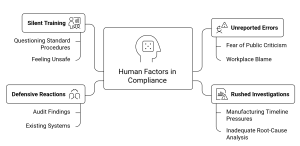
At first glance, these appear to be technical failures. Look deeper, and a different picture emerges. An operator hesitates to report an error because previous mistakes resulted in public criticism.
A supervisor rushes an investigation because production pressure is mounting. A quality manager reacts defensively when findings challenge existing processes. A team remains silent during training because questioning procedures is perceived as risky. None of these issues can be solved through documentation alone. They require leaders who understand not only systems and regulations, but also people.
This is why emotional intelligence is rapidly becoming one of the most valuable competencies in modern quality management. It serves as the bridge between compliance and culture, between procedure and behavior, between technical excellence and operational reality. Organizations that understand this distinction are beginning to recognize a powerful truth:
Quality is not ultimately a documentation challenge. It is a human challenge.
Blaming human error feels like an answer. Regulators see it as proof you stopped investigating too soon.
→ Is Human Error a Root Cause? RCA Guide for Pharma
FAQs
Q1. Is emotional intelligence measurable, or is it just a soft skill?
Yes, emotional intelligence is measurable. Validated tools such as the MSCEIT, EQ-i 2.0, and TalentSmartEQ Appraisal assess EI competencies like self-awareness, empathy, and self-regulation. Research consistently shows that EI predicts workplace performance, making it a measurable and developable capability rather than just a soft skill.
Q2. How does emotional intelligence help reduce FDA 483 observations?
Emotional intelligence helps create a culture where employees feel safe reporting deviations and near-misses, leading to earlier problem detection. It also improves root cause investigations through better communication and empathy, resulting in more effective CAPAs. During inspections, emotionally intelligent leaders communicate more openly and constructively with regulators, strengthening credibility and reducing repeat observations.
Q3. Can emotional intelligence be developed, or is it fixed?
Emotional intelligence can be developed through training, coaching, practice, and feedback. Unlike IQ, EI competencies such as self-awareness, empathy, and self-regulation improve over time. For quality professionals, approaching EI as a learnable professional skill makes development both practical and measurable.
Q4. How can quality directors integrate EI into QMS and GMP training?
Integration can begin with simple changes. Use open-ended, curiosity-driven questions during deviation investigations, include cultural and leadership factors in CAPA reviews, and connect GMP training to real patient outcomes through case studies. These low-effort adjustments strengthen empathy, motivation, and self-regulation without requiring major system changes.
Q5. Which EI competency should pharmaceutical QA leaders develop first?
Self-regulation should be the top priority. It influences decision-making during inspections, deviation investigations, CAPA reviews, and batch release discussions. Leaders who remain calm and objective under pressure make better quality decisions and foster greater trust. A simple starting point is introducing deliberate pauses before responding to critical quality issues or regulatory findings.
Reporting on the science, business and regulation shaping the pharmaceutical industry.
More in HR in Pharma
All articles →
Crisis Management: HR's Role in Business Continuity in the Pharmaceutical Industry

Top HR Strategies for Successful Pharma Mergers: People, Culture, and Integration 2025

Discussion