Is Human Error a Root Cause? A Practical Guide To RCA In Pharma
Human error is not the root cause — it's where investigation begins. Here's what RCA demands in pharma.


When something goes wrong in a pharmaceutical or life sciences setting, the investigation that follows often leads to a familiar conclusion: human error. It is the most common label assigned during quality investigations and also the most misused. While it may feel like a complete answer, stopping at "human error" as the root cause is, in most cases, the beginning of a much deeper conversation, not its end.
This guide breaks down what root cause analysis (RCA) really means, why human error is rarely the true root cause, and what you should be doing instead to build a quality management system that actually prevents recurrence.
What Is Root Cause Analysis?
Root Cause Analysis is a structured, systematic method used to identify the underlying reason behind a problem or failure. The goal is not just to address what went wrong on the surface, but to understand why it happened and prevent it from happening again.
In simple terms, RCA answers three questions: What happened? How did it happen? And most importantly, why did it happen?
In the pharmaceutical and life sciences industry, RCA is commonly applied to:
- Product defects and out-of-specification (OOS) results
- Process deviations and failures
- Regulatory and compliance violations
- Adverse events and patient safety incidents
- Clinical trial failures and documentation errors
RCA is typically carried out by a cross-functional team, including representatives from quality assurance, manufacturing, regulatory affairs, and other relevant departments. Together, they brainstorm and evaluate probable root causes using structured frameworks and tools.
Some of the most widely used RCA tools include:
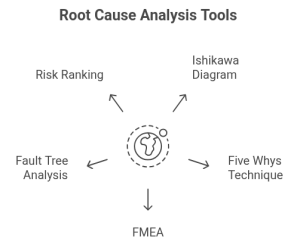
- Ishikawa Diagram (Fishbone Diagram): A visual tool that organises probable causes into categories, helping teams see the relationship between factors and outcomes.
- Five Whys Technique: A method of repeatedly asking "Why?" until the systemic cause is identified.
- Failure Mode and Effects Analysis (FMEA): A proactive approach to identifying where and how a process might fail.
- Fault Tree Analysis: A top-down, logic-based diagram that traces the path from failure to its causes.
- Risk Ranking: A method that prioritises identified risks by their likelihood and impact.
These tools are only effective, however, when the team using them is willing to look beyond the obvious.
Is Human Error Really a Root Cause?
Here is an uncomfortable truth that quality professionals in the pharmaceutical industry regularly face: Labelling human error as the root cause is the easiest way to close an investigation without actually solving anything.
When using the Fishbone (Ishikawa) Diagram, probable causes are typically organised into five categories, often called the 5Ms: Manpower, Material, Method, Machine, and Measurement. The "Manpower" category is the most frequently misused one. It becomes a convenient bucket where investigators dump unexplained failures under the umbrella of human error and move on.
This pattern is dangerous for several reasons. First, the real issue remains unaddressed. Second, the same failure will recur. Third, and perhaps most damaging, it creates a blame culture rather than a learning culture within the organisation.
Here is the key point: if your investigation ends at human error, it means your train of thought stopped too early. You still have unanswered questions. The real root cause is almost always something systemic.
Already writing CAPA reports that close investigations but don't stop recurrence?
Most pharma QA teams check this before their next deviation →
CAPA Report in Pharma: A Practical Guide
Think about a straightforward example from a laboratory setting. Two scientists measure the volume of a liquid using a measuring cylinder, but their readings differ. One measured at the lower meniscus, the other at the upper. It would be easy to call this human error. But the real question is: why did this happen in the first place? Was there no standard operating procedure (SOP) specifying which meniscus to measure? Was the SOP unclear? Was the analyst never trained on this step?
The error is human, yes. But the root cause is a system gap.
What Is Really Behind Human Error?
To investigate human error objectively and scientifically, quality teams in life sciences and pharma use frameworks from human factors engineering and cognitive psychology. The most widely applied one is the Skills, Rules, Knowledge (SRK) Framework, developed to explain how people perform tasks and make decisions under different conditions.
Understanding this framework helps investigators move from blaming individuals to understanding how the system failed them.
The SRK Framework Explained
Skills (S) - Automatic Actions
Skill-based behaviour refers to actions performed automatically, without much conscious thought. These are tasks an individual has done so many times that they become almost instinctive, like a trained analyst performing routine pipetting or operating familiar lab equipment. Errors at this level are usually slips or lapses: a momentary distraction, a brief lapse in attention, or a temporary memory failure.
Rules (R) - Protocol-Driven Decisions
Rule-based behaviour involves following established guidelines, procedures, or protocols to handle recognised situations. In pharma and life sciences, this translates directly to following SOPs, work instructions, batch manufacturing records, and regulatory guidelines. Errors at this level typically involve misapplying a rule, skipping a step, or applying the wrong procedure to a situation.
Knowledge (K) - Problem-Solving in Novel Situations
Knowledge-based behaviour comes into play when someone encounters an unfamiliar or complex situation that existing rules and skills do not cover. This requires analytical thinking, understanding of underlying principles, and sound judgment. Errors here are more complex and often arise from information overload, insufficient expertise, or misunderstanding the root principles of a process.
The Generic Error Modelling System (GEMS)
Once the SRK framework helps identify where in the cognitive process an error occurred, the Generic Error Modelling System (GEMS) is used to understand why that cognitive process broke down and what can be done about it.
GEMS categorises errors by cognitive process and helps teams implement strategies to reduce the likelihood of recurrence. It works in close integration with the SRK framework:
- Skill-based errors under GEMS are examined in relation to environmental triggers, including noise, distraction, workload, and fatigue.
- Rule-based errors are analysed to improve the clarity of procedures and the effectiveness of training.
- Knowledge-based errors are investigated for systemic gaps in competency development, staffing adequacy, and workload management.
Together, the SRK framework and GEMS provide a rational, evidence-based path from "human error" to the actual systemic causes that need to be corrected.
What Can You Do to Address the Real Root Cause?
Once the cognitive category of the error is understood, the next step is to develop an action plan to address the systemic conditions that enabled the error. Here is how each category translates into corrective and preventive actions:
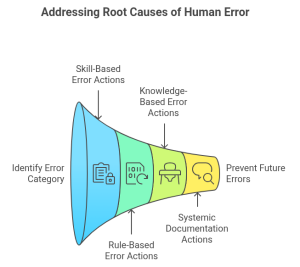
For Skill-Based Errors, the key question is: Was the person distracted? Was the work environment cluttered or noisy? Was the individual fatigued or handling too many tasks simultaneously? Corrective actions here might include redesigning workspaces to reduce distractions, revising shift schedules, or adding visual job aids at critical steps.
For Rule-Based Errors: Investigate whether the SOP was clear, up-to-date, and easily accessible at the point of use. Was the analyst adequately trained on the specific procedure? Were there conflicting instructions in different documents? Corrective actions should focus on strengthening SOPs, improving training programs, and ensuring documents are version-controlled and review-ready.
For Knowledge-Based Errors: Ask whether the individual had the expertise required for the task. Was the team under-resourced? Was the person multitasking across responsibilities that required deep focus? Corrective actions here typically involve competency assessments, role clarity, mentoring programs, and better resource allocation.
For Systemic Documentation Gaps: Poor documentation practices, outdated SOPs, hard-to-navigate procedures, and missing work instructions contribute heavily to human error across all three categories. Streamlining document management, making procedures accessible in real time, and setting periodic SOP review schedules are critical preventive actions.
The Role of CAPA in Addressing Human Error
In FDA-regulated manufacturing, identifying a root cause is only half the job. Organisations are expected to eliminate that root cause through a structured Corrective and Preventive Action (CAPA) plan.
When human error is the stated root cause, and no CAPA is defined, regulators view it as a failure to investigate adequately. That is because, without addressing the systemic issue, you are essentially accepting that the error will happen again, which is not an acceptable outcome in pharmaceutical quality management.
A quality management system that frequently attributes failures to human error is person-dependent rather than process-dependent. Regulatory agencies, including the FDA and EMA, look for robust, process-driven systems where quality outcomes do not hinge on any one individual's attention or memory on a given day.
Effective CAPAs that stem from proper RCA typically include:
- Revising or creating SOPs to eliminate ambiguity
- Redesigning processes to include built-in checks or automation
- Updating training programs and verifying their effectiveness
- Adding redundancy or double-check mechanisms at high-risk steps
- Conducting trend analysis to detect recurring failures early
Your quality system is only as strong as the validation behind it.
Here is what most teams overlook when building one →
CSV vs CSA: What Pharma Teams Need to Know
Building a Culture That Goes Beyond Blame
The broader lesson from all of this is about organisational culture. Organisational error is repeatedly cited as the root cause; it sends a signal to the workforce: when things go wrong, someone gets blamed. That fear drives underreporting, which means problems leaving the den until they calibrate into serious quality events or regulatory observations.
A robust quality culture, on the other hand, treats every deviation or failure as an opportunity to strengthen the system. It asks not "who made the mistake?" but "what in our system allowed this mistake to happen?"
This shift in mindset, from blame to learning, is what separates organisations that continually improve from those that cycle through the same problems year after year.
Conclusion
Human error is where the investigation begins, not where it ends. It is a signal pointing toward deeper systemic flaws, gaps in procedures, weaknesses in training, poor process design, or resource constraints that made the error possible in the first place.
Using frameworks like SRK and GEMS, pharmaceutical and life sciences teams can move beyond the surface label and identify what truly needs to change. The ultimate goal is a quality management system that is so well-designed that it makes errors difficult to commit and, when they do occur, easy to detect and correct.
The next time your RCA lands on human error, treat it as the opening question: Why was this error possible? Answering that question honestly is where real quality improvement begins.
FAQs
1. Is human error considered a valid root cause in pharmaceutical investigations?
In pharmaceutical quality systems, human error alone is not accepted as a sufficient root cause. Regulatory agencies like the FDA expect investigations to go deeper and identify systemic conditions, such as unclear OPs, training gaps, or process design flaws, that enabled the error.
2. What tools are used to investigate human error in root cause analysis?
Common RCA tools include the Fishbone (Ishikawa) Diagram, the Five Whys technique, FMEA, and cognitive psychology frameworks such as the Skills, Rules, Knowledge (SRK) model and the Generic Error Modelling System (GEMS).
3. What is the SRK framework in root cause analysis?
The SRK (Skills, Rules, Knowledge) framework is a cognitive model used to classify human errors based on the type of mental process involved: automatic action (skills), rule-following (rules), or problem-solving (knowledge). It helps quality teams understand why an error occurred and design appropriate corrective actions.
4. What is the difference between a root cause and a contributing factor in RCA?
A root cause is the fundamental systemic reason an event occurred, eliminating its recurrence. A contributing factor is a condition that worsened the situation but did not independently cause it. Human error is most often a contributing factor, not a standalone root cause.
5. How does CAPA relate to root cause analysis for human error?
CAPA (Corrective and Preventive Action) is the formal mechanism for eliminating root causes identified through RCA. When human error is identified, an effective CAPA addresses the systemic issue behind it, such as rewriting an SOP, improving a training program, or redesigning a process step, to prevent the error from recurring.
Reporting on the science, business and regulation shaping the pharmaceutical industry.
More in Regulatory Intelligence
All articles →
The Pattern Behind FDA Warning Letters: What Startups & CDMOs Often Miss

ISO 14644 Cleanroom Classes for Pharma (with EM Implications)

Discussion