How AI Is Rapidly Changing Pharma HR And Why Most Companies Aren’t Ready?
AI in pharma HR adoption: risks, governance, compliance, bias mitigation, and how to implement responsible AI-driven hiring and workforce management.

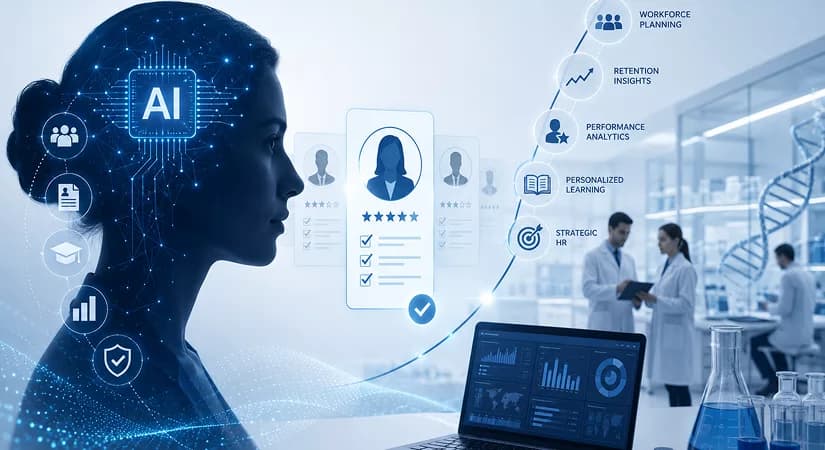
Artificial intelligence is no longer a distant prospect for the pharmaceutical industry, it is already embedded in how companies hire, train, manage performance, and retain talent. From screening thousands of resumes in minutes to predicting which employees are at risk of leaving, AI is transforming HR functions that were previously slow, manual, and largely intuition-driven.
Yet the pace of this transformation is outrunning most organizations' ability to keep up. Pharma companies are adopting AI tools faster than they are building the governance, culture, and expertise needed to use them responsibly. The result is a growing gap between technological capability and organizational readiness, one that carries real risks if left unaddressed.
The Scale Of AI Adoption In HR Is Already Significant
The numbers alone tell a compelling story. According to SHRM's 2025 Talent Trends report, 43% of organizations now use AI in HR tasks — up from just 26% the previous year. A few headline figures put the scale of this shift into perspective:
- By 2025, 90% of HR functions are expected to be augmented by AI in some form
- AI-driven HR tools are projected to generate as much as $1.5 trillion in savings globally
- In pharma specifically, AI applications are projected to create between $350 billion and $410 billion in annual value by 2025
- AI will transform HR into a strategic function in 80% of organizations by 2025, according to industry projections
What is driving this rapid adoption? The pharmaceutical industry faces a uniquely complex talent environment, a persistent skills shortage, highly specialized roles that take months to fill, intense competition for data scientists and regulatory professionals, and a workforce that is aging faster than it can be replaced.
AI offers a practical response to all of these pressures, and pharma HR teams are reaching for it quickly. The challenge is that speed of adoption and quality of implementation are two very different things.
Where AI Is Changing Pharma HR Most Visibly?
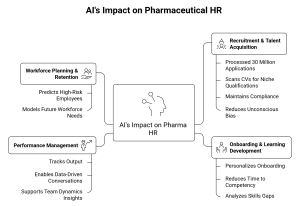
AI is making its presence felt across almost every dimension of the HR function in pharma. The changes are most visible in the following areas!
1) Recruitment & Talent Acquisition
Recruitment is where AI has had the earliest and most dramatic impact. In 2024, AI-powered hiring tools processed over 30 million job applications in the US alone. In pharma, where roles often require highly specific credentials — CRISPR expertise, biostatistics experience, GMP knowledge, clinical trial management, AI sourcing tools can scan CVs and professional profiles for niche qualifications that would take human recruiters far longer to identify.
AI systems can also be configured to maintain compliance with pharma-specific hiring standards such as GxP, FDA documentation requirements, and data privacy laws including HIPAA and GDPR, generating audit trails throughout the recruitment process. Beyond speed, AI is being used to reduce unconscious bias in screening.
When trained on unbiased datasets and regularly audited for fairness, AI tools can help pharma companies recruit based on skills and competencies rather than the subjective judgments that often influence human decisions. However, this only holds true when the tools are properly governed, poorly trained models can amplify historical bias rather than eliminate it.
2) Onboarding And Learning & Development
AI is also reshaping how new employees are brought into pharma organizations and how existing employees continue to develop. AI-powered onboarding platforms personalize the experience based on each individual's role, learning pace, and prior knowledge, replacing generic, one-size-fits-all onboarding programs with tailored learning paths.
For a highly regulated industry like pharma, where employees must be trained on GMP requirements, SOPs, and compliance protocols before they can contribute meaningfully, this kind of adaptive learning significantly reduces the time to competency.
In learning and development more broadly, AI tools analyze skills gaps across the workforce and recommend targeted training, helping organizations build the capabilities they need from within rather than relying entirely on external hiring. This is particularly valuable in pharma, where the talent market for experienced specialists is both thin and expensive.
3) Performance Management
Traditional annual performance reviews are giving way to continuous, data-driven performance management supported by AI. In pharma HR, AI tools can track output, flag early signs of disengagement, and generate insights that help managers have more informed, timely conversations with their teams.
For organizations running complex, multi-year drug development programs, understanding team dynamics and individual performance trends in real time can make a meaningful difference in project outcomes.
4) Workforce Planning & Retention
Perhaps the most strategically significant application of AI in pharma HR is in workforce planning and retention. AI models can analyze patterns in employee data — tenure, role changes, compensation, engagement scores, performance trajectories, in order to predict which employees are at high risk of leaving.
Given that replacing a senior scientist or regulatory specialist can cost anywhere from 50% to 200% of their annual salary, early retention intervention enabled by AI can deliver significant value. AI is also enabling pharma companies to model future workforce needs against anticipated pipeline milestones, helping leaders make more informed decisions about hiring, reskilling, and organizational structure.
The Risks That Come With Moving Too Fast
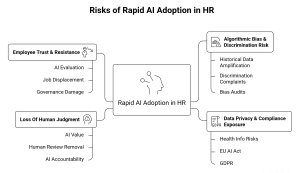
The speed at which pharma HR is adopting AI tools is creating risks that many organizations are not yet fully equipped to manage.
a) Algorithmic Bias & Discrimination Risk
AI systems learn from historical data and if that data reflects past biases in hiring, promotion, or performance evaluation, the AI can replicate and amplify those biases at scale. In 2024, AI-powered hiring tools triggered hundreds of discrimination complaints in the US.
Regulators are taking notice. New York City now requires annual independent bias audits for any automated employment decision tool used in hiring or promotion. California's regulations, effective October 2025, go further, requiring meaningful human oversight for any automated decision system, proactive bias testing, and detailed record-keeping for at least four years.
Federal agencies including the EEOC have made clear that employers remain legally responsible for discriminatory outcomes even when the decision was influenced by an AI tool. For pharma companies, where regulatory scrutiny is already high, this is not a risk to be taken lightly.
b) Data Privacy & Compliance Exposure
Pharma HR teams handle sensitive employee and candidate data such as health information, background checks, compensation history, performance records. When AI systems process this data, the compliance obligations multiply. The EU AI Act introduces transparency and human oversight requirements specifically aimed at employee tracking and decision-making tools.
GDPR gives individuals the right to contest automated decisions. In a sector already navigating complex regulatory environments, adding AI-driven HR tools without proper data governance frameworks creates significant compliance exposure.
c) The Loss Of Human Judgment
One of the most important findings from SHRM's 2025 research is that three-quarters of HR professionals believe AI will increase, not decrease the value of human judgment in the workplace over the next five years. Yet many organizations are deploying AI tools in ways that effectively remove human review from critical employment decisions.
If an HR team cannot explain why a candidate was screened out, or why an employee was flagged as a flight risk, that decision becomes difficult to defend — both legally and culturally. AI can inform decisions; it cannot replace the accountability and contextual understanding that human HR professionals bring to the table.
d) Employee Trust & Resistance
Workers are aware that AI is increasingly being used to evaluate them and many are uncomfortable with it. Concerns about surveillance, algorithmic fairness, and job displacement are fueling anxiety across workforces in every sector, including pharma. Organizations that implement AI HR tools without transparent communication and clear governance policies risk damaging employee trust at exactly the moment when retention is most critical.
AI moving fast in HR is inevitable.The question is who is actually doing it right.
Here is how IBM's automation model is setting the benchmark for pharma hiring.
→ Read: How IBM's HR Automation Model Is Redefining Hiring For The Pharma Industry
What Pharma Companies Need To Do To Keep Pace?
The question is not whether pharma HR will use AI — it already does and will increasingly do so. The question is how to implement it responsibly and build the organizational capacity to use it well. Several priorities stand out.
- Establish AI Governance For HR Early: Before deploying any AI-powered HR tool, pharma companies should establish clear governance frameworks that define how the tool will be used, who is accountable for its outputs, how decisions will be reviewed by humans, and how the system will be audited for bias and accuracy over time. This is not bureaucratic overhead, it is the foundation of responsible AI use.
- Treat HR Data As Regulated Data: Given the sensitivity of the information involved and the regulatory environment pharma already operates in, HR data processed by AI should be governed with the same rigor applied to clinical or quality data. Data privacy assessments, access controls, audit trails, and documented retention policies should be standard practice.
- Invest In HR Team Capability: Many pharma HR professionals were not trained to evaluate AI tools, interpret algorithmic outputs, or identify signs of model bias. Closing this capability gap is essential. HR teams need enough technical literacy to ask the right questions of vendors, recognize when AI recommendations should be overridden, and maintain meaningful human oversight across the HR lifecycle.
- Communicate Transparently With Employees: Employees deserve to know when AI is being used in decisions that affect them and they deserve to know how. Clear, honest communication about what AI tools do, what they do not do, and how human review is built into the process is not just good practice; in many jurisdictions, it is becoming a legal requirement.
- Start With High-Value, Lower-Risk Applications: Not all HR functions carry the same risk when AI is applied. Starting with applications like scheduling, internal knowledge management, or learning recommendations, rather than high-stakes decisions like hiring or termination, gives organizations time to build confidence, test governance frameworks, and develop the organizational habits needed before extending AI further into the HR function.
Building AI governance is only half the equation. Understanding where the talent market is heading is the other half.
Here is what the pharma and biotech hiring landscape looks like right now.
→ Read: The Talent Inflection Point In Pharma And Biotech
Summing It Up!
AI is reshaping pharma HR in ways that are genuinely powerful and genuinely risky at the same time. The tools available today can help organizations hire faster, develop talent more effectively, retain critical employees longer, and plan their workforces with greater precision.
But the speed of adoption is running ahead of the governance, capability, and cultural readiness needed to use these tools well. Pharma companies that pause to build the right foundations, strong governance, transparent communication, human oversight, and data integrity, will not fall behind.
They will build the kind of trusted, responsible AI capability that turns short-term efficiency gains into lasting competitive advantage. The companies that skip those foundations in the race to adopt will find that the risks catch up with them quickly.
FAQs
1) How Fast Is AI Adoption Growing In Pharma HR?
AI adoption in pharma HR is growing rapidly as the industry faces persistent skill shortages in areas like biologics manufacturing, regulatory affairs, and data science. Surveys from LinkedIn and Deloitte show that life sciences companies are among the top adopters of AI-driven recruiting tools to speed up screening and match candidates to highly specialized roles. This growth is driven by rising demand for niche talent and increasing pressure to reduce time-to-hire. As AI tools become more embedded across recruiting, training, and workforce planning, HR functions in pharma are shifting from administration to data-driven decision making.
2) Why Are Pharma Companies Struggling To Use AI In HR Responsibly?
Pharma companies face challenges because AI requires high-quality, structured workforce data — something many organizations still lack. HR teams often rely on legacy applicant tracking systems, incomplete records, or inconsistent job taxonomy, which limits AI accuracy. Regulations from bodies such as European Medicines Agency and U.S. Food and Drug Administration do not directly regulate HR AI, but the pharma sector’s overall responsibility for compliance and auditability makes companies more cautious. Without strong governance, bias monitoring, and transparency practices, AI can produce errors that undermine both compliance expectations and employee trust.
3) What Risks Do Pharma HR Teams Face When Implementing AI Too Quickly?
Deploying AI too quickly can introduce biased hiring recommendations, incorrect applicant screening, and reduced fairness in talent evaluations. Pharma HR teams also risk creating “black box” decision systems that they cannot fully explain during internal audits or compliance reviews. Poor rollout can damage employee confidence, especially if workers feel monitored or assessed by algorithms without clear communication. Over time, this may weaken culture, increase turnover, and reduce the effectiveness of AI tools that depend on human oversight to perform well.
Reporting on the science, business and regulation shaping the pharmaceutical industry.
More in HR in Pharma
All articles →
Crisis Management: HR's Role in Business Continuity in the Pharmaceutical Industry
Top HR Strategies for Successful Pharma Mergers: People, Culture, and Integration 2025
Discussion