Burnout In Pharma: The Silent Productivity Crisis And The Hidden Risks Threatening Quality, Safety, & Innovation
Pharma workers are quietly burning out. Learn why this silent crisis hurts productivity, quality, and how to fix it.


Pharmaceutical professionals dedicate their careers to improving and saving lives. They run clinical trials, navigate complex regulations, manufacture life-saving drugs, and push science forward every single day. But here's the uncomfortable truth: many of these same people are quietly burning out and the industry is paying a steep, largely invisible price for it.
Burnout in pharma is not a new conversation, but it remains a remarkably underdiscussed one. Behind the polished annual reports and breakthrough drug announcements, a large portion of the workforce is running on empty. People are showing up physically but checking out mentally. This is the silent productivity crisis no one in the boardroom wants to admit and it is getting worse, not better.
Here are a few numbers you must know!
- 68% pharma workers report moderate-to-high burnout
- 2–3× cost to replace a burned-out employee vs. retaining one
- $322B global cost of workplace burnout annually
What Exactly Is Burnout?
The World Health Organization officially classifies burnout as an occupational phenomenon, not a medical diagnosis, but a syndrome resulting from chronic workplace stress that has not been successfully managed. It shows up in three defining ways: emotional exhaustion, growing mental distance or cynicism toward one's job, and a reduced sense of personal accomplishment.
It is important to understand that burnout is not the same as being tired after a tough week. It is a deep, accumulated depletion that builds over months and years. It rewires how a person relates to their work, their colleagues, and their own sense of capability. In plain terms, burnout is when a person stops caring, not because they want to, but because they literally have nothing left to give. And in an industry where caring is non-negotiable, that is a very serious problem.
“You start to go through the motions. You file the reports, attend the meetings, hit the deadlines — but the sense of purpose that once drove you? It's gone. That's burnout in pharma.”
Why Is Pharma Especially Vulnerable?

Most industries deal with workplace stress. But pharma has a particular combination of pressures that makes burnout more likely and more severe than in most other fields. It is not just that the work is hard, it is that the work is hard in ways that are uniquely draining.
- Relentless Regulatory Pressure: Every submission, every trial, every label change comes with a compliance deadline and a regulatory body watching closely. The stakes are rarely low, and even minor errors carry major consequences.
- Compressed Timelines: Post-COVID, the expectation that drugs can be developed faster has stuck. Speed pressure that once applied to crisis situations has become the everyday standard, leaving teams perpetually stretched.
- Emotional Weight Of The Work: When your product fails in a Phase III trial, patients who needed that drug don't get it. That kind of outcome lands differently than a missed sales target. The moral weight of the work is real and cumulative.
- Constant Restructuring: Mergers, patent cliffs, and pipeline failures mean the industry reorganizes frequently. Layoffs and role changes keep employees in a perpetual state of uncertainty about their futures.
- High-Performer Culture: Pharma attracts driven, achievement-oriented people. Many of them won't admit to struggling until they're already far gone and by then, recovery is a much longer road.
These pressures don't exist in isolation — they layer on top of each other, week after week, year after year. The result is a workforce that is systematically stretched beyond sustainable limits, with very little structural support to catch people before they fall.
The Signs That Get Ignored
Burnout rarely announces itself dramatically. It tends to creep in through signals that are easy to dismiss, misread, or simply push past. In pharma, where people are conditioned to problem-solve and push through adversity, the first instinct is almost always to work harder rather than step back and ask what is actually wrong.
Here's what it often looks like before anyone names it:
- A scientist who used to stay late because she loved the work now stays late because she fears falling behind
- A regulatory affairs manager who has started making careless errors he would never have made two years ago
- A sales rep who has become visibly cynical about the products she once believed in wholeheartedly
- A medical writer who takes twice as long to complete tasks that used to take half the time
A team lead who has simply stopped participating in meetings with any genuine input or energy
None of these signs say "burnout" in bright red letters. They look like performance issues. They look like attitude problems. They look like personal shortcomings. Managers often address the symptoms, a performance improvement plan, a warning, a difficult conversation without ever identifying the root cause. That approach does not just fail to fix the problem; it often accelerates it.
What Does It Cost The Industry?
This is where the "silent productivity crisis" label earns its name. Burnout doesn't show up in a line item on a budget. Its costs are hidden, delayed, and distributed across the organization in ways that are genuinely difficult to trace, which is exactly why leadership tends to underestimate them, or ignore them altogether.
Consider what happens when a burned-out employee makes a documentation error in a clinical trial. Or when a fatigued QA professional misses a process deviation that later becomes a regulatory finding. Or when a talented research director quietly resigns, taking decades of institutional knowledge and hard-won expertise with her because she simply cannot continue at this pace.
The tangible costs include higher turnover (replacing a mid-level employee costs anywhere from 50% to 200% of their annual salary), increased sick days, lower output quality, and expensive mistakes that ripple through project timelines. The intangible costs such as loss of innovation, weakened team cohesion, a damaged culture that struggles to attract new talent are harder to quantify but arguably more damaging over the long run.
“The pharma industry spends billions developing drugs for stress-related illnesses. It spends comparatively little addressing the stress inside its own walls.”
A fatigued team is the fastest way to compromise your facility's operational integrity.
Ensure your foundations are bulletproof before minor deviations become structural failures.
→ Read: How to Design a GMP-Compliant Cleanroom Layout (2025 Pharma Guide)
What Can Actually Be Done?
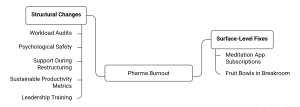
The good news is that burnout is preventable. The not-so-good news is that prevention requires structural change, not just wellness perks. A meditation app subscription and a fruit bowl in the breakroom will not fix a workforce that is chronically understaffed, overdeadlined, and under-supported.
Meaningful intervention looks like this:
- Workload audits. Leaders need to get honest about whether headcount truly matches actual work volume. Many pharma teams have been running understaffed for years without anyone formally acknowledging the gap or committing to fix it.
- Psychological safety in performance conversations. Employees need to be able to say "I'm struggling" without fearing it will affect their next performance review or promotion opportunity. That requires deliberate cultural work, not just an open-door policy that nobody actually uses.
- Better transitions during restructuring. Organizational changes should come with clear communication, honest timelines, and genuine transition support, not just a town hall announcement and a new org chart circulated by email.
- Redefining productivity metrics. When success is measured only by speed and output volume, quality and sustainability inevitably suffer. Pharma needs to develop metrics that reward sustainable performance, not just short-term delivery at any cost.
- Leadership training on early recognition. Managers who can identify burnout early, before it becomes a resignation letter or a serious quality error, are among the most valuable assets a company can invest in developing.
The Bigger Picture
There is something deeply ironic about an industry that exists to improve human health while quietly degrading the health of the very people who make that mission possible. Pharma companies speak regularly about patient-centricity, about the importance of their people, about culture as a true competitive advantage. Burnout is the gap between that language and the daily reality experienced on the ground.
The most important drugs being developed right now, for Alzheimer's, cancer, rare diseases affecting thousands of families, depend entirely on teams of people who are sharp, motivated, curious, and capable of sustained creative thinking. Burnout systematically erodes all of those qualities. It is not just a human resources problem. It is a pipeline risk. It is a patient safety risk. It is a long-term strategic risk that compounds silently until it can no longer be ignored.
Addressing burnout in pharma is not about being soft on performance standards or lowering expectations. It is about being genuinely smart about what actually drives high performance over time and being completely honest about what quietly erodes and destroys it when leadership chooses to look the other way.
Burnout systematically erodes your compliance defenses and long-term pipeline safety.
Learn how to protect your operations and stay ahead of global standards when your workforce is stretched thin.
→ Read: How to Meet Regulatory Compliance in Pharma Manufacturing
FAQs
1) What Causes Burnout In The Pharmaceutical Industry?
Burnout in pharma is driven by a unique combination of intense regulatory pressure, fast-paced development timelines, emotionally heavy responsibilities, constant organizational restructuring, and high-performance expectations. These factors create stress that builds over months or years, eventually depleting employees' emotional, mental, and physical reserves. Many professionals also struggle with perfectionism because mistakes can have patient-impacting consequences, adding to the psychological load. Over time, this creates a work environment where even the most dedicated employees feel overwhelmed and unable to recover.
2) How Does Burnout Affect Productivity And Quality In Pharma?
Burnout leads to slower work, increased errors, reduced creativity, and declining engagement. In a sector where accuracy and consistency are critical, even minor mistakes can impact clinical trial outcomes, compliance, timelines, and patient safety. It also affects collaboration, as burned-out employees are less likely to participate actively in discussions or decision-making. Ultimately, burnout erodes the quality culture every pharma company relies on to maintain high standards and meet regulatory expectations.
3) What Can Pharma Companies Do To Reduce Burnout?
Effective burnout prevention requires systemic changes, not one-off wellness programs. Pharma organizations can reduce burnout by conducting workload audits, improving psychological safety, supporting employees during restructures, redefining productivity metrics to prioritize sustainability, and training managers to spot early signs of burnout. Investing in adequate staffing and resource planning also ensures teams are not consistently operating in crisis mode. When companies create realistic timelines and set humane expectations, employees are far more likely to stay engaged and high performing.
Reporting on the science, business and regulation shaping the pharmaceutical industry.
More in HR in Pharma
All articles →
Crisis Management: HR's Role in Business Continuity in the Pharmaceutical Industry

Top HR Strategies for Successful Pharma Mergers: People, Culture, and Integration 2025

Discussion