Capital Is Flowing Again. The Real Challenge Is Building the Teams That Will Deliver Tomorrow's Medicines
Capital's back, but pharma hiring isn't easy. Discover why specialized talent decides which biotech programs actually succeed.
Table Of Content
1. Capital Builds Companies. People Build Medicines.
2. The Talent Market Has Not Become Easier
3. The Hiring Challenge Begins Earlier Than Most Companies Realize
4. Specialized Hiring Requires Specialized Knowledge
5. The Functions Most Likely to Experience Hiring Pressure
6. Recruitment Is Becoming More Strategic
7. Why This Matters Beyond Business
The biotechnology industry has always moved in cycles.
Periods of tremendous innovation are often followed by tighter capital markets, cautious investors, and difficult decisions about which programs survive and which never make it to patients. Those of us who have worked in the industry for decades have seen these cycles before. While the science continues to advance, access to capital often determines how quickly—or whether—that science can become a therapy.
Over the past several years, the industry endured one of its more challenging funding environments. Companies delayed hiring, programs were paused, and many promising startups struggled to secure financing. Organizations that only a few years earlier were growing aggressively suddenly found themselves reducing headcount, prioritizing only their highest-value assets, and extending cash runways wherever possible.
Today, the conversation has changed.
Funding has returned.
Across the pharmaceutical and biotechnology sectors, venture capital firms are once again investing in innovative science. Investors remain disciplined and selective, but they are also demonstrating renewed confidence in companies with differentiated platforms, compelling clinical data, experienced leadership teams, and clear regulatory strategies.
While every financing announcement is different, the broader trend is unmistakable. Compared with 2024, venture investment continued to strengthen throughout 2025, and 2026 has shown even greater momentum. Larger financing rounds, renewed IPO activity, strategic partnerships with major pharmaceutical companies, and increased merger and acquisition activity have all contributed to a healthier investment climate.
For entrepreneurs, scientists, and investors, this is encouraging news.
For those of us involved in building organizations, however, funding is only the beginning.
Capital Builds Companies. People Build Medicines.
Every successful financing announcement follows a familiar pattern.
There is excitement.
There are congratulatory press releases.
Investors celebrate.
Employees celebrate.
Social media fills with headlines announcing another company that has successfully raised tens or hundreds of millions of dollars.
Then reality arrives.
Within days or weeks, executive leadership begins asking a very different set of questions. Who will lead pharmacology?
Where do we find experienced DMPK scientists?
Do we have enough clinical operations professionals to support expanding trials? Who understands CMC well enough to prepare for manufacturing?
How quickly can we recruit biostatisticians before patient enrollment accelerates? Who will manage regulatory strategy across multiple global agencies?
Who can build quality systems that will satisfy commercial manufacturing expectations? These questions are far more difficult than announcing a successful financing round. Money allows a company to execute its vision.
People determine whether that vision succeeds.
The Talent Market Has Not Become Easier
One misconception often accompanies renewed investment.
Some assume that because funding has improved, hiring will naturally become easier. In reality, the opposite is often true.
When hundreds of companies begin hiring simultaneously, they compete for the same highly specialized professionals.
Unlike many industries, pharmaceutical and biotechnology expertise cannot simply be created overnight.
A company cannot instantly produce an experienced pharmacometrician with years of oncology modeling experience.
Nor can it quickly develop a regulatory leader who has guided multiple products through global approvals.
Experts in quantitative systems pharmacology, PBPK modeling, translational medicine, biologics manufacturing, analytical development, process engineering, pharmacovigilance, government pricing, or late-stage CMC have typically spent years—often decades—developing their expertise.
Those professionals are already employed.
Most are succeeding where they are.
Many are not actively seeking new opportunities.
That means companies entering aggressive hiring phases are competing for a relatively small pool of experienced talent.
Hiring pressure isn't unique to newly-funded biotechs — pharma HR teams have been fighting this battle for years. Here are the 10 challenges reshaping how leaders attract and retain talent industry-wide.
→ Read: 10 Key HR Challenges in the Pharmaceutical Industry and How Leaders Are Solving Them
The Hiring Challenge Begins Earlier Than Most Companies Realize
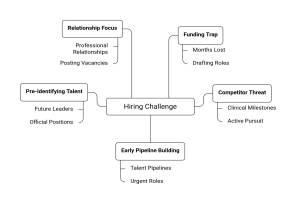
One lesson repeated throughout my career is that hiring timelines rarely align with development timelines. Organizations often wait until funding closes before beginning critical searches.
Unfortunately, by the time the position is approved, written, posted, and advertised, months may have already passed.
Meanwhile, competitors are pursuing the same candidates.
Clinical milestones continue approaching.
Manufacturing timelines remain fixed.
Investor expectations do not slow down simply because hiring has taken longer than anticipated. The companies that consistently execute well understand this relationship.
They build talent pipelines before they become urgent.
They identify future leaders months before positions officially exist.
They invest time developing relationships rather than simply posting vacancies and waiting for application.
That proactive approach frequently becomes a competitive advantage.
Specialized Hiring Requires Specialized Knowledge
Life sciences recruiting differs significantly from general recruiting.
Understanding a resume is only part of the equation.
Successful hiring requires understanding the science behind the position.
Recruiting for a Director of Clinical Pharmacology is not the same as recruiting for an Associate Director of Government Pricing.
Finding an expert in microbial genomics differs entirely from recruiting someone experienced in process validation for commercial biologics manufacturing.
Even within pharmacology, expertise varies dramatically.
Discovery pharmacology.
Translational pharmacology.
Clinical pharmacology.
Toxicology.
DMPK.
PK/PD.
QSP.
PBPK.
Each discipline contributes differently throughout drug development.
Each requires different technical backgrounds, different experiences, and often entirely different professional networks.
Organizations that appreciate these distinctions typically make stronger hiring decisions because they evaluate candidates beyond keywords alone.
The Functions Most Likely to Experience Hiring Pressure
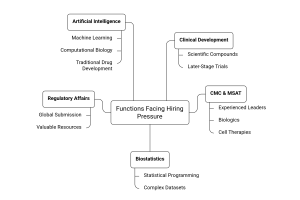
As investment continues to increase, several functions are likely to remain especially competitive.
Clinical Development will continue expanding as more compounds advance into later-stage trials.
CMC organizations will require experienced leaders capable of scaling manufacturing from clinical production to commercial supply.
Biostatistics and statistical programming professionals remain in high demand as increasingly sophisticated trial designs generate larger and more complex datasets.
Manufacturing Science and Technology (MSAT) continues to experience significant growth, particularly as biologics and cell therapies move toward commercialization.
Technology transfer specialists capable of moving products between development and manufacturing environments remain difficult to identify.
Regulatory Affairs professionals with global submission experience continue to represent one of the industry's most valuable resources.
Government Pricing and Market Access expertise is becoming increasingly important as commercialization planning begins much earlier in development than many organizations historically anticipated.
Artificial intelligence is also reshaping hiring priorities.
Companies increasingly seek professionals capable of integrating computational biology, machine learning, biomarker discovery, and advanced analytics into traditional drug development.
Rather than replacing scientists, AI is creating demand for scientists capable of working alongside increasingly sophisticated computational tools.
AI isn't replacing pharma scientists — it's changing how they're found. Here's how predictive screening and bias-free hiring tools are rewriting recruitment for hyper-specialized roles.
→ Read: AI-Driven Hiring: The Future of Pharma Recruitment
Recruitment Is Becoming More Strategic
The traditional recruiting model has evolved significantly.
Posting positions and reviewing applications remains important, but it is no longer sufficient for many specialized roles.
Today's recruitment strategies increasingly rely on long-term relationship building. The strongest candidates often are not applying.
They are being identified through professional networks, scientific publications, conference participation, referrals, and years of industry relationships.
Many professionals who eventually change organizations never submit an application.
Instead, they respond because someone took the time to understand both their expertise and their career goals.
That relationship-driven approach has become increasingly valuable as scientific specialization continues expanding.
Why This Matters Beyond Business
Although recruiting is often discussed in terms of open positions, hiring metrics, and organizational growth, there is a much larger purpose behind every successful search.
Every scientist hired.
Every clinician recruited.
Every manufacturing engineer onboarded.
Every regulatory professional added to a development team.
Each represents another step toward delivering therapies that may improve—or even save—patients' lives. Behind every FDA approval is an extraordinary collection of people working across disciplines. Researchers.
Clinical investigators.
Pharmacologists.
Engineers.
Manufacturing professionals.
Biostatisticians.
Medical writers.
Quality specialists.
Project managers.
Commercial teams.
No breakthrough belongs to one individual.
Drug development remains one of the world's greatest examples of collaborative innovation. That perspective is easy to lose when conversations focus exclusively on financing rounds and valuation. Funding is important.
It fuels innovation.
But innovation only reaches patients when exceptional people transform promising science into approved medicines.
Looking Ahead
The outlook for pharmaceutical and biotechnology hiring remains encouraging.
Companies continue investing across oncology, neuroscience, rare diseases, immunology, metabolic disorders, gene therapies, radiopharmaceuticals, and AI-enabled drug discovery.
Many organizations that delayed hiring over the past several years are now rebuilding teams while newly funded startups begin constructing organizations from the ground up.
That combination is likely to keep competition for experienced talent elevated well into the coming years. For executives, founders, and hiring leaders, this creates both opportunity and responsibility. Capital provides the resources to pursue ambitious scientific goals.
Building the right team determines whether those goals become reality.
As someone who has spent more than two decades recruiting across discovery, development, manufacturing, clinical operations, regulatory affairs, and commercialization, I remain optimistic about what lies ahead.
Every funding announcement represents more than another investment.
It represents another possibility.
Another program advancing.
Another disease being studied.
Another chance to improve the lives of patients waiting for new therapies.
The next generation of medicines will not be defined solely by the companies that raised the most capital
They will be defined by the organizations that assembled the right people, at the right time, with the right expertise to transform scientific promise into clinical reality.
In the end, that has always been the true measure of success.
Capital may start the journey.
People are the ones who finish it.
Reporting on the science, business and regulation shaping the pharmaceutical industry.
More in HR in Pharma
All articles →
Crisis Management: HR's Role in Business Continuity in the Pharmaceutical Industry

Top HR Strategies for Successful Pharma Mergers: People, Culture, and Integration 2025

Discussion