The Growing Talent Gap In Pharma: And the Forecasting Models That Can Fix It
Pharma science is outracing talent. Discover why forecasting models are a boardroom-level strategy to value your people and protect your pipeline


There's a quiet crisis unfolding inside pharmaceutical companies right now, and it has nothing to do with clinical trials, supply chains, or regulatory submissions. It's about people — specifically, the growing gap between the talent pharma companies have today and the talent they'll desperately need tomorrow.
The pharmaceutical industry moves fast. New modalities like cell and gene therapy are rewriting what drug development looks like. AI and data science are becoming core capabilities, not nice-to-haves. Regulatory requirements keep evolving. And through all of it, companies are trying to figure out how to staff their organisations not just for today's pipeline, but for what's coming in three, five, and ten years.
That's exactly where talent forecasting models come in. They're not a new HR concept dressed up in fancy language. Done properly, they're a strategic tool that connects your workforce to your business ambitions — helping leadership plan ahead instead of constantly reacting to gaps that were entirely predictable. This post explains what talent forecasting actually means in a pharma context, why it matters more now than ever before, and what happens to companies that continue without it.
The Workforce Planning Gap That's Slowing Pharma Down
Before getting into solutions, it's worth being clear about the problem. Most pharmaceutical companies have some form of workforce planning in place. They know how many people they have, what roles are filled, and what their immediate hiring needs look like. What they're often missing is the longer view — a structured way of anticipating how their talent needs will evolve as the business grows, changes direction, or enters new therapeutic areas.
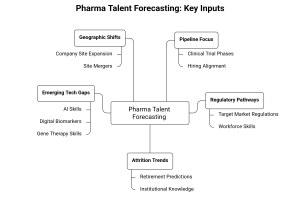
Talent forecasting fills that gap. At its core, it's the practice of using data, business strategy, and workforce analytics to project what skills, roles, and headcount an organisation will need over a defined time horizon. In pharma specifically, a well-built forecasting model will take into account:
- Pipeline Stage & Therapeutic Focus: the skills needed to advance an early-stage oncology asset are different from those needed to run a Phase III rare disease trial
- Regulatory Pathway Complexity: different markets, different modalities, and different submission types all carry different talent requirements
- Attrition Patterns & Retirement Trends: especially important in specialised scientific roles where institutional knowledge is hard to replace quickly
- Emerging Capability Gaps: areas like AI-driven drug discovery, digital biomarkers, and decentralised trial management that most current teams weren't built to handle
- Geographic & Site-Level Shifts: as companies expand into new markets or consolidate operations, the talent picture changes significantly
When these factors are accounted for in a model, workforce planning stops being reactive and starts becoming genuinely strategic.
Why Right Now Is The Wrong Time To Wing It?
Pharmaceutical companies have always faced complexity. But several forces converging at once are making workforce planning more urgent and more difficult, than at any previous point in the industry's history.
The science is changing faster than talent can keep up.The rise of biologics, mRNA therapeutics, cell and gene therapy, and AI-augmented discovery has created entirely new capability requirements within the span of a decade. Universities and training programmes haven't fully caught up. The pool of people with the right combination of scientific knowledge and technical skills for these modalities is genuinely small, and competition for them is intense.
The regulatory environment keeps shifting. Agencies like the FDA and EMA are continuously updating their expectations around data integrity, pharmacovigilance, digital submissions, and real-world evidence. Companies need people who not only understand these frameworks today but can adapt as they evolve. That kind of regulatory fluency takes years to develop — it's not something you can hire for in a hurry when a submission deadline is approaching.
Attrition in senior scientific and regulatory roles is accelerating. A significant portion of experienced pharmaceutical professionals who built their careers in the 1980s and 1990s are approaching or entering retirement. The knowledge they carry about specific compounds, regulatory history, manufacturing processes, walks out the door with them unless there's a deliberate plan to capture and transfer it.
Competition for talent has expanded well beyond pharma. Tech companies, biotech startups, and contract research organisations are all competing for the same pool of data scientists, regulatory scientists, clinical operations specialists, and bioinformaticians. Pharma is no longer the obvious destination for top scientific talent, and compensation alone doesn't win every time.
Each of these pressures is manageable on its own. Together, without a forecasting model to help you see them coming, they have a way of arriving all at once.
Is your underlying compliance infrastructure built to handle sudden regulatory shifts?
Don't let operational gaps stall your pipeline. Read our deep dive on Quality Without Digitalization: A Risk Modern Pharma Leaders Can't Ignore
What A Talent Forecasting Model Actually Does?
It's easy to describe talent forecasting in abstract terms. It's more useful to understand what it actually looks like in practice — what goes in, what comes out, and how it changes the way decisions get made.
A well-designed talent forecasting model for a pharmaceutical organisation typically draws on several interconnected data sources and analytical processes:
- Strategic Business Inputs: pipeline data, planned market entries, partnership or acquisition plans, and long-range financial projections that define where the business is heading
- Current Workforce Data: headcount, role distribution, skill profiles, tenure, location, performance data, and succession readiness across the organisation
- Attrition & Mobility Modelling: using historical patterns and predictive analytics to estimate who is likely to leave, retire, or move internally over the forecast period
- External Labour Market Data: Supply and demand dynamics for critical roles, salary benchmarking, talent pool mapping by geography and institution
- Skills Gap Analysis: A systematic comparison between the capabilities the business will need and the capabilities currently available internally
When these inputs are combined and modelled effectively, the output is a clear picture of where talent surpluses and shortfalls are likely to emerge and when! That picture allows HR, finance, and business leadership to make proactive decisions about:
- Where to prioritise internal development and reskilling programmes
- Which roles to build pipelines for through graduate schemes, apprenticeships, or academic partnerships
- When to begin external hiring campaigns for long-lead roles that take months to fill
- Which capabilities to access through partnerships, contract staff, or outsourcing rather than building in-house
- How to structure succession planning for critical scientific and regulatory positions
The Consequences Of Flying Blind On Talent
Some pharma leaders still treat workforce planning as an operational concern, something HR handles rather than a boardroom-level strategic priority. That perception is changing, but not fast enough. The cost of not having a forecasting capability is real, and it shows up in ways that are sometimes hard to trace directly back to workforce gaps.
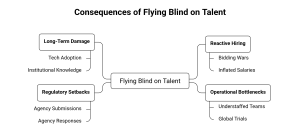
Here's what underprepared talent pipelines actually lead to in practice:
- Trial delays caused by insufficient clinical operations staffing, particularly for complex global studies that require experienced CRAs, data managers, and regulatory coordinators in multiple regions simultaneously
- Regulatory submission setbacks when the team responsible for a submission lacks the depth or experience to respond to agency queries quickly and accurately
- Over-reliance on contract staff for critical functions, which increases costs, reduces continuity, and creates knowledge transfer risks every time a contract ends
- Failed technology adoption when companies invest in new digital tools — AI platforms, electronic data capture systems, quality management software but don't have the internal capability to use them effectively
- Loss of institutional knowledge as senior employees retire or leave without any structured process for capturing what they know or developing who comes next
- Bidding wars and inflated salaries for in-demand roles because hiring happens reactively, under pressure, with no leverage from a prepared pipeline
None of these are inevitable. They're all symptoms of the same underlying issue: treating talent as something to acquire on demand rather than something to develop and plan for deliberately.
Failed technology adoption directly impacts your bottom line.
Discover the hidden financial costs of staying manual and how an electronic system fixes it in
Why the Life Sciences Industry Cannot Afford to Ignore eQMS.
Building A Forecasting Model That Actually Gets Used
The graveyard of pharmaceutical HR initiatives is full of models that were built, presented, filed, and forgotten. A talent forecasting model only creates value if it influences real decisions and that requires it to be built and maintained in a way that earns the confidence of business leadership, not just the HR function.
A few principles that separate forecasting models that stick from ones that don't:
1) Ground it in business strategy, not just HR data. A model that starts from headcount and works backward to business goals will always feel like an HR exercise. A model that starts from the pipeline, the regulatory milestones, and the geographic expansion plan and then derives the talent implications will feel like a business tool.
2) Make it dynamic, not a static spreadsheet. The pharmaceutical environment changes constantly. A forecasting model needs to be designed to update as inputs change — new partnerships, revised timelines, unexpected attrition, not rebuilt from scratch every time something shifts.
3) Include scenario planning. The future is not one path. A useful forecasting model shows what talent needs look like under different strategic scenarios — accelerated pipeline, delayed approvals, a major acquisition — so leadership can plan for multiple eventualities.
4) Integrate it with finance and operations planning. Talent forecasting that sits in isolation from budget cycles and operational planning has limited impact. When headcount projections feed directly into financial models and project staffing plans, the workforce conversation moves into the rooms where real decisions are made.
5) Assign ownership and accountability. Models don't maintain themselves. Someone or a small team, needs to be responsible for keeping the data current, reviewing outputs regularly, and escalating findings to the right people when gaps are projected to emerge.
What Does This Mean For The People Doing The Work?
It's easy to discuss talent forecasting in terms of models, data, and strategic decisions. But behind every workforce gap or surplus is a person, a researcher whose career isn't progressing because there's no development plan, a regulatory affairs specialist who burns out because the team is perpetually understaffed, a new graduate who joins a pharma company and finds no structure for growing their skills.
Good talent forecasting isn't just good for the business. It creates better working environments. When organisations know what skills they'll need in three years, they can invest in developing the people they already have, building careers rather than filling vacancies.
When succession planning is done thoughtfully, senior employees feel their knowledge is valued rather than disposable. When hiring is planned rather than reactive, new employees join teams that are ready for them rather than already stretched.
The pharmaceutical industry asks a lot of the people who work in it. Talent forecasting is one of the clearest ways a company can demonstrate that it takes that responsibility seriously, that it's building an organisation where people can grow alongside the science, not one that simply consumes talent as fast as it can find it.
The Bottom Line: Planning For People Is Planning For Performance
Pharmaceutical companies invest enormous resources in planning their pipelines, their manufacturing capacity, their regulatory strategies, and their commercial launches. The question talent forecasting asks is a simple one: why wouldn't you apply the same rigour to the people who make all of that possible?
The companies that will navigate the next decade of pharmaceutical development most successfully won't just be the ones with the best science. They'll be the ones that figured out early how to build, develop, and retain the human capability their science requires and who planned for it far enough in advance to actually do it well.
Here's what that looks like in practice:
- Start with your business strategy and work backward to your talent implications, not the other way around
- Build models that are dynamic and scenario-based, not static snapshots
- Connect your forecasting to finance, operations, and learning and development so it influences real decisions
- Treat attrition, retirement, and skills obsolescence as predictable risks to be managed, not surprises to react to
- Invest in developing the people you have, not just acquiring the people you need
Talent forecasting isn't a prediction of exactly what the future holds. It's a discipline that ensures you're not caught completely off guard when it arrives. In an industry where the cost of being unprepared is measured in delayed treatments and missed opportunities, that discipline is worth building now.
FAQs
1) What Is The “Talent Gap” In Pharma, And Why Is It Growing?
The talent gap in pharma refers to the widening disconnect between the skills companies currently have and the capabilities they’ll need in the near future. Rapid scientific advances, emerging modalities like cell and gene therapy, evolving regulatory expectations, and increasing competition for skilled scientific and technical talent are all driving this gap. As a result, many companies are struggling to keep their workforce aligned with how fast the science and industry landscape are evolving.
2) How Can Talent Forecasting Models Help Pharma Companies?
Talent forecasting models use data, business strategy, and workforce analytics to predict the skills, roles, and headcount an organisation will need over the next few years. For pharma companies, these models help anticipate capability shortages, plan hiring in advance, support succession planning, and guide decisions on reskilling or partnering — ultimately reducing delays, burnout, and reactive hiring. This ensures that talent decisions are proactive and fully connected to long-term business goals.
3) What Happens When Pharma Companies Don’t Use Talent Forecasting?
Without forecasting, companies often face avoidable challenges such as trial delays, regulatory submission setbacks, loss of institutional knowledge, failed adoption of digital tools, and inflated hiring costs. These issues occur because staffing decisions become reactive instead of strategic, leading to understaffed teams and critical skill gaps. Over time, this can significantly slow down growth, innovation, and the ability to bring new therapies to patients.
Reporting on the science, business and regulation shaping the pharmaceutical industry.
More in HR in Pharma
All articles →
Crisis Management: HR's Role in Business Continuity in the Pharmaceutical Industry

Top HR Strategies for Successful Pharma Mergers: People, Culture, and Integration 2025

Discussion