Quality Without Digitalization: A Risk Modern Pharma Leaders Can’t Ignore
40% of drug recalls linked to documentation. Learn the true cost of paper QMS, eQMS benefits, and how to justify digital quality transformation.
.webp&w=1920&q=75&dpl=dpl_6ysJ9LfPjjK65PGFB6RKfCshR8pW)

In the Life Sciences industry, quality is not optional — it is the foundation upon which patient safety and regulatory trust are built. Yet, thousands of pharmaceutical, biotech, and medical device organizations continue to operate on paper-based Quality Management Systems (QMS) or repurpose collaboration tools like Microsoft SharePoint for quality processes. The perceived cost savings are illusory.
A study by McKinsey & Company (2023) found that up to 40% of all drug recalls in the United States are linked to failures in quality documentation and process control — areas where a robust electronic Quality Management System (eQMS) provides direct, automated safeguards.
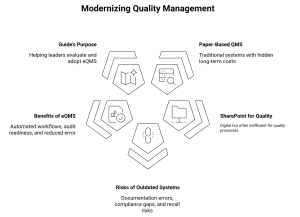
This guide is designed for Pharma quality leaders, VP Quality Assurance professionals, and Regulatory Affairs executives who are evaluating whether to modernize their QMS infrastructure. We will quantify the hidden costs, compare systems with evidence-based analysis, and provide the decision framework needed to act.
"Quality is everyone's responsibility. But in a regulated industry, it is the systems we build that determine whether that responsibility is honored consistently — or only on paper." — Former FDA Commissioner, speaking on GMP enforcement priorities
Why the Life Sciences Industry Cannot Afford to Ignore eQMS
The global eQMS market was valued at USD 12.4 billion in 2023 and is projected to reach USD 28.7 billion by 2030, growing at a CAGR of 12.6% (Grand View Research, 2024). This growth is not driven by trend — it is driven by regulatory necessity and operational survival
The FDA issued over 300 warning letters in 2023 related to quality system deficiencies, with citations including inadequate CAPA procedures, deficient document controls, and lack of audit trail integrity. The European Medicines Agency (EMA) similarly cited data integrity failures as a leading cause of inspection failures under EU GMP Chapter 4.
Yet many organizations still cling to paper binders and SharePoint libraries as their primary quality infrastructure. The competitive and regulatory cost of this inertia is compounding every year.
Knowing you need an eQMS is one thing; migrating to one without disrupting operations is another.
A step-by-step guide for every quality leader planning the shift by 2026.
→ Read: eQMS Migration In Pharma | A Guide For Quality Leaders
eQMS vs. Paper-Based QMS vs. SharePoint: Evidence-Based Comparison
The table below summarizes the critical functional and compliance dimensions across all three system types:
Source: Adapted from FDA GMP Guidelines, EU Annex 11, Microsoft 365 GxP Guidelines (2023), and published industry benchmarks.
1. Visibility and Real-Time Oversight
eQMS delivers real-time visibility into all quality processes — from nonconformance tracking to CAPA closure timelines and audit readiness scores. Quality leaders can monitor compliance KPIs through pre-built dashboards without generating manual reports.
Paper-based systems require manual data compilation that is invariably delayed, inconsistent, and subject to human interpretation errors. A CAPA that is open for 180 days may not surface until a monthly review — by which time a regulatory inspection could already be underway.
SharePoint can display documents in libraries, but without significant custom development, it cannot provide quality-specific KPI dashboards or real-time nonconformance trending without third-party integration (e.g., Power BI, Tableau).
2. Audit Trail Integrity and 21 CFR Part 11 Compliance
The FDA's 21 CFR Part 11 and EU GMP Annex 11 regulations require that all electronic records be attributable, legible, contemporaneous, original, and accurate — the ALCOA principles. A purpose-built eQMS enforces these automatically.
In a paper-based system, audit trail documentation is only as reliable as the people generating it. Missing signatures, undated corrections with single-line strikethroughs, and unauthorized alterations are common findings in FDA 483 observations.
"Data integrity deficiencies continue to be one of the most cited GMP violations globally. The absence of an automated audit trail remains a primary driver of regulatory action." — FDA Data Integrity Guidance for Industry, 2018 (updated references in 2023 enforcement data)
According to Microsoft's own GxP Guidelines, SharePoint customers must independently configure and monitor audit logs, manage versioning, and enforce access controls — responsibilities that demand dedicated IT and quality resources that most mid-size pharma organizations cannot sustain internally.
The True Financial Cost of Not Having an eQMS
The following table provides an evidence-based estimate of annual cost differentials between paper-based QMS and eQMS for a mid-size pharmaceutical company (500-1,000 employees):
Sources: Pharmaceutical Technology (2022), FDA enforcement database analysis, PwC Life Sciences Operations Report (2023). Figures are representative estimates for illustrative purposes.
Non-compliance financial risk is the most significant hidden cost. A single FDA Warning Letter can cost between $1 million and $10 million in remediation, legal fees, and lost revenue — excluding the immeasurable cost of reputational damage and loss of market access.
"Organizations that invest in digital quality infrastructure consistently outperform those that do not, both in inspection outcomes and in time-to-market for new products." — Deloitte Life Sciences Quality Survey, 2023
Scalability: Why This Matters as Your Organization Grows
As a pharmaceutical or biotech company scales its operations — adding manufacturing sites, expanding product lines, or entering new regulatory jurisdictions — the limitations of paper-based QMS become structurally incompatible with growth.
An eQMS scales elastically: new users, sites, and processes can be onboarded without disrupting existing workflows. Quality events from different sites can be consolidated and analyzed for systemic trends. CAPA management, change control, and training management remain centralized and auditable across the entire organization.
SharePoint, by contrast, often requires parallel infrastructure investments — additional licensing, custom development sprints, and IT administration overhead — when scaling to multi-site or international operations under varying GMP requirements.
CWhy the Life Sciences Industry Cannot Afford to Ignore eQMShange Control and Quality Event Management
Change control is the backbone of GMP compliance. Every change to a validated process, piece of equipment, or controlled document must be risk-assessed, approved, and documented before implementation. An eQMS provides built-in change control workflows that enforce this discipline automatically.
In paper-based systems, change requests routed through email threads or physical forms frequently suffer from approval delays, version confusion, and missing stakeholder sign-offs — all of which are critical observations during FDA inspections.
SharePoint can host change request forms, but without GxP-specific workflow configuration, it cannot enforce mandatory approval sequences, risk classification routing, or electronic signature compliance without third-party development investment.
Quality Leader's Transition Checklist
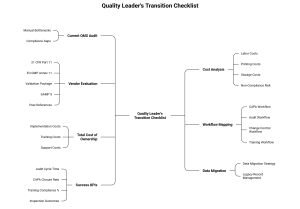
Use this checklist when evaluating your organization's readiness to transition from a paper-based or SharePoint-based QMS to a dedicated eQMS:
- Audit your current QMS for manual bottlenecks and compliance gaps
- Quantify the true cost of paper-based processes (labor, printing, storage, non-compliance risk)
- Evaluate SharePoint customization costs vs. purpose-built eQMS licensing
- Verify eQMS vendor compliance with 21 CFR Part 11 and EU GMP Annex 11 out-of-the-box
- Assess vendor's validation package (IQ/OQ/PQ documentation aligned to GAMP 5)
- Request references from peer Life Sciences organizations using the same eQMS
- Map your CAPA, audit, change control, and training workflows to eQMS modules
- Calculate 3-year total cost of ownership (TCO) including implementation, training, and support
- Confirm data migration strategy and legacy record management plan
- Define success KPIs: audit cycle time, CAPA closure rate, training compliance %, inspection outcomes
A compliant eQMS must satisfy ISO 13485 documentation requirements, paper systems structurally cannot.
What ISO 13485 demands from pharma and medical device leaders and why eQMS is not optional.
→ Read: ISO 13485 Quality Management System | A Pharma Leaders Guide
Conclusion
The hidden costs of not having an eQMS are not theoretical — they materialize in FDA warning letters, failed inspections, product recalls, operational inefficiencies, and the erosion of organizational quality culture. The evidence from regulatory enforcement data, industry benchmarks, and total cost of ownership analyses consistently points to the same conclusion:
A purpose-built eQMS is not an operational expense — it is a strategic investment in patient safety, regulatory resilience, and competitive advantage.
Paper-based QMS, while historically familiar, cannot meet the data integrity, scalability, and compliance demands of modern Life Sciences regulations. SharePoint, while configurable, places an enormous and underestimated compliance burden on the customer organization.
For Pharma, Biotech, and Medical Device leaders committed to building a quality-first culture, transitioning to a validated eQMS is the single most impactful operational decision available. The cost of action is predictable and manageable. The cost of inaction is not.
"Quality systems are not a back-office function. They are the front line of patient protection. Investing in the right digital infrastructure is investing in the people who depend on your products." — World Health Organization (WHO) Technical Report on GMP, Series 970
FAQs
1. What is an eQMS and why does it matter for Life Sciences organizations?
An electronic Quality Management System (eQMS) is purpose-built software that automates and digitizes all quality management processes including document control, CAPA, audit trails, training management, and regulatory compliance workflows. In Life Sciences, where patient safety is paramount, eQMS ensures real-time data integrity, traceability, and 21 CFR Part 11 / EU GMP Annex 11 compliance out-of-the-box, reducing the risk of costly regulatory violations.
2. What are the biggest hidden costs of a paper-based QMS?
The most significant hidden costs include excessive labor hours for manual document handling and retrieval, storage costs for physical records, heightened risk of non-compliance during FDA/EMA inspections (penalties can exceed $1 million), and bottlenecks in quality processes that slow product release cycles. Research published in Pharmaceutical Technology has shown that manual QMS processes can consume up to 30% of quality team resources in redundant tasks.
3. Is SharePoint a compliant alternative to a dedicated eQMS?
SharePoint is not compliant out-of-the-box with 21 CFR Part 11 or EU GMP Annex 11. According to Microsoft's own GxP Guidelines, the responsibility for meeting ALCOA data integrity principles is shared, with the customer bearing significant responsibility for configuring audit logs, electronic signatures, versioning, data governance, and access controls. This demands substantial internal IT resources, specialized expertise, and ongoing maintenance, making it a costlier and riskier alternative than a purpose-built eQMS.
4. How long does eQMS implementation typically take, and what does it involve?
Implementation timelines vary by organization size and complexity, typically ranging from 8 to 24 weeks. A structured eQMS vendor will provide onboarding services including system configuration to regulatory requirements, data migration, user training, and a validation package compliant with GAMP 5 standards. Unlike SharePoint, a quality-specific eQMS reduces implementation friction by providing pre-built compliance frameworks.
5. What ROI can a Pharma company expect from transitioning to an eQMS?
Studies and industry benchmarks indicate that organizations transitioning from paper-based QMS to eQMS typically see a 40-60% reduction in time spent on quality documentation tasks, a 50-70% improvement in audit readiness, and significant reductions in CAPA closure times. The FDA's enforcement data consistently shows that companies with robust digital quality systems face fewer warning letters and import alerts, directly protecting revenue and market access.
References & Citations
1. FDA Data Integrity and Compliance with Drug CGMP — Guidance for Industry. U.S. Food and Drug Administration, 2018.
2. Grand View Research (2024). Electronic Quality Management System Market Size & Trends Report, 2024-2030.
3. McKinsey & Company (2023). Quality in Pharma: The Cost of Getting It Wrong.
4. Microsoft Corporation. Microsoft 365 GxP Guidelines for Regulated Industries, Version 2.0, 2023.
5. Deloitte Life Sciences (2023). The Future of Quality Operations: Digital Transformation Survey.
6. PricewaterhouseCoopers (2023). Life Sciences Operations Excellence Report.
7. World Health Organization. WHO Technical Report Series No. 970 — Good Manufacturing Practices, 2012.
8. European Medicines Agency. EMA Good Manufacturing Practice Guide — Annex 11: Computerised Systems, 2011.
9. Pharmaceutical Technology (2022). Digital QMS: Quantifying the ROI of Transition. Vol. 46, Issue 3.
10. FDA. Warning Letters Database — Quality System Observations, FY2023. fda.gov/inspections-compliance-enforcement.
Reporting on the science, business and regulation shaping the pharmaceutical industry.
More in Regulatory Intelligence
All articles →
The Pattern Behind FDA Warning Letters: What Startups & CDMOs Often Miss

ISO 14644 Cleanroom Classes for Pharma (with EM Implications)

Discussion