ISO 13485 Quality Management System: The Definitive Guide for Pharma and Medical Device Leaders
A definitive guide to ISO 13485 QMS for pharma and medical device leaders requirements, certification roadmap, and 2026 regulatory updates.

In 1985, the International Organization for Standardization published the first version of what would become the backbone of global medical device quality. Four decades later, ISO 13485 is not merely a standard. It is the difference between a device reaching the patient safely and a regulatory rejection at the border.
The stakes in medical device manufacturing are unlike those in any other industry. A software bug can be patched. A pharmaceutical formulation can be recalled. But a flawed implantable device or a contaminated diagnostic kit can injure or kill before anyone realizes the system has failed.
This guide is written for pharma leaders, plant heads, QA directors, and regulatory affairs professionals who must not only understand ISO 13485 quality management system requirements but operationalize them in high-pressure, high-scrutiny environments.
"Quality is never an accident; it is always the result of high intention, sincere effort, intelligent direction, and skillful execution." — William A. Foster
What Is ISO 13485 Quality Management System?
The ISO 13485 quality management system is an internationally recognized framework that specifies requirements for a QMS where an organization needs to demonstrate its ability to provide medical devices and related services that consistently meet customer and applicable regulatory requirements.
The current version, ISO 13485:2016+A11:2021, was developed to align more closely with global regulatory demands, including the EU's Medical Device Regulation (EU MDR 2017/745) and the FDA's Quality Management System Regulation (QMSR), which became effective on February 2, 2026, and is harmonized with ISO 13485.
Unlike ISO 9001, which is a general quality management standard, ISO 13485 is specifically designed for the medical device lifecycle. It covers everything from design and development inputs to post-market surveillance, with a non-negotiable emphasis on risk management, traceability, and documented evidence at every stage.
Key differentiator from ISO 9001: ISO 13485 does not require an organization to demonstrate continual improvement of the QMS's effectiveness in the same way ISO 9001 does. Instead, it mandates that the organization maintain effectiveness, a subtler but critical distinction for regulated industries.
The Global Market Context: Why ISO 13485 Certification Cannot Wait
The global medical devices market was valued at USD 542.21 billion in 2024 and is projected to reach USD 886.68 billion by 2032, growing at a CAGR of approximately 6.3% (Grand View Research, 2024). This expansion is driven by aging populations, rising chronic disease prevalence, and increasing demand for minimally invasive diagnostics and therapeutics.
As the market grows, so does the regulatory complexity. A 2023 McKinsey analysis found that regulatory timelines for medical device approval have increased by an average of 27% across major markets since the EU MDR transition period began. For manufacturers, this means a well-structured ISO 13485 QMS is no longer a competitive advantage. It is table stakes.
Market Share by Region (2024)
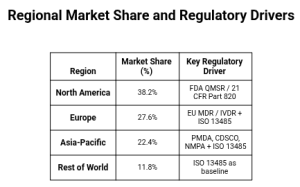
Source: Grand View Research, Global Medical Devices Market Report, 2024
For plant heads operating across multiple jurisdictions, a single ISO 13485 certification provides the evidentiary backbone for regulatory submissions in over 100 countries.
ISO 13485 Requirements: A Clause-by-Clause Leadership Breakdown
The standard is structured around eight clauses. The first three are definitional; the final five define the operational ISO 13485 requirements that your QMS must fulfill.
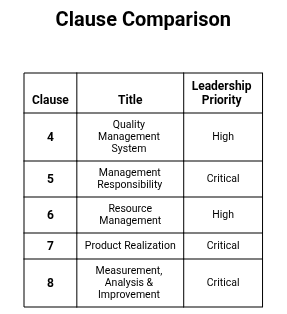
Clause 4: Quality Management System
This clause establishes the foundation. It requires documented procedures for all processes that affect product quality, a quality manual, and a medical device file for each device type or family.
For pharma leaders operating under ICH Q10 alongside ISO 13485, the documentation requirements are additive. An eQMS becomes essential here, not optional. Manual, paper-based systems cannot provide the version control, audit trails, and real-time visibility that inspectors increasingly demand.
Clause 5: Management Responsibility
This clause is the most underestimated in practice. ISO 13485 requires that top management be directly accountable for quality policy, resource allocation, and management review outcomes. Quality cannot be delegated entirely to the QA function.
A 2022 study published in the Journal of Medical Devices (Vol. 16, Issue 3, ASME) found that 68% of major non-conformities identified during ISO 13485 certification audits were attributable to gaps in management commitment, specifically the absence of documented management review records and unclear quality objectives at the leadership level.
"In a regulated environment, quality leadership is not a soft skill. It is a structural requirement with legal consequences." — Dr. Sandra Lee, Senior Regulatory Consultant, RAPS Annual Conference 2023
Clause 6: Resource Management
Human capital, infrastructure, and work environment are all within scope. For sterile manufacturing environments, this clause directly intersects with cleanroom qualification, environmental monitoring programs, and personnel hygiene requirements under 21 CFR Part 211.
The standard requires that personnel performing quality-affecting activities are competent on the basis of education, training, skills, and experience, and that this competence is documented and retained.
Training Gap Risk Table:
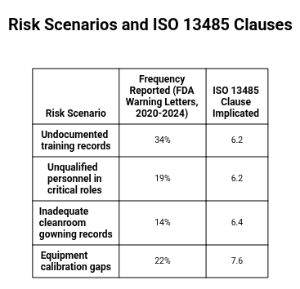
Source: FDA Warning Letter Database, 2020-2024, compiled analysis
Clause 7: Product Realization
This is the operational heart of the ISO 13485 QMS. It encompasses design controls, purchasing controls, production and service provision, sterility assurance, and control of monitoring and measuring equipment.
For medical device manufacturers, Clause 7 is where ISO 14971 (Risk Management) integrates directly. Every design input, design output, design verification, design validation, and design transfer activity must be traceable within the design history file (DHF).
The FDA's QMSR, now in force as of February 2026, has aligned 21 CFR Part 820 explicitly with ISO 13485 Clause 7. This means any gaps in your product realization documentation under the standard are now simultaneously gaps under US federal regulation.
Clause 8: Measurement, Analysis, and Improvement
This clause drives the feedback loop that keeps the ISO 13485 QMS functional over time. It requires internal audits, complaint handling, adverse event reporting, CAPA management, nonconforming product control, and data analysis for system improvement.
Post-market surveillance (PMS) reporting under the EU MDR has added a new dimension to Clause 8 obligations for European market participants. Periodic Safety Update Reports (PSURs) and Post-Market Clinical Follow-Up (PMCF) activities must be integrated into the QMS and documented accordingly.
"The CAPA system is the immune system of your QMS. A weak CAPA process means your organization cannot learn from its own failures." — Published in Regulatory Affairs Professionals Society (RAPS) Focus, 2023
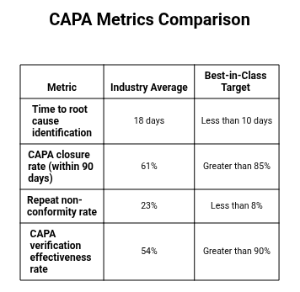
Source: ASQ Quality Progress Survey, Medical Device Sector, 2023
ISO 13485 Clause 8 demands a strong CAPA system.
Before your next audit, make sure your CAPA reports are built to hold up under scrutiny.
→ Read: How To Write a CAPA Report That Stands Up To Any Audit
How to Get ISO 13485 Certification: A 5-Step Roadmap for Leaders
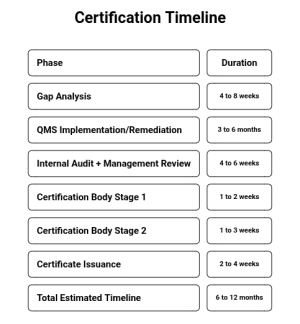
Step 1: Gap Analysis
Commission a formal gap analysis against all mandatory clauses of ISO 13485:2016+A11:2021. This assessment should cover documentation, process maturity, training records, and system infrastructure. Engage an external consultant with relevant notified body experience where internal bandwidth is limited.
Step 2: QMS Implementation or Remediation
Address gaps systematically. Prioritize Clauses 5, 7, and 8 for immediate action, as these generate the most findings in pre-certification audits. Deploy an eQMS platform to manage document control, training, CAPA, and audit workflows in a single validated environment.
Step 3: Internal Audit
Conduct a full internal audit against all applicable clauses before the certification body engagement. Internal auditors must be trained, independent of the areas they audit, and their findings must be documented with CAPA linkages.
Step 4: Management Review
Top management must formally review QMS performance before the certification audit. This review must be documented and must cover: audit results, customer feedback, process performance, regulatory changes, and resource adequacy.
Step 5: Certification Audit
A recognized certification body conducts a two-stage audit: Stage 1 reviews documentation and QMS design; Stage 2 is an on-site assessment of QMS implementation and effectiveness. Non-conformities are categorized as major (require correction before certification) or minor (correction plan accepted). Certificates are typically valid for three years, with annual surveillance audits.
A well-architected ISO 13485 QMS needs the right digital infrastructure to sustain it.
Here is everything pharma leaders need to know before migrating to an eQMS.
→ Read: eQMS Migration In Pharma: The Step-by-Step Guide For Leaders
Conclusion
The organizations that treat ISO 13485 QMS compliance as a strategic investment rather than a regulatory tax will outperform their peers on every meaningful metric: inspection outcomes, time-to-market, customer trust, and long-term operational resilience.
The convergence of the FDA QMSR, EU MDR post-market obligations, and increasingly data-driven notified body audits means that the evidentiary bar for quality system performance is rising across every major market simultaneously.
For pharma leaders and QA directors, the message is clear: a well-architected, digitally supported, and leadership-driven ISO 13485 quality management system is not a compliance checkbox. It is the infrastructure upon which safe, effective, and globally competitive medical devices are built.
The patients who depend on your devices deserve nothing less.
FAQs
1. Is ISO 13485 certification mandatory for EU market access?
ISO 13485 certification is not explicitly required by EU MDR as a legal prerequisite, but notified bodies universally require evidence of a conformant QMS as part of the conformity assessment procedure. In practice, ISO 13485 certification is the most efficient and universally accepted mechanism to satisfy this requirement.
2. How does the FDA QMSR affect existing ISO 13485 certified manufacturers?
The FDA QMSR, effective February 2, 2026, aligns 21 CFR Part 820 with ISO 13485:2016. Manufacturers already certified to ISO 13485 will find significant overlap. However, certain FDA-specific requirements, such as complaint files under 21 CFR 820.198 and the specific US device master record (DMR) format, require attention. A gap analysis against QMSR is recommended for all US market participants.
3. Can a combination product manufacturer use ISO 13485 as their QMS foundation?
Yes. For combination products with a primary device mode of action, ISO 13485 provides the primary QMS framework. Pharmaceutical components will additionally require alignment with 21 CFR Part 211 (cGMP) or ICH Q10. Regulatory affairs teams managing combination product BLA or NDA submissions should document the interface between the two frameworks explicitly in the quality plan.
4. What is the typical cost of ISO 13485 certification for a mid-sized manufacturer?
Direct certification costs from a recognized certification body typically range from USD 15,000 to USD 40,000 for a mid-sized organization, depending on site complexity and the number of device families in scope. When implementation costs, internal resource time, consultant fees, and eQMS investment are included, total program costs for first-time certification typically range from USD 100,000 to USD 350,000 over the implementation period.
5. How frequently must the QMS be recertified?
ISO 13485 certificates are valid for three years. During this period, annual surveillance audits are conducted by the certification body. A full recertification audit is performed at the end of the three-year cycle. Significant changes to the QMS scope, organizational structure, or manufacturing processes may trigger an unplanned surveillance visit.
Reporting on the science, business and regulation shaping the pharmaceutical industry.
More in Regulatory Intelligence
All articles →
The Pattern Behind FDA Warning Letters: What Startups & CDMOs Often Miss

ISO 14644 Cleanroom Classes for Pharma (with EM Implications)

Discussion