eQMS Migration in Pharma: The Step-by-Step Guide for Leaders
A step-by-step eQMS migration guide for pharma leaders, covering document inventory, validation, risk assessment, system testing, training, and go-live.


It is 2:00 AM. A regulatory inspector arrives in six hours. Somewhere inside a fireproof filing cabinet, beneath three years of paper SOPs, sits a signed approval that could save or sink tomorrow's audit. The Quality Director knows it is there. She just cannot find it.
This is not a hypothetical. It is the reality that hundreds of pharmaceutical quality teams still live with today. According to a 2023 survey by the McKinsey Center for Government, organisations operating paper-based or hybrid quality systems spend up to 35% of quality staff time on document retrieval, manual version reconciliation, and compliance administration alone.
The shift to an electronic quality management system (eQMS) is no longer a matter of digital preference. It is a strategic, operational, and regulatory imperative. And yet, the migration itself remains one of the most mismanaged transitions in the industry.
This article is a step-by-step guide for every leader looking to shift to an eQMS by 2026. Take a deep breath to dive deep into the article.
Is the Urgency Real?
The regulatory environment has never been more demanding. The FDA's data integrity guidance, EMA's Annex 11 requirements, and ICH Q10 pharmaceutical quality system framework have collectively raised the compliance bar for electronic records and signatures. Paper systems, by their very nature, cannot keep pace.
Beyond compliance, the commercial argument is equally compelling. A 2022 Deloitte Life Sciences report found that organisations with mature digital quality infrastructure reduced their cost of poor quality (COPQ) by an average of 22% over three years. COPQ in pharma, inclusive of recalls, rework, failed audits, and regulatory action letters, routinely runs at 5 to 10% of annual revenue for mid-sized companies.
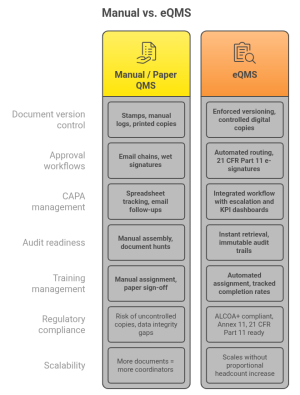
The table below summarises the operational difference between a manual QMS and a purpose-built eQMS, across the dimensions that matter most to quality leaders.
The Six-Step Migration Playbook
Successful eQMS migration is not a technology project. It is a quality improvement initiative that happens to involve technology. The distinction matters because it changes who leads it, how success is measured, and where most implementations fail.
The framework below is drawn from documented implementation practices in GMP-regulated environments and reflects the experience of organisations that have successfully migrated quality systems of varying complexity and scale.
Step 1: Inventory and Classification — Know What You Actually Have
Before a single document is imported, a rigorous inventory must be completed. This is where most organisations underestimate the effort required. A document inventory is not a file count. It is a structured audit of what exists, what is in use, what is required by regulation, and what can be retired.
Quality leaders should build a master document tracker with the following fields for each document: current ID, title, document type (SOP, WI, policy, record), department, owner, lifecycle status (draft, effective, obsolete), last reviewed date, regulatory retention requirement, and migration decision (import, retire, or recreate).
Inventory Checklist for Quality Leaders
- Complete a full document count across all storage locations, including shared drives, physical archives, and SharePoint
- Classify every document as: import-ready, requires update before import, retain for archive only, or retire
- Flag all documents with regulatory retention obligations under 21 CFR Part 211, EU GMP Annex 15, or ICH Q10
- Identify documents tied to active investigations, open CAPAs, or pending change controls
- Assign an owner to every document before migration begins
- Confirm that former document IDs will be preserved in the new system for traceability continuity
Step 2: Define Your Metadata Architecture
Metadata is the connective tissue of a functioning eQMS. It determines whether documents are findable, filterable, and traceable during an inspection. Yet metadata design is routinely treated as an afterthought during migration planning.
Core metadata fields should include document ID, title, type, owner, department, status, effective date, next review date, and version. Extended fields can include site or location code, product code, risk level classification, regulatory impact flag, former system ID, and linked change control reference.
"Metadata gives context to your documents and results. Do not throw your metadata away. Complete traceability of metadata is the difference between a clean audit and a 483 observation."
— Santiago Ibanez, Head of Quality Assurance, Subiton
A practical rule for metadata design: if a regulator or auditor might search or filter by a piece of information, it should be a structured field, not buried in free text. This discipline pays dividends on every inspection day thereafter.
Step 3: Configure the eQMS Before Import Begins
System configuration must precede document migration. Attempting to import documents into an unconfigured system is the single most common cause of rework in eQMS implementations. The configuration phase establishes the information architecture, workflow logic, access controls, and document templates that all imported content will conform to.
Information architecture should mirror how quality teams think and work, not how the system vendor has structured its default folders. Workflows should reflect the actual review and approval sequence used in the organisation, inclusive of due dates and escalation rules. Templates should be created for all core document types with locked structural sections and automated variables for ID, version, effective date, and linked documents.
Note for the leaders:
A well-configured eQMS significantly reduces the long-term quality administration burden. McKinsey's 2023 digital operations benchmark found that pharma companies with purpose-configured quality platforms reduced document cycle time by an average of 48% within 18 months of go-live. Configuration time is not overhead. It is infrastructure.
Step 4: Execute the Document Migration — The PIV Framework
The Preparation, Import, Validation (PIV) framework provides a structured, auditable approach to moving legacy documents into the eQMS. Each phase has distinct deliverables and quality gates.
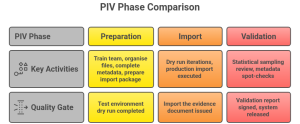
For organisations migrating fewer than 200 documents, manual import through the system user interface is typically sufficient. For volumes of 2,000-10,000 documents or more, an assisted import using a structured Excel template processed in bulk significantly reduces error rates and import time.
Dry runs serve as dress rehearsals. They enable the QA team to identify metadata inconsistencies, file-naming errors, and workflow configuration issues before they enter the production environment. Most experienced teams require approximately 3 dry-run iterations before the production import proceeds cleanly.
Step 5: Review, Reconcile, and Validate
Post-import validation is not optional. It is a regulatory requirement under 21 CFR Part 11 and GAMP 5, and it is the stage at which the organisation formally establishes that the imported records are complete, accurate, and unaltered.
ALCOA+ principles, which require that all records be attributable, legible, contemporaneous, original, accurate, complete, consistent, enduring, and available, apply directly to the imported document set. The validation protocol should explicitly test each of these attributes against a statistically valid sample of imported records.
Version histories, approval signatures, effective dates, and linked document references must all be confirmed against the legacy system records. Any discrepancies identified during validation must be resolved and documented before the system is released for operational use.
Step 6: Training, Change Management, and Go-Live
Technology readiness is necessary but not sufficient for a successful eQMS go-live. The human dimension of the transition determines whether the system is adopted in practice or worked around in parallel. A dual-track approach covering both technical training and change management is essential.
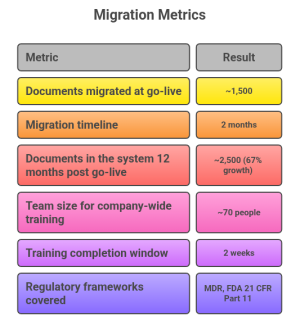
Training should be role-based, distinguishing between read-only users who complete training and access documents, and full users who author, review, approve, and manage quality events. QA leadership should be trained first, serving as internal champions and first-line support during the broader rollout. Subiton's implementation trained approximately 70 people across the organisation within two weeks using this cascade approach.
Change management requires clear communication about what is changing, what is staying the same, and where to get help. Feedback loops should be formally established within the first 90 days post-go-live. Resistance to the new system is almost always rooted in uncertainty, and transparency about the transition process is the most effective antidote.
"Our concern going in was added bureaucracy. In practice, what we saw was greater engagement and better document updates. The system made quality visible to people who had never thought about it before."
— Santiago Ibanez, Head of Quality Assurance, Subiton
When systems change, human error risks spike. Most teams don't investigate why.
Here's the framework pharma QA teams use to get to the real root cause
→ Is Human Error a Root Cause? A Practical Guide To RCA In Pharma
Compliance Architecture: E-Signatures, Audit Trails, and Archiving
For pharmaceutical organisations, the eQMS's compliance architecture is not a feature set. It is the regulatory foundation on which the entire quality system rests. Three elements deserve specific attention: electronic signatures, audit trails, and archiving policy.
Electronic Signatures and 21 CFR Part 11 / Annex 11 Compliance
Electronic signatures in a compliant eQMS must be unique to the signatory, require re-authentication at the moment of signing, and be permanently and irrevocably bound to the associated record. Once a document is signed, any subsequent alteration must trigger re-signing, preserving the integrity of the original approval.
The distinction between 21 CFR Part 11 (US FDA) and Annex 11 (EU GMP) is important for organisations operating across multiple regulatory jurisdictions. Both require equivalent levels of control over electronic records and signatures, but differ in specific implementation requirements around audit trails, system validation, and business continuity. Quality leaders managing global operations should ensure their eQMS configuration explicitly addresses both frameworks.
Audit Trails
A compliant audit trail captures who performed what action, on which record, and when, across every module of the quality system, from document approvals and CAPA closures to print and download events. Critically, audit trails must be immutable, meaning they cannot be altered or deleted, even by system administrators.
Audit trails that are human-readable and exportable in a standard format significantly reduce inspection burden. The ability to respond to an inspector's question about a specific document's history in under two minutes, with a complete and unambiguous record, is a concrete operational advantage of a well-configured eQMS.
Archiving and Retention Policy
Archiving policy in a GMP-regulated environment is governed by GAMP 5 guidelines and applicable regional regulations. Archiving is the process of moving records from the active system to a protected, read-only state for the duration of the regulatory retention period. It is distinct from backup and restore, which are business continuity functions.
Archived records must remain searchable and retrievable by authorised users throughout the retention period. Metadata associated with archived records must be protected against unauthorised modification. The eQMS should clearly differentiate between active, archived, and obsolete document states, with corresponding access controls for each.
A compliant eQMS will surface deviations. Your CAPA reports need to hold up when they do.
Here's the practical guide most QA teams bookmark before their next audit
→ How To Write a CAPA Report That Stands Up To Any Audit
Case Study: Subiton's Migration from Paper to eQMS
Subiton, a life sciences company operating under MDR and FDA regulatory frameworks, completed a full migration from a paper-based quality system to an electronic QMS within a two-month window, transferring approximately 1,500 documents with a lean quality team.
The migration presented three interconnected challenges: volume and timeline pressure, the need to adapt existing document control and change control processes to the new system's capabilities, and initial organisational concern about increased administrative burden.
Subiton's team developed a new document coding system using a two-letter document type prefix and a two-letter responsible sector code. Legacy document IDs were preserved in a dedicated metadata field, enabling users to search by either old or new ID without disrupting compliance continuity.
Templates were created for core quality documents with locked structural sections to prevent unauthorised modification. The migration was executed in phases, importing legacy documents in their existing format first, then applying new templates as documents came up for periodic review. This phased approach avoided the paralysis of attempting to standardise everything simultaneously.
Audit trail activation across all modules provided the visibility the team needed to investigate history, manage control copies, and demonstrate compliance to regulators. Periodic review was initially disabled during the migration period to prevent generating review obligations for the entire document library on day one, then gradually re-enabled as the team stabilised operations in the new system.
Checklist You Need Before You Migrate:
The leaders preparing to initiate an eQMS migration should use the following checklist to consolidate the critical readiness criteria that determine whether the migration succeeds or stalls.
Strategic Readiness
Confirm these items before authorising the migration programme.
- Executive sponsor identified with the authority to resolve cross-functional blockers
- Business case approved with defined ROI metrics, including COPQ reduction target and audit readiness improvement
- Budget confirmed covering implementation, validation, training, and first-year support
- Success metrics defined: document cycle time, on-time training completion rate, CAPA closure rate, audit finding rate
- Change management plan approved and communications timeline established
- IT and information security requirements reviewed and approved for cloud-based eQMS deployment
Operational Readiness (Quality Leaders)
Confirm these items before the migration begins.
- Full document inventory completed and migration decisions documented for every record
- Metadata schema designed and approved by QA leadership
- eQMS configuration completed and validated in the test environment before production import
- User role matrix defined covering all staff classifications and access levels
- PIV framework adopted with a dry run schedule and a validation protocol approved
- Training programme developed with role-based paths for read-only and full users
- Archiving and retention policy documented and configured in the new system
- Go-live cutover plan confirmed, including legacy system decommission or read-only access policy
The Strategic Bottom Line
eQMS migration is one of the highest-leverage quality investments a pharmaceutical organisation can make. If done well, it reduces compliance risk, improves inspection readiness, accelerates document cycle times, and scales quality operations without proportional increases in headcount.
But if done poorly, it shall create a digital replica of all the problems that existed in the paper system, with the added complexity of a new technology layer. The difference between these outcomes lies almost entirely in the discipline of the approach: the rigour of the inventory, the quality of the metadata design, the thoroughness of configuration before import, and the commitment to change management alongside technical training.
The Guide above is not theoretical. It reflects the documented experience of organisations that have successfully made this transition under live regulatory scrutiny. The steps are sequential for a reason. The checklists exist because skipping items creates consequences that appear months after go-live, often at the worst possible moment.
For quality leaders reading this with a migration on the horizon, the most important action is not to find the perfect eQMS vendor. It is to build the internal readiness to execute the migration with the discipline the investment deserves.
FAQs
Q1. What is the single most common mistake organisations make when migrating to an eQMS?
The most prevalent error is attempting to migrate documents before the system is properly configured. Importing content into an unconfigured eQMS means metadata fields, workflow routing, access controls, and templates are undefined, creating substantial rework. Configuration must precede migration. A secondary common error is failing to complete a thorough document inventory before migration begins, resulting in obsolete or duplicate documents entering the new system.
Q2. How should organisations handle documents that need to be updated as part of a regulatory change during migration?
Where regulatory requirements do not mandate retention of legacy versions, new documents can be created directly in the eQMS using the system's native templates and version control. The migration plan and computer system validation (CSV) documentation should explicitly describe the approach taken, and the decision should be supported by a documented risk assessment. Legacy documents should remain accessible in read-only format throughout the applicable retention period, whether in the new system or in an authorised archive.
Q3. What happens to the quality record history of a staff member who leaves the organisation after migration?
From a regulatory standpoint, departed employees must be deactivated in the eQMS promptly upon their exit, ideally through an automated link to the organisation's HR or directory system. Deactivation revokes system access while preserving the complete audit trail of all actions taken during their tenure, including document approvals, CAPA assignments, and training completions. Pending tasks should be reassigned by an administrator, with the reassignment fully traceable in the system.
Q4. How should organisations approach periodic document review during and immediately after migration?
A pragmatic approach is to disable automated periodic review triggers during the migration period, then re-enable them in a phased sequence as the team stabilises in the new system. Activating periodic review for the entire document library at go-live creates an immediate and unmanageable review backlog. Subiton's experience demonstrates that phased re-enablement, prioritising highest-risk or most frequently used documents, is both operationally sustainable and defensible from a regulatory standpoint.
Q5. What does a compliant Computer System Validation (CSV) for an eQMS migration require?
CSV for an eQMS migration follows GAMP 5 guidance and must include a validation plan, user requirements specification (URS), risk assessment, configuration specification, installation qualification (IQ), operational qualification (OQ), and performance qualification (PQ) documentation. The validation must cover both the system configuration and the data migration itself, including the statistical sampling methodology used for post-import record verification. Validation documentation should be reviewed and approved by QA before go-live and retained for the duration of the system's operational life plus the applicable regulatory retention period.
Reporting on the science, business and regulation shaping the pharmaceutical industry.
More in Leadership
All articles →
Essential Leadership Skills for Success in the Pharmaceutical Industry

Pharmaceutical Regulatory Affairs: Roles, Skills, and Roadmap

Discussion