Asking the Right Questions: Why Scientific and Engineering Fluency Matters When Speaking With Pharmaceutical and Biotechnology Candidates
Why scientific and engineering fluency matters in pharma recruiting | how better questions uncover real competence and improve life sciences hiring.


In pharmaceutical and biotechnology recruiting, one of the most overlooked drivers of hiring success is not technology, databases, or even access to talent. It is the quality of the conversation.
The questions asked during the first interaction with a candidate often determine whether the recruiter uncovers genuine capability or simply gathers surface-level information. In life sciences, where every hire can influence a clinical milestone, manufacturing timeline, regulatory submission, or plant startup, surface-level conversations are not enough.
The pharmaceutical and biotechnology sectors are built on specialization. Drug discovery teams work in complex translational environments. Clinical development leaders navigate protocols, endpoints, and regulatory strategy. CMC professionals balance speed, compliance, and scalability. GMP engineers and utilities specialists protect the systems that keep validated facilities operating without interruption. In each of these functions, the difference between someone who has merely “been around” the work and someone who has truly led it can only be uncovered by asking the right questions.
That begins with understanding the role beyond the title.
Too often, recruiting conversations in our industry start and end with broad prompts such as “Tell me about your background” or “Walk me through your résumé.” While those questions may help establish rapport, they rarely expose the technical judgment, scientific thinking, or engineering ownership that defines top-tier talent in life sciences.
A candidate interviewing for a Director of Pharmacology role should not be evaluated the same way as a Senior Director of Biologics Analytical Technologies. A GMP utilities mechanic supporting water-for-injection systems, clean steam, and compressed air cannot be screened using the same framework as a clinical scientist leading IND-to-Phase I transition work. Yet many recruiting conversations unintentionally flatten these distinctions because the person leading the conversation lacks enough fluency in the underlying science or engineering.
Candidates recognize this almost immediately.
Within the first few minutes, highly specialized professionals can tell whether the person on the other side of the conversation truly understands their world. They know whether the questions are grounded in the realities of pharmacometrics, translational modeling, assay transfer, validation strategy, deviation management, process engineering, or clinical study design. If the questions remain generic, the conversation becomes transactional. If the questions are relevant and technically informed, trust develops quickly.
This trust is not a soft concept. It directly impacts hiring outcomes.
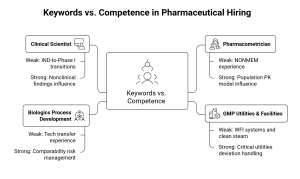
When candidates feel they are speaking with someone who understands the function, they provide richer and more meaningful information. They move beyond rehearsed résumé language and begin discussing decision points, technical obstacles, strategic tradeoffs, and the real impact of their work. This is where the best insights emerge.
For example, asking a pharmacometrician whether they have experience with NONMEM may confirm a keyword. It does not confirm competence. A stronger question is: “How did your population PK model influence dose selection and regulatory interactions during the progression from first-in-human through proof-of-concept?” That question explores both technical skill and business relevance. It reveals whether the candidate simply ran models or whether they helped shape development decisions.
Understanding hiring market dynamics helps recruiters anticipate talent shifts and skill gaps before they happen.
Learn how 2026 pharma/biotech hiring is reshaping recruitment strategy and candidate expectations.
→ Read: Pharma and Biotech Hiring Market Shift in 2026
The same principle applies in manufacturing and engineering.
A GMP utilities or facilities candidate may list experience with WFI systems, clean steam, HVAC, compressed air, and chilled water. However, the meaningful differentiator lies in ownership. Did they monitor the systems, or did they troubleshoot excursions? Were they involved in preventive maintenance only, or did they write corrective actions and partner with validation teams? Did they understand the risk to manufacturing uptime if those systems failed?
The recruiter who understands the science and engineering behind the role can ask: “Walk me through the most critical utilities deviation you handled and how you balanced urgency, compliance, and root-cause resolution.”
That question reveals technical maturity, GMP discipline, and operational thinking in a way no résumé bullet ever could.
This is especially important in pharmaceutical and biotechnology environments because the cost of a hiring mistake is magnified.
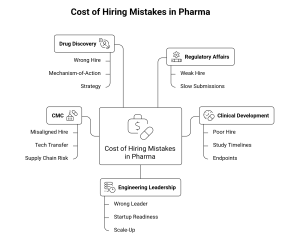
A weak hire in regulatory affairs may slow a submission. A poor clinical development hire can impact study timelines. The wrong engineering leader can delay startup readiness or commercial scale-up. A misaligned CMC hire can create technology transfer bottlenecks that ripple into supply chain risk.
In these settings, the recruiter’s responsibility is not simply to match titles to open requisitions. It is to assess whether the candidate’s skills align with the scientific and operational outcomes the company must achieve.
That level of assessment requires functional fluency.
Scientific fluency does not mean the recruiter must be a bench scientist. Engineering fluency does not require having worked as a process mechanic or validation engineer. But it does require enough domain understanding to know what the function does, where it sits in the broader development or manufacturing ecosystem, and what success in the role actually looks like.
A clinical scientist moving programs from IND-enabling studies into Phase I/II has a very specific challenge set. Their work sits at the intersection of nonclinical data interpretation, protocol development, CRO management, investigator communication, regulatory documentation, and internal scientific alignment. The right questions must probe that bridge.
How did nonclinical findings influence protocol design?
What role did they play in investigator brochure development?
How did they respond when emerging data changed assumptions about endpoints or dose escalation?
These are the kinds of questions that uncover strategic thinking.
Similarly, in biologics process development, asking whether a candidate has tech transfer experience is not enough. A more relevant question would explore comparability risk, scale-dependent variability, CMO oversight, and the interaction between process development and MSAT. The objective is not simply to hear terminology. It is to understand the level at which the candidate operated.
This distinction between keywords and competence remains one of the largest blind spots in life sciences recruiting.
The industry increasingly relies on systems, automated filters, and acronym matching to determine fit. Yet the most impactful scientific and engineering professionals often bring contextual depth that cannot be captured through keywords alone. A candidate may not explicitly list a specific modeling platform, assay technology, or validation protocol framework, but through informed questioning, their adjacent experience may prove highly transferable.
This is why the human element remains so critical.
When the recruiter understands the role well enough to ask layered follow-up questions, they can uncover adjacent skills, translational capabilities, and leadership behaviors that technology alone would miss. They can also more accurately represent the candidate to the hiring manager, translating technical accomplishments into business value.
For hiring leaders, this has enormous implications.
When a recruiter can present a candidate not just as “experienced in biologics” but as someone who successfully led analytical method transfer into a CMO network while mitigating comparability risk and supporting PPQ readiness, the quality of the slate changes dramatically. Hiring managers gain confidence faster because the recruiter is speaking the language of outcomes, not just résumés.
Scientific fluency combined with recruitment technology multiplies hiring effectiveness exponentially.
Discover how AI is reshaping pharma recruitment while maintaining the human judgment that finds real talent.
→ Read: AI in Recruitment for Pharma
The same is true for candidates.
The best candidates want to feel that the person representing them understands their expertise. In highly specialized markets such as oncology clinical development, pharmacometrics, QSP, GMP engineering, validation, and biologics manufacturing, credibility is everything. A recruiter who demonstrates real understanding builds stronger relationships, earns more transparency, and often gains access to talent that would never engage in a generic recruiting conversation.
Ultimately, asking the right questions in pharmaceutical and biotechnology recruiting is about respect for the complexity of the work.
These are industries where one scientist can shape a mechanism-of-action strategy, one engineer can protect validated production systems, and one clinical leader can influence the trajectory of a program moving toward pivotal studies. The stakes are too high for shallow conversations.
The best hiring outcomes happen when the recruiter knows the science behind the science and the engineering behind the engineering.
Because in life sciences, great hiring is rarely about checking boxes. It is about understanding how a person’s technical decisions, scientific judgment, and functional leadership influence the larger mission of getting therapies developed, approved, manufactured, and delivered to patients.
That level of understanding starts with one simple principle: ask better questions.
And better questions only come from truly knowing the work.
Reporting on the science, business and regulation shaping the pharmaceutical industry.
More in HR in Pharma
All articles →
Crisis Management: HR's Role in Business Continuity in the Pharmaceutical Industry

Top HR Strategies for Successful Pharma Mergers: People, Culture, and Integration 2025

Discussion